
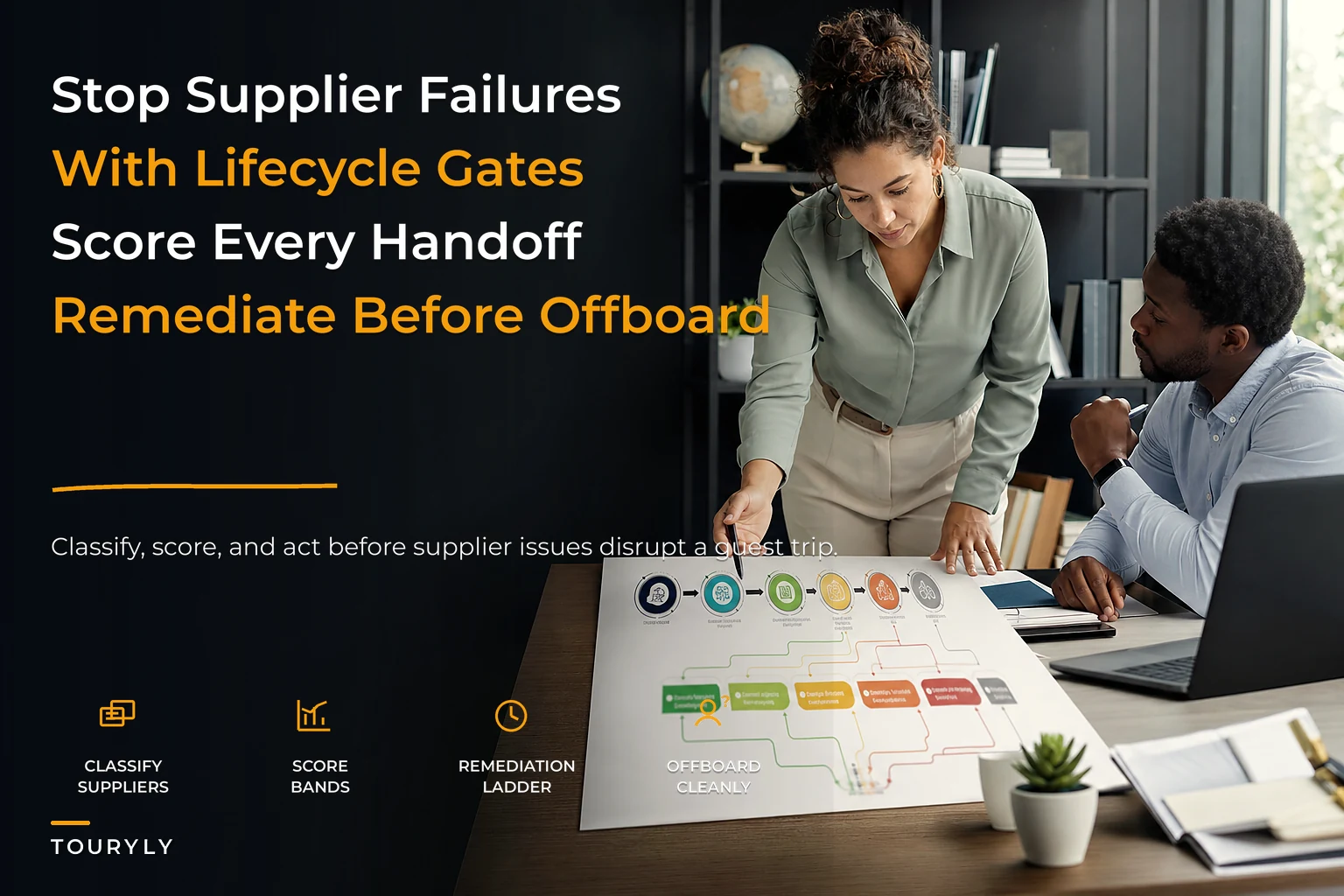

Most tour operators don't have a supplier problem. They have a supplier tracking problem. The good vendors and the ones about to blow up your peak season look identical in your spreadsheet until the day one of them doesn't answer the phone. That gap — between what you assume and what's actually happening — is what this article is about. Treating suppliers as a lifecycle you actively manage, rather than a contact list you occasionally clean up.
There's plenty written about picking good vendors and writing tight contracts. That matters, but it's just the front door. What actually breaks operations is everything after onboarding: the drift, the quiet degradation, the supplier who was excellent in April and unreliable by July, and nobody caught it until three itineraries fell apart in the same week.
A real supplier lifecycle for tour operators has four moving parts that connect: how you classify them coming in, how you score them continuously, how you respond when scores drop, and how you exit the ones that can't recover. Miss any one and the whole thing turns back into guesswork.
Why supplier failures cluster instead of arriving one at a time
Supplier failures are rarely random. They cluster. A transfer company that's been slipping on pickup times for six weeks is usually the same one that goes fully dark during a heatwave when demand spikes. The early signals were there — you just weren't reading them as a trend.
In real operations this happens because the people who feel the problems aren't the people who track the suppliers. Your guides know the boat operator has been showing up late. Your ops coordinator knows a hotel keeps "losing" reservations. But that knowledge lives in WhatsApp threads and people's heads, never landing somewhere anyone can see the accumulation. By the time it reaches the owner, it's already a crisis rather than a data point.
The second reason failures cluster: everyone treats onboarding as the finish line. You vet a supplier hard, sign the deal, and then nothing. No re-check, no scoring, no periodic review. A supplier who cleared your bar two years ago is still running on that assumption. Businesses change hands, lose key staff, take on too much volume. The vetting you did is a snapshot, and snapshots go stale.
This connects closely to how you write and enforce agreements in the first place. If you haven't nailed down measurable expectations, there's nothing to score against later. The groundwork lives in Supplier SLAs that prevent last-minute failures, and this system assumes you've got at least the basics of that in place.
Step one: classification gates, so not every supplier gets the same treatment
The biggest waste in supplier management is applying the same process to everyone. Your critical boat operator on a signature multi-day tour does not need the same oversight as the souvenir shop you send guests to twice a season. When you flatten everyone into one list, you either over-manage the trivial ones or under-manage the dangerous ones. Usually both.
Never miss a booking or update.
Touryly streamlines your travel bookings, confirmations, and itinerary updates—all in one place.
- Unified booking management
- Automated customer notifications
- Itinerary & staff coordination
No credit card required
Classification gates fix this. Before a supplier fully onboards, you route them through a quick decision that sets their tier — and the tier determines how much scrutiny they get, how tight the SLA is, and how aggressive the remediation ladder becomes.
| Tier | What defines it | Onboarding depth | Monitoring cadence |
|---|---|---|---|
| Critical | Trip fails without them (lead transport, primary accommodation, licensed activity operator) | Full — insurance, licenses, backup capacity check, reference calls | Every booking + weekly review |
| Important | Trip degrades but survives (meals, secondary transfers, standard excursions) | Standard — insurance, license, one reference | Sampled + monthly review |
| Replaceable | Easily swapped, low guest impact (photo stops, retail, optional add-ons) | Light — basic verification | Quarterly spot-check |
The gate itself is a set of yes/no questions at intake: Does a trip cancel if this supplier fails? Is there a same-day substitute available? Does this supplier touch guest safety or money? Answers push them into a tier automatically.
The part most operators miss: tier isn't permanent. A "replaceable" excursion supplier who becomes your only option in a remote region has quietly become critical — and your monitoring should reflect that. Review tiers at least once a season, not once ever.
Step two: an onboarding checklist that produces data, not just a signed contract
Onboarding usually gets treated as paperwork collection. That's a missed opportunity. Done right, it sets the baseline every future score is measured against. If you don't capture a starting point, you can't detect drift.
-
Identity & legal — business registration, tax ID, license numbers with expiry dates captured as structured fields (not "attached PDF somewhere")
-
Insurance — coverage type, limits, and expiry — set to trigger a re-check 30 days before it lapses
-
Capacity declaration — max simultaneous bookings they can honor, in writing
-
Backup / substitution terms — what happens when they can't deliver, and how fast they'll tell you
-
Response-time commitment — the SLA on confirmations and change requests
-
Payment & penalty terms — deposit timing, cancellation windows, penalty triggers
-
Named contacts — a primary and an escalation contact, not a shared inbox
-
Baseline test booking — one live or dummy booking to measure their real confirmation speed before you trust them with guests
Store expiry dates as structured fields so they can trigger automated reminders.
That last one is underrated. A supplier who takes 40 minutes to confirm a test booking is telling you exactly what peak-season response will look like — probably worse. Capture that number. It's your day-zero score.
If you're negotiating tiers, substitution windows, and volume commitments during this stage, the clause-level detail in the supplier procurement playbook pairs directly with this checklist — one covers what you agree to, this covers how you record and monitor it.
Step three: continuous performance scoring
This is the part almost nobody does, and it's the part that changes everything. Instead of judging a supplier by your most recent bad experience — and recency bias runs supplier decisions far more than most owners admit — you build a rolling score from a handful of tracked signals.
You don't need something complicated. Four to six signals, weighted, updated as events happen. A practical starting model:
-
Confirmation speed (25%) — average time to confirm a booking or change
-
Reliability (30%) — completed-as-booked rate; no-shows and last-minute cancels hurt most
-
Accuracy (15%) — did what was delivered match what was booked (room type, vehicle size, itinerary)
-
Communication (15%) — proactive notice of problems vs. silence
-
Guest impact (15%) — complaints or incidents tied to that supplier
Score each signal 0–100, apply the weights, and roll it into a single number. The exact math matters less than the fact that the score moves continuously and lives somewhere everyone can see it.
| Score band | Status | What it means |
|---|---|---|
| 85–100 | Healthy | Preferred, route more volume here |
| 70–84 | Watch | Fine, but flag any further slip |
| 55–69 | At risk | Trigger corrective action |
| Below 55 | Critical | Escalation or offboard track |
One thing worth building in deliberately: weight reliability and guest impact heaviest for critical-tier suppliers and speed heavier for high-volume replaceable ones. The scoring model should reflect what actually hurts you when that specific supplier type fails. A slow souvenir shop is annoying. A boat operator who no-shows cancels a trip.
Step four: the remediation ladder — what happens when a score drops
A score nobody acts on is just a number. The point of scoring is to drive a predictable response — so a slipping supplier meets an escalating sequence instead of a random reaction depending on who happened to notice that week.
-
Alert (Watch band, 70–84) — automatic notice to the ops owner. No customer-facing action yet. Just: "This supplier is trending down, keep an eye out." Log it.
-
Corrective action (At risk, 55–69) — a documented conversation with the supplier. Specific problem, specific fix, specific deadline. Reduce new volume routed to them until the score recovers. This is where you invoke penalty terms if they exist.
-
Escalation (sustained At risk or first dip below 55) — decision-maker involved, backup supplier activated for upcoming bookings, formal written notice with a recovery window (30 days is a reasonable default). No new bookings.
-
Offboard (Critical, below 55 with no recovery) — planned exit. Migrate existing bookings to substitutes, settle outstanding payments, archive records, remove from routing.
The mistake operators make is skipping rungs in a panic — jumping straight from "everything's fine" to "we're never using them again" the moment something goes wrong. That whiplash costs you good suppliers who hit one bad patch, and it means the truly failing ones limp along because a full offboard feels like too much effort. The ladder removes the emotion. The score decides the rung.
One more thing: offboarding needs its own mini-checklist, because a messy exit creates its own failures — orphaned bookings, unpaid balances, guests sent to a vendor you've already cut. A clean offboard reroutes everything before you pull the plug.
Supplier lifecycle flow
[Intake] → [Classification Gate] → [Tier Assignment] ↓ [Onboarding Checklist] → [Baseline Score] ↓ [Continuous Scoring] → [Score Bands] ↓ [85–100 Healthy] → [Preferred routing] [70–84 Watch] → [Alert + monitor] [55–69 At Risk] → [Corrective action + throttle] [Below 55] → [Escalation → Offboard]
Each stage feeds the next. The score is only useful if the gate and onboarding captured the right baseline. The remediation ladder is only reliable if the score is current. Skip one stage and the whole chain weakens.
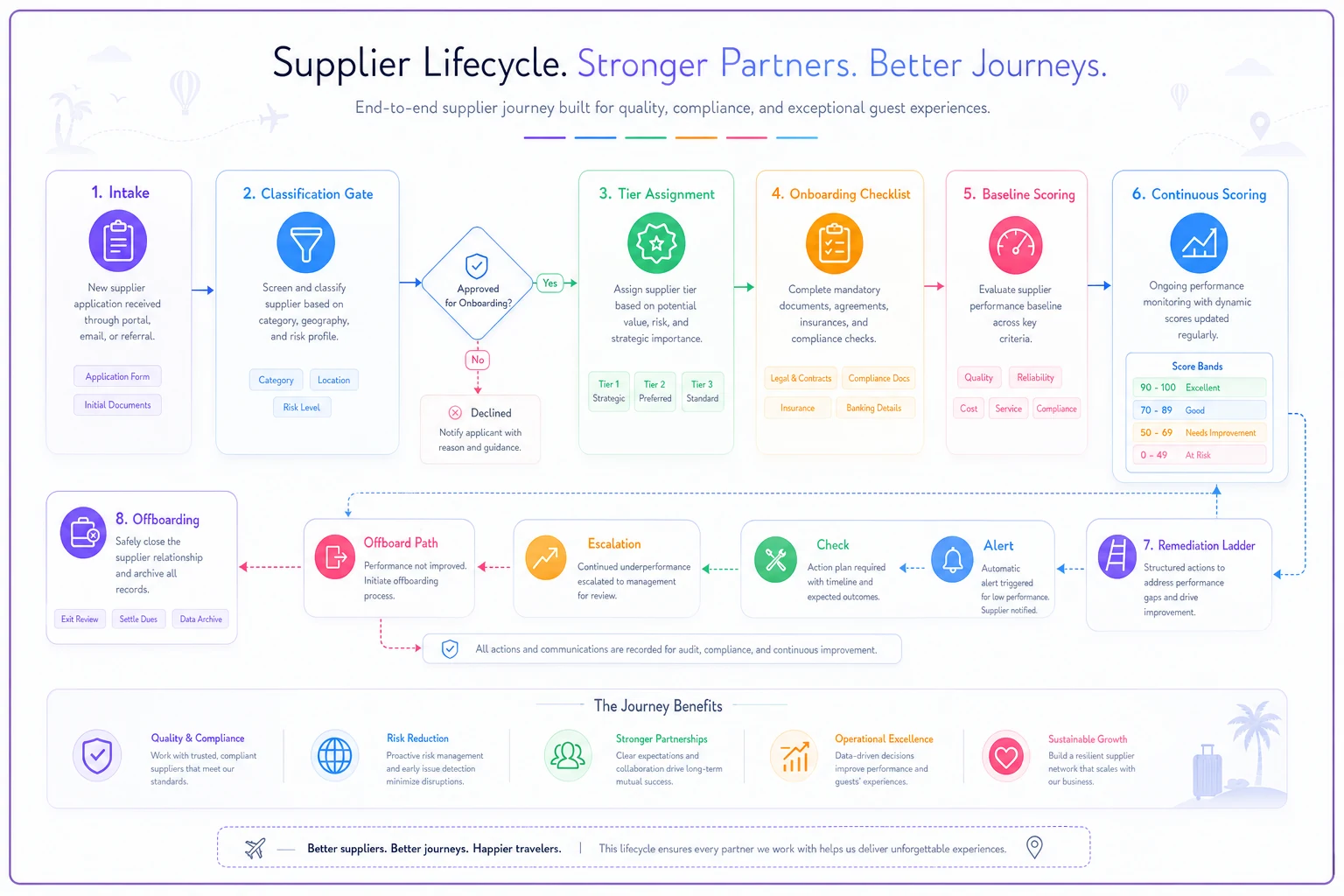
A simple diagram of the lifecycle stages and transitions.
Where automation actually earns its place
Everything above works on paper. It fails in practice for one boring reason: nobody has time to update scores and watch thresholds by hand across 60 suppliers during peak season. The tracking dies within a month, and you're back to memory and WhatsApp.
-
Gate enforcement — a supplier whose insurance or license expiry passes gets automatically blocked from new bookings until re-verified. The gate isn't a suggestion; the system won't route to a lapsed vendor.
-
Score-driven alerts — when a supplier crosses from Watch into At-risk, the ops owner gets pinged and the supplier is flagged in the booking flow, so staff see the risk at the moment they'd assign work.
-
Auto-throttling — At-risk suppliers stop appearing as the default option; new volume shifts toward Healthy ones automatically. This is where lifecycle management and availability routing overlap — the same logic that powers a channel-priority matrix and recovery SOP can weight supplier selection by health score, not just channel.
-
Ladder progression — corrective-action deadlines that pass without recovery auto-escalate to the next rung and notify the decision-maker, so nothing stalls because someone forgot to follow up.
The value isn't automation for its own sake. It's that the discipline survives a busy August. Manual supplier scoring always erodes exactly when you need it most.
A realistic scenario
A mid-sized operator running day tours and short multi-day trips in a coastal region — roughly 300–350 departures a month at peak — kept losing a handful of trips each season to the same transfer and boat suppliers. Nobody could say in advance which ones. Post-mortems always revealed the warning signs had been visible for weeks in guide feedback that never got logged centrally.
They put in a basic version of this system: three tiers, a five-signal score updated per booking, and four threshold bands wired to alerts. No fancy math — just consistent tracking that everyone could see.
The first real win wasn't dramatic. Two critical-tier suppliers dropped into the At-risk band in early June, weeks before the peak crunch. Because the alert fired early, the operator had time to run corrective conversations, throttle new bookings to them, and quietly line up backups. One supplier recovered. The other kept sliding and got offboarded cleanly in July — bookings migrated before anything failed on a guest.
Over that season, supplier-caused trip disruptions dropped from around a dozen the prior year to a small handful, and the ones that did happen were caught at the alert stage instead of on the day. The owner's rough estimate was somewhere in the range of $6k–$9k in avoided rebooking costs, refunds, and comps. But the bigger change was that peak season stopped feeling like waiting for the next surprise.
When this system makes sense — and when it's overkill
It makes sense when you're running enough volume that you can't hold every supplier's reliability in your head, when a single supplier failure can cancel a trip, or when you've already been burned by a vendor who degraded quietly. Once you have more than a couple dozen active suppliers, informal tracking stops working.
It's overkill when you're a small operator with five suppliers you talk to weekly and know personally. At that scale, a lightweight classification and a shared note is enough — building formal scoring would cost more attention than it saves.
Who should not start here: if you don't yet have SLAs or even basic written expectations with your suppliers, don't jump to scoring. You'd be measuring against nothing. Get the agreements and measurable commitments in place first, then build the lifecycle on top. Scoring is only meaningful when there's a defined standard to score against.
The reason supplier failures feel like bad luck is that most operations only see suppliers at two moments — the day they sign, and the day they fail. Everything in between is dark. A lifecycle system turns on the lights: classification tells you how hard to watch each one, continuous scoring shows you the drift as it happens, the remediation ladder gives you a calm pre-decided response, and clean offboarding keeps a bad exit from becoming its own incident.
None of this requires predicting the future. It just requires refusing to be surprised by signals that were already there. The operators who stop losing trips to supplier failures aren't luckier — they've built a pipeline where a supplier can't quietly rot without something, or someone, noticing well before it matters.
Ready to elevate your travel business?
Join 500+ travel operators using Touryly to optimize bookings, improve client satisfaction, and grow revenue.