


Most operators spend weeks arguing over rate cards and then sign a supplier contract that hands away every point of leverage they just negotiated. The rate is only about half the deal. The other half lives in the clauses nobody reads twice: how substitutions work, what triggers a tier discount, when a rate can move, and who eats the cost when a boat, a bus, or a block of rooms disappears three days before departure.
This is where margin leaks. Not in the headline price, but in the fine print governing what happens when reality doesn't match the plan. A hotel that can "substitute equivalent category" without defining equivalent. A DMC volume tier that resets to zero every quarter. A transport supplier whose "peak surcharge" clause has no cap. Each one looks minor on signing day and costs real money by August.
Why the same rate produces different margins
Two operators can sign the same €140 per-room-night rate with the same coastal hotel and end the season with completely different results. The difference is almost never price. It's the structure around the price.
Margin erosion usually happens in three places:
-
Uncontrolled substitutions. The supplier swaps in a lower-value alternative and charges the original rate, or swaps up and passes the difference to you.
-
Rate volatility. The contract lets the supplier reprice mid-season on "market conditions," and your quotes are already out to customers at the old number.
-
Tier leakage. You hit a volume threshold that should trigger a rebate, but the counting rules are written loosely enough that you never actually qualify.
The operators who protect margin aren't better hagglers. They just refuse to sign vague clauses. Every ambiguous term is a future dispute you'll lose because you were quoting to end-customers on a fixed price while your cost floated.
Substitution windows: the clause most operators get wrong
Substitution is where seasonal and evergreen products diverge hardest, so it's worth getting the mechanics right before anything else.
Never miss a booking or update.
Touryly streamlines your travel bookings, confirmations, and itinerary updates—all in one place.
- Unified booking management
- Automated customer notifications
- Itinerary & staff coordination
No credit card required
A substitution clause needs to answer four questions, and vague contracts answer none of them:
-
What counts as equivalent? Define it objectively — star rating, distance from center, room category, inclusions. "Comparable property" is not a definition. "4-star, within 2km of the original, sea-view or equivalent, breakfast included" is.
-
How much notice must the supplier give? This is your substitution window. It should scale with how far out you are.
-
Who pays the difference? If they substitute down, you get a credit. If they substitute up for their own operational reasons, they eat it. Spell out both directions.
-
What's your right to refuse? You need the option to reject a substitution and take a full refund without penalty inside a defined window.
Here's a substitution window structure that holds up in practice:
| Days before departure | Supplier notice required | Operator right | Cost handling |
|---|---|---|---|
| 30+ days | Written notice, 48h to respond | Accept, reject for full refund, or request alternative | Down-substitution credited at rate difference |
| 15–29 days | Written notice, 24h to respond | Accept or reject for full refund | Down-substitution credited; up-substitution at supplier cost |
| 7–14 days | Written notice + phone confirmation | Accept only equal-or-better; reject = refund + 10% inconvenience credit | Any difference borne by supplier |
| Under 7 days | Immediate notice + manager sign-off | Equal-or-better only; failure triggers SLA penalty | Full supplier liability |
The pattern that matters: the closer to departure, the more burden shifts to the supplier. That's the opposite of how most default contracts read, where late substitutions become your emergency to solve. If you're already tracking supplier reliability, this connects directly to the penalty logic in supplier SLAs that prevent last-minute failures — the substitution window is the front end, the SLA penalty is the back end.
Volume-tier levers that don't quietly reset
Volume discounts are the most misunderstood lever in supplier contracts. Operators celebrate a "10% at 200 room-nights" tier and never notice the two words that gut it: per quarter.
A typical example: an operator projects around 900 room-nights across a season with a coastal hotel. On a single annual counter, they'd clear the 800-night tier and earn the top rebate. But the contract counts per quarter. Their volume is seasonal — heavy in July and August, thin in spring and autumn. So they hit the top tier for one quarter and fall to the bottom for the other three. The blended discount ends up roughly half what the headline promised.
The lever isn't asking for a bigger discount. It's controlling how volume gets counted.
-
Annual aggregation with quarterly advances. Count volume across the full contract year, but let the supplier pay rebates quarterly against a forecast, trued up at year-end. You get cash flow, they get certainty.
-
Rolling 12-month windows for evergreen products so a slow month never drops you a tier.
-
Retroactive tier application. When you cross a threshold, the better rate applies to all volume in the period, not just the units above the line. Suppliers default to marginal tiers; push for retroactive.
-
Blended-product counting. If you book rooms, transfers, and excursions from one DMC, aggregate them into one volume count rather than three separate tiers you'll never individually reach.
The mistake operators make is negotiating tier percentages hard and tier definitions not at all. The percentage is visible. The definition is where the money actually lives.
Rate-protection clauses: locking your cost to your quote
If you quote customers a fixed price in January for an August departure, and your supplier can reprice in May, you've written yourself a guaranteed margin squeeze. Every point the supplier moves comes straight out of your pocket because you can't reprice the customer.
Two clauses fix this, and which one you use depends on the product type.
For seasonal products (peak-dated hotels, seasonal boat charters, festival transport), negotiate a hard rate freeze for any inventory you've contracted against confirmed forward bookings. The language: "Rates for confirmed allocation are fixed at contract signing and not subject to revision for the duration of the contract period, notwithstanding market fluctuation." Suppliers resist this on unsold allocation, and that's fine — freeze it on committed volume only.
For evergreen products (year-round city hotels, standing excursion partners), a full freeze is often unrealistic and you don't need it. Use a capped escalation clause instead: "Rate adjustments limited to once per contract year, capped at CPI or 4%, whichever is lower, with 60 days written notice." You trade absolute certainty for predictability, which is usually enough to keep quotes safe.
Suppliers will almost always accept a cap when they'd reject a freeze. A cap gives them upside protection while giving you a number you can plan around. Never sign an open-ended "subject to market conditions" repricing clause. That clause has no ceiling and it always moves in one direction.
Worked scenario 1: negotiating a seasonal supplier
Product: A coastal hotel block, 12 rooms, peak July–August only.
Your position: High demand, short window, no flexibility on dates. You're quoting customers now for a season you can't reprice.
The seasonal dynamic cuts both ways. The supplier has pricing power because it's peak. But you're offering guaranteed volume in a window they'd otherwise fill piecemeal. Your leverage is commitment and certainty, not price shopping.
How the negotiation actually runs:
-
Open with committed volume, not rate. "We'll commit to the full 12-room block for the entire peak window, paid on a firm deposit schedule." Lead with what they want — filled inventory — before you ask for anything.
-
Trade commitment for a rate freeze on the block. Because you're committing, the frozen rate is fair. They lose nothing they'd realistically earn.
-
Tighten the substitution window hard. In peak season, a substitution 5 days out is a disaster you can't fix. Push the under-7-day tier to equal-or-better-only with a penalty trigger.
-
Skip volume tiers. A single seasonal block rarely spans tiers meaningfully. Don't waste leverage here — spend it on the freeze and the substitution window instead.
A realistic outcome: you accept a rate maybe €5–8 above your target per room-night, but you win the freeze and tight substitution terms. On a 12-room, 60-night block that's a small cost difference. The freeze alone protects you against a mid-season repricing that could've cost several times more.
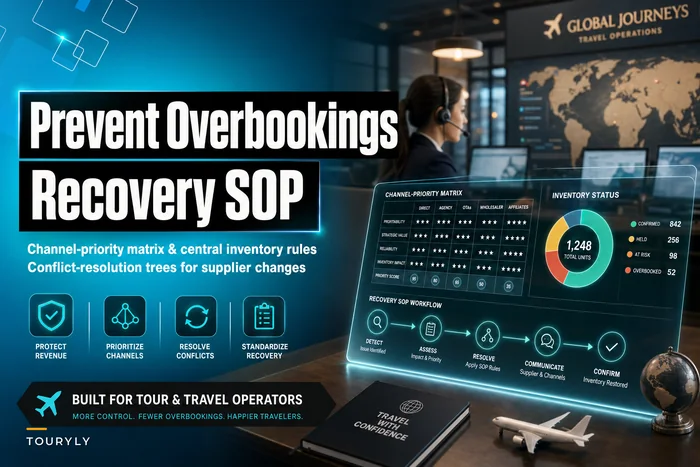
Because seasonal blocks concentrate risk into a narrow window, pair this with a clear recovery plan for when availability breaks anyway — the logic in the channel-priority matrix and recovery SOP for supplier availability matters most exactly when you have no slack in the calendar.
Worked scenario 2: negotiating an evergreen supplier
Product: A year-round city excursion partner, running most weeks.
Your position: Steady, predictable volume. No peak crunch. Multiple alternative suppliers exist.
Everything inverts here. You have more leverage because you're a reliable, repeating customer and you have alternatives. But you don't need a freeze — you need predictability and a tier structure that rewards consistency.
How the negotiation runs differently:
-
Lead with the relationship, not a single order. "We run this route roughly weekly, year-round. We're consolidating suppliers and want a partner we grow with."
-
Push for annual-aggregated, retroactive volume tiers. Your steady volume adds up across the year. Make sure it counts as one number, and make sure crossing a tier reprices everything below it.
-
Accept a capped escalation clause. You don't need a freeze on a year-round product; you need a cap so quotes stay safe. This costs you nothing and the supplier accepts it easily.
-
Loosen the substitution window slightly in exchange for other terms. On evergreen products with alternatives, a substitution isn't catastrophic — you can rebook. Trade that flexibility for a better tier.
A realistic outcome: your effective rate drifts down over the year as aggregated volume clears higher tiers retroactively, and the escalation cap keeps your customer quotes reliable. You gave up the tight substitution window you'd fight for in peak season — but on a year-round route with backups, that was never your real risk anyway.
When tight clauses are worth it — and when they're not
Not every supplier deserves a heavily negotiated contract. Over-lawyering a small, flexible supplier wastes time and can sour a relationship you'd rather keep easy.
Push hard on clauses when:
-
The product is peak-seasonal and you can't reprice customers
-
The supplier is single-source with no realistic backup
-
You've committed forward volume against a frozen customer price
-
Substitution failures would strand travelers mid-trip
Keep it light when:
-
Multiple interchangeable suppliers exist
-
Volume is small relative to your total book
-
The product is easily rebooked with minimal customer impact
-
The relationship value outweighs the marginal clause protection
Operators running a handful of departures a year with abundant supplier choice probably don't need the full playbook. The negotiation overhead won't pay back. The full clause structure earns its keep when you're committing real forward volume into constrained inventory — that's when a single vague line costs you a season's margin.
A short procurement checklist before you sign
Run every supplier contract through this before signing:
-
[ ] Substitution "equivalent" is defined objectively, not as "comparable"
-
[ ] Substitution windows scale burden toward the supplier as departure nears
-
[ ] You have a right to refuse-and-refund inside a defined window
-
[ ] Volume tiers count annually (or rolling 12-month), not per quarter
-
[ ] Tier crossings apply retroactively to all volume in the period
-
[ ] Multi-product volume aggregates into one tier count where possible
-
[ ] Rate is frozen (seasonal committed volume) or capped-escalation (evergreen)
-
[ ] No open-ended "subject to market conditions" repricing language
-
[ ] Repricing, if allowed, requires 60 days notice minimum
-
[ ] Penalty triggers align with your customer-facing SLA commitments
Run every supplier contract through this before signing:
Keeping the terms from becoming paperwork nobody enforces
The quiet failure in procurement isn't the negotiation — it's what happens after. You win a great substitution window and a retroactive tier structure, then six months later nobody's tracking whether the supplier honored the notice periods, or whether your volume crossed the tier that should have triggered a rebate.
This is where operators leave signed money on the table. The rebate you earned but never claimed. The substitution that arrived 4 days out with no penalty logged because nobody was watching the clock. Operators who actually capture these terms treat the contract as a live checklist, not a filed PDF — logging every substitution against its window, tracking cumulative volume against tier thresholds in real time, and flagging rebate triggers before someone forgets at year-end reconciliation.
Log substitutions with timestamps in the same system you use for bookings to avoid missed penalties.
Whether you run that tracking in a spreadsheet or a proper operations platform matters less than running it at all. The clauses only protect margin if someone is enforcing them. A frozen rate you don't audit against your invoices is just a number in a document, and a volume tier nobody counts is a discount you negotiated and then quietly gave back.
Here's a simple workflow to help your operations team enforce contract terms.
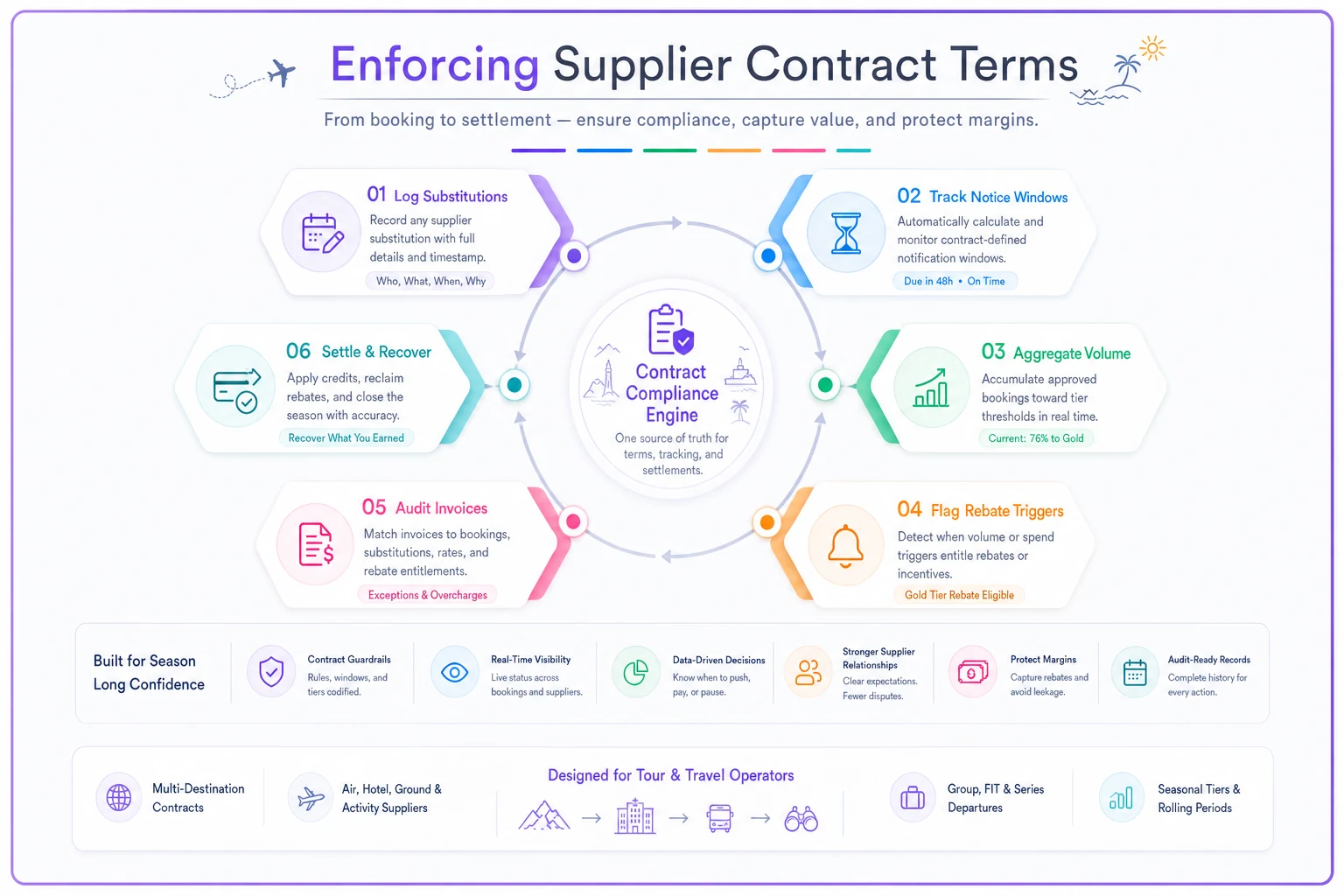
Whether you run that tracking in a spreadsheet or a proper operations platform matters less than running it at all. The clauses only protect margin if someone is enforcing them.
Rate negotiation gets all the attention, but the contract structure around the rate decides whether you keep what you negotiated. Substitution windows that shift burden to the supplier as departure nears, volume tiers counted annually and applied retroactively, and rate protection matched to whether the product is seasonal or evergreen — these are the levers that actually move margin.
Seasonal products need frozen rates and tight substitution windows because you can't reprice or rebook under pressure. Evergreen products need capped escalation and smart tier aggregation because your leverage is consistency, not urgency. Same supplier, same rate card, completely different playbook. Get the structure right at signing, enforce it through the season, and you stop handing back the margin you worked to win.
Ready to elevate your travel business?
Join 500+ travel operators using Touryly to optimize bookings, improve client satisfaction, and grow revenue.