


Three years ago, a tour operator in Barcelona taught me something brutal about supplier relationships. They had 42 separate hotel contracts, each with different cancellation terms buried in email threads and WhatsApp messages. When their biggest hotel partner suddenly dropped 18 rooms during peak season—24 hours before arrival—they ate a $28,000 loss. Not because they couldn't recover. Because they had no structured way to prove the violation or trigger penalties.
That operator now runs a completely different system. Every supplier relationship has specific availability commitments, notification windows, and penalty triggers built into monitored agreements. Their last-minute failure rate dropped from around 8% to under 1%, and they've collected roughly $45k in penalties this year that previously would've been pure loss.
Most tour operators treat supplier agreements like wedding vows—nice words that everyone forgets the moment something goes wrong. The real operational challenge isn't getting suppliers to sign agreements. It's building SLAs with teeth that actually prevent failures before they happen.
Why standard contracts fail when operations scale
The typical supplier agreement looks impressive on paper. Twenty pages of legal language covering force majeure, liability limits, and jurisdiction clauses. But when you actually need to prevent a supplier from ruining tomorrow's departure, those contracts are useless.
Here's what breaks: your legal team writes contracts focused on catastrophic failures. Your operations team needs protection from the daily failures that slowly bleed margin. The hotel that confirms availability then suddenly discovers "maintenance issues." The transfer company that accepts bookings then claims vehicle shortages. The activity provider who goes dark 48 hours before a group arrives.
These aren't breach-of-contract situations. They're operational failures that standard agreements don't address. You need specific operational clauses that define exactly what availability means, when notifications must happen, and what triggers automatic penalties.
Plenty of operators try to manage this through relationship building and verbal agreements. Works great until your account manager quits, ownership changes, or someone decides margins matter more than promises. The only protection that actually works is structured, monitored, enforceable operational agreements.
Building availability clauses that prevent the "sorry, we're full" surprise
Real availability protection starts with defining what "confirmed" actually means operationally. Not legally—operationally.
Never miss a booking or update.
Touryly streamlines your travel bookings, confirmations, and itinerary updates—all in one place.
- Unified booking management
- Automated customer notifications
- Itinerary & staff coordination
No credit card required
Your availability clause needs three components that standard contracts miss. First, the commitment window. This isn't about final cancellation deadlines—it's about when a supplier can no longer modify availability without penalties. For hotels, 14-day locks for individual bookings and 30-day locks for groups over 10 rooms tends to work. For activities and transfers, those windows shrink to 7 and 3 days respectively.
Second, allocation guarantees. A hotel saying they have "availability" means nothing if they can shift you to inferior rooms or split your group across floors. Your SLA needs specific allocation commitments: room types, floor proximity for groups, vehicle categories for transfers. One operator includes maximum walking distance between rooms for groups—sounds petty until you're explaining to 40 elderly travelers why they're scattered across a resort.
Third, overbooking recovery rules. Every supplier overbooks. The question is who gets bumped when they do. Your SLA needs clear priority rules—are you protected as a contracted partner? What's the minimum notice for availability changes? What comparable alternatives must they provide?
Confirmed Booking Protection Windows:
-
Groups 20+
45 days before arrival
-
Groups 10-19
30 days before arrival
-
Individual bookings
14 days before arrival
-
During protection window
No modifications without penalty
-
Exceptions require 48-hour notice + comparable alternative
The magic happens in the "comparable alternative" definition. Same star rating isn't enough. You need location parameters (within 2km), amenity matching (pool if original had pool), and cost coverage for any price difference. Without these specifics, suppliers will dump you in whatever inventory they can't sell.
Notification windows that give you time to actually fix problems
Late notifications kill recovery options. A hotel telling you about problems 24 hours before arrival leaves you scrambling for alternatives when inventory is gone and prices are peaked. Your notification requirements need to match your operational reality.
The notification matrix should vary by booking type and season. Peak season needs longer windows because alternatives are harder to find. Group bookings need longer windows because coordination complexity increases. Here's a framework that actually prevents scrambles:
Minimum Notification Windows:
| Booking Type | Peak Season | Shoulder | Low Season |
|---|---|---|---|
| Groups 30+ | 72 hours | 48 hours | 36 hours |
| Groups 10-29 | 48 hours | 36 hours | 24 hours |
| Individual Premium | 36 hours | 24 hours | 18 hours |
| Individual Standard | 24 hours | 18 hours | 12 hours |
Notification alone isn't enough, though. You need escalation triggers. If a supplier notifies you about availability issues, they should simultaneously provide alternatives—not "we'll help you find something," but specific alternatives with confirmed availability and pricing.
One operator handling Mediterranean tours built this into their system after losing a significant chunk of margin to last-minute hotel changes. Now every notification must include three alternative options, pre-verified for availability, with cost differentials clearly stated. Suppliers hate it initially, then realize it actually reduces the frantic back-and-forth when problems occur.
Substitution rules that protect quality and customer experience
Substitutions are where supplier relationships really reveal themselves. Every supplier will eventually need to substitute—the question is whether they'll protect your customer experience or just solve their inventory problem.
Standard substitution language like "comparable property" means nothing operationally. "Comparable" has been interpreted as same city, regardless of whether that puts customers 45 minutes from their intended location. Your substitution rules need specific parameters that protect what actually matters to your operation.
Start with location boundaries. For city tours, maximum distance from the original property or key attractions. For resort destinations, specific zone requirements. One operator maps this literally—suppliers get a Google Maps polygon showing acceptable substitution zones. Anything outside requires explicit approval and triggers compensation.
Quality markers matter more than star ratings. A business hotel might have the same stars as a boutique property, but they're not substitutable for a honeymoon package. Your rules need to specify which characteristics are non-negotiable: beachfront for beach packages, kitchen facilities for family tours, meeting spaces for corporate groups.
Substitution Requirements:
-
Location
Within 2km of original or closer to primary attraction
-
Category
Same or higher official rating
-
Amenities
Must match critical amenities (pool, beach access, parking)
-
Room type
Same bed configuration and square footage (+/- 10%)
-
Notification
48 hours minimum for peak, 24 hours for low season
-
Cost coverage
Supplier covers all differentials including transport
-
Customer notice
Supplier provides explanation template for customer communication
That last point about customer communication templates seems minor but saves real operational headaches. When substitutions happen, you need clean messaging that explains the change positively. Making suppliers provide this forces them to think about customer impact, not just inventory solutions.
The penalty trigger matrix that makes violations costly
Penalties without clear triggers are worthless. Vague trigger conditions or anything requiring subjective judgment almost never gets enforced. Your penalty matrix needs binary triggers—either the violation happened or it didn't.
The key is making penalties progressive and automatic. Not negotiable based on relationships or circumstances, but triggered by specific operational failures. Here's a penalty structure that actually drives behavior change:
Automatic Penalty Triggers:
| Violation Type | First Instance | Second Instance | Third Instance |
|---|---|---|---|
| Late notification (per hour) | €50 | €100 | €200 |
| Availability change inside window | 10% of booking value | 20% of booking value | 30% of booking value |
| Non-comparable substitution | 15% of booking value | 25% of booking value | Contract review |
| Complete failure (no alternative) | 50% of booking value | 75% of booking value | Contract termination |
| Quality degradation | Differential + 10% | Differential + 20% | Differential + 30% |
Penalties alone don't prevent problems, though. You need positive incentives too. Several operators include performance bonuses for suppliers who maintain clean availability records—2% volume bonuses for zero violations per quarter is one structure that seems to work. Sounds expensive until you calculate what those violations typically cost in customer recovery and reputation damage.
The enforcement mechanism matters as much as the penalties themselves. Don't bury this in accounting reconciliation. Make violations visible immediately. One operator displays a supplier scorecard in their booking system—every violation logged with timestamp and penalty amount. Suppliers can see their standing in real-time, which drives better behavior than quarterly penalty invoices.
Monitoring cadence and early warning systems
SLAs without monitoring are prayer, not protection. You need systematic visibility into supplier performance before failures occur, not after customers complain.
The monitoring cadence should match your operational risk. High-volume suppliers need daily touches. Seasonal suppliers need weekly check-ins during active periods. New suppliers need intensive monitoring for the first 90 days regardless of volume.
Below is a simple flow showing how monitoring escalates from routine check-in to active intervention:
Daily Availability Check → Flag Anomaly → Escalate to Weekly Review → Trigger Early Warning → Supplier Contact → Resolution or Penalty
Daily Monitoring (High Risk):
-
Availability confirmation for next 7 days
-
Response time tracking (should be under 2 hours)
-
Modification requests and reasons
-
Customer complaint correlation
Weekly Reviews (Standard Risk):
-
Upcoming group bookings (next 30 days)
-
Availability patterns and changes
-
Substitution frequency and quality
-
Payment and reconciliation status
Monthly Analysis (All Suppliers):
-
SLA violation summary
-
Penalty calculations and disputes
-
Customer feedback correlation
-
Capacity utilization vs. allocation
Manual checking works for 5 suppliers. At 50, you need systems. Most operators discover this after a major failure, when the cost of manual monitoring suddenly seems very reasonable compared to the loss they just absorbed.
Your early warning system should track patterns, not just violations. A hotel that suddenly starts requesting more modifications might be having financial trouble. A transfer company with increasing response delays might be losing staff. These patterns predict future failures better than any contract clause.
Visualizing the escalation workflow helps teams adopt it quickly.
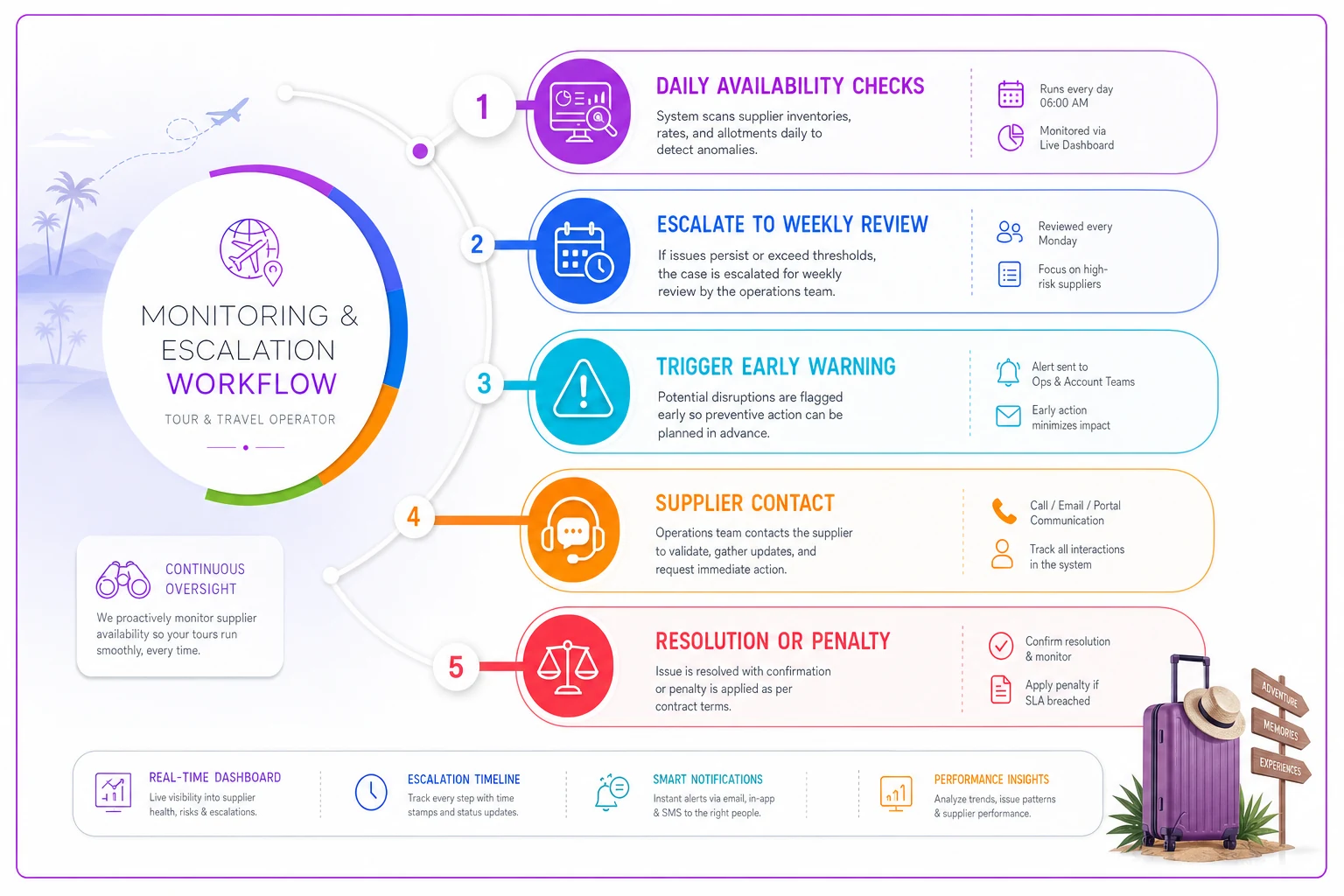
Start monitoring your top five suppliers daily during peak season to surface pattern changes before they impact bookings.
These routine checks and pattern monitors are what turn SLAs from documents into operational tools that prevent last-minute failures.
Sample dashboards that make performance visible
Supplier performance needs to be visible to everyone making booking decisions—not buried in quarterly business reviews, but live on dashboards your team actually uses.
Your primary dashboard should show three things: current status, trending performance, and risk indicators.
Supplier Health Dashboard (Main View):
-
Green/Yellow/Red status by supplier
-
Last 7 days
Violations and penalties triggered
-
Next 7 days
Booking volume and risk exposure
-
Response time
Current average vs. SLA requirement
-
Availability confirmation rate
-
Active issues requiring resolution
The real value comes from the drill-down views. Each supplier should have a detailed performance page that gives your team context, not just raw numbers.
Individual Supplier Scorecard:
-
Total bookings this month/quarter/year
-
SLA violations by type with dates
-
Penalties assessed and collected
-
Customer complaints correlated to bookings
-
Substitution history and quality metrics
-
Payment terms compliance
-
Contract renewal date and terms
Give suppliers access to their own performance dashboard. The transparency completely changes the dynamic—suppliers start calling proactively about potential issues because they can see their metrics declining before you flag them.
Predictive elements matter most here. Flag any supplier whose modification rate increases 20% month-over-month. That catches problems weeks before they impact customers.
The complete contract checklist for operational protection
Standard contracts protect lawyers, not operations. Your agreement needs specific operational provisions that standard templates miss.
Operational Availability Provisions:
-
Specific confirmation windows by booking type
-
Allocation guarantees with room/seat specifics
-
Overbooking priority rules
-
Availability modification restrictions
-
Peak season special provisions
-
Group proximity requirements
-
Inventory commitment minimums
Notification and Communication Requirements:
-
Notification windows by season and booking type
-
Escalation contact matrix with backup contacts
-
Required alternative provision with notifications
-
Customer communication templates
-
Response time SLAs for queries
-
Modification request procedures
-
System integration requirements for real-time updates
Substitution and Quality Standards:
-
Location parameter definitions with maps
-
Quality equivalence specifics beyond star ratings
-
Amenity matching requirements
-
Customer notification procedures
-
Cost differential coverage
-
Transportation provision for distant substitutions
-
Right of refusal conditions
Penalty and Performance Metrics:
-
Binary violation definitions
-
Progressive penalty schedule
-
Automatic trigger conditions
-
Payment offset rights
-
Performance bonus criteria
-
Dispute resolution timeline
-
Contract termination triggers
Monitoring and Reporting Obligations:
-
System access requirements
-
Reporting frequency and format
-
Audit rights and procedures
-
Performance review schedule
-
Data sharing requirements
-
Availability forecast obligations
Financial and Insurance Provisions:
-
Payment terms and penalties
-
Security deposit requirements
-
Insurance minimums and proof
-
Indemnification specifics
-
Currency and pricing stability
-
Volume commitment structures
-
Reconciliation procedures
This checklist is a starting point, not an endpoint. Every destination and supplier type needs modifications. Hotels in Paris have different operational realities than beach resorts in Thailand, and your contracts need to reflect that.
Technology infrastructure that makes SLA management automatic
Manual SLA management breaks somewhere around 20 suppliers. You simply can't track all the windows, notifications, and violations across email threads and spreadsheets—the overhead becomes larger than the problems you're trying to prevent.
The solution isn't more people checking more frequently. It's building SLA monitoring into your operational workflow. Every booking confirmation should automatically start tracking against SLA parameters. Every supplier message should be logged against notification requirements. Every substitution should trigger quality checks.
AI-powered operational platforms can automate most of this. Systems that read supplier communications, flag potential violations, and surface early warning signals based on communication patterns can cut monitoring time dramatically while catching more violations than manual checking ever could. One platform reduced SLA monitoring overhead by around 80% for an operator I know—while catching significantly more violations than their previous manual process.
The key is integration, not isolation. SLA management can't be a separate system that people need to remember to check. It needs to be embedded in your booking flow, visible in availability searches, and connected to financial reconciliation. When your team sees supplier performance every time they make a booking, behavior changes across the entire operation.
Making SLAs work in practice
The best supplier SLA I ever saw was 3 pages long. Not 30 pages of legal protection—3 pages of operational clarity that both parties actually understood and could execute. It prevented more problems than any 50-page contract I've reviewed.
The difference was focus. Instead of trying to protect against every possible scenario, it addressed the five failures that actually happened repeatedly. Simple operational terms instead of complex legal language. A one-page penalty matrix that accounts payable could execute without legal interpretation.
Your supplier relationships will fail occasionally. That's just operational reality in travel. The difference between occasional failures and systematic problems is whether you have proper SLAs with monitoring and enforcement. The operators who thrive aren't the ones with perfect suppliers—they're the ones with systems that prevent small failures from becoming customer disasters.
Start with your highest-volume supplier and build a proper operational SLA. Test your monitoring process. Enforce your first penalty. Once you see how much better that relationship performs, you'll wonder why you ever accepted verbal agreements and email confirmations as protection.
Suppliers who matter will appreciate the clarity. The ones who resist are telling you something important about their reliability. Either way, you're building protection that actually works when Thursday afternoon chaos hits and you need solutions, not legal theories.
Ready to elevate your travel business?
Join 500+ travel operators using Touryly to optimize bookings, improve client satisfaction, and grow revenue.