

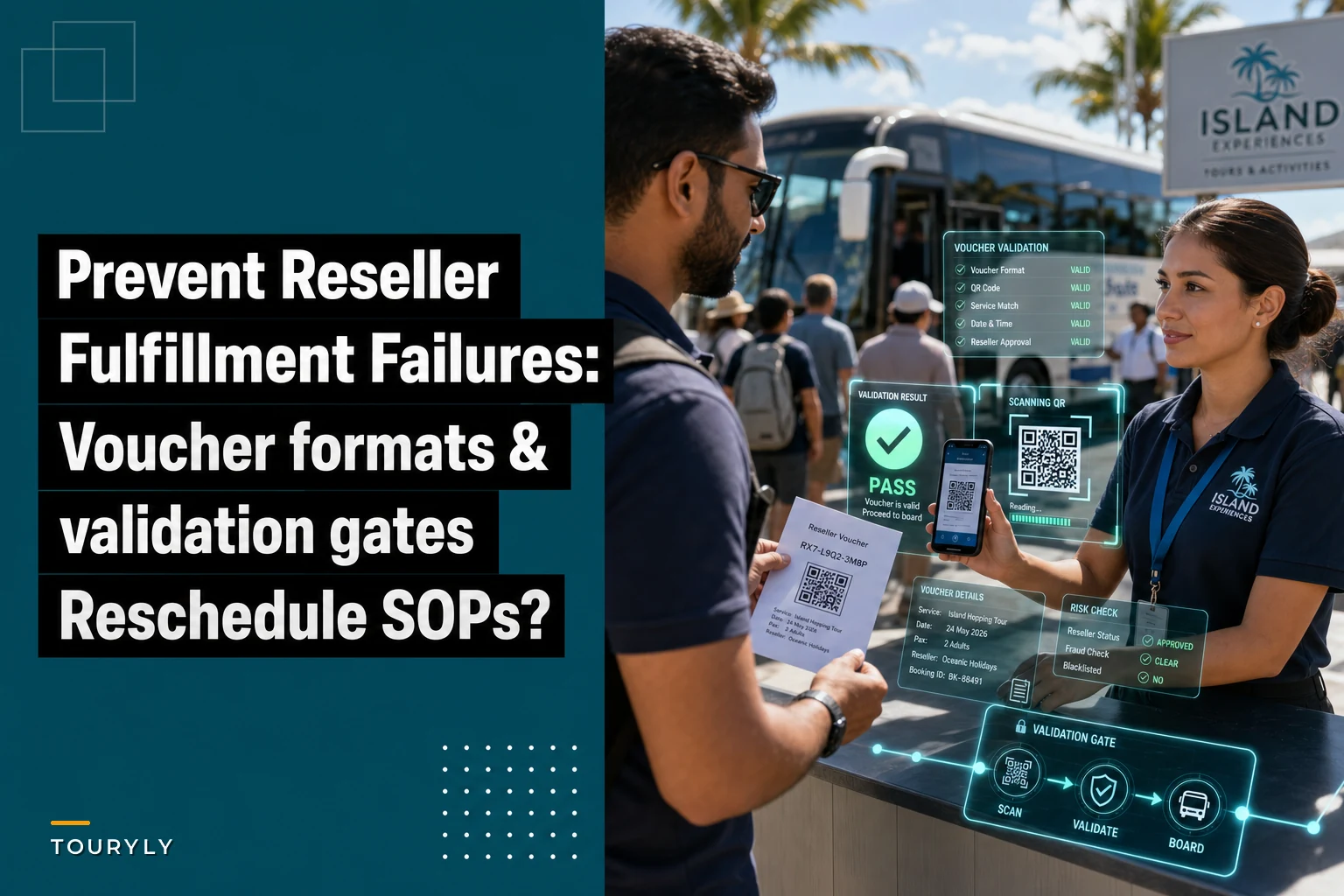

The voucher validation failure always happens at the worst possible moment. Your partner reseller sold a sunset kayak tour. Their customer drove 45 minutes, found parking, walked to your dock. Now your staff member is staring at a QR code that won't scan while twelve other people wait behind them.
The customer shows their phone screen. The QR is blurry. Or it's a screenshot of a forwarded email. Your staff tries typing the code manually but the reseller used a different format than your system expects. The customer starts getting angry. They paid $180 for this tour. Your staff has to make a call — let them on and risk a double-booking, or turn them away and deal with the fallout.
This exact scenario destroys reseller partnerships. Not because of one failed validation, but because these failures stack up. Each incident creates friction. The reseller gets complaints. They start questioning whether your operation can handle volume. Eventually they start routing customers to a competitor with cleaner handoff processes.
The reseller voucher workflow tour operators actually need
Most operators treat reseller vouchers like an afterthought. They email a PDF template to partners, hope everyone follows the same format, then scramble when something breaks. The real operational challenge isn't just creating vouchers — it's building a validation system that works when customers show up with screenshots, forwarded emails, printed papers, or third-party booking confirmations.
A solid reseller handoff workflow needs three core components working together: format standardization across all channels, validation gates that handle edge cases, and clear escalation protocols when things go wrong.
Why voucher formats keep breaking
Resellers want flexibility. They're selling through their own systems, their own branding, their own customer flows. Some use booking platforms that generate their own confirmation codes. Others manually create vouchers in Word. A few have API connections but even those break when systems update.
Meanwhile, your operation needs consistency. Your dock staff can't spend five minutes decoding each voucher while a bus full of customers waits. But forcing rigid requirements on resellers creates its own problems — they'll find workarounds that break your system in different ways.
The format problem multiplies with volume. When you're handling twenty reseller bookings a week, manual workarounds are annoying but manageable. At 200 bookings weekly across eight different resellers, those edge cases become operational nightmares.
Building validation gates that actually work
The solution isn't picking the perfect voucher format. It's building validation layers that handle multiple formats while maintaining security. Here's the operational framework that works across hundreds of tour operations:
Never miss a booking or update.
Touryly streamlines your travel bookings, confirmations, and itinerary updates—all in one place.
- Unified booking management
- Automated customer notifications
- Itinerary & staff coordination
No credit card required
Primary validation layer: Your system generates a unique 8-character alphanumeric code for every reseller booking. This code lives in your operational database regardless of what format the reseller uses for their customer-facing voucher. The reseller can wrap this code in a QR, embed it in a PDF, or write it on a napkin — your system only cares about validating that core code.
Secondary validation layer: Customer name plus booking date creates a backup validation path. When the primary code fails, staff can search by these fields. This catches situations where customers show up with the wrong voucher or resellers make transcription errors.
Tertiary validation layer: Reseller reference number plus approximate booking value. Some resellers will always use their own booking codes. Rather than fight this, build a lookup table that maps their codes to yours. The booking value adds a layer of security — someone can't just guess random codes.
A simple visual flow helps staff remember the layers quickly.
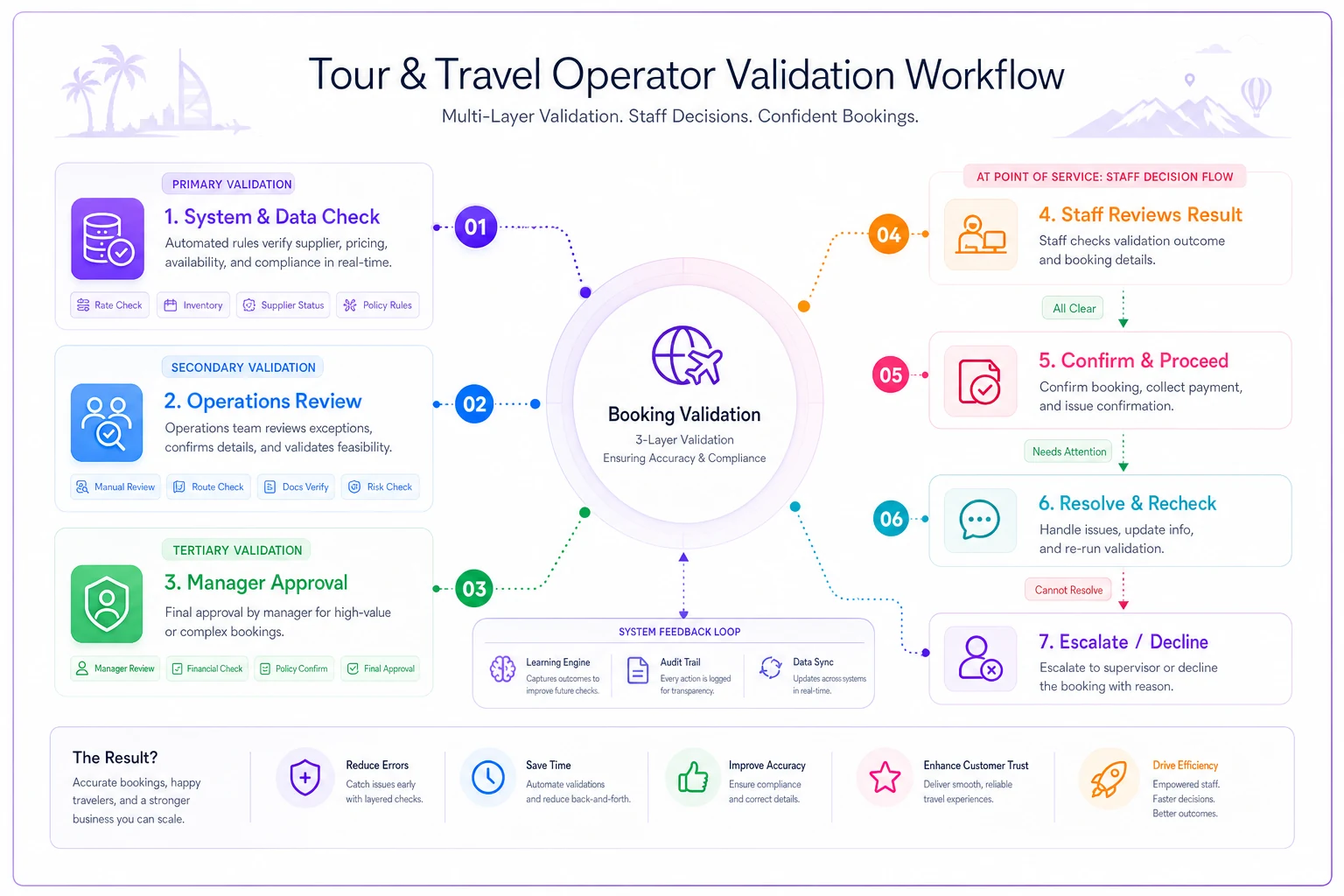
Use this flow to reduce hesitation at the gate and keep lines moving.
The validation checklist your staff actually needs
-
Can you scan or type the primary code? - Yes → Validate and proceed - No → Move to step 2
-
Can you find booking by name + date? - Yes → Verify tour details match, then proceed - No → Move to step 3
-
Do they have reseller confirmation? - Yes → Check reseller lookup table - No → Move to step 4
-
Can customer show payment proof? - Yes → Create manual entry, proceed, flag for reconciliation - No → Escalate to manager
Each decision point needs a clear action. No ambiguity. No "check with someone else" unless it's the final escalation.
Reschedule and refund flows that don't destroy partnerships
The real test of reseller workflows happens during exceptions. A storm cancels tomorrow's tours. Now you need to communicate with eight resellers who need to contact 73 customers. Or a reseller's customer no-shows and wants to reschedule, but the reseller already paid you for that original slot.
Most operators handle these situations ad-hoc. Each incident becomes a lengthy email chain. Resellers get frustrated with response times. Customers get conflicting information. Money gets lost in refund confusion.
Weather cancellations: who owns customer communication?
The cleanest approach: operators notify resellers, resellers notify customers. Sounds simple until you realize resellers operate on different schedules. Your 6am weather call might not reach a reseller who opens at 9am. By then, customers are already driving to your location.
Tier 1 (immediate): Automated SMS to all affected booking phone numbers, regardless of booking source. Message clearly states: "Tour cancelled due to weather. Your booking agent will contact you about rescheduling."
Tier 2 (within 2 hours): Direct notification to resellers through their preferred channel — API webhook, email, SMS, or phone call for major partners.
This redundancy prevents the worst-case scenario where customers show up to cancelled tours. The message hierarchy matters — customers know their reseller handles next steps, but they're not left completely in the dark.
No-show reschedule economics
Resellers pre-pay for slots at wholesale rates. When their customer no-shows, the reseller has already paid you. Now their customer wants to reschedule. Who absorbs the cost of that second slot?
| Model | Description |
|---|---|
| Credit bank model (high-volume resellers) | Resellers maintain a credit balance. No-shows don't get refunded but can be rescheduled within 30 days using existing credit. This incentivizes resellers to fill slots while giving flexibility for genuine customer issues. |
| Strict policy model (low-volume resellers) | No-shows forfeit payment, period. Reschedules require new payment. Clean and simple but can strain smaller partnerships. |
| Shared risk model (strategic partners) | First no-show per month can reschedule free. Additional no-shows forfeit payment. Balances partnership flexibility with operational protection. |
Document which model applies to each reseller. Don't negotiate exceptions on the fly — that's how accounting nightmares start.
Fraud patterns specific to reseller channels
Reseller fraud looks different than direct booking fraud. The separation between payment and service creates unique vulnerabilities. A scammer books through a reseller using stolen payment info. By the time the chargeback hits the reseller, the tour already happened. The reseller demands a refund from you. Now you're eating the cost of fraud you didn't even process.
Booking velocity checks: Flag when a reseller suddenly books 5x their normal volume. Could be legitimate growth, could be compromised account credentials. Either way, it needs verification before fulfillment.
Guest list requirements: Resellers must provide customer names 24 hours before service. No "TBD" bookings. No day-of name changes without manager approval. This prevents voucher resale and makes it harder to exploit stolen bookings.
Photo ID matching: For bookings over $200, require photo ID matching the booking name. Resellers hate this one, but it stops the most expensive fraud. Make it non-negotiable for high-value experiences.
The reseller audit trail you need for disputes
-
Timestamp
-
Staff member who validated
-
Validation method used (QR scan, manual code, name lookup)
-
Any override decisions
-
Customer ID verification status
-
Photo of physical voucher if presented
This seems like overkill until you're defending a $3,000 private tour that someone claims was fraudulently redeemed. The audit trail turns finger-pointing into fact-finding.
Manual processes that kill reseller programs
Successful reseller programs die from operational friction, not bad partnerships. Each manual step adds delay and creates another opportunity for error. When you're reconciling bookings through spreadsheet exports and email chains, mistakes compound.
Common manual bottlenecks:
-
Availability updates Manually emailing partners when tours sell out leads to overbookings. By the time they get the message, they've already sold three more slots.
-
Payment reconciliation Matching reseller payments to specific bookings through bank transfers and invoice numbers wastes hours every week. Accounting spends more time reconciling than analyzing.
-
Commission calculations Different rates for different partners, seasonal adjustments, volume bonuses — calculating payments manually guarantees errors that damage trust over time.
These aren't just efficiency problems. A reseller who can't trust your availability updates will overbook elsewhere. One who waits weeks for commission payments will start prioritizing competitors who pay faster.
Modern reseller workflow automation
The fix isn't complicated technology — it's systematic process design. Map every touchpoint between booking creation and service delivery. Identify where human decisions add real value versus where staff are just transcribing data from one place to another.
If availability is the biggest friction, prioritize API or a real-time partner portal first.
Real-time availability syncing prevents most overbooking problems before they start. When resellers see live capacity, they can't accidentally sell slots that don't exist. This requires either API integration or a partner portal, but even a basic web portal beats email updates.
Automated validation code generation removes format confusion. Every booking gets a unique code regardless of source. Resellers can wrap it however they want — the core validation stays consistent on your end.
Payment automation through virtual cards or ACH reduces reconciliation from hours to minutes. Each booking links directly to its payment. No more matching invoice numbers to bank transfers manually.
The operational improvement happens gradually. Start with the highest-friction point — usually availability updates or payment reconciliation. Fix that, then move to the next bottleneck. Within a few months, a manual process that took 15-20 hours weekly can drop to a couple hours of exception handling.
Measuring what matters in reseller operations
Track the metrics that predict partnership health, not just booking volume:
-
Validation failure rate Should be under 2%. Higher rates indicate format confusion or training gaps.
-
Time to validate Target under 30 seconds from customer arrival to clearance. Longer times create queues and frustration.
-
Reschedule request rate Over 10% suggests resellers aren't setting proper customer expectations.
-
Payment reconciliation time Should take less than 1 hour per 100 bookings. More than that indicates process problems.
-
Partner response time How quickly resellers acknowledge cancellations or changes. Slow responses are usually a sign of bigger problems ahead.
These metrics reveal operational health before partnerships deteriorate. A reseller with increasing validation failures needs process help, not more marketing support.
The reseller workflow that scales
Building reseller partnerships without proper operational workflows is like constructing a house without plumbing — everything looks fine until you turn on the water. The leaks start small. A validation failure here, a payment confusion there. But as volume grows, those small leaks become floods that wash away profitable partnerships.
The solution isn't perfection. It's building validation gates that handle messy reality, escalation procedures that resolve issues quickly, and enough automation to remove friction without removing flexibility.
The voucher format matters less than the validation process. The refund policy matters less than clear communication. The technology stack matters less than consistent execution. Focus on the workflows that directly impact customer experience at the moment of truth — when they show up expecting service. Everything else is just supporting infrastructure for that critical moment.
The voucher format matters less than the validation process. The refund policy matters less than clear communication. The technology stack matters less than consistent execution. Focus on the workflows that directly impact customer experience at the moment of truth — when they show up expecting service. Everything else is just supporting infrastructure for that critical moment.
Ready to elevate your travel business?
Join 500+ travel operators using Touryly to optimize bookings, improve client satisfaction, and grow revenue.