

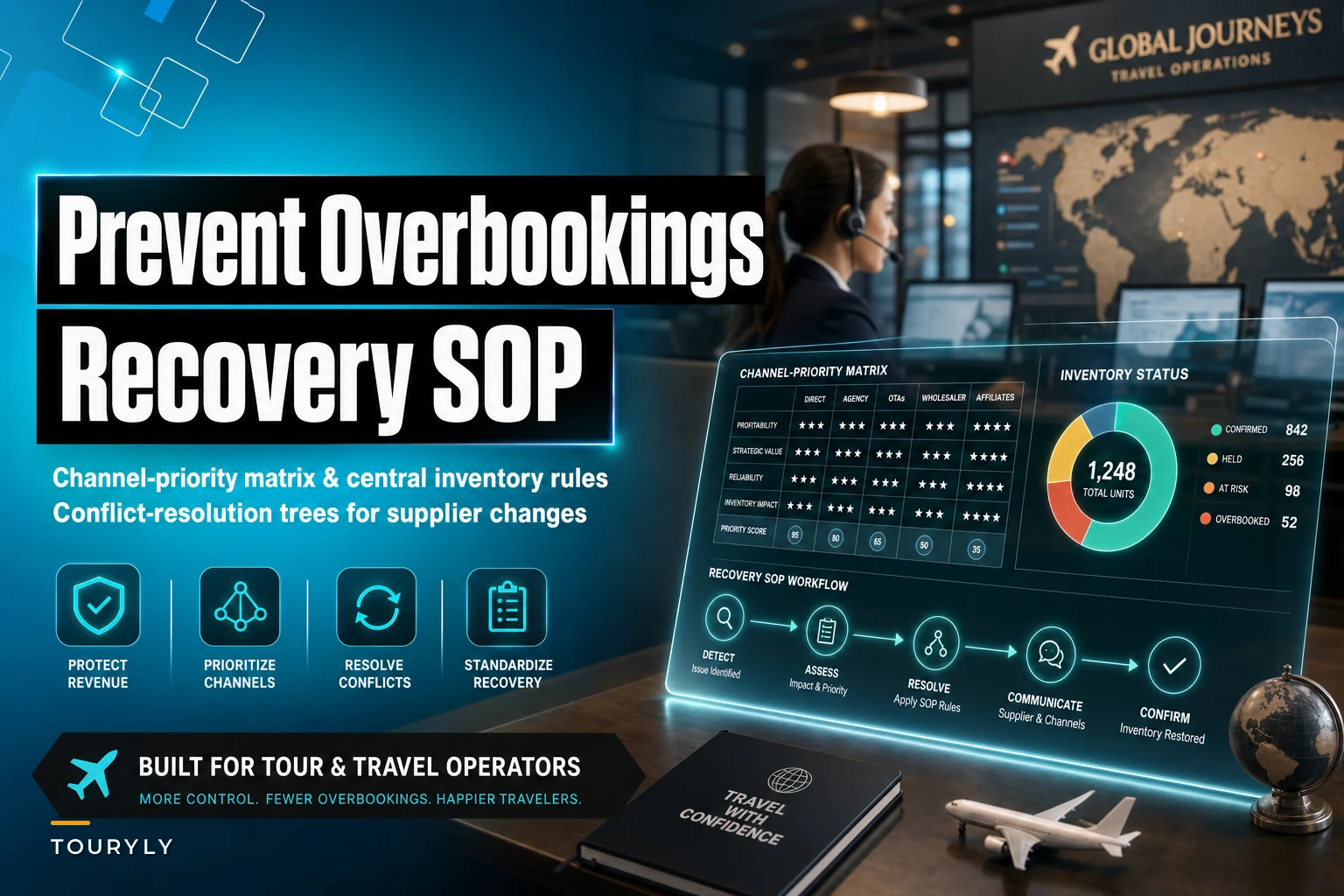

Supplier availability sync for tour operators breaks constantly. Not because the technology doesn't exist, but because most operators treat it like a technical problem when it's actually an operational one.
The real issue sits between conflicting data sources. Your ground handler emails availability updates twice a week. Your DMC partner uses a shared Google Sheet. Hotels push XML feeds every four hours. Activity providers text you on WhatsApp. Meanwhile, you're selling the same inventory across your website, OTAs, wholesale partners, and direct B2B channels.
Each channel runs on different update frequencies, confirmation protocols, and cancellation windows. Without clear priority rules and conflict resolution procedures, you end up confirming bookings you can't deliver.
The hidden complexity of multi-source inventory management
Tour operators juggle anywhere from 8 to 40 supplier relationships per destination. A typical Iceland operator running Northern Lights tours might work with:
-
3 vehicle providers, each with different fleet sizes
-
5 accommodation partners ranging from boutique hotels to guesthouses
-
2 adventure activity suppliers
-
4 restaurant partners for group dinners
-
1 equipment rental company
Each supplier communicates availability differently. The vehicle company updates their calendar nightly. Hotels send manual emails when they're approaching 80% occupancy. The activity supplier only confirms upon booking request.
Now multiply that across every tour package and departure date. A moderate-sized operator running 12 products across 4 destinations manages roughly 1,400 availability data points per week. Miss one update and you've got angry customers and a scrambling ops team.
It gets worse when suppliers change availability at the last minute. Hotels oversell during peak season. Activity providers cancel for weather. Transport companies double-book vehicles. Without structured protocols, your team makes reactive calls that cascade into real operational chaos.
Building your channel-priority matrix
Stop treating all inventory sources equally. Some channels deserve priority based on reliability, margin, and operational impact.
Never miss a booking or update.
Touryly streamlines your travel bookings, confirmations, and itinerary updates—all in one place.
- Unified booking management
- Automated customer notifications
- Itinerary & staff coordination
No credit card required
Here's how to structure it:
-
Priority Level 1
Direct supplier confirmations
- Confirmed bookings with deposit paid - Written confirmations from primary suppliers - XML/API feeds with real-time updates -
Priority Level 2
Partner platforms
- DMC inventory systems - Wholesale partner allocations - Preferred supplier availability -
Priority Level 3
Manual communications
- Email availability updates - WhatsApp/phone confirmations - Shared spreadsheet updates -
Priority Level 4
Unconfirmed sources
- Verbal availability promises - Historical availability patterns - Secondary supplier options
When conflicts come up between channels, the higher priority source wins. That's it.
Practical priority matrix implementation
| Conflict Scenario | Resolution Rule | Action Required |
|---|---|---|
| Hotel shows available on booking platform but email says sold out | Email (Level 3) overrides platform if less than 48 hours old | Update platform, block dates |
| DMC confirms space but direct supplier says full | Direct supplier (Level 1) wins | Request alternative from DMC |
| Historical availability suggests open but no confirmation | Cannot sell until Level 1-3 confirmation | Mark as request-only |
| WhatsApp confirms but system shows unavailable | Written confirmation (Level 3) valid for 24 hours | Screenshot and process manually |
Your team needs absolute clarity on these rules. Print them. Post them. Test your staff on them monthly.
Central inventory rules that actually work
Central inventory management means establishing non-negotiable rules about how availability flows through your operation. Not guidelines — rules.
Rule 1: Single source of truth per supplier Each supplier gets one official communication channel for availability. Hotels use your booking platform. Ground handlers use email. Activity providers use your reservation system. No exceptions. When that adventure company tries sending updates via WhatsApp because "it's faster," redirect them to the official channel.
Rule 2: Time-decay protocol for manual updates Manual availability confirmations expire. Email confirmations stay valid for 48 hours. Phone confirmations for 24 hours. WhatsApp messages for 12 hours. After that, you reconfirm or mark it unavailable.
Track expiration timestamps in a shared dashboard so you never rely on expired manual confirmations.
Rule 3: Confirmation hierarchy Written confirmations with booking references beat everything. Emails beat phone calls. System updates beat manual communications. When your Petra camping supplier confirms through their reservation system but then calls to say they're full, the system confirmation stands until it's formally cancelled.
Rule 4: Buffer inventory requirements Maintain a 15% buffer on all group bookings. If a hotel confirms 20 rooms, sell 17. If transport confirms 3 vehicles, book 2 and hold 1 as backup. This buffer is what saves you during peak season when suppliers inevitably oversell.
Rule 5: Cut-off synchronization All channels must respect the most restrictive cut-off time. If hotels require 72-hour confirmation but activities need 48, your whole package runs on a 72-hour cut-off. Mixing cut-offs creates availability gaps.
Decision trees for last-minute supplier changes
Suppliers will fail you. Usually about four hours before departure when clients are already at the airport. How you respond determines whether you lose one booking or your reputation.
Primary supplier failure decision tree
-
Step 1
Assess impact severity
- How many bookings are affected? - Can you partially deliver the service? - Is this a core or supplementary component? -
Step 2
Check alternative supplier availability
- Same-category replacement (different hotel, same star rating) - Upgrade options (better hotel, absorb the cost difference) - Downgrade with compensation (lower category plus partial refund) -
Step 3
Client communication protocol
- Immediate notification if the change affects the core experience - 24-hour notice for supplementary changes - Present a solution, not just the problem
The 60-minute recovery protocol
-
Minutes 0-15
Damage assessment
- List affected bookings - Identify which components are failing - Calculate financial impact -
Minutes 15-30
Solution development
- Contact backup suppliers - Check upgrade availability - Price replacement options -
Minutes 30-45
Decision and approval
- Choose the best alternative - Get management sign-off if needed - Prepare client communication -
Minutes 45-60
Execution
- Confirm alternative arrangements - Update all systems - Notify affected clients - Brief the operations team
This sequence gives your team a structured 60-minute response window.
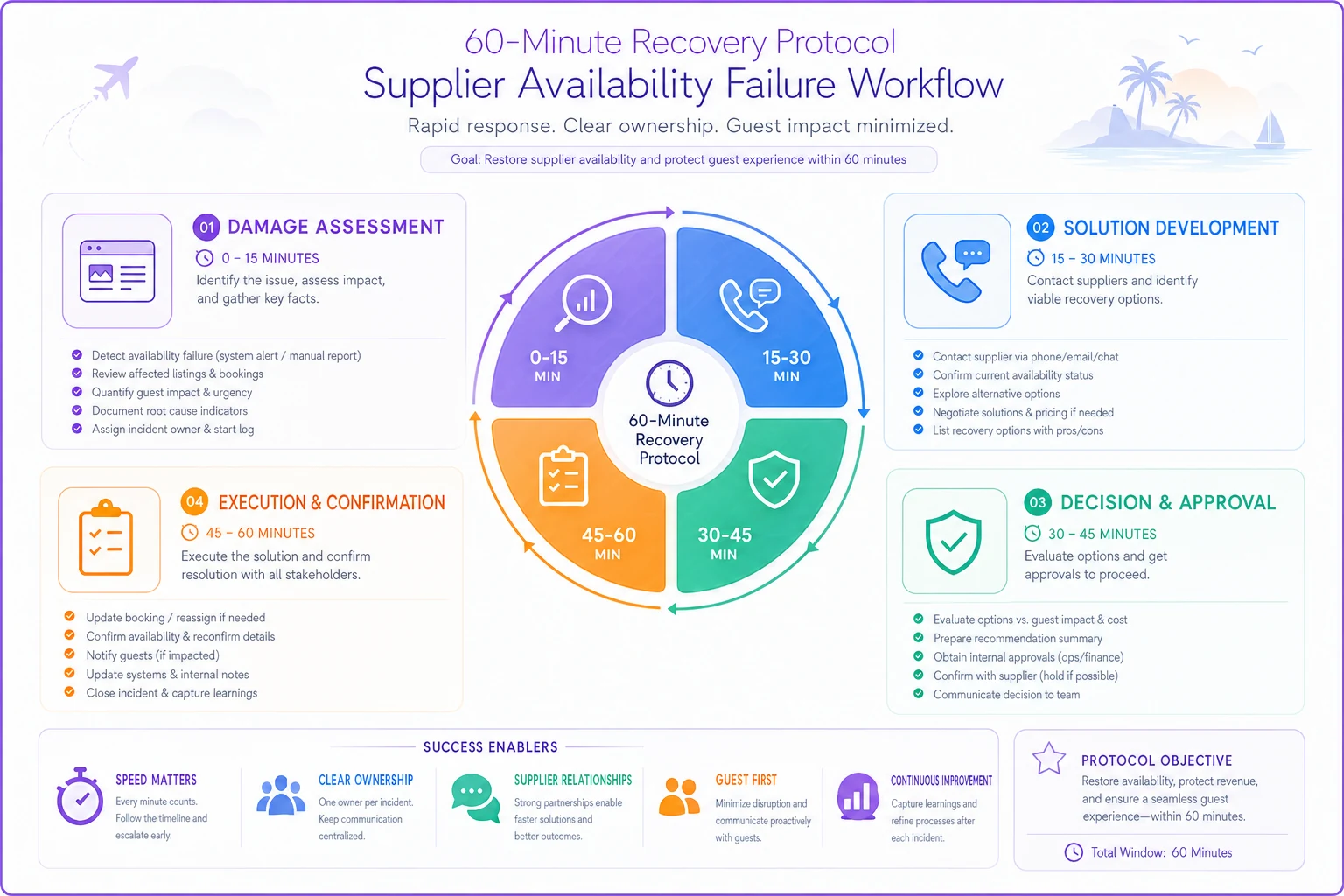
This visual maps responsibilities and timing so everyone knows their next step.
Managing conflicting availability across OTAs and direct channels
OTAs create their own availability problems. Viator might show your Santorini sunset tour as available while your website shows sold out. Booking.com displays rooms you released back to the hotel two days ago. GetYourGuide sells spots on tours you paused last month.
OTA availability often lags 4 to 24 hours behind your actual inventory. During peak season, that lag can mean 3 to 5 overbookings per day for a mid-sized operator.
Dedicated OTA allocation pools Reserve specific inventory blocks for each OTA rather than sharing general availability. Allocate 30% to Viator, 20% to GetYourGuide, keep 50% for direct. When an OTA's allocation sells out, they can't touch your direct inventory.
Automated stop-sell triggers Set thresholds that automatically close OTA sales. At 80% capacity, stop selling on tertiary OTAs. At 90%, pause secondary OTAs. At 95%, close everything except direct bookings.
Channel update sequencing Update OTAs in order of booking volume and system latency. Viator first (highest volume, 4-hour lag). GetYourGuide second. Smaller OTAs last. This narrows the window where conflicting availability exists.
Daily reconciliation protocol Every morning, reconcile all channel availability. Compare OTA dashboards against your central inventory. Flag discrepancies. Update immediately. This catches sync failures before they turn into customer complaints.
Real scenario: Managing Morocco supplier chaos during Ramadan
A Morocco operator learned these lessons the expensive way during Ramadan.
They ran 8-day Imperial Cities tours across Casablanca, Fes, Meknes, and Marrakech. Inventory came from 6 hotels, 3 transport companies, 12 restaurants, and 4 local guides — all communicating differently. Hotels through Hotelbeds, transport via WhatsApp, restaurants by phone, guides through a local DMC.
During Ramadan, availability shifted constantly. Restaurants changed operating hours daily. Hotels suddenly blocked rooms for local celebrations. Transport companies juggled government contracts alongside tourist bookings. The operator's tracking system — a sprawling Google Sheet managed by 3 coordinators — couldn't keep pace.
Week 1 brought 4 overbookings. Week 2 saw 7 failures, including stranding 12 tourists without accommodation in Fes. By Week 3, they'd spent around $18,000 in emergency rebookings and compensation.
They restructured using the framework above:
-
Single confirmation channel per supplier, no more WhatsApp
-
48-hour expiration on manual updates
-
20% buffer inventory during Ramadan
-
Twice-daily OTA reconciliation
-
60-minute recovery protocol for failures
The following Ramadan? Two minor issues across 200+ bookings. When a Fes riad suddenly claimed overbooking, the team ran the recovery protocol, moved guests to a better property within 45 minutes, and turned what could have been a disaster into a positive review about problem-solving.
Technology enablement without the complexity
Everything above works with basic tools. You could run it all through spreadsheets and disciplined process. But AI-powered operational software makes supplier availability sync manageable when you're operating at scale.
Modern platforms centralize your availability data from all sources — APIs, emails, spreadsheets, even WhatsApp messages. They apply your priority rules automatically, flag conflicts before they become problems, and keep audit trails for when suppliers claim they "never confirmed that booking."
The bigger value is in removing the repetitive work that burns out operations teams. Checking 12 OTA dashboards every morning. Cross-referencing supplier confirmations against bookings. Updating availability across channels after every change. These tasks are error-prone and time-consuming, and they don't require human judgment — which is exactly why automation handles them better.
The right platform also enforces your protocols without manual effort. Buffer inventory rules apply automatically. Time-decay triggers fire without anyone tracking them. Recovery procedures can launch the moment a supplier cancellation comes in.
That's not about replacing human judgment. Supplier negotiations, relationship management, and real crisis decisions still need experienced operators. But removing manual availability tracking gives your team back the bandwidth to focus on what actually matters — delivering good tours even when things go sideways.
When strict availability management makes sense (and when it doesn't)
Not every operator needs this level of structure. Your operational complexity determines what's actually required.
You need strict availability management when:
-
Managing 15+ suppliers per destination
-
Selling through 4+ distribution channels
-
Running fixed-departure group tours
-
Operating in destinations with unreliable suppliers
-
Handling 50+ bookings weekly
You can stay more flexible when:
-
Working with 5 or fewer trusted suppliers
-
Selling primarily through direct channels
-
Running private or custom tours with built-in flexibility
-
Operating in mature tourism markets
-
Managing under 20 bookings weekly
A small operator running day tours from one location might find this overkill. But once you expand to multi-day tours, add distribution partners, or scale beyond what one person can track mentally, structure stops being optional.
Making availability sync actually work
Availability challenges won't disappear. Suppliers will always use different systems. OTAs will always lag behind real-time inventory. Last-minute changes will always threaten smooth operations.
But structured protocols turn availability management from daily crisis into predictable process. A clear priority matrix removes the confusion when data conflicts. Central inventory rules stop the slow drift toward chaos. Recovery protocols make supplier failures manageable rather than reputation-destroying.
The operators who handle this well treat availability sync as an operational discipline, not a technology problem. They build clear rules, enforce them consistently, and use the right tools to scale what humans do well — make smart decisions within clear frameworks.
Your customers don't care that your Jordanian desert camp uses WhatsApp while your Amman hotel uses Hotelbeds. They care that their booking gets confirmed and delivered. Getting that right, regardless of how chaotic your supplier ecosystem is, comes down to having the right structure in place.
Ready to elevate your travel business?
Join 500+ travel operators using Touryly to optimize bookings, improve client satisfaction, and grow revenue.