

Most tour operators find out something broke when a guest is standing in a parking lot with no van. The booking confirmed fine. The supplier "usually shows up." The guide had it "handled." And then one weak link snaps at the worst possible moment, in front of paying customers, during your busiest week.
Software teams solved a version of this problem years ago. When you're running a system that thousands of people depend on every minute, you can't afford to wait for complaints before you notice a failure. So they built a discipline around it — service level indicators (SLIs), service level objectives (SLOs), alerting, runbooks, and post-incident reviews. The core idea is boring but powerful: decide what "healthy" means, measure it continuously, and know exactly what to do when it drifts.
That same discipline maps almost perfectly onto a tour operation. You've got a booking pipeline (your "front end"), suppliers (your "dependencies"), and guides (your "on-call responders"). Each one has a healthy state and a failure state. Most operators just don't measure the gap between them until it's too late.
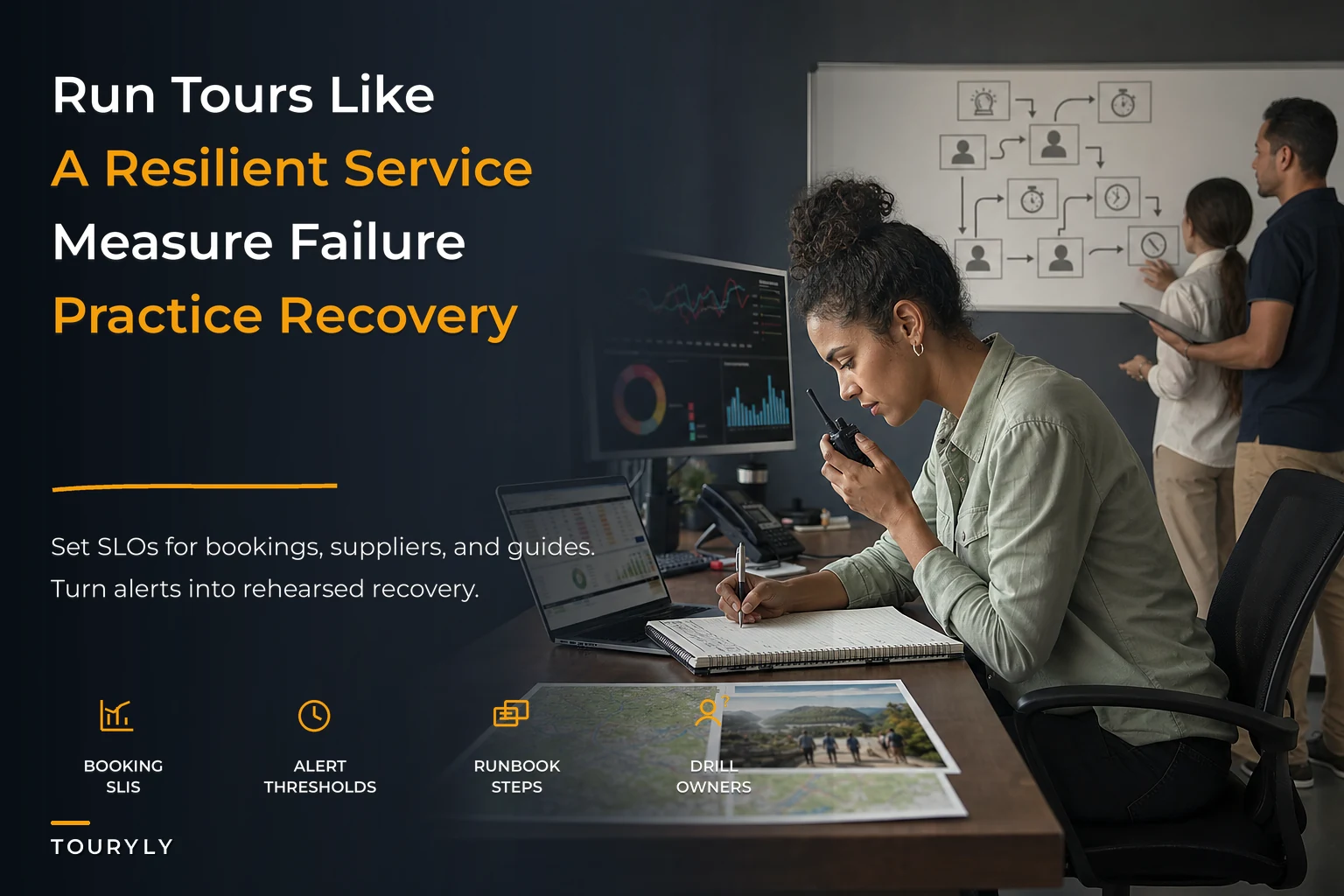
This is a playbook for building SLOs for tour operations the way an SRE team would — with real metrics, alert thresholds, escalation ladders, and drills that connect your daily monitoring to how you actually respond when things go sideways.
Why "we'll notice if something's wrong" stops working
At three or four tours a day, the operator is the monitoring system. You know every booking by name. You've texted every supplier this week. If a guide goes quiet, you feel it.
That breaks somewhere around 15–30 departures a day across multiple products and a handful of suppliers. The failure modes don't get bigger — they get invisible. A confirmation email silently bounces. One supplier's availability feed goes stale but still returns cached data. A guide's phone dies and nobody notices until the 9am guests are calling the office.
This usually happens when growth outpaces attention. You didn't lose the ability to fix problems. You lost the ability to see them early. That's the whole reason SRE exists as a field — not to prevent every failure, but to shrink the time between "something broke" and "we know about it."
Operators who scale cleanly treat reliability as a measurable thing, not a vibe. And that starts with defining what you're actually watching.
Step one: pick your SLIs (the things worth measuring)
An SLI is just a metric that reflects whether a part of your operation is working from the customer's point of view. Not every metric qualifies. "Number of emails sent" is a vanity number. "Percentage of bookings that received a confirmation within 5 minutes" is an SLI — it tells you whether the promise you made to the customer is actually being kept.
Never miss a booking or update.
Touryly streamlines your travel bookings, confirmations, and itinerary updates—all in one place.
- Unified booking management
- Automated customer notifications
- Itinerary & staff coordination
No credit card required
Across a tour operation, the SLIs worth tracking cluster into three domains:
-
Bookings - Confirmation delivery rate (booking → confirmation received) - Payment capture success rate - Booking-to-itinerary completeness (every booking has a supplier assigned and a guide assigned before departure minus X hours)
-
Suppliers - Availability feed freshness (how old is the data you're pricing against) - Confirmation response time (you request a slot → they confirm) - Same-day reliability (booked services that were actually delivered without substitution)
-
Guides - Check-in compliance (guide confirmed ready before tour start) - Incident acknowledgment time (how fast a guide responds to an urgent message) - Handover completeness (post-tour reports submitted on time)
The mistake most operators make is measuring what's easy instead of what predicts failure. Total booking volume is easy. But "bookings still missing a guide assignment 12 hours before departure" is the number that actually tells you a tour is about to go wrong.
Step two: turn indicators into SLOs (the line between fine and not fine)
An SLI is the measurement. An SLO is the target — the threshold that separates acceptable from a problem. This is where you make judgment calls, and they should be honest, not aspirational. Setting a 100% target for anything guarantees you'll ignore your own alerts within a week.
Here's a sample SLO table you can adapt. The point isn't the exact numbers — it's that every critical function has a defined "healthy" line and a defined breach point.
| Domain | SLI | SLO target | Breach threshold | Why it matters |
|---|---|---|---|---|
| Bookings | Confirmation delivered within 5 min | ≥ 98% | < 95% over 1 hr | Silent bounce = no-show risk |
| Bookings | Payment capture success | ≥ 97% | < 93% daily | Direct revenue leakage |
| Bookings | Guide assigned by T-12h | 100% | Any booking unassigned at T-6h | Prevents parking-lot failures |
| Suppliers | Availability feed age | < 15 min | > 60 min stale | Overbooking / mispricing risk |
| Suppliers | Confirmation response | < 2 hrs | > 6 hrs pending | Late itinerary assembly |
| Suppliers | Same-day delivery reliability | ≥ 96% | < 90% rolling 7-day | Predicts supplier collapse |
| Guides | Pre-tour check-in by T-60min | ≥ 99% | Any missed at T-30min | Last chance to swap coverage |
| Guides | Urgent message ack | < 10 min | > 20 min | Incident response speed |
Notice the "guide assigned by T-12h" line sits at 100% while confirmation delivery sits at 98%. That's deliberate. Some failures are recoverable with buffer time; others are catastrophic the moment they happen. Your SLOs should reflect how much slack a failure actually gives you, not a flat "good enough" number applied everywhere.
Supplier same-day reliability is often your earliest warning of a supplier about to fail entirely.
One pattern worth flagging: supplier same-day reliability is often your earliest warning of a supplier about to fail entirely. A drop from 96% to 91% over a week almost always precedes a complete no-show. If you're building supplier scoring, this ties directly into the supplier SLA monitoring and penalty triggers work — the SLO is the leading indicator, the SLA is the contractual consequence.
It's also worth being honest that these targets will feel uncomfortable the first time you set them. That discomfort is useful — it means you're committing to something specific instead of leaving "reliable" undefined.
Step three: alert thresholds and escalation ladders
An SLO breach means nothing if the alert lands in an inbox nobody watches during a busy shift. This is where most operators go wrong — they build monitoring, then route every alert to the same overloaded person or channel, and within two weeks everyone's numb to it.
Good alerting has two properties: the right severity, and the right recipient. Not everything is an emergency, and not everything goes to the owner.
-
Tier 1 — Info / self-healing. Logged, batched into a daily digest. Example: a single confirmation retry succeeded on second attempt. Nobody gets paged.
-
Tier 2 — Attention needed. Routed to the ops coordinator during working hours. Example: supplier confirmation pending past 4 hours, or payment capture dipping below target. Someone has to act, but the tour isn't in immediate danger.
-
Tier 3 — Live-operations critical. Pages the on-shift lead immediately, any hour. Example: a guide missed pre-tour check-in at T-30min, or a supplier feed went fully stale during active booking hours.
A sample alert recipe
ALERT: Guide check-in missed Condition: pre-tour check-in status = false AND time-to-departure ≤ 30 min Severity: Tier 3 Route to: On-shift ops lead (SMS + call) Context to include: tour ID, guide name/phone, guest count, meeting point, backup guides available Auto-action: trigger backup-guide lookup, draft guest delay message Escalate if unacked in: 5 minutes → operations manager
The escalation ladder matters as much as the first alert. Define, in advance, who gets pulled in and when if the first responder goes silent. On-shift lead → operations manager → owner, each with a fixed timeout. During peak season, an unacknowledged Tier 3 alert should never sit more than a few minutes before it climbs the ladder automatically.
The goal isn't to bury your team in pings. It's to make sure that by the time something reaches Tier 3, there's no ambiguity about who owns it or what happens next.
Step four: runbooks that a stressed human can actually follow
A runbook is a pre-written response to a known failure. The whole point is to remove decision-making from the worst possible moment. When a supplier no-shows 40 minutes before departure, nobody should be improvising — they should be executing a checklist someone wrote calmly on a Tuesday afternoon.
Bad runbooks read like policy documents. Good ones read like a pilot's emergency card: numbered, specific, and doable under pressure.
-
Confirm the failure. Call the supplier's primary contact. If no answer in 3 minutes, mark confirmed no-show and move on. Don't spend 20 minutes hoping.
-
Check the substitution list. Pull pre-approved backup suppliers for this service and region. (This list should already exist — building it is a procurement task, not a crisis task.)
-
Confirm backup availability. Contact backup #1. Give a hard 5-minute window for a yes/no.
-
Trigger guest communication. Send the pre-approved delay/change template. Do this before everything is resolved — guests tolerate delays far better than silence.
-
Reassign the guide. Update the guide with the new meeting point or provider details. Confirm they've acknowledged.
-
Log the incident. Timestamp, cause, resolution, cost impact. This feeds the debrief later.
-
Flag the supplier. Increment their failure count against the SLA. Repeat offenders trigger a review.
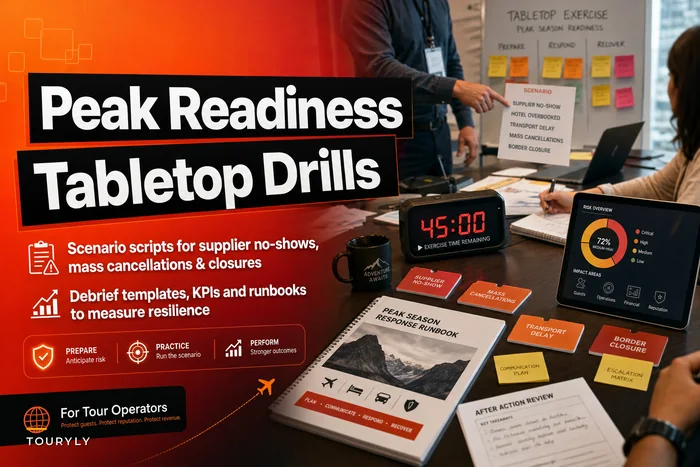
Every runbook should name an owner, list its trigger condition, and end with a logging step. The logging matters more than it looks — it's what turns a one-off scrape into data you can actually act on. This kind of tiered, pre-authorized response connects naturally to broader disruption planning, and if you've already built tabletop exercises and failure-mode drills, your runbooks are the scripts those drills should be testing.
The runbook steps form a simple workflow you can visualize:
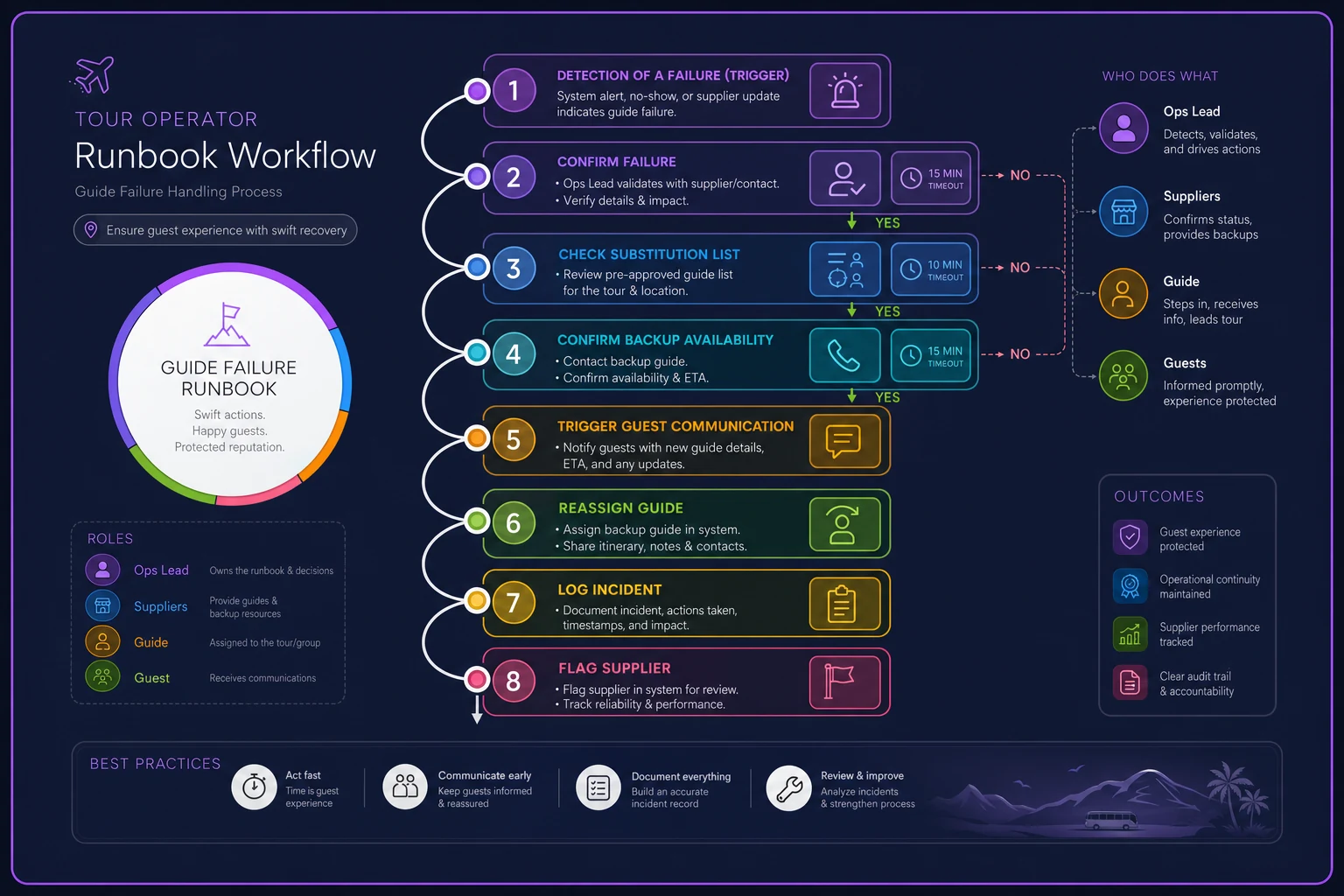
The logging matters more than it looks — it's what turns a one-off scramble into data you can actually act on. This kind of tiered, pre-authorized response connects naturally to broader disruption planning.
Where the software layer quietly earns its keep
You can run all of this on spreadsheets and a shared phone — plenty of small operators do, and it works up to a point. The strain shows up when the measurement becomes manual. Someone has to notice the stale supplier feed. Someone has to remember to check which bookings still lack a guide at T-12h. That "someone" is a single point of failure, and they take vacations.
This is where a workflow platform with AI automation stops being a nice-to-have. The value isn't flashy — it's that the boring, continuous watching happens without a human remembering to do it. The system checks confirmation delivery against your 5-minute SLO on every booking. It watches supplier feed freshness and fires the Tier 2 alert at 60 minutes stale. It scans the departure board and flags the booking that's missing a guide before it becomes a 6am emergency. When a Tier 3 condition hits, it can pull the runbook context together — backup guides, guest counts, meeting points — so your on-shift lead spends their time deciding, not gathering.
None of that replaces judgment. It just makes sure the alert reaches a human early enough for judgment to matter.
Connecting daily monitoring to drills and debriefs
Monitoring, drills, and post-incident reviews are the same loop at different speeds. Daily monitoring catches drift. Drills rehearse the response before you need it. Debriefs feed lessons back into your SLOs and runbooks so the next failure is smaller.
Say your supplier same-day reliability SLI has been sliding — 96% down to 92% over ten days, still above your 90% breach line but trending badly. That's a signal, not yet an incident. The right move is to run a tabletop drill using that exact supplier as the scenario: "It's 7am Saturday, this supplier just no-showed on a 14-person group. Go." Walk your team through the runbook in real time. Watch where they hesitate. Time how long each step actually takes.
A quick tabletop drill template
-
- Scenario one sentence, specific, with real numbers (guests, time, supplier).
-
- Trigger what alert would fire in production?
-
- Roles who's on-shift lead, who's coordinator, who plays the angry guest.
-
- Run it execute the runbook out loud, no shortcuts.
-
- Measure total time to guest-communication, time to resolution.
-
- Capture gaps every "wait, who does that?" moment is a runbook fix.
Then the debrief. After any real incident — or a drill that exposed a gap — run a short, blameless review. Blameless matters: if people fear the debrief, they hide the near-misses, and near-misses are your most valuable data. Three questions cover most of it: What did our monitoring catch or miss? Did the runbook hold up? What SLO or alert should change because of this?
That last question is the flywheel. Maybe the debrief reveals your guide check-in SLO of T-60min doesn't give enough time to find backup coverage on weekends, so you push it to T-90min for Saturday departures. Small change, driven by real data, that quietly prevents the next parking-lot failure. This cycle — monitor, drill, debrief, adjust — is what separates operators who get better each season from the ones who just survive it.
A real scenario: mid-size adventure operator, peak-season chaos
Consider an operator running multi-day hiking and rafting trips — around 20–25 departures a day at peak, maybe eight core suppliers, a roster of freelance guides. Before building any of this, their failure pattern was predictable: two or three "surprise" incidents every peak weekend, usually a supplier flake or a guide mix-up discovered too late to fix cleanly. Each one cost them a few hundred dollars in comps and refunds, plus the harder-to-measure damage of a bad review.
They didn't overhaul everything at once. They started by defining SLOs for the two things that hurt most — guide assignment by T-12h and supplier same-day reliability — and wired up alerts for just those. Within the first peak month, the missing-guide alerts caught five or six departures that would have gone out with an unassigned or unconfirmed guide. All fixed the day before instead of the morning of.
Over a full season, weekend surprise incidents dropped from a handful per weekend to closer to one, and the ones that did happen resolved faster because the runbook was already written. The refund-and-comp line went from a genuine budget item to noise. Nothing dramatic — just the gap between "something broke" and "we knew about it" shrinking from hours to minutes. That's the entire game.
When this is worth it — and when it isn't
This kind of structure earns its keep once you've crossed the threshold where no single person can hold the whole operation in their head. If you're running a handful of tours a day and you personally know every booking, formal SLOs are overkill — you are the SLO. Build this when you feel the operation getting away from you, when surprises start outnumbering your ability to catch them early.
Don't try to build all of it at once. Operators who define 30 SLIs on day one end up with dashboards nobody reads. Start with the two or three failures that cost you the most money and the most sleep. Instrument those, write those runbooks, run one drill. Expand only when the first set is running clean.
This is also genuinely the wrong move if your underlying operation isn't defined yet. SLOs measure adherence to a process. If your supplier confirmations and guide assignments are ad hoc — different every time — there's no baseline to measure against. Get the process consistent first. This connects tightly to staffing: reliable guide check-in SLOs assume you actually have coverage to check in, which is a forecast-to-roster staffing problem before it's a monitoring one.
The shift worth making
The operators who survive peak season without burning out aren't the ones who work hardest during the chaos. They're the ones who moved the work earlier — into definitions, thresholds, and runbooks written when nobody was panicking. SRE didn't invent a secret; it just formalized the idea that you should decide what "broken" means before you're staring at it.
Start small. Pick the two failures that hurt most, define what healthy looks like, set the line where you want to be warned, and write down what to do when that line gets crossed. Run one drill before the season hits. That's a foundation you can build on for years — and it's the difference between finding out from your dashboard versus finding out from a guest standing in a parking lot.
Start small. Pick the two failures that hurt most, define what healthy looks like, set the line where you want to be warned, and write down what to do when that line gets crossed. Run one drill before the season hits. That's a foundation you can build on for years — and it's the difference between finding out from your dashboard versus finding out from a guest standing in a parking lot.
Ready to elevate your travel business?
Join 500+ travel operators using Touryly to optimize bookings, improve client satisfaction, and grow revenue.