

Running tours means constantly juggling feast and famine. March might need 3 guides while July needs 14. Your receptionist handles everything fine in winter, then drowns during school holidays. And somehow, despite all the planning, you're still scrambling for coverage when someone calls in sick at peak season.
Most tour operators approach staffing rostering backwards. They hire for average demand, scramble during peaks, and hope nothing breaks. Then wonder why their best guides burn out, why quality drops during busy periods, and why labor costs keep creeping up even when bookings stay flat.
The operators who get this right treat staffing as a connected system, not a collection of individual shifts. They build coverage models that flex with demand, create clear escalation paths when things get tight, and know exactly who does what when everything hits at once.
Why traditional rostering breaks for tour businesses
Tour operations have staffing patterns that standard scheduling software simply wasn't built for. A wine tour company might run 2 tours daily in winter, then suddenly need to coordinate 8 simultaneous Saturday departures in summer. Adventure operators deal with weather windows that can shift an entire week's schedule with 24 hours notice.
The complexity compounds fast. You're not just scheduling bodies — you're matching certifications, language skills, local knowledge, and personality types to different products. Your German-speaking wilderness guide can't cover the food tour. Your charismatic city guide doesn't have the dive certification for coastal trips.
Then there's the operational reality of the work itself. Guides don't just show up and lead tours. They prep equipment, brief groups, handle on-trip issues, complete post-tour admin, and coordinate handoffs. A "4-hour tour" might need 6 hours of actual staff coverage. Miss this in your rostering and you'll have guides rushing between back-to-back trips with no reset time.
Small operators usually patch this together with spreadsheets and group chats. Works fine when you're running 20 tours a month with 3 guides. Falls apart completely when you're juggling 150 tours with 12 guides, 4 office staff, and seasonal contractors.
The forecast-to-roster framework that actually works
The tour operators who maintain quality while scaling share a similar approach. They work backwards from demand forecasts to build coverage models — not forward from available staff.
Never miss a booking or update.
Touryly streamlines your travel bookings, confirmations, and itinerary updates—all in one place.
- Unified booking management
- Automated customer notifications
- Itinerary & staff coordination
No credit card required
Start with a proper demand forecast broken down by product line. Not just "busy in summer" but actual numbers:
-
Wine tours
4 daily in July, 2 on weekends in May
-
City walks
3 morning + 2 afternoon peak season, 1 daily off-season
-
Adventure trips
Weather-dependent, average 5 per week in summer
Then map the actual work required for each product. A half-day kayak tour might look like:
-
Guide arrives 45 minutes early for equipment prep
-
15-minute safety briefing
-
3-hour on-water time
-
30-minute equipment cleanup and storage
-
20-minute trip report and incident documentation
That's 5 hours of coverage for a "3-hour tour." Multiply that across your product mix and you get real staffing requirements, not wishful thinking.
Build your minimum coverage rules around this reality. Every tour type needs a baseline:
-
Solo guide products
1 qualified lead + on-call backup
-
Group tours under 20
1 lead guide + 1 assistant
-
Adventure activities
Lead guide + safety support + shore coordinator
-
Multi-day trips
2 guides minimum for group management
These aren't suggestions — they're operational requirements. When demand spikes, you scale from this baseline rather than scramble to meet it.
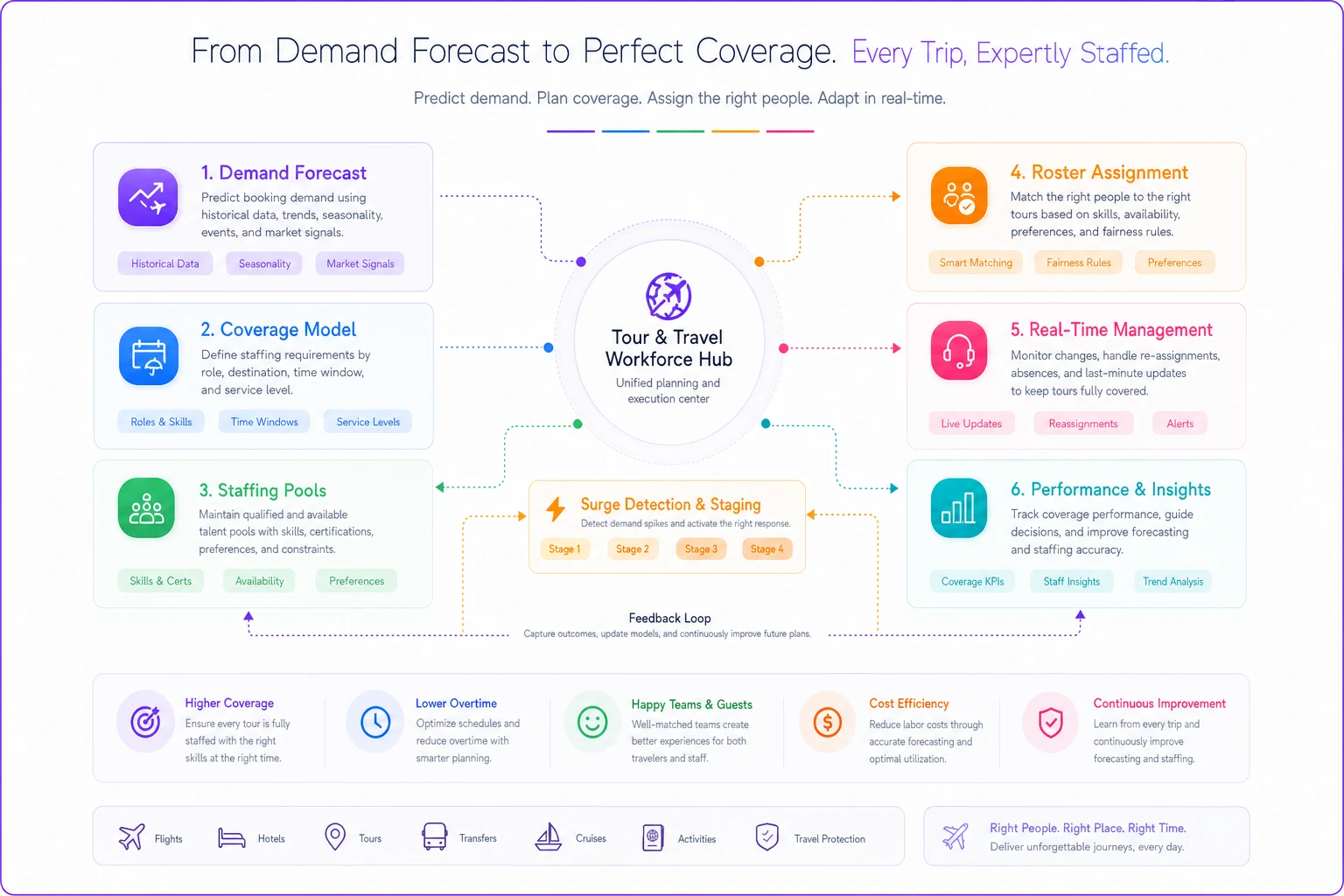
This workflow illustration shows how forecasts map to baseline coverage, surge runbooks, and final roster assignments.
Building surge capacity without destroying margins
Peak periods will always test your staffing. The difference is whether you have a system for handling surges or just throw people at the problem.
Smart operators build surge runbooks that trigger at specific thresholds. When bookings hit 70% of normal capacity, Stage 1 activates: extend hours for current staff who want overtime. At 85%, Stage 2: bring in your trained casual pool. At 100%, Stage 3: partner operators provide overflow coverage through reciprocal agreements.
Stage 1 - Extended Coverage (70% capacity)
-
Offer overtime to permanent guides (1.5x rate)
-
Shift office staff to guide support roles
-
Extend booking desk hours
-
Pre-position equipment for quick turnarounds
Stage 2 - Casual Activation (85% capacity)
-
Contact casual guide pool 72 hours out
-
Confirm availability and schedule
-
Assign shadow shifts for rusty returners
-
Double-check certifications still current
Stage 3 - Overflow Protocols (100% capacity)
-
Activate partner operator agreements
-
Refer overflow to specific partners
-
Maintain quality standards through shared training
-
Track referred bookings for commission splits
Each stage has specific triggers, actions, and approval levels. No deliberating whether to call in extra help — the system decides based on actual demand.
Keep a clear activation window (e.g., 72/48/24 hours) for each surge stage so contract and casual activations happen smoothly.
Each stage has specific triggers, actions, and approval levels. No deliberating whether to call in extra help — the system decides based on actual demand.
The RACI matrix that prevents coverage chaos
When multiple people share responsibility for coverage, nobody actually owns it. That's how you end up with three managers all assuming someone else confirmed tomorrow's guide roster.
A RACI matrix (Responsible, Accountable, Consulted, Informed) clarifies exactly who handles what in your staffing process. Not the most exciting thing to build, but it stops the finger-pointing when coverage gaps appear.
For tour operator staffing rostering, it typically breaks down like this:
| Task | Operations Manager | Tour Coordinator | Lead Guide | Admin |
|---|---|---|---|---|
| Demand forecasting | A | R | C | I |
| Roster creation | A | R | C | I |
| Shift assignments | C | R | I | I |
| Sick coverage | I | R | R | C |
| Skills verification | C | I | R | R |
| Overtime approval | A | C | I | R |
| Casual activation | A | R | I | C |
The value here is clarity. Tour coordinator owns creating rosters but operations manager approves them. Lead guides handle skills verification but admin tracks certifications. When someone calls in sick, the coordinator finds coverage while lead guides handle same-day adjustments.
This feels like bureaucracy until you're juggling 8 Saturday morning departures and a guide texts at 6 AM that they're sick. With clear RACI assignments, coverage gets sorted in minutes instead of an hour of confused phone calls.
Shift templates that scale from 3 to 30 guides
Small operators and mid-sized companies need completely different rostering approaches. What works with 3 guides breaks with 10.
Small operator model (3-8 staff):
Everyone does everything. Guides handle bookings. The office manager might lead tours during peaks. The owner fills gaps wherever needed.
Sample week for a small wine tour operator:
-
Monday-Tuesday
1 guide + owner covering office
-
Wednesday-Friday
2 guides running tours, admin remote
-
Saturday-Sunday
All hands — 3 guides + owner + contracted help
Cross-training is the key here. Every person needs 2-3 capabilities. Your guide can process bookings. Your admin can assist tours. Build coverage through flexibility, not specialization.
Mid-sized operator model (12-30 staff):
Specialization becomes necessary. Guides guide. Office handles bookings. Coordinators manage logistics. But you need systematic coverage for each function.
Sample peak Saturday for mid-sized adventure operator:
-
6 AM
2 equipment coordinators prep gear
-
7 AM
4 morning guides arrive, brief groups
-
8 AM
Morning tours depart, 2 afternoon guides prep
-
12 PM
Morning tours return, quick turnaround
-
1 PM
Afternoon tours depart
-
2 PM
Float guide covers any issues
-
5 PM
All tours back, equipment reset
-
6 PM
Admin processes paperwork, confirms tomorrow
Notice the overlap periods and float coverage. When you're running multiple simultaneous tours, you need buffers — someone to handle the delayed group, the equipment failure, the late-notice sick guide. Build these buffers into templates from the start, not as emergency additions.
Automated scheduling that reduces manual coordination
The typical tour operator spends somewhere between 8 and 12 hours weekly just managing schedules. Texting guides about shifts. Updating spreadsheets. Confirming coverage. Handling swap requests. Chasing down availability for next month.
This manual coordination starts breaking down somewhere around 60-80 tours monthly. Too much complexity for one person to hold in their head, too many moving parts for basic spreadsheets.
Modern operations software handles the repetitive parts. Set your rules once — minimum coverage levels, skill requirements, maximum consecutive days, mandatory rest periods — and the system builds compliant rosters automatically, flags conflicts, and suggests solutions for gaps.
The real value comes from connecting scheduling to other operations. When a tour books, the system checks guide availability and skills automatically. When weather forces cancellations, it notifies affected guides immediately. When someone calls in sick, it surfaces qualified replacements based on certifications, availability, and proximity.
This isn't about replacing human judgment. It's about freeing managers from schedule tetris so they can focus on quality and training. Let automation handle the basic matching while you handle decisions about who works best with which groups.
Preventing cascade failures during peak periods
Peak season failures rarely stay contained. One missing guide affects three tours. Three delayed tours creates six unhappy groups. Six complaints flood your reviews. That tanks next season's bookings.
The operators who survive peak seasons design cascade prevention in from the start. They know which failures ripple and build around them.
Single point dependencies: Only one person knows the river route. Only one guide speaks Mandarin. Only one staff member can process refunds. When that person is unavailable, multiple operations stop.
Sequential scheduling: Guide A finishes Tour 1 at 2 PM and needs to start Tour 2 at 2:30 PM across town. Any delay in Tour 1 automatically delays Tour 2. Assign sequential tours to the same guide and you're building problems in from the start.
Shared resource conflicts: Three tours all need the van at 9 AM. Two groups booked the "premium" equipment. The good bikes are still out with the morning tour when afternoon guests arrive.
Smart operators map these dependencies explicitly. They know Tour A affects Tour B affects Tour C. They build buffers between sequential assignments, maintain backup equipment for conflicts, and cross-train multiple people for critical functions.
When building peak season rosters, assume a 20% failure rate. If you need 10 guides Saturday, roster 12. If tours end at 2 PM and start at 3 PM, build 90-minute buffers. Plan for problems and they become manageable. Assume everything works perfectly and small hiccups turn into major failures.
The documentation that makes handoffs seamless
Every tour operator has experienced the chaos of incomplete handoffs. The morning guide forgot to mention the equipment issue. The coordinator didn't flag the group's dietary requirements. The afternoon shift doesn't know about the morning's incident.
This gets exponentially worse during peak periods when you're running multiple simultaneous tours with different guides, support staff, and coordinators. Information falls through cracks, problems compound, and service quality drops.
Build standard handoff documentation into your roster system:
Pre-shift briefing template:
-
Group composition and special needs
-
Equipment status and location
-
Weather/condition updates
-
Previous shift notes
-
Confirmation of certifications/requirements
Post-shift debrief template:
-
Actual vs planned timing
-
Incidents or near-misses
-
Equipment issues
-
Customer feedback
-
Recommendations for future tours
Shift change protocols:
-
Overlap period minimum 15 minutes
-
Face-to-face or video handoff required
-
Written notes in shared system
-
Confirmation of receipt
-
Escalation path for urgent issues
The trick is making documentation easy enough that tired guides actually complete it. Mobile-friendly forms, voice-to-text options, pre-populated templates. The easier you make compliance, the more consistent your information flow.
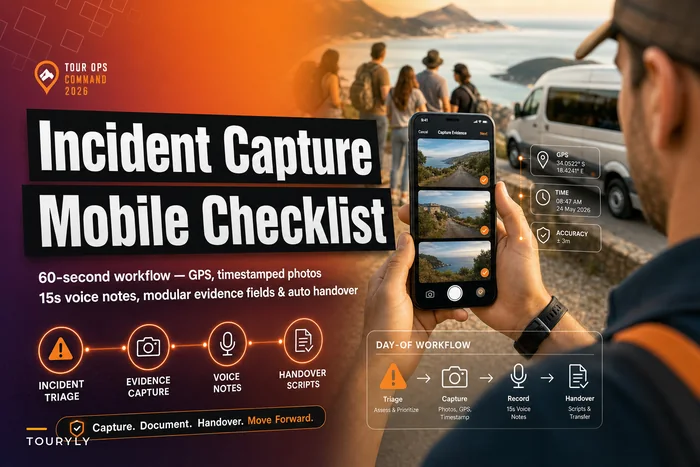
This connects directly to your day-of mobile checklists for guides for handling incidents and evidence capture. When guides have clear documentation requirements built into the workflow, problems get caught early instead of blindsiding the next shift.
Managing seasonal contractors without quality drops
Most tour operators rely on seasonal contractors during peaks — university students for summer, ski instructors doing tours between winter seasons, retired teachers covering school holidays. These contractors can provide excellent surge capacity, if they're managed properly.
The typical mistake is treating contractors like temporary versions of permanent staff. Throw them into full duties immediately. Expect them to know your systems. Hope they maintain standards. Then wonder why quality drops every peak season.
A better approach builds a contractor integration system that maintains standards while being realistic about their temporary status.
Contractor capability tiers:
Tier 1 - Support only (Week 1-2)
-
Shadow experienced guides
-
Handle equipment and logistics
-
Assist with groups but don't lead
-
Learn routes and procedures
Tier 2 - Simple tours (Week 3-4)
-
Lead basic/standard tours
-
Work with supervision nearby
-
Handle normal situations independently
-
Escalate anything unusual
Tier 3 - Full duties (Week 5+)
-
Lead all tour types they're qualified for
-
Handle complex situations independently
-
Train other contractors
-
Cover for permanent staff
This progression protects quality while building capability. New contractors don't get thrown into complex situations before they're ready. Experienced contractors earn more responsibility over time. Everyone knows what level they're at and what's expected.
Track contractor performance consistently — not for punishment but for next season's planning. Which contractors progressed quickly? Who struggled with what? What additional training would actually help? That institutional memory about your seasonal workforce is worth more than most operators realize.
Real scenario: From scheduling chaos to systematic coverage
Here's how this played out for a Pacific Northwest adventure tour company running kayak, hiking, and wildlife tours. They had 4 full-time guides, brought in 6-8 seasonal contractors each summer, and were consistently scrambling during July-August peaks.
Their original "system" was a shared Google Sheet with everyone's availability, updated whenever someone remembered. The owner would text guides about shifts, usually last-minute. No clear backup plans, no documentation about who could lead which tours, regular double-bookings and coverage gaps.
They built a proper forecast-to-roster system over one winter.
First, they mapped actual demand patterns from previous seasons and discovered their "random" busy periods actually followed predictable patterns — cruise ship schedules, local festival dates, long weekend surges.
They built minimum coverage rules for each tour type. Kayaking needed 1 guide per 6 guests plus a shore coordinator for groups over 12. Hiking could run 1:10 ratios for easy trails but needed 1:6 for technical routes. Wildlife tours required specialized certifications.
They created a RACI matrix. Operations manager owned forecasting and roster approval. Lead guide managed day-of adjustments. Admin tracked certifications and processed schedules. Everyone knew their role.
They developed surge runbooks with three escalation stages. Stage 1 kicked in automatically when bookings hit 70% capacity two weeks out. Stage 2 at 85% triggered casual guide activation. Stage 3 brought in partner operators for overflow.
After one peak season: no coverage gaps despite running roughly 35% more tours than the previous year. Guest satisfaction scores climbed to 4.8/5 average. Guide overtime dropped by around 40% because scheduling became predictable. They knew a week in advance who was working when, instead of scrambling daily.
Most importantly, the operation became systematically reliable. New contractors could slot in easily because processes were documented. Guides could take actual days off because coverage was planned. The owner stopped spending evenings frantically texting about tomorrow's shifts.
Technology and staffing rostering for modern tour operators
The gap between spreadsheet chaos and enterprise scheduling software is finally getting filled for tour operators specifically. You don't need airline-level systems, but you do need more than Google Sheets once you're past roughly 10 staff.
Modern operations platforms built for tour businesses handle the unique requirements — certifications, skill matching, equipment assignments, weather dependencies. They connect scheduling to bookings so coverage adjusts automatically with demand. They track guide hours to prevent burnout and flag compliance issues before they become problems.
The automation helps most with routine coordination. Instead of manually texting each guide about shifts, the system sends notifications. Rather than checking certifications across separate spreadsheets, it flags expiring qualifications automatically. When someone calls in sick, it surfaces who's qualified and available to cover.
Operational software also gives visibility into staffing patterns most operators never bother to track. Which guides consistently get positive mentions? Which tour combinations create the most overtime? Where are you over-staffing versus under-staffing? That data helps optimize both costs and quality in ways gut instinct just can't match.
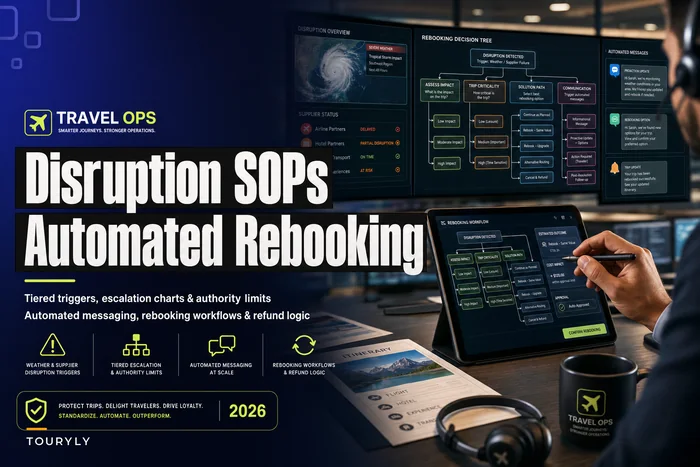
The key is choosing a platform built for tour operations, not generic workforce management. You need something that understands tours aren't shifts, guides aren't interchangeable, and weather changes everything. It's also worth having solid tiered disruption SOPs for weather and supplier failures ready to go alongside your rostering system — because even the best schedule falls apart when something unexpected hits mid-peak.
Building lasting coverage systems
Peak season will always test your staffing rostering. The operators who maintain quality while scaling treat coverage as a connected system — from forecasting through scheduling to handoffs.
Start with accurate demand forecasting by product line. Build minimum coverage rules that reflect actual operational needs. Create surge runbooks that trigger at specific thresholds. Use RACI matrices to clarify exactly who owns what. Develop shift templates that match your scale. Document everything so information doesn't disappear between shifts.
Good staffing rostering isn't about having enough bodies — it's about having the right capabilities in the right place at the right time. That requires systems, not heroics. When your coverage model runs on clear processes instead of last-minute scrambling, peak seasons become predictable revenue opportunities rather than operational nightmares.
The tour operators thriving through demand surges aren't necessarily bigger or better funded. They've built systematic approaches to staffing that flex with demand while maintaining standards. They plan for problems, build in buffers, and document everything. They treat staffing rostering as a critical operational function, not an administrative afterthought.
Your next peak season is coming whether you're ready or not. The question is whether you'll meet it with clear coverage systems or the usual chaos.
Ready to elevate your travel business?
Join 500+ travel operators using Touryly to optimize bookings, improve client satisfaction, and grow revenue.