


Three years ago, a mid-sized tour operator in Miami lost $47,000 in a single weekend. Not from cancellations — from handling cancellations badly.
They had 280 clients booked across Caribbean cruises when Hurricane Ida shifted course. Their operations manager spent 19 hours straight on the phone, manually calling each client, negotiating with suppliers, calculating refunds on spreadsheets. Different clients got different information. Some got full refunds while others in identical situations got credits. Two groups showed up at the dock anyway because nobody told them their trip was canceled.
Their competitor down the street handled twice as many disrupted bookings with half the staff. The difference wasn't experience or headcount. It was having clear contingency workflows their team could actually execute under pressure — not improvise under panic.
The disruption severity framework that changes everything
Most operators treat all disruptions the same: panic mode. But weather events and supplier failures follow predictable enough patterns that you can map them into operational tiers.
A Tier 1 disruption affects less than 20% of a departure. Afternoon thunderstorms delaying a city tour by two hours. A restaurant closing for lunch service. These need acknowledgment, not intervention. A simple automated message saying "We're monitoring the situation" prevents the majority of inbound calls before they happen.
Tier 2 hits 20-50% of the experience. Maybe the morning activity gets canceled but afternoon proceeds. Your primary hotel loses power but the backup has availability. This triggers decision trees — clients need options, not just notifications.
Tier 3 means more than half the trip experience changes substantially. The whale watching boat breaks down. The destination airport closes for 24 hours. Now you're in full contingency mode with specific rebooking priorities and compensation formulas.
Tier 4 is complete cancellation. The volcano erupts. The tour company goes bankrupt overnight. Every client needs individual attention, but still within a structured framework — not a free-for-all.
What makes this work operationally is linking each tier to specific action triggers. A weather forecast showing 70% chance of disruption 48 hours out automatically shifts bookings into Tier 2 monitoring. Supplier non-response for 6 hours escalates to Tier 3. You're not making subjective judgment calls in the moment — the framework decides for you.
Weather disruption protocols that actually scale
Weather follows patterns. Hurricanes give you 3-7 days warning. Snowstorms give you 24-48 hours. Thunderstorms might give you 2-4 hours. Each timeline needs a different operational response.
Never miss a booking or update.
Touryly streamlines your travel bookings, confirmations, and itinerary updates—all in one place.
- Unified booking management
- Automated customer notifications
- Itinerary & staff coordination
No credit card required
For 7-day weather warnings, your first move isn't customer communication — it's supplier coordination. Lock in alternative dates before announcing anything. Get written confirmation of waived change fees. Secure backup inventory at comparable properties. Only then do you trigger client messaging.
The 72-hour mark is when you shift from monitoring to active management. Run your rebooking prioritization: highest-margin bookings get first choice of alternatives, groups before individuals, direct bookings before agency bookings. Uncomfortable? A little. But trying to be "fair" to everyone in a chaotic rebooking window usually means disappointing everyone equally.
At 48 hours, open self-service rebooking. Clients can choose from pre-selected alternatives without calling anyone. One operator running trips out of Orlando found that about 65% of clients self-rebooked when given three clear options, versus around 12% when told to "call to discuss alternatives." That's not a small gap.
The 24-hour protocol is pure execution. Stop taking new bookings for affected dates. Calculate preliminary refunds. Generate voucher codes. Prepare driver manifests for alternative routings. Document everything now — not after — for insurance claims.
Day-of disruptions are different. Your guides need clear authority limits on what they can offer without calling headquarters. Usually that means meal vouchers up to $30 per person, taxi reimbursement up to $100 per group, or activity substitutions within 20% of original cost. Anything beyond that triggers escalation. Keep it simple enough that a guide can remember it without looking it up.
For 72-hour warnings, run rebooking prioritization automatically so staff can contact only the highest-priority bookings.
Here's a quick visual to make the workflow clear.
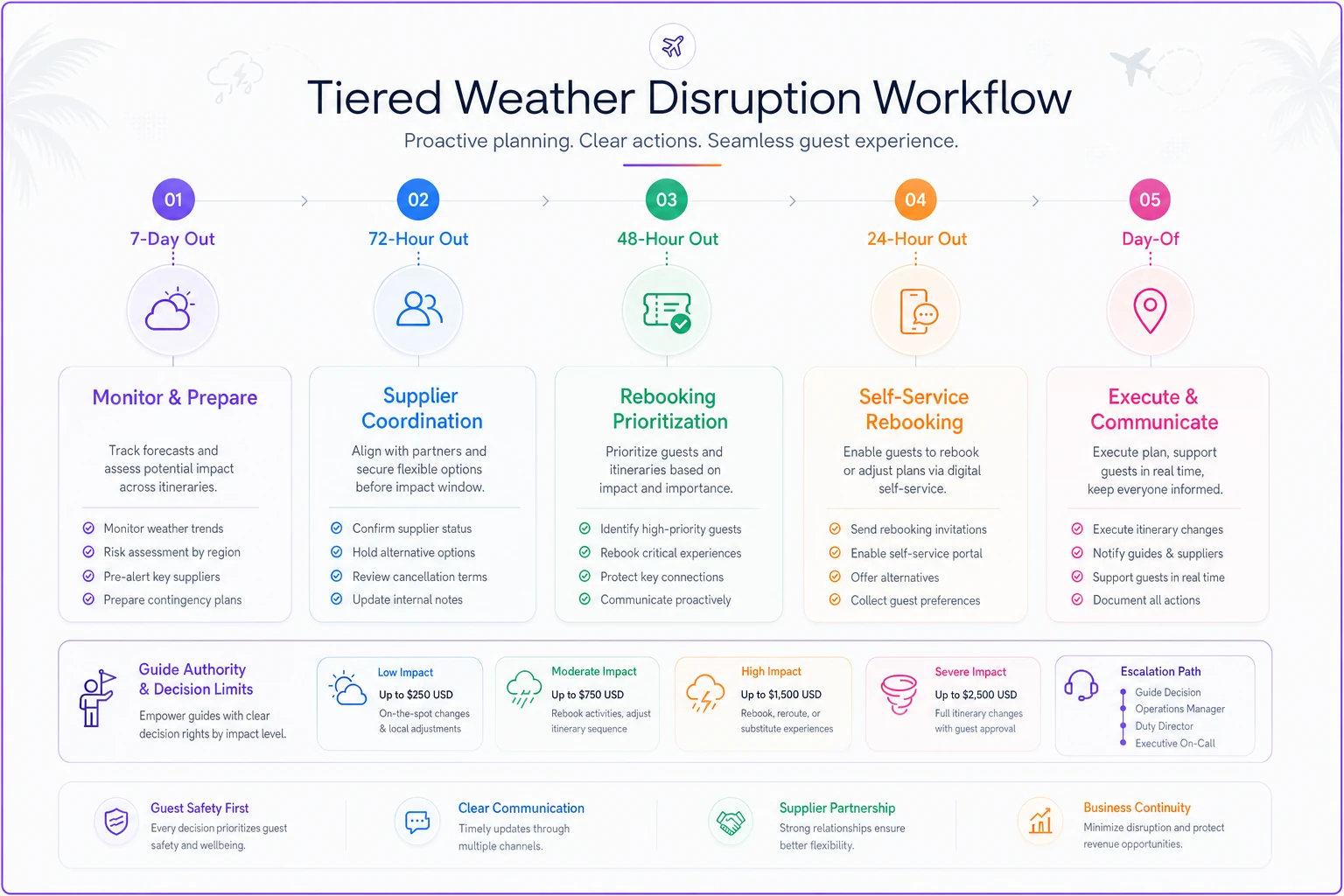
Automate monitoring and supplier coordination early, then shift to client-facing actions as the timeline tightens.
Supplier failure: the predictable emergency nobody plans for
Supplier failures seem random until you've tracked enough of them. The tour boat operator who suddenly has "engine problems" the third Saturday of every month. The restaurant that's "closed for renovation" whenever occupancy drops below 40%. The transportation company that goes silent 18 hours before pickup.
Each failure type needs different contingency workflows operators can activate immediately.
For transportation failures, maintain a three-tier backup. Primary alternative (usually 20-30% more expensive), emergency alternative (50-100% premium), and a partial solution for splitting groups across multiple vehicles. Know your break-even point — sometimes absorbing a $500 loss on upgraded transportation saves a $5,000 trip and a client relationship.
Accommodation failures are time-sensitive in a different way. A hotel overbooking at 2pm requires a different response than one at 11pm. Afternoon protocol: secure comparable alternatives within a 10-minute drive, arrange transportation, offer a small gesture of compensation. Late-night protocol: find any available inventory first, worry about comparability in the morning, plan to relocate clients properly once the sun's up.
Activity failures are where decision trees earn their keep. Can you shift timing? Swap in a similar experience? Partially deliver with a credit? Or go straight to refund plus future voucher? The decision tree should account for: time until departure, availability of alternatives, client segment, and whether this client has already dealt with issues on this trip.
Message automation that doesn't sound like robots
The most common mistake in disruption messaging is over-communicating. Clients don't need hourly updates saying "we're still monitoring." They need clear information at actual decision points.
Your Tier 1 message goes out once: "We're aware of [specific issue]. Your trip operates as planned with minor adjustments we'll handle on-site. No action needed from you."
Tier 2 triggers three messages. First: "We're tracking [issue] that may affect [specific component]. You have options — no action needed yet." Second, 24 hours later: "Here are your options: [A/B/C]. Choose by [deadline] or we'll automatically apply Option A." Third: confirmation of whatever they chose, or the default action taken.
Tier 3 requires a personal touch but still within templates. Something like: "Hi [Name], the flooding in [destination] affects your [specific bookings] on [dates]. We've secured [alternative] which provides [key similarities to original]. Your price remains unchanged. Reply 'YES' to confirm or call for other options."
Tier 4 needs voice first, then written confirmation. Even emergency calls follow a script: acknowledge the situation, present the immediate solution, explain compensation, set follow-up timeline.
The variable insertion matters more than people think. Not: "Dear valued customer, your booking #12345 is affected." Instead: "Hi Sarah, I know you've been planning this anniversary trip to Santorini for months. The ferry strike affects your Tuesday transfer, but we've arranged a private speedboat that actually gets you there 90 minutes earlier."
Same information. Completely different client experience.
The rebooking matrix that eliminates guesswork
Rebooking isn't about finding any alternative — it's about matching client priorities to available inventory systematically. Build your matrix around four factors:
-
Price sensitivity scoring
Track who paid full rate versus early-bird discounts. Who upgraded versus who picked the basic option. This indicates how flexible they'll be about alternatives.
-
Experience priorities
Some clients book for a specific experience (Northern Lights), others for a destination (anywhere in Iceland), others for specific dates (must be spring break week). Your rebooking offers should match their original priority, not yours.
-
Lifetime value tiers
A first-time booker gets standard alternatives. Someone on their fifth trip gets premium options at standard prices. Your top clients get whatever it takes.
-
Operational cost of alternatives
Sometimes upgrading everyone to business class costs less than dealing with chargebacks, complaints, and reputation damage. Calculate total cost including staff time, not just the hard number.
Here's what this looks like in practice. Hurricane cancels Jamaica trips. Your matrix automatically segments:
-
Price-sensitive repeat clients
Offer Dominican Republic same dates (30% cheaper destination)
-
Experience-focused new clients
Offer Jamaica rebook with 15% credit
-
Date-rigid groups
Offer Turks & Caicos same week (comparable experience)
-
VIP clients
Personal call with three curated options
Use the matrix to automate suggestions, then have staff confirm before finalizing bookings.
Escalation paths that protect margins and relationships
Escalation isn't about passing problems up the chain — it's about matching the right level of experience and authority to the situation.
Level 1 handles all Tier 1-2 disruptions using decision trees. They can offer rebooking to published alternatives, credits up to 10% of booking value, or future travel vouchers. Response time: immediate to 2 hours.
Level 2 manages Tier 3 disruptions and unsatisfied Tier 2 resolutions. They can approve upgrades at company cost, refunds beyond standard policy, or custom alternatives. Response time: 2-4 hours during business hours, 12 hours overnight.
Level 3 handles Tier 4 events and anything that could become a public reputation issue. Authority includes full refunds regardless of policy, compensation beyond booking value, or competitor buyouts to keep a relationship intact. Response time: 30 minutes, any hour.
The escalation trigger points matter more than the levels themselves. Three declined alternatives triggers Level 2 automatically. A social media complaint gaining real traction triggers Level 3. A government travel advisory triggers automatic Level 3 for all affected bookings. A media inquiry triggers Level 3 plus legal review immediately.
Compensation formulas that clients actually accept
Arbitrary compensation creates more problems than the original disruption. Use formulas tied to measurable impact.
| Category | Formula |
|---|---|
| Time delays | First 2 hours = no compensation |
| Time delays | Hours 3-4 = $25 per person credit |
| Time delays | Hours 5-8 = $50 per person |
| Time delays | Beyond 8 hours = 10% of that day's allocated tour cost |
| Experience downgrades | Comparable alternative = no compensation |
| Experience downgrades | Minor downgrade (4-star to 3.5-star) = 10% credit |
| Experience downgrades | Major downgrade (promised experience unavailable) = 25% refund of affected component |
| Experience downgrades | Complete failure to deliver = full refund of component plus 20% future credit |
| Itinerary changes | Single activity swap at similar value = no compensation |
| Itinerary changes | Multiple changes = 5% per changed component, maximum 20% |
| Itinerary changes | Destination change = 15% credit minimum, negotiable based on comparability |
| Complete cancellations | Outside control (weather, government) = full refund or future credit plus 10% |
| Complete cancellations | Supplier failure = full refund plus 15% credit |
| Complete cancellations | Operational failure = full refund plus 25% credit |
Apply these formulas consistently and document the calculation for each client.
The documentation trail that prevents disputes
Every disruption becomes a potential chargeback or legal claim six months later. Your documentation needs to tell the complete story without anyone needing to interpret it.
Start with trigger documentation. Screenshot weather advisories with timestamps. Save supplier communications with headers showing date and time. Record government notices with URL and access date. This establishes the "why" behind every decision.
Track decision points chronologically. Your log should read like: "14:47 — Weather service upgrades to hurricane warning. 14:52 — Tier 4 protocols activated by Operations Manager. 15:15 — First client notifications sent." This protects your staff from hindsight criticism later.
Document client choices explicitly — not just what they chose, but what they declined. "Client offered: A) Full refund, B) Rebook same trip in October, C) Alternative destination same dates. Client selected B on [date/time] via email confirmation." That kills the "you never gave me options" dispute before it starts.
For verbal communications, every phone call gets a follow-up email within the hour: "Per our call at 2pm, you confirmed accepting the sunrise boat tour instead of sunset, with a $30 per person meal credit as discussed."
Automation that supports people, not the other way around
The best contingency workflows combine automation efficiency with human judgment. You're not replacing people — you're freeing them to handle what actually requires a human.
Automated monitoring runs continuously. Weather API triggers, supplier response tracking, booking pattern anomalies — all happening in the background. When thresholds hit, your team gets alerts, not surprises.
Automated messaging handles initial communications. Your system sends tier-appropriate messages, but humans write them and can override before anything goes out. Clients get timely information; your staff aren't typing the same message 50 times during a crisis.
Automated rebooking surfaces options based on your matrix, but humans confirm before anything processes. The system might flag three alternatives — your team decides whether that pottery class really substitutes for snorkeling.
Automated documentation captures everything with timestamps, but staff add context. The system logs the action; your team notes "Client initially upset but satisfied after we explained the yacht upgrade included a sunset cocktail hour."
Operators running large volumes of disrupted bookings consistently find the same thing: the ones who maintain client relationships aren't those with the most sophisticated systems. They're the ones where systems free staff to actually listen and solve problems creatively. When your team isn't scrambling to find a hotel's phone number or calculate refunds manually, they can focus on the client in front of them.
The bottom line on disruption readiness
A tour operator in Phoenix recently managed a supplier bankruptcy affecting 400 bookings over three days. Using tiered protocols, automated messaging, and clear escalation paths, they resolved around 85% of cases without a single chargeback. Their previous mass disruption — about 150 bookings over a week — had resulted in 40 disputes and two lost corporate accounts.
The difference wasn't heroic effort. They'd built contingency workflows their team could execute under real pressure. Staff knew exactly what to do. Clients got consistent information and fair, predictable compensation. Documentation prevented disputes from materializing months later.
They also turned the disruption into a referral source. While competitors melted down publicly on social media, they handled each case professionally and gained roughly 20 referrals from clients who were impressed by how it was handled.
The frameworks here aren't theoretical. They come from actual operator experiences across a wide range of disruptions. Weather will always surprise you. Suppliers will always fail at the worst possible moment. But your response doesn't have to be chaos.
Start with severity tiers. Build message templates. Create your rebooking matrix. Document everything from the first trigger. Then layer in automation where it actually multiplies what your team can do.
Your next disruption is coming. The only question is whether your team has a playbook or just a prayer.
Ready to elevate your travel business?
Join 500+ travel operators using Touryly to optimize bookings, improve client satisfaction, and grow revenue.