

Most operators find out their disruption plan doesn't work at the worst possible moment — 6:40am, a coach that never showed, 44 guests in a hotel lobby, and one duty manager trying to call three suppliers while simultaneously fielding WhatsApp messages from a guide who's already losing the room.
The plan existed. It was in a shared drive somewhere. Nobody had ever actually run it under pressure.
That's the gap tabletop exercises fill. A tabletop exercise for a tour operator is a low-stakes rehearsal of a high-stakes failure — you get the people who'd actually respond, drop them into a realistic scenario, and walk through decisions in real time without touching a live booking. No coaches actually cancel. No guests get emailed. But your team finds out, in a conference room, exactly where the plan falls apart.
Written SOPs tell you what should happen. Tabletops tell you what does happen when your reservations lead is on holiday and the backup supplier's number goes to voicemail. Those are very different things.
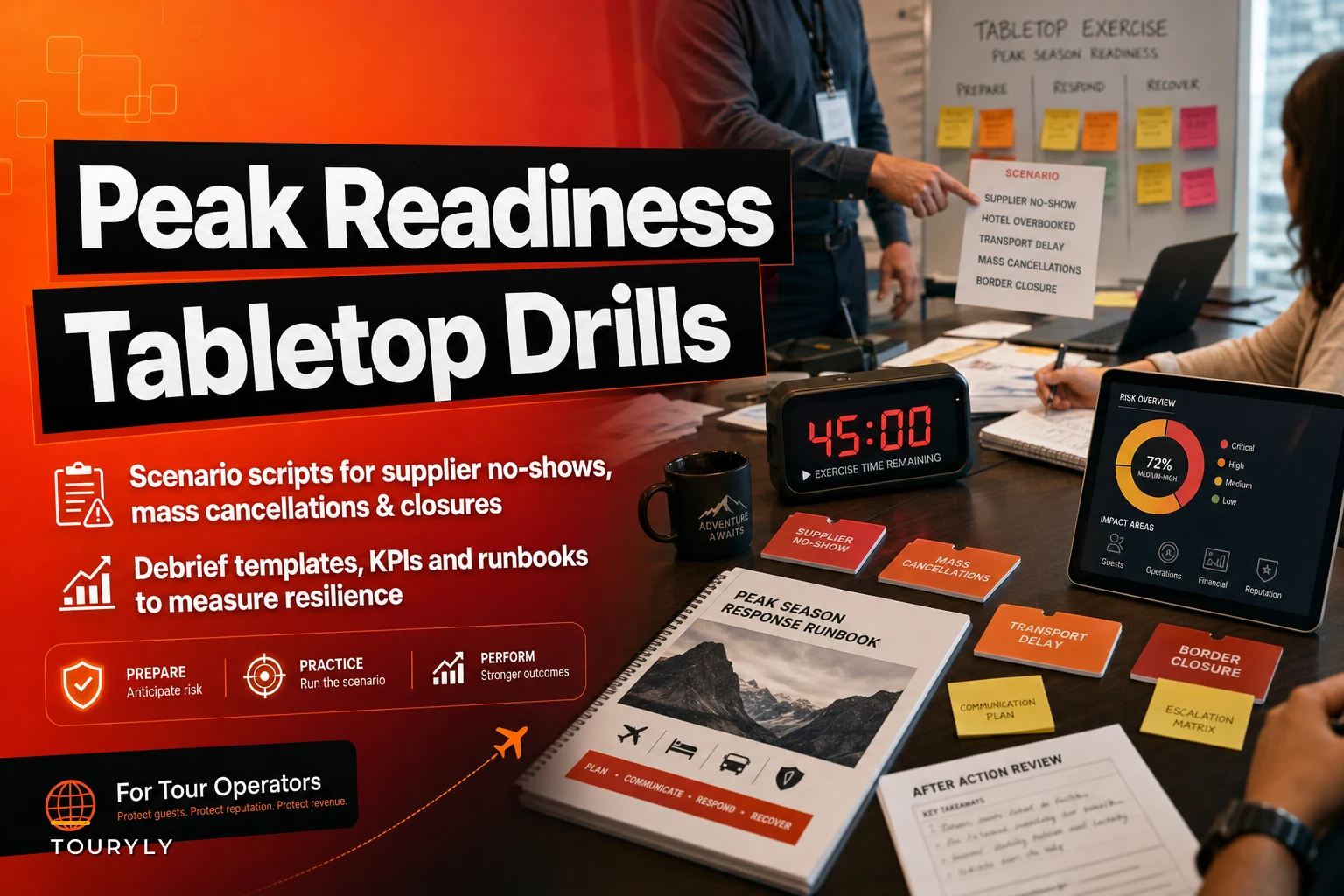
This is a runbook you can actually use: three scenario scripts, the injects that make them realistic, a debrief template, and the KPIs that tell you whether your drills are making the team faster or just making everyone feel like they did something useful.
Why written plans fail and drills don't
The uncomfortable truth about disruption SOPs is that they're usually written by someone calm, at a desk, imagining an orderly version of chaos. Real failures don't arrive orderly. They arrive with incomplete information, a customer already filming, and two decisions that both look wrong. In practice, plans break not because the steps are missing but because:
-
The person who wrote the SOP isn't the person on shift when it triggers
-
The "call the backup supplier" step assumes the backup exists and actually answers
-
Three separate people start solving the same problem and nobody owns the guest-facing message
-
The authority to spend money on a fix sits two levels up and that person is asleep
None of those surface when you read the document. All of them surface in a 40-minute drill. You're not testing whether the plan is well-written — you're testing whether humans under mild stress can actually execute it.
Teams that run drills quarterly don't necessarily have better plans than teams that don't. They have faster decisions. The plan on paper might be identical. But one team has muscle memory for who calls the supplier, who owns comms, and who has spend authority — and the other team is inventing that hierarchy live while guests wait.
The three scenarios worth drilling
You don't need twenty scenarios. You need the handful that cause the most damage and happen often enough to justify practice. For most operators, that's supplier no‑shows, mass cancellations, and authority closures.
Never miss a booking or update.
Touryly streamlines your travel bookings, confirmations, and itinerary updates—all in one place.
- Unified booking management
- Automated customer notifications
- Itinerary & staff coordination
No credit card required
Here's how they differ operationally, because each demands a different response shape:
| Scenario | Trigger speed | Primary pressure | Who leads | Biggest failure point |
|---|---|---|---|---|
| Supplier no‑show | Instant (day-of) | Guests physically stranded | Ops duty manager | No pre-agreed backup, slow spend approval |
| Mass cancellation | Hours to a day | Refund/rebook volume + cash | Reservations lead | Inconsistent messaging, refund panic |
| Authority closure | Minutes to hours | Safety + legal + itinerary rebuild | Senior ops / owner | No decision on who can override an itinerary |
Notice the "who leads" column changes across scenarios. One of the most common drill discoveries is that the same person tries to lead all three, gets overwhelmed, and the whole response stalls. Assigning a clear lead per scenario type is often the single highest-value output of a first drill.
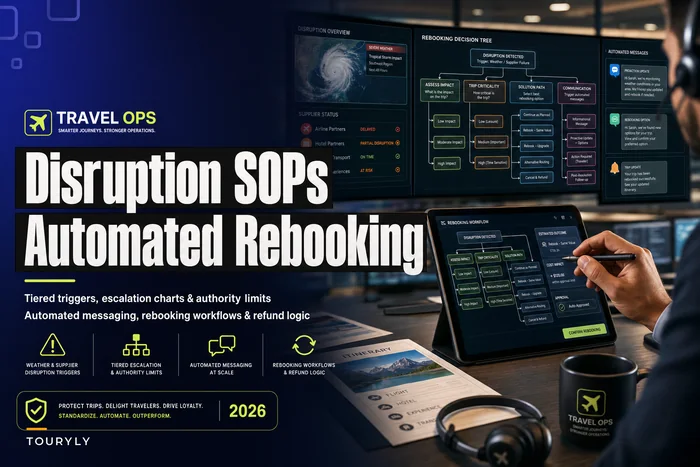
If you've already built tiered response logic — like the kind covered in tiered disruption SOPs for weather and supplier failure — the tabletop is where you stress-test whether those tiers actually trigger the right actions under pressure, rather than just looking neat on a flowchart.
Scenario 1: The supplier no‑show
Setup you read to the room: "It's 6:35am on a Saturday in peak season. Your 07:00 full-day wine tour has 38 confirmed guests meeting at the central pickup point. The coach operator hasn't arrived. Your guide just messaged: 'Where's the bus?' The operator's dispatch line is ringing out. Guests are starting to gather. Go."
Then you feed injects — small pieces of new information dropped in every few minutes to keep it moving:
-
Inject at 4 min
"The supplier answers. Their vehicle broke down 40 minutes away. Earliest replacement is 90 minutes."
-
Inject at 8 min
"One guest is a travel journalist. She mentions she's writing about your operator."
-
Inject at 12 min
"Your backup coach company can send a 30-seater in 25 minutes, but you have 38 guests. Cost is 40% above your original rate."
What you're actually testing:
-
Who takes control of guest communication in the first two minutes?
-
Does anyone know the backup supplier's number without looking it up?
-
Who has authority to approve the 40% cost overrun, and how long does that approval actually take?
-
What's the decision on the 8-seat gap — split the group, source a second vehicle, or delay everyone?
The script for the guest-facing lead (this is what most teams don't have and desperately need):
> "Good morning everyone — I'm [name] from [operator]. Our vehicle has had a mechanical issue and we've already arranged a replacement. It'll be here in about 25 minutes. We're sorry for the delay, and to make up for it we've arranged [coffee vouchers / a stop upgrade]. I'll give you a firm update in ten minutes even if nothing's changed."
That last line — "I'll update you in ten minutes even if nothing's changed" — is probably the single most valuable sentence in disruption comms. It stops the crowd from spiraling because silence is what turns a delay into a complaint.
Scenario 2: Mass cancellations
This one plays out slower but hits cash flow and reputation harder. A typical trigger: a wildfire warning, a transport strike, or a regional advisory that makes 60% of next week's departures unviable.
Setup: "It's Tuesday afternoon. A rail strike has just been confirmed for Friday through Sunday — your three busiest departure days. Roughly 140 guests across 9 tours rely on that rail connection. Bookings are still coming in for the weekend. What do you do in the next hour?"
-
Inject
"One of your affected departures is a private group of 22 who paid in full and non-refundable."
-
Inject
"A partner OTA is asking whether they should keep selling the weekend slots — they need an answer in 20 minutes."
-
Inject
"Two guests have already requested full refunds by email, citing the strike."
The mass-cancellation drill exposes a specific failure: inconsistent messaging under volume. When 140 people need to hear from you, five different staff members improvising five different offers creates a mess that takes weeks to untangle — and often costs more in goodwill refunds than a single clear policy would have.
-
One canonical message, one refund/rebook offer, approved once, sent to everyone
-
A decision on the non-refundable group before they call, not after
-
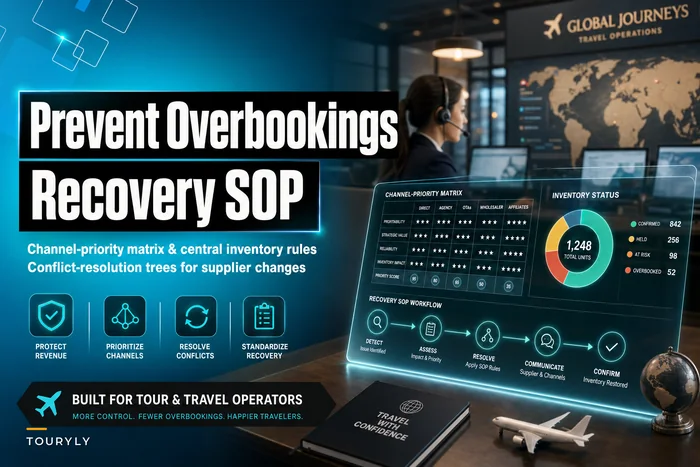
Immediate instruction to the OTA to pause affected weekend inventory (this connects directly to availability control — the same discipline behind a channel-priority matrix and recovery SOP for overbookings)
The debrief question that matters most here: how long between the strike confirmation and the first outbound message to guests? If it's more than 30–45 minutes, guests are getting news from the media before they get it from you, and you've already lost the narrative.
Scenario 3: Authority closures
The rarest of the three, and the one teams handle worst — because it involves safety, legal exposure, and rebuilding an itinerary on the fly, often all at once.
Setup: "A national park announces an emergency closure effective immediately due to a landslide. You have 3 groups currently inside or en route, totaling about 55 guests, and 6 more groups booked over the next four days. Rangers are turning vehicles around at the gate. Go."
Injects:
-
Inject
"One group is already inside and being asked to leave via a longer alternate route, adding 90 minutes."
-
Inject
"A guest with a mobility issue can't manage the alternate exit route on foot."
-
Inject
"Local news is reporting the closure. Your phone lines start ringing with worried family members of guests currently inside."
The authority-closure drill tests the messiest question in tour ops: who is actually allowed to override a booked itinerary and commit to replacement plans? In a lot of small operators, nobody really knows. The guide thinks it's ops, ops thinks it's the owner, and the owner is unreachable. Ninety minutes of paralysis follows.
A drill forces you to write that authority down. Something as simple as: "On safety-driven closures, the on-shift senior ops person can commit up to £X per group on alternate arrangements without further approval" removes the single biggest source of delay.
Running the drill: a workable process
You don't need a facilitator with a clipboard. You need about 45 minutes, the right people, and enough discipline to stop it drifting into a general chat about what's wrong with suppliers.
-
Pick one scenario. Don't stack them. One failure, one drill.
-
Get the actual responders in the room — duty manager, reservations, a guide (or someone playing one), and whoever holds spend authority. If they'd be involved on the day, they're in the room.
-
Read the setup cold. No prep, no pre-warning about which scenario. Real failures don't send calendar invites.
-
Start a clock and feed injects. Every 3–5 minutes, drop in new information. Keep the pressure gentle but constant.
-
Have one person just take notes — specifically noting where the response stalled and why. Not blame, just friction points.
-
Stop at a natural resolution point or at 30 minutes, whichever comes first.
-
Debrief immediately, while it's still fresh.
Keep a laminated card at pickup points with backup supplier numbers and simple guest scripts.
A simple diagram of the drill flow can help new responders understand roles quickly.
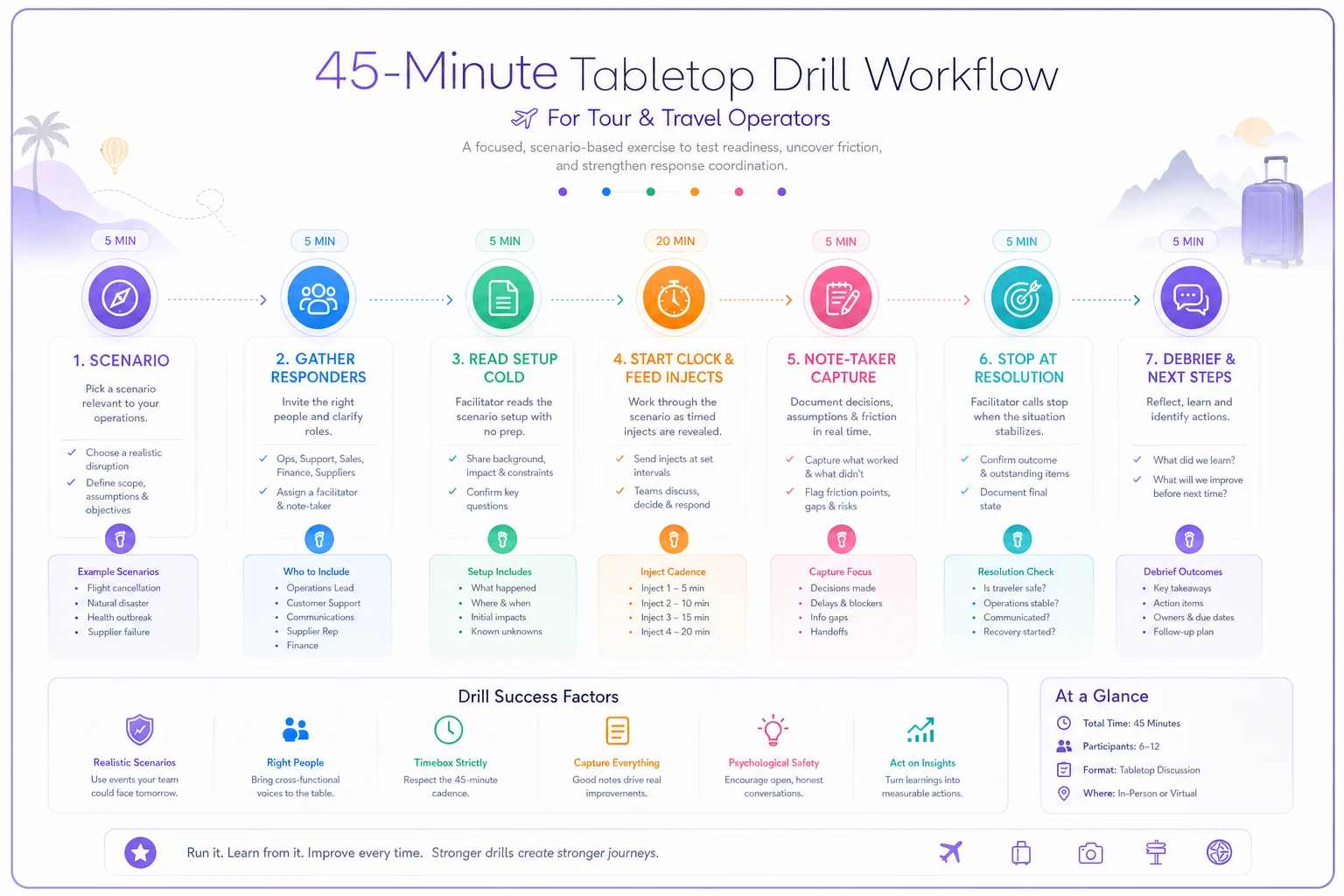
Use the diagram in pre-briefs so everyone knows the expected rhythm and the note-taker's role.
The most common mistake is skipping the note-taker and relying on memory. By the time you debrief, everyone remembers a slightly different version and the real friction points get smoothed over.
The debrief template
The drill is worthless without the debrief. This is where discoveries turn into fixes. Keep it to four questions:
-
What decision took the longest, and why? (This almost always points at an authority or information gap.)
-
Where did we duplicate effort? (Two people calling the same supplier, three people drafting guest messages.)
-
What information did we not have that we needed? (A phone number, a policy, a spend limit.)
-
What one change would make this 20% faster next time? (Force a single concrete action, not a vague "communicate better.")
Then — and this is the part teams skip — assign an owner and a date to each fix. A drill that surfaces ten problems and fixes zero is just an expensive way to feel anxious. One drill, two or three concrete fixes actually shipped, is a good outcome.
KPIs: measuring whether drills are working
You need numbers, otherwise you can't tell whether the second drill was better than the first. Keep the metrics simple and behavioral:
-
Time to first guest-facing message — from trigger to first outbound communication. This is your single best proxy for response health.
-
Time to decision — from trigger to a committed course of action (backup booked, refund policy set, alternate route chosen).
-
Number of stalls — moments where the response paused because nobody knew who owned the next step. This should drop drill over drill.
-
Fixes shipped between drills — did the action items from last time actually get done? If not, the drills aren't compounding.
A realistic progression looks something like this: a first drill where time-to-first-message runs 18–22 minutes and there are four or five stalls. By the third quarterly drill, first-message time is under 8 minutes and stalls are down to one or two. You're not chasing perfection — you're chasing "faster and calmer than last time."
A real scenario
A mid-sized day-tour operator running roughly 90–110 departures a week kept getting hit by the same failure: coach no-shows during peak. Each incident meant a scramble, an angry crowd, and usually a batch of goodwill refunds. They estimated these events were costing somewhere in the £4k–£6k per incident range once you counted refunds, discounts, and review damage — and they were hitting three or four a season.
They ran their first supplier no-show tabletop and the results were ugly: time to first guest message was over 20 minutes, nobody had the backup coach company's direct line memorized, and getting spend approval to book a replacement took two phone calls to the owner.
The fixes were unglamorous. A laminated card at the pickup meeting points with the backup supplier's number. A pre-agreed spend limit the duty manager could authorize alone. A three-line guest script pinned in the ops WhatsApp. Nothing sophisticated.
By the next real no-show, a replacement coach was booked within about seven minutes and guests had their first update before the crowd had time to get restless. The incident still happened — but it stopped becoming a crisis. Over the following season the per-incident cost dropped noticeably, mostly because they weren't handing out reflexive goodwill refunds to a crowd that had been standing in silence for 25 minutes.
Where operational software actually helps
The drills themselves are a people exercise — you can't automate a rehearsal. But everything the drills reveal tends to be an information and coordination problem, and that's where an operational platform earns its place.
When your team discovers during a drill that nobody could find the backup supplier's number, or that spend limits live in someone's head, or that guest messaging depends on who happens to be awake — those are exactly the gaps a well-built workflow platform closes. Centralized supplier contacts and pre-approved backups, spend authority baked into the ops workflow, and templated guest messages ready to fire mean the plan you rehearsed is actually available at 6:40am. The drill finds the gap; the system makes sure the fix survives past the debrief.
The operators who improve fastest treat the two as a loop: drill to find the friction, tighten the system to remove it, then drill again to confirm it's gone.
Start with one drill this month
You don't need a full program to begin. Pick the failure that scares you most — probably supplier no-show if you run day tours, mass cancellation if you're exposed to strikes or weather advisories — block 45 minutes, and get the real responders in a room. Read the setup cold. Feed a few injects. Watch where it stalls.
You'll walk out with two or three fixes that would have taken a real, expensive incident to teach you otherwise. That's the whole trade: 45 minutes of controlled discomfort now, so peak season doesn't teach you the same lesson in front of 40 guests and a travel journalist.
You'll walk out with two or three fixes that would have taken a real, expensive incident to teach you otherwise. That's the whole trade: 45 minutes of controlled discomfort now, so peak season doesn't teach you the same lesson in front of 40 guests and a travel journalist.
Ready to elevate your travel business?
Join 500+ travel operators using Touryly to optimize bookings, improve client satisfaction, and grow revenue.