


Most tour operators treat payments and disputes as two separate worlds. Payments live in finance — the merchant account, settlement reports, the reconciliation spreadsheet someone updates on Fridays. Disputes live in operations — the frantic customer email, the guide who forgot to log an incident, the supplier who won't refund a no-show. When those two worlds don't talk to each other, money leaks out through the gap. And it leaks quietly.
What makes chargebacks particularly brutal for operators is the timeline. A customer pays in March for a July trip. The card processor holds part of it. You forward deposits to suppliers in May. The trip runs in July. The dispute window can stay open into September or later. That's a six-month tail where a single chargeback can claw back cash you've already spent on a supplier who won't give it back.
This is the part nobody builds a system for. So let's build one — a finance-ops playbook that treats routing, disputes, evidence, and supplier recovery as one connected lifecycle instead of four disconnected fire drills.
Why the leak happens even in well-run operations
The leak usually isn't fraud. Fraud is the dramatic version, but it's a small slice. The bigger, quieter losses come from process gaps between the moment money comes in and the moment a dispute forces you to prove what happened.
A typical example: a customer books a two-day wine tour for four people, pays roughly €1,400, and cancels 10 days out — outside your refund window. You keep the deposit per your terms. Six weeks later they file a chargeback claiming "service not provided." Your processor gives you 7 to 14 days to respond. Now someone on your team has to reconstruct the booking confirmation, the terms they agreed to, the cancellation timestamp, the full communication trail. If that evidence lives across three inboxes, a booking platform, and a WhatsApp thread with the guide, you'll lose. Not because you were wrong — because you couldn't assemble the proof in time.
The pattern is consistent: the dispute is usually winnable, but the evidence is unwinnable to gather. Money doesn't leak because the customer had a case. It leaks because the deadline passed while someone was hunting for a screenshot.
The second cause is routing blindness. Operators run bookings through whatever merchant account was set up first, without rules for which transaction should route where. A high-risk, high-value international booking gets processed the same way as a €40 local walking tour. When it disputes, it disputes on the account with the worst evidence support and the tightest timelines. There's more on this in the payments-governance playbook linking merchant-routing to pricing and dispute SLAs, which pairs well with everything below.
The lifecycle, mapped end to end
Think of the whole thing as one line with four stages. Money enters, sits, gets challenged, and gets recovered — or written off. Each stage has decisions that should be pre-made, not improvised.
Never miss a booking or update.
Touryly streamlines your travel bookings, confirmations, and itinerary updates—all in one place.
- Unified booking management
- Automated customer notifications
- Itinerary & staff coordination
No credit card required
-
Routing — when a booking comes in, a rule decides which merchant account processes it based on amount, currency, risk signals, and product type.
-
Holding — the money sits in a state where part of it is committed to suppliers and part is yours. You need to know, at any moment, how much of an incoming payment is actually recoverable if disputed.
-
Dispute — a chargeback or claim opens a countdown. The system needs to know the deadline, the required evidence, and who owns the response.
-
Recovery / handoff — if the loss traces back to a supplier (no-show, cancellation, failure to deliver), a supplier-claim handoff begins with its own timeline and evidence requirements.
Most operators only formalize stages one and three, and even then poorly. Stages two and four — the holding state and supplier recovery — are where the real leakage hides, because that's where money you've already paid out becomes unrecoverable.
Here's a visual of that lifecycle.
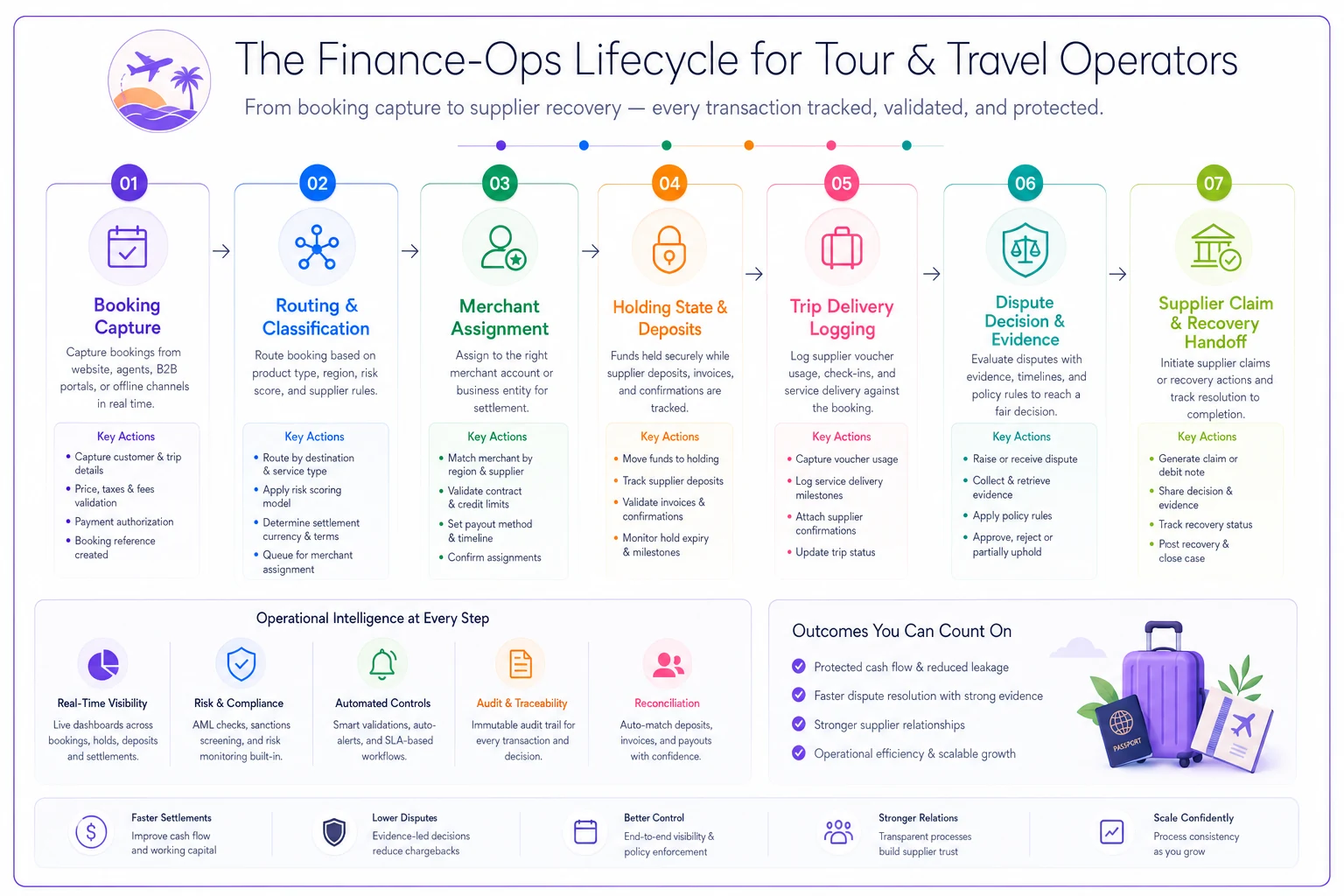
The diagram shows routing rules firing at capture, holding state tracking supplier deposits, delivery proof logged on trip day, dispute branching to evidence pack retrieval and fight/accept decisions, and supplier claim filing when recovery is needed.
Merchant-routing rules that actually reduce dispute exposure
Routing isn't just about processing fees. It's about landing each transaction where it has the best chance of surviving a dispute. A good rule set considers value, geography, risk, and how much evidence support the acquirer offers.
Here's a simplified routing table an operator might run:
| Booking condition | Route to | Reason |
|---|---|---|
| < €150, domestic card, standard tour | Primary low-cost acquirer | Cheap, low dispute risk |
| €150–€1,000, international card | Acquirer with strong chargeback tooling | Better evidence submission, longer response window |
| > €1,000 or group booking | Acquirer + mandatory deposit split | High exposure needs stronger terms + partial supplier hold tracking |
| High-risk signals (mismatched billing, rushed booking, new card) | Manual-review queue before capture | Stop the loss before it becomes a dispute |
| Recurring / installment plans | Dedicated MID with clear descriptor | Reduces "I don't recognize this charge" disputes |
One overlooked detail: your billing descriptor. A large share of "unrecognized charge" disputes happen because the customer booked "Coastal Adventures Ltd" and their statement says "CAL-PYMT-4471." That mismatch alone drives disputes that have nothing to do with the quality of your service. Fixing it costs nothing and quietly eliminates a whole category of losses.
When routing rules live in a booking-to-settlement system rather than in someone's head, the rule fires automatically at the moment of capture. That's the difference between a policy and an actual control. If you don't have that data layer connected yet, the minimum viable booking→settlement data stack is the foundation this whole lifecycle sits on.
Dispute timelines: the countdown nobody assigns
Every dispute is a clock. Most operators only find out the clock was running when it's nearly out.
A rough working timeline: the chargeback notification lands. You typically have somewhere between 7 and 20 days to respond depending on the card network and acquirer. Within that window you decide — fight or accept. If you fight, you submit an evidence packet. The issuer reviews. Weeks pass. You either win, lose, or the customer escalates to a second round (pre-arbitration), which restarts a shorter, harsher clock with fees attached.
The operational failure is almost always ownership. When a dispute email hits a shared inbox, everyone assumes someone else has it. Three days disappear. By the time it's assigned, half the response window is gone and the packet gets thrown together in a rush.
A simple decision table removes the ambiguity:
| Dispute reason code | Default action | Evidence required | Owner | Deadline buffer |
|---|---|---|---|---|
| Service not provided | Fight | Confirmation, delivery proof, guide log | Ops lead | Respond by day 5 |
| Cancellation dispute | Fight | Terms accepted, cancellation timestamp | Finance | Respond by day 4 |
| Unrecognized charge | Fight | Descriptor, booking IP, comms trail | Finance | Respond by day 3 |
| Duplicate charge | Investigate first | Settlement records | Finance | Respond by day 3 |
| Genuine fraud (confirmed) | Accept + refund | — | Finance | Same day |
The "deadline buffer" column matters more than the actual network deadline. If your internal target is day 5 and the network allows 14, you've built in slack for the cases where the guide is unreachable or the customer thread is buried. Operators who run this way win a meaningfully higher share of disputes — not because their cases are stronger, but because they never miss the window.
Evidence packs: assemble them at booking, not at dispute
This is the single biggest shift in how you approach this. Stop treating evidence as something you gather after a dispute opens. Assemble the packet at the moment of booking and keep it attached to the reservation.
A complete chargeback evidence packet for a tour booking should contain:
-
Booking confirmation with itemized services and dates
-
Proof the customer accepted your terms (timestamp + version of terms shown)
-
Full communication trail (email, SMS, chat — consolidated)
-
Payment record with descriptor and authorization details
-
Delivery proof
check-in log, guide confirmation, signed manifest, or photo timestamp
-
Cancellation policy and, if relevant, the exact cancellation timestamp
-
Any customer acknowledgment of the trip running (a post-trip message, a review, a photo they sent)
Require guides to capture a timestamped day-of check-in so delivery proof is automatic.
The key piece is delivery proof. Card networks weight "did the service actually happen" heavily. For a physical business, delivery is a tracking number. For you, it's a guide's check-in log or a signed manifest. If your guides aren't capturing that on the day, you're missing the strongest evidence you'll ever have. A simple day-of check-in that records who showed up, timestamped, turns "service not provided" disputes from coin-flips into near-certain wins.
When evidence auto-attaches to each booking as it's created and updated, a dispute response becomes a two-minute export instead of a two-day archaeology dig. That's the whole point of building the lifecycle as one connected record rather than four disconnected tools.
Supplier-claim handoffs: where recovered money actually comes from
This is the stage almost everyone skips. You lose a €900 chargeback for a no-show cruise excursion — but you already paid the cruise supplier €600 for that booking. The customer's chargeback and your supplier payment are two separate recoveries. Winning the chargeback protects your revenue; recovering from the supplier protects your cost.
Most operators eat the supplier side because there's no process to reclaim it. The trip failed, the loss traces to the supplier, but nobody files the claim because it's nobody's job and the SLA was never written down.
| Loss cause | Recoverable from supplier? | Claim trigger | Evidence needed | Deadline |
|---|---|---|---|---|
| Supplier no-show / cancellation | Yes | Guide incident log filed | Booking ref, SLA clause, incident timestamp | Within 14 days |
| Weather cancellation (supplier-side) | Depends on contract | Ops review | Contract clause, met report | Within 30 days |
| Customer no-show | No (customer liability) | — | — | — |
| Overbooking by supplier | Yes | Availability failure logged | Confirmation vs actual | Within 14 days |
| Quality failure (refund issued) | Partial | Complaint logged + refund proof | Customer complaint, refund record | Within 21 days |
The trigger column is what makes this real. A supplier claim should open automatically when a guide files a no-show or failure log. If it depends on someone remembering weeks later, the deadline lapses and the money's gone. Tie your supplier claims to the same incident-capture your guides already do on the ground, and reference your supplier SLA clauses so the claim cites the exact penalty term you agreed to.
Worked accounting: journal entries for recoveries and losses
The finance side needs to be clean too, otherwise your books show phantom revenue you'll later reverse.
Scenario A — Chargeback lost, no supplier recovery. Original booking: €1,400 recognized as revenue. Customer wins a "service not provided" chargeback.
-
Dr Chargeback Loss / Revenue Reversal €1,400
-
Cr Merchant Clearing / Bank €1,400
Plus the chargeback fee (say €15):
-
Dr Bank Fees €15
-
Cr Bank €15
Scenario B — Chargeback lost, but supplier cost recovered. Same €1,400 loss, but you'd paid a supplier €600 and successfully reclaim it.
-
Record the loss as above, then the recovery
-
Dr Bank €600
-
Cr Supplier Recovery / Cost Reversal €600
Net loss to the business drops from €1,400 to €800. That €600 only exists because someone filed the supplier claim inside the window.
Scenario C — Dispute won. The provisional debit reverses. If you'd booked a provisional loss when the chargeback hit:
-
Dr Merchant Clearing / Bank €1,400
-
Cr Chargeback Loss (reversal) €1,400
A cleaner approach many operators use is a dispute-pending liability account. When a chargeback lands, park it there rather than reversing revenue outright. If you win, clear it back; if you lose, move it to the loss account. This keeps your monthly revenue from whipsawing on disputes that are still open. For operators running multiple currencies, this ties directly into your reconciliation process — the multi-currency reconciliation SOP covers how to handle FX movement between the dispute date and the resolution date.
A short real scenario
A mid-sized day-tour operator running roughly 400–500 bookings a month across three countries had a dispute win rate somewhere around 30%. Not because their cases were weak — because responses were late and evidence was scattered. Supplier recovery was basically zero; nobody was filing those claims at all.
They didn't buy anything fancy. They did three things: assigned every dispute an owner with a day-5 internal deadline, made guides log check-ins on every trip so "service not provided" disputes had hard proof, and opened a supplier claim automatically whenever a failure got logged. Over the following two quarters their dispute win rate moved into the 60s, and they started recovering supplier-side costs they'd previously written off — somewhere in the low thousands each month that had simply been evaporating before.
Nothing about that was a technology miracle. It was closing the loop between finance and operations so the two stopped functioning as strangers.
When this level of structure makes sense — and when it doesn't
When it makes sense: you're past roughly 150–200 bookings a month, you sell across borders or currencies, your average booking value is high enough that a single lost dispute stings, or you forward significant deposits to suppliers before trips run. At that point the leakage is real money and the manual approach is already failing.
When it's overkill: if you're running a handful of low-value local tours a month, a full routing-and-recovery lifecycle is more machinery than you need. Get the billing descriptor right, keep terms acceptance timestamped, and handle disputes as they come. Don't build a supplier-recovery decision table for three suppliers you talk to every day.
Who should not do this yet: operators whose booking data isn't consolidated. If your reservations, payments, and communications live in separate tools that don't share a record, building routing rules and evidence packs on top of that chaos won't hold. Fix the data foundation first — a connected booking→settlement record — then layer this lifecycle on top.
Pulling it together
The reason payment and chargeback losses feel random is that operators experience them as isolated events — a dispute here, an unrecovered supplier cost there. But they're not isolated. They're the visible symptoms of a lifecycle that was never connected. Money enters through routing rules nobody wrote, sits in a holding state nobody tracks, gets challenged on a clock nobody owns, and traces back to supplier costs nobody reclaims.
Connect those four stages into decision tables and SOPs — routing rules at capture, evidence packs assembled at booking, dispute ownership with internal deadlines, and supplier claims triggered by incident logs — and the leak closes. Not because you're fighting harder, but because the system already has the answer ready before the deadline hits. That's what a finance-ops playbook is really for: making the recoverable actually recovered, and turning the winnable disputes into wins.
Ready to elevate your travel business?
Join 500+ travel operators using Touryly to optimize bookings, improve client satisfaction, and grow revenue.