



Running tours means juggling suppliers in euros, hotels demanding USD, local guides wanting their home currency, and customers paying in whatever their credit card defaults to. The real killer isn't the exchange rates themselves — it's discovering three weeks later that your accounting shows a healthy profit while your bank account tells a completely different story.
Multi-currency reconciliation for tour operators turns into a nightmare when you're tracking supplier invoices in four currencies, customer payments in twelve more, and your accounting software thinks everything should magically convert at month-end rates. Meanwhile, that Bali villa you booked six months ago at 14,500 IDR per dollar just settled at 15,800, and nobody caught it because your reconciliation process is basically "we'll figure it out when the accountant asks."
The gap between what you quoted, what you collected, and what you actually paid creates phantom profits that vanish the moment someone does the real math. Most operators discover this at the worst possible time — right when they need cash for peak season deposits.
Why standard accounting practices fail tour operations
Tour operators face a uniquely brutal FX challenge. Unlike importers who hedge large transactions or retailers with predictable currency exposure, you're dealing with a few compounding problems at once.
Timing mismatches everywhere
Customer books in January, pays deposit in February, final payment in May, you pay suppliers in March and June, trip happens in July. Each transaction hits at different FX rates, but your P&L needs to show accurate margins throughout.
Supplier payment terms that don't match customer cycles
Hotels want 30% now, 70% two weeks before arrival. Ground transport wants full payment upfront. Activities bill you after the tour. Customers pay 20% deposit, then nothing for months, then the balance whenever they remember. Every gap creates FX exposure.
Multiple small transactions instead of bulk transfers
You're not wiring $500K once a month. You're sending €300 here, £1,200 there, $450 somewhere else, multiple times a week. Bank fees and rate markups on small transfers absolutely destroy margins, but most operators don't even track this separately.
Traditional accounting assumes you can match revenues and expenses in the same period. When a December booking for next August gets partially refunded in March, modified in May, and finally reconciled in September — which rate do you use? Your accountant will say "use the transaction date rate" but that only works if you actually captured it at the time.
Account structure that actually tracks FX impact
Setting up proper multi-currency accounts means abandoning the idea that everything flows through one operating account.
Never miss a booking or update.
Touryly streamlines your travel bookings, confirmations, and itinerary updates—all in one place.
- Unified booking management
- Automated customer notifications
- Itinerary & staff coordination
No credit card required
Operating accounts by currency
-
USD operating account (for US suppliers and dollar-denominated bookings)
-
EUR operating account (for European suppliers)
-
Local currency account (for wherever you're based)
-
GBP account if you deal with UK suppliers regularly
Holding accounts for customer funds
-
Customer deposit holding (multi-currency sub-accounts)
-
Balance due holding (tracks what's committed but not collected)
FX variance accounts
-
Realized FX gains/losses (actual differences when money moves)
-
Unrealized FX gains/losses (paper differences on outstanding balances)
-
Bank fee allocation account (yes, track this separately)
The critical part: every customer booking creates entries in both the customer holding account at their payment currency, and a shadow entry in your operating currency for margin calculation. Don't convert everything to your home currency immediately — maintain the foreign currency detail until settlement.
Sample setup for a European operator dealing with US customers:
Main Operating Account (EUR)
-
Feeds all local expenses
-
Receives transfers from other currency accounts
-
Shows true operating position
USD Collection Account
-
Receives all USD customer payments
-
Holds until transfer timing makes sense
-
Tracks USD supplier payments separately
USD Supplier Payment Account
-
Separate from collection to avoid mixing flows
-
Clear audit trail for supplier settlements
FX Trading Account
-
Intermediate account for currency conversions
-
Makes it obvious what you paid in conversion costs
Maintaining these separate ledgers makes it obvious where FX gains and losses originate and gives a clear audit trail for any margin investigations.
FX cost allocation rules that reflect reality
Most operators treat FX as some mysterious force that randomly helps or hurts them each month. In reality, FX costs follow predictable patterns based on your operational choices.
Direct allocation rules
-
Customer-specific FX costs stay with that booking — if converting a customer payment to pay their specific supplier, allocate the conversion cost directly, not spread across all bookings for that period.
-
Bulk conversion costs get allocated by transaction value — converting €10K to pay multiple suppliers means that €3K hotel payment bears 30% of the conversion cost.
-
Timing penalties go to whoever caused them — rush conversion because sales promised something impossible? Sales bears the cost. Supplier demanded early payment? That supplier relationship bears it.
Indirect allocation framework
-
Monthly holding costs (the price of maintaining multiple currency balances)
allocate based on average balance per currency.
-
Hedging costs (if you're sophisticated enough)
allocate to forward bookings based on booking value.
-
Bank relationship fees
overhead allocation based on transaction volume.
Here's what this looks like in practice:
| Cost Type | Allocation Method | Tracking Mechanism |
|---|---|---|
| Spot conversion fees | Direct to transaction | Tag at transfer time |
| Monthly FX facility fees | Pro-rata by currency volume | Monthly calculation |
| Wire transfer fees | Direct to supplier payment | Tag at payment |
| Rate markups | Direct to transaction | Calculate vs. mid-market rate |
| Forward contract costs | Spread across protected bookings | Amortize over contract period |
Getting this table built into your reconciliation process — even as a simple spreadsheet — forces the discipline of categorizing each FX cost rather than lumping it all into a single line item.
The reconciliation checklist that catches issues before they compound
Daily reconciliation sounds excessive until you realize that catching a rate discrepancy after one day costs you $50, but catching it after a month costs you $500 plus hours of investigation.
Daily checks (5 minutes)
-
Bank balance by currency matches system balance
-
New bookings
customer payment currency recorded correctly
-
Supplier invoices
currency and amount match quote
-
Any conversion done today
rate captured and allocated
Weekly supplier reconciliation (30 minutes)
-
Outstanding supplier balances by currency
-
FX rate movement on unpaid invoices — flag anything over 3%
-
Payment timing optimization — can we batch anything?
-
Supplier statement matching in original currency
Weekly customer reconciliation (20 minutes)
-
Deposit collection vs. quoted amounts
-
Balance due aging by currency
-
Refund calculations at current vs. original rates
-
Currency mismatch warnings — customer paid different currency than quoted
Monthly full reconciliation
-
Realized FX gains/losses by booking
-
Unrealized FX impact on forward bookings
-
Bank fee analysis by currency corridor
-
Margin impact report by destination
Run the daily currency balance check first thing to catch mismatches before bookings and payments are processed for the day.
The critical addition most operators miss is forward exposure reporting. You need to know how much you're committed to pay in each currency over the next six months, how much you're expecting to collect, the net exposure by month, and what rate movement would actually create a cash crisis. That last one is the one nobody builds until it's already happened.
Sample journal entries for common operator scenarios
Actual entries matter here because most accounting software mangles multi-currency tour operations. These examples assume a EUR-based operator for clarity.
Scenario 1: US customer books Mediterranean cruise
-
Customer books January 15
-
Total price
$3,500
-
Deposit collected
$700 (at 0.92 EUR/USD)
Dr. USD Customer Deposits Account $700 Cr. Customer Liability - Smith $700 Dr. Accounts Receivable - Smith €644 Cr. Deferred Revenue €644 (Shadow entry in EUR at booking rate)
Supplier invoice received January 20:
-
Cruise line invoices
€2,800
-
Payment terms
€500 now, balance May 1
Dr. Tour Cost Commitment €2,800 Cr. Accounts Payable - CruiseLine €2,800
Initial supplier payment January 25:
-
Transfer $543 to pay €500 (rate
0.920)
Dr. Accounts Payable - CruiseLine €500 Cr. USD Operating Account $543 Dr. FX Variance €4 (Actual cost €500 at 0.920 = $543 vs. customer rate)
Customer final payment May 10:
-
Balance of $2,800 received (rate
0.88)
Dr. USD Customer Deposits Account $2,800 Cr. Customer Liability - Smith $2,800 Dr. FX Variance €54 Cr. Accounts Receivable €54 (Rate movement from 0.92 to 0.88)
Scenario 2: Refund after FX movement
-
Original
£2,000 collected at 1.15 EUR/GBP
-
Refund
£500 processed at 1.19 EUR/GBP
Dr. Customer Liability £500 Cr. GBP Operating Account £500 Dr. Revenue Reversal €575 Dr. FX Loss on Refund €20 Cr. Deferred Revenue €595 (Original revenue at 1.15, refunded at 1.19)
Scenario 3: Supplier payment timing optimization
-
Three Thai suppliers need payment, batched conversion
-
Supplier A
THB 45,000
-
Supplier B
THB 62,000
-
Supplier C
THB 28,000
-
Bulk conversion at preferential rate
Dr. THB Staging Account THB 135,000 Cr. EUR Operating Account €3,580 (Bulk rate: 37.71) Dr. Accounts Payable - A THB 45,000 Dr. Accounts Payable - B THB 62,000 Dr. Accounts Payable - C THB 28,000 Cr. THB Staging Account THB 135,000 FX cost allocation: Dr. FX Cost - Supplier A €12 Dr. FX Cost - Supplier B €16 Dr. FX Cost - Supplier C €8 Cr. FX Benefit from Batching €36
That batching entry is the one most operators never create. Without it, you lose visibility into exactly how much you saved — or lost — by timing payments together.
Building automated variance reporting that guides decisions
Manual reconciliation breaks down fast. Somewhere around 20 bookings per month it stops being sustainable, and the operational overhead compounds with every currency you add.
Core variance reports to build:
Rate variance by booking:
-
Expected margin at booking rate
-
Current margin at today's rates
-
Flag anything beyond ±5% threshold
Payment timing variance:
-
Days between customer payment and supplier payment
-
FX movement during that window
-
Cost of float by currency
Supplier rate tracking:
-
Rate at quote vs. rate at invoice vs. rate at payment
-
Pattern detection for suppliers who consistently quote in volatile currencies
The most useful report tracks "FX erosion by destination" — showing which routes consistently bleed margin to currency movements. One operator found their seemingly profitable Jordan tours were actually losing money after FX, because the timing gap between customer deposits and supplier payments created a 45-day exposure window during historically volatile periods. Nobody had spotted it because the booking-level numbers looked fine in isolation.
AI-powered operational software changes this from a weekly headache into automated monitoring. Instead of manually checking rates and calculating variances, the system continuously tracks exposure, suggests optimal payment timing, and automatically allocates FX costs to the right bookings. When a rate movement threatens margins, you know immediately — not at month-end reconciliation when there's nothing you can do about it.
Below is a simple workflow visualization.
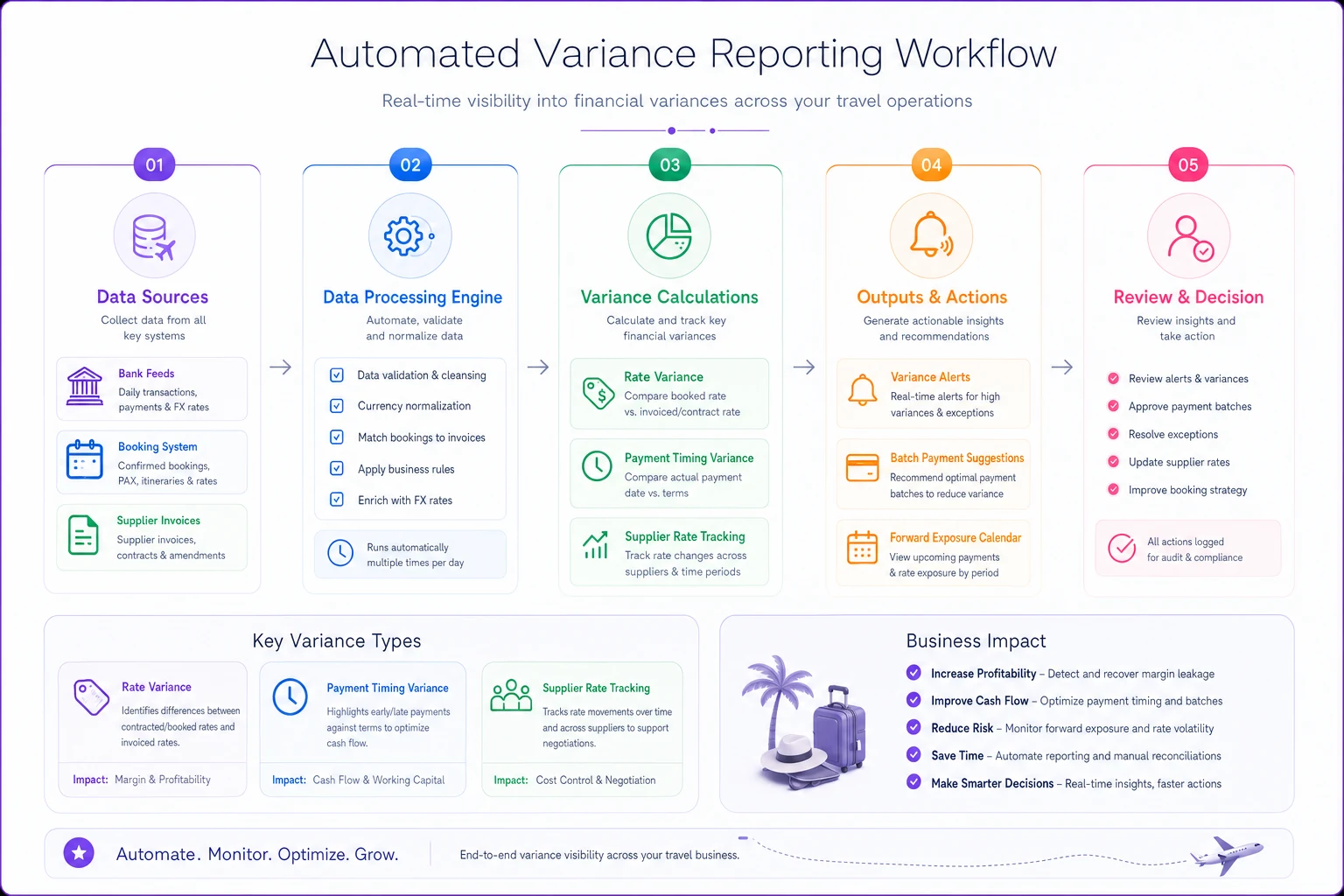
The automation handles routine tracking while flagging what actually needs a human decision: should we accelerate this payment to lock in a favorable rate? Is it time to adjust pricing for this destination based on a sustained currency trend? Which supplier relationships are consistently creating FX losses?
Common FX mistakes that kill operator margins
The "mental conversion" trap
Operators quote in USD, think in EUR, pay suppliers in local currency, and somehow expect it to work out. Every mental conversion introduces rounding errors that compound. Stop converting everything to your preferred currency for comparison. Work in the actual transaction currency until the moment of payment.
Treating all currencies equally
IDR and THB can move 15% in a month. EUR and USD might move 2%. Your processes should reflect that difference. High-volatility corridors need tighter controls, shorter commitment windows, and probably different margin structures.
Ignoring bank spread on small transactions
Your bank quotes "no fees" on FX but buries a 3-4% spread on transactions under €10K. Ten supplier payments of €1K each costs far more than one €10K payment. Most operators never calculate this because the fee is hidden in the rate, not listed separately.
Using accounting rates instead of economic rates
Your accounting software updates rates monthly. Your bank charges you today's rate. That gap creates phantom profits that disappear at reconciliation. Track both, but make decisions based on achievable rates, not theoretical ones.
Supplier contract clauses that protect against FX volatility
Your supplier contracts need FX protection built in. Here's language that actually works:
"Prices quoted in [CURRENCY] are valid for 30 days from quote date. Bookings confirmed outside this window subject to rate adjustment if exchange rate moves beyond ±3% from quote rate. Rate reference: ECB daily fixing."
For volatile currencies, add:
"Either party may request rate review if currency moves >8% from contract rate. Payment timing may be accelerated to lock favorable rates with mutual agreement."
For long-term commitments:
"Annual rates subject to quarterly FX adjustment. Base rate: [RATE]. Adjustment formula: 50% of movement beyond ±5% band shared equally between parties."
One underused approach worth trying: suppliers in emerging markets often prefer USD stability over local currency amounts. Offering to pay in USD at a locked rate might cost you 2-3% but saves 10-15% volatility risk. Most operators never have that conversation because they assume suppliers won't go for it.
Technology that makes multi-currency reconciliation manageable
Spreadsheets break down fast. The operational overhead of manual tracking starts exceeding the cost of proper tools somewhere around 50 bookings per month — sometimes earlier depending on how many currencies you're juggling.
What effective multi-currency tracking actually needs:
-
Real-time rate feeds for automatic mark-to-market calculations
-
Separate tracking of customer currency, supplier currency, and operating currency for each transaction
-
Automatic flags when rate movement exceeds thresholds
-
Batch payment optimization suggestions
-
Forward exposure calendars by currency
These aren't nice-to-haves once you're past a certain volume. Without them, someone is manually pulling rate data, building spreadsheet formulas, and making judgment calls that should be systematic.
Making FX management part of operational rhythm
The best operators don't treat FX as a finance problem — they embed it into daily operations.
Sales knows which currencies to avoid quoting in during volatile periods. They build shorter validity windows for risky corridors and build appropriate buffers into pricing from the start.
Operations batches payments strategically. They maintain the discipline of weekly payment runs by currency rather than paying suppliers randomly throughout the month.
Finance provides simple decision-making tools. Not complex hedging strategies — just clear rules like "if USD/EUR moves past 0.95, accelerate all European supplier payments."
The difference between operators who manage FX well and those who don't isn't sophisticated financial engineering. It's consistent application of simple rules, systematic tracking of what actually happens, and the discipline to reconcile before problems compound.
Your multi-currency reconciliation process either controls risk or creates it. That choice happens in how you structure accounts, how frequently you reconcile, and whether you treat FX as an unavoidable mystery or a manageable operational challenge. Most operators lose somewhere between 2-4% of margin to poor FX management — often the difference between a sustainable business and one that struggles despite seemingly healthy bookings.
The framework here — from account structure through daily reconciliation — turns multi-currency chaos into manageable process.
It won't eliminate FX risk, but it makes it visible, trackable, and something you can actually act on before it's too late to do anything about it.
Ready to elevate your travel business?
Join 500+ travel operators using Touryly to optimize bookings, improve client satisfaction, and grow revenue.