



Payment governance for tour operators feels broken because it usually is. Most operators treat payment routing like picking a checkout lane — whichever looks fastest. But when you're juggling multiple currencies, varying processor fees, and dispute windows that shift depending on which acquirer you're routed through, that casual approach bleeds margin constantly.
The real damage shows up months later. Your European processor hits you with a €4,800 chargeback for a group booking from May. Your backup US processor already settled those funds at a 2.3% worse exchange rate than your primary. Meanwhile, your dispute team can't figure out which SLA applies because nobody documented the routing decision or why that transaction went through that specific channel.
This isn't really about payment processing being complicated. It's about running payments without governance — no routing rules tied to actual costs, no FX controls mapped to processor capabilities, and dispute procedures that completely ignore which acquirer handled the transaction.
The hidden architecture of payment routing decisions
Tour operators typically work with 2–4 payment processors, but routing logic stays trapped in someone's head. "We use Processor A for EU cards, Processor B for everything else" sounds reasonable until you realize Processor A charges 0.4% more for business cards, has a 48-hour settlement delay for amounts over €5,000, and their dispute window closes 30 days faster than Processor B.
Every routing decision creates downstream consequences across three dimensions that most operators never connect:
Pricing impact: The immediate transaction fee plus the hidden costs. A 2.1% rate might look better than 2.3%, but if that cheaper processor holds funds for 72 hours during peak season, the working capital cost often exceeds the fee savings. One operator processing around $1.2M monthly discovered their "cheaper" processor was actually costing them roughly $3,400 extra per month once they factored in float costs.
FX exposure windows: Multi-currency operations create timing gaps between when you lock in a customer payment and when you settle with suppliers. Route a EUR payment through your US processor and you've added an extra conversion step plus extended your FX exposure window by however long that processor takes to settle. A tour operator handling around €800K in European bookings watched their margins swing by €12,000 in one quarter — purely from routing decisions that ignored FX timing.
Dispute jurisdiction complexity: Each processor operates under different dispute rules, response windows, and evidence requirements. Route a high-risk booking through a processor with aggressive chargeback policies and you've essentially pre-approved the dispute loss. The same booking through a processor with merchant-friendly rules might stay protected.
Building routing rules that actually protect margins
Effective routing rules go beyond simple geography or card type. They need to evaluate multiple factors simultaneously and make decisions based on total cost, not just the transaction fee on the invoice.
Never miss a booking or update.
Touryly streamlines your travel bookings, confirmations, and itinerary updates—all in one place.
- Unified booking management
- Automated customer notifications
- Itinerary & staff coordination
No credit card required
Here's a basic routing decision table that captures the essential logic:
| Transaction Profile | Primary Route | Fallback Route | Trigger Conditions |
|---|---|---|---|
| EU card, under €2,000, leisure booking | Processor A (1.9% + €0.20) | Processor C (2.2% + €0.15) | A availability >99.5% |
| EU card, over €2,000, leisure booking | Processor C (2.2% + €0.15) | Processor A (1.9% + €0.20) | Faster settlement priority |
| US card, group booking >$5,000 | Processor B (2.3% + $0.30) | Processor D (2.6% + $0.25) | Enhanced dispute protection |
| High-risk indicators present | Processor B (2.3% + $0.30) | Manual review queue | Any 2+ risk signals |
| FX-sensitive (supplier pay <48hrs) | Local currency processor | Processor C with FX lock | Minimize conversion layers |
Define temporary routing overrides for peak periods so settlement speed can be prioritized over fee minimization without changing core booking logic.
The routing logic needs to evaluate in real-time. A booking for a €3,500 wine tour from a US-based corporate card hits different triggers than a €350 day trip from a German debit card. The corporate booking needs enhanced dispute protection even at higher cost. The day trip needs minimal fees since margins are already tight.
The routing table is just the start. You need enforcement mechanisms that actually work during booking flow. Most operators try to build this into their booking system, but that creates brittle dependencies. Better to establish routing rules at the payment gateway level where you can adjust without touching core booking logic.
Connecting FX exposure to processor capabilities
Currency exposure in tour operations happens in layers, and payment routing decisions directly impact each layer's risk profile. When you understand how each processor handles FX, you can route strategically to minimize exposure windows and lock in margins.
Start with processor settlement currencies. If Processor A settles everything in USD while Processor B can settle in EUR, GBP, and USD, routing European bookings through Processor B eliminates one conversion layer. But that only works if Processor B's multi-currency capabilities include the specific currency pairs you actually need. Many processors claim "multi-currency support" but really just convert everything to USD first, then back to your target currency.
FX reconciliation becomes even more complex when you factor in processor-specific timing differences. Some processors lock in exchange rates at authorization, others at settlement. Route a booking through the wrong processor and you've added 2–3 days of currency risk to an already volatile transaction.
The operational impact compounds during busy periods. A Mediterranean tour operator processing roughly €400K in July bookings lost around €8,200 to FX movements because their routing logic didn't account for their primary processor's 72-hour settlement delay during peak months. Their backup processor settled in 24 hours, but nobody updated the routing rules to reflect summer volumes.
For immediate supplier payments: Route through processors with same-day settlement in local currency. Accept higher transaction fees to eliminate FX risk.
For deferred supplier payments (30+ days): Route through processors with the best rates, since you have time to manage FX exposure through other instruments.
For partial prepayments: Split routing based on payment timing. Immediate portion through fast-settlement processor, deferred portion through cost-optimized processor.
For volatile currencies: Always route through processors offering rate locks at authorization, even if settlement is delayed.
This routing intelligence prevents situations where you collect EUR from customers, convert to USD for processing, then convert back to EUR to pay suppliers — losing 2–4% in unnecessary conversions along the way.
Dispute SLAs that match your processor mix
Every processor handles disputes differently, but most operators use the same dispute process regardless of which processor actually handled the transaction. This mismatch causes preventable losses and operational chaos when dispute deadlines vary by processor.
Processor A (EU-focused):
-
Initial response window
7 calendar days
-
Evidence requirements
Invoice, booking confirmation, signed terms
-
Prevailing party rate
68% merchant favorable
-
Liability threshold
€10,000 per quarter before review
Processor B (US-focused):
-
Initial response window
10 business days
-
Evidence requirements
All above plus customer communication logs
-
Prevailing party rate
54% merchant favorable
-
Liability threshold
$5,000 per quarter before review
Processor C (Backup/overflow):
-
Initial response window
5 calendar days
-
Evidence requirements
Extensive (includes IP logs, device fingerprints)
-
Prevailing party rate
41% merchant favorable
-
Liability threshold
No automatic protection
These differences matter operationally. A chargeback arriving Friday afternoon for a Processor C transaction needs immediate attention — you have until Wednesday to respond. The same chargeback through Processor B gives you two full weeks.
Your dispute SLA should specify:
-
Identification protocol
How quickly must payment ops identify which processor handled the disputed transaction? (Target: within 2 hours of dispute notification)
-
Evidence assembly
What evidence is pre-staged for each processor's requirements? Don't scramble to find IP logs when Processor C disputes arrive.
-
Response templates
Pre-written responses for common dispute types, customized for each processor's adjudication style.
-
Escalation triggers
When does a dispute escalate beyond payment ops? Processor-specific thresholds based on win rates and liability limits.
-
Post-dispute routing adjustments
How do dispute outcomes affect future routing for similar transaction profiles?
The refund decision matrix you use should also incorporate processor-specific dispute risks. Sometimes issuing a proactive refund through Processor A costs less than fighting a likely-losing dispute through Processor C.
Sometimes issuing a proactive refund through Processor A costs less than fighting a likely-losing dispute through Processor C.
Multi-acquirer flow orchestration
Running multiple acquirers without orchestration logic creates chaos during failure scenarios. Your primary processor goes down during Saturday afternoon bookings. The backup processor is running but only at 60% acceptance rate. The tertiary processor works but adds $3.40 to every transaction. Meanwhile, customers are abandoning bookings and your ops team is manually trying to route payments.
Scenario: Saturday 2PM, peak booking window for next week's departures
-
Primary processor (A)
Timeout errors, 0% success rate
-
Secondary processor (B)
Operational, 62% acceptance rate
-
Tertiary processor (C)
Operational, 94% acceptance rate, +$3.40 per transaction
Orchestration Logic:
-
First attempt
Route to B (lower cost despite lower acceptance)
-
If B soft-declines
Immediate retry on C
-
If B hard-declines
Do not retry (customer card issue)
-
Monitor B acceptance rate
If drops below 50%, skip to C for all transactions
-
Every 10 minutes
Test transaction to A to detect recovery
-
Once A recovers
Gradual traffic shift back (10% increments per hour)
This kind of orchestration prevented one operator from losing an estimated $47,000 in abandoned bookings during a 3-hour processor outage. Without it, their manual fallback process was catching maybe 30% of failed transactions.
The orchestration rules should account for:
-
Transaction value tiers
High-value bookings justify higher processing costs to ensure completion. Route all transactions over $2,000 through the most reliable processor during outages.
-
Customer geography
US customers might have better acceptance rates on US-based processors even if those cost more. Don't lose a booking to save $2 on processing.
-
Booking urgency
Last-minute bookings (departure under 72 hours) should route through the highest-reliability processor. The revenue loss from a failed booking exceeds any processing cost difference.
-
Historical decline patterns
If a customer's card previously declined on Processor B but worked on C, start with C for their future transactions.
Here's a simple visual of the orchestration flow.
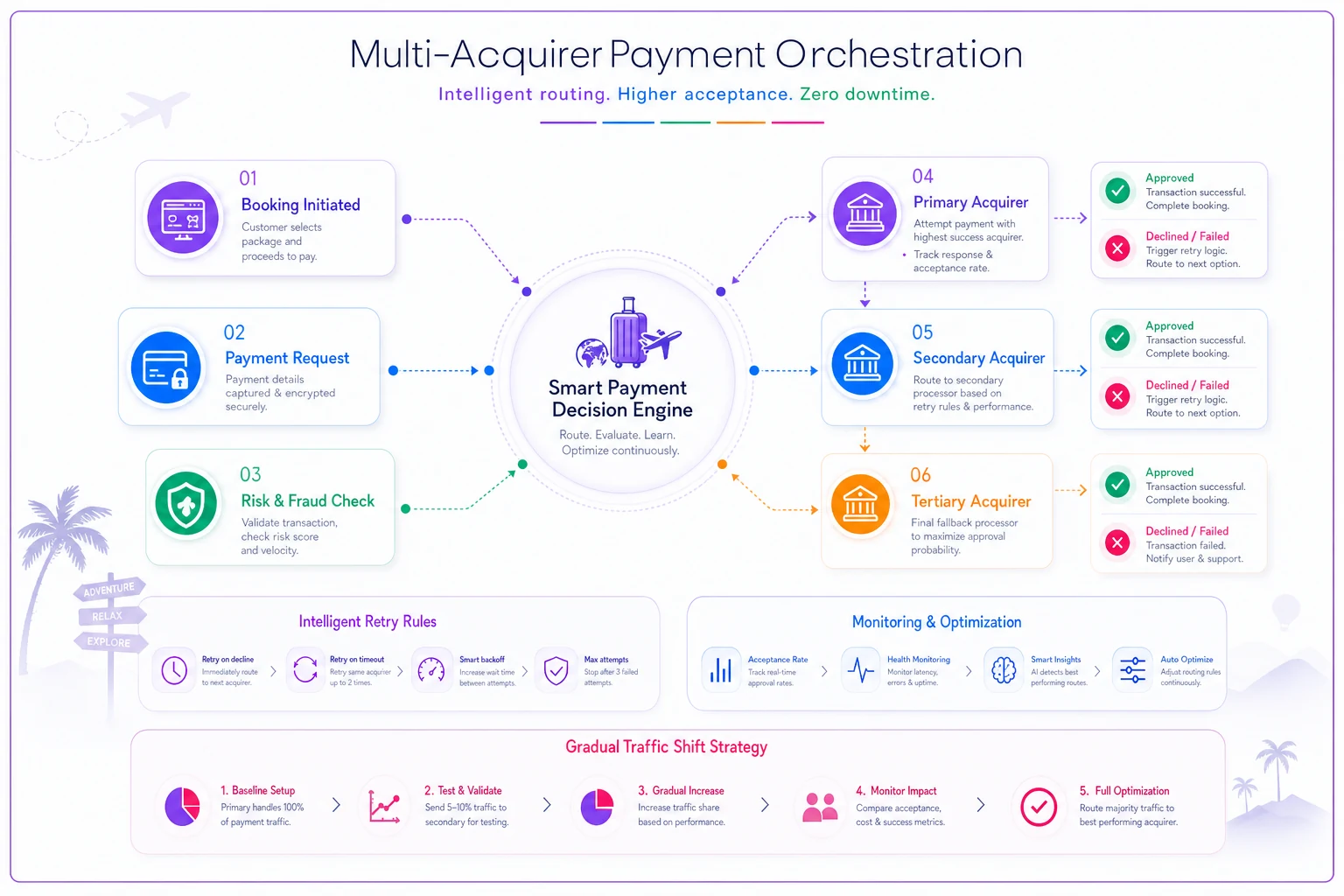
The orchestration rules above reduce abandonment, balance cost vs acceptance, and enable automated recovery testing during outages.
The compound effect of payment governance gaps
Payment governance failures compound in ways that only become visible during reconciliation or dispute season. You discover that 30% of your EU bookings went through the expensive US processor because someone forgot to update routing rules after adding a new booking channel. Or your dispute win rate drops because high-risk transactions weren't routed to the processor with better fraud tools.
A Mediterranean tour operator running about $3M annually discovered they were losing $14,000 monthly to payment governance gaps:
-
$4,800 from suboptimal routing (wrong processor for transaction type)
-
$3,200 from unnecessary FX conversions
-
$2,400 from preventable dispute losses
-
$3,600 from delayed settlements impacting cash flow
None of these were dramatic failures. Just steady margin erosion from operating without clear governance rules. Every individual transaction made sense in isolation, but the aggregate impact was significant.
The governance gaps typically hide in transition points:
When you add a new booking channel but don't update routing rules, the channel defaults to your most expensive processor and nobody notices for months.
When you expand to a new market but keep using US-based processing, every booking adds unnecessary FX conversion costs.
When seasonal volume spikes overwhelm your primary processor, overflow traffic routes to expensive backups without any cost controls.
When dispute patterns change but routing doesn't adjust, you keep sending high-risk profiles through processors with weak dispute protection.
Implementing governance without destroying operations
The path to better payment governance doesn't require rebuilding your entire payment stack. Start with visibility, then add controls, then optimize routing.
Phase 1: Transaction visibility (Week 1–2) Map every transaction to its processor, cost, settlement time, and dispute exposure. Most operators discover surprising routing patterns immediately. "Why are 40% of our German bookings going through the UK processor?"
Phase 2: Basic routing rules (Week 3–4) Implement simple geography and amount-based routing. EU cards to EU processor, US cards to US processor. Amounts over $5,000 to an enhanced-protection processor. This alone usually saves 0.3–0.5% on processing.
Phase 3: FX optimization (Week 5–6) Add currency-matching logic to routing rules. Eliminate unnecessary conversion layers. Route based on settlement timing when supplier payments are imminent.
Phase 4: Dispute-aware routing (Week 7–8) Integrate risk signals into routing decisions. High-risk indicators trigger routes to processors with better dispute tools. Track win rates by processor and adjust routing accordingly.
Phase 5: Dynamic optimization (Ongoing) Monitor routing performance and adjust rules based on actual outcomes. If Processor B's dispute win rate drops below 50%, reduce its share of high-risk transactions.
The implementation sequence matters. Don't try to build perfect routing rules before you have basic visibility. And don't optimize for edge cases before handling the common scenarios that drive most of your volume.
Monitoring and adjusting governance rules
Payment governance isn't set-and-forget. Processor terms change, new acquirers enter your mix, and transaction patterns evolve. Your governance playbook needs built-in review cycles and clear adjustment triggers.
Monthly reviews should examine:
-
Actual vs expected routing distribution
-
Processing costs by route and transaction type
-
Dispute rates and win rates by processor
-
FX impact from routing decisions
-
Settlement timing impacts on cash flow
Quarterly deep-dives should evaluate:
-
Whether routing rules still match business priorities
-
New processor capabilities or pricing changes
-
Emerging transaction patterns requiring new rules
-
Technology integration opportunities for better automation
Annual strategic reviews should consider:
-
Processor relationship restructuring
-
New acquirer evaluation
-
Major routing logic overhauls
-
Platform upgrades or replacements
The monitoring shouldn't be passive. Set specific triggers for routing adjustments:
-
If any processor's dispute win rate drops below 45%, reduce high-risk routing through them by 50%
-
If FX losses exceed 1.5% of processed volume, mandate local-currency routing
-
If settlement delays impact more than 10% of supplier payments, switch to faster processors
-
If processing costs exceed 2.8% average, renegotiate or find alternatives
These triggers create accountability and prevent the slow drift that erodes margins over time.
The technology layer that makes governance sustainable
Manual payment governance works until it doesn't — usually during peak season, when you need it most. The sustainable approach means embedding governance rules into your operational platform where they execute automatically without constant human intervention.
This doesn't mean buying expensive payment orchestration platforms. Many tour operators build effective governance using existing tools plus some workflow automation. The key is making routing decisions systematic rather than situational.
A practical implementation might look like:
-
Payment gateway with rule-based routing capabilities
-
Simple database tracking routing decisions and outcomes
-
Daily reconciliation process comparing expected vs actual routing
-
Automated alerts when routing patterns deviate from rules
-
Monthly reports showing governance impact on margins
The automation focuses on execution consistency, not complex optimization. Simple rules that always execute beat sophisticated rules that require manual intervention.
For operators ready to scale, AI-powered operational software can shift payment governance from a compliance burden into a genuine operational advantage. These platforms learn from your transaction patterns, automatically adjust routing rules based on outcomes, and can predict which processor will deliver the best result for each specific transaction type. Your team sets the business priorities and constraints; the system optimizes within those parameters.
Moving from reactive to strategic payment operations
Payment governance done right transforms payments from a cost center into a strategic capability. Instead of reacting to processor issues, you're proactively routing for optimal outcomes. Instead of discovering FX losses during reconciliation, you're preventing them through intelligent routing. Instead of fighting disputes with generic responses, you're using processor-specific strategies that actually win.
The shift requires thinking about payments as an operational system with multiple interconnected components, not just a series of isolated transactions. Every routing decision affects downstream processes — settlement timing, dispute exposure, FX risk, cash flow availability. When you govern these decisions systematically, the compound benefits exceed the sum of individual optimizations.
Most tour operators who implement comprehensive payment governance see real impact fairly quickly: somewhere in the range of 0.5–1% reduction in processing costs, meaningful improvement in dispute win rates, and significantly less FX loss. The bigger value, though, is operational predictability. When payments run on clear rules with defined SLAs, your team can focus on growth instead of fighting fires.
The governance playbook outlined here is based on patterns that work across different operators, volumes, and markets. The specific rules and thresholds will need adjustment for your operation, but the fundamental structure — routing rules, FX controls, dispute SLAs — stays consistent regardless of scale.
Start with the basics: map your current processor mix, document existing routing patterns, identify the biggest sources of payment leakage. Then build governance incrementally, adding rules and controls that address your specific pain points. Within 90 days, payments can shift from a source of constant stress into a predictable, governed operation that protects margins without requiring someone to babysit it.
Ready to elevate your travel business?
Join 500+ travel operators using Touryly to optimize bookings, improve client satisfaction, and grow revenue.