



Refund accounting for tour operators gets messy fast. Not because the journal entries themselves are complicated — they're actually pretty straightforward once you map them out — but because every refund scenario creates a different accounting path, a different customer communication requirement, and a different reconciliation problem at month-end.
How a $12,000 group cancellation creates three separate accounting problems
The real issue isn't recording the refund. It's that tour operators handle refunds, credits, supplier claims, chargebacks, and partial cancellations all differently, yet most track them the same way in their books. Then month-end arrives and you're suddenly trying to figure out why your merchant account, general ledger, and booking system are showing three different numbers.
Most tour operators handle refunds reactively. Customer cancels, you process the refund, record something in QuickBooks, send an email, move on. But each refund type requires different accounting treatment, and mixing them up creates reconciliation problems that compound every single month.
The decision matrix nobody builds (but everyone needs)
Here's what a proper refund decision matrix looks like:
Never miss a booking or update.
Touryly streamlines your travel bookings, confirmations, and itinerary updates—all in one place.
- Unified booking management
- Automated customer notifications
- Itinerary & staff coordination
No credit card required
| Trigger Event | Customer Outcome | GL Impact | Merchant Account | Supplier Action | Customer Message Type |
|---|---|---|---|---|---|
| Weather cancellation | Full refund | Reverse revenue + costs | Credit issued | Claim filed | Apology + rebooking offer |
| Customer cancels (30+ days) | Partial refund | Reverse revenue, retain deposit | Partial credit | No action | Policy reminder + credit option |
| Customer cancels (<7 days) | Future credit only | Move to deferred revenue | No transaction | Hold booking | Credit confirmation + expiry |
| Supplier failure | Full refund + compensation | Reverse revenue + expense comp | Credit + payment | Claim + penalty | Apology + compensation details |
| Overbooking error | Choice: refund or upgrade | Varies by choice | Conditional | Reallocation | Options email + deadline |
| Quality complaint | Partial refund | Reduce revenue recognition | Partial credit | Possible claim | Investigation + resolution |
| Chargeback filed | Disputed | Provision for loss | Held/reversed | Evidence needed | Documentation request |
The matrix matters because each path hits your P&L differently. A weather cancellation where you'll recover costs from suppliers gets treated completely differently than a customer who cancels last-minute and forfeits their deposit. Mix these up and your gross margins look wrong all quarter.
Journal entries that actually match operations
Generic accounting guidance gives you generic refund entries. Tour operator refunds involve multiple moving parts — customer payments, supplier prepayments, credit card fees, sometimes insurance claims. Each needs its own entry.
Scenario 1: Full weather cancellation with supplier recovery
A group books a $12,000 wine tour package. Weather forces cancellation. You refund customers fully but expect to recover $8,000 from suppliers.
Initial booking entries (when originally booked): DR Cash $12,000 CR Tour Revenue $12,000 DR Supplier Prepayment $8,000 CR Cash $8,000
Cancellation and refund entries: DR Tour Revenue $12,000 CR Customer Refunds Payable $12,000 DR Customer Refunds Payable $12,000 CR Cash $12,000 DR Supplier Claims Receivable $8,000 CR Supplier Prepayment $8,000
When supplier claim settles: DR Cash $8,000 CR Supplier Claims Receivable $8,000 Net impact: Zero revenue, zero cost, only lost the gross margin.
Scenario 2: Last-minute customer cancellation with deposit forfeiture
Customer cancels 3 days before a $3,500 tour. Your policy keeps the $500 deposit. Original entries stay intact Cancellation entries: DR Tour Revenue $3,000 CR Customer Refunds Payable $3,000 DR Customer Refunds Payable $3,000 CR Cash $3,000 The $500 deposit stays as recognized revenue. But this is where operators consistently mess up — you still need to reverse supplier costs for the cancelled spots if they're refundable: DR Supplier Claims Receivable $2,000 CR Supplier Prepayment $2,000
Scenario 3: Converting refund to future credit
Customer wants to cancel but accepts future credit instead of a cash refund. Cash stays in your business but you're now carrying a liability. DR Tour Revenue $3,500 CR Customer Credit Liability $3,500 No cash moves. When they eventually use the credit: DR Customer Credit Liability $3,500 CR Tour Revenue $3,500 The operational problem here is credit expiration tracking. Most tour operators don't age their credit liabilities properly, which means phantom liabilities sitting on the books from credits that legally expired a year or two ago.
Customer message templates that prevent confusion
The journal entry is only half the job. How you communicate the refund determines whether customers understand what's happening or flood your inbox with follow-ups.
Weather cancellation with full refund:
Hi [Name], Unfortunately, tomorrow's [tour name] is cancelled due to [specific weather condition]. Your refund of $[amount] has been processed and will appear on your statement in 3-5 business days as a credit from [merchant name]. We have availability on [specific alternative dates]. Reply with your preferred date and we'll transfer your booking with priority placement. If these dates don't work, your refund stands as processed. [Signature]
Partial refund for service issue:
Hi [Name], Following up on your experience yesterday. We've processed a partial refund of $[amount] which reflects [specific percentage]% of your tour cost. This will appear on your statement in 3-5 business days. The partial refund accounts for:
-
[Specific issue acknowledged]
-
[What portion of experience was delivered]
We'd love to welcome you back. Reply to this email and we'll apply a 20% discount to any future booking. [Signature]
Credit instead of refund:
Hi [Name], Your cancellation has been processed as a credit of $[amount] valid until [specific date]. Credit code: [CODE] Valid for: Any tour of equal or lesser value Expires: [Date] To use your credit, book any tour online and enter your code at checkout, or reply to this email with your preferred tour date. Note: Credits cannot be combined with other promotions and have no cash value. [Signature]
The month-end reconciliation checklist most operators skip
Month-end reconciliation is where refund accounting for tour operators usually falls apart. You're matching three systems that rarely agree: your booking platform, accounting software, and merchant processor.
Weekly during the month:
-
[ ] Match refund initiation dates between booking system and GL
-
[ ] Verify supplier claim submissions match GL receivables
-
[ ] Confirm customer credit balances match between systems
-
[ ] Flag any refunds over 7 days old without merchant confirmation
Month-end specific:
-
[ ] Run aging report on Customer Credit Liability account
-
[ ] Match merchant processor refund report to GL entries
-
[ ] Reconcile Supplier Claims Receivable to actual pending claims
-
[ ] Clear any refunds in "pending" status over 10 days
-
[ ] Verify refund revenue reversals match original booking periods
-
[ ] Check for expired credits that should be written off
-
[ ] Match chargeback provisions to actual disputed amounts
The critical reconciliation is your merchant processor's refund report against your GL's refund entries. These almost never match perfectly because of timing differences. Track them in a simple spreadsheet:
| Date Initiated | Booking Ref | GL Entry Date | Merchant Process Date | Amount | Status |
|---|---|---|---|---|---|
| March 28 | B-4521 | March 28 | April 2 | $2,400 | Cleared |
| March 30 | B-4556 | March 30 | Pending | $890 | Processing |
This catches refunds that got initiated but never processed — or worse, processed twice. Keep in mind the timing differences between systems are normal, but left untracked they accumulate into reconciliation gaps that take hours to untangle at quarter-end.
Why refund type matters for financial reporting
Different refund types hit your P&L differently, and lumping them together distorts your actual operational performance.
Weather cancellations shouldn't hurt your gross margin if you recover supplier costs. But if you're recording both the refund and supplier recovery in the same revenue account, your margins look terrible until the supplier claim clears weeks later. Customer-initiated cancellations with deposit forfeiture can actually improve your margin percentage — revenue with no associated cost — but operators often reverse the entire transaction and give up earned revenue they were entitled to keep.
Quality-related partial refunds need to be tracked separately from standard cancellations. One signals an operational problem; the other is normal business friction. Grouping them hides service issues that need attention. That granular tracking also matters when you're working to prevent overbookings. If you can't separate capacity-related refunds from customer-initiated ones, you can't accurately assess available inventory during recovery procedures.
The supplier claim tracking nobody does properly
Supplier claims are the orphaned part of refund accounting. You process the customer refund immediately, but supplier recovery might take 30-60 days. Most operators lose track of these claims entirely and leave real money on the table.
Track every supplier claim in a dedicated log:
| Claim Date | Supplier | Tour Date | Customer Refund | Claim Amount | Status | Expected Recovery | Notes |
|---|---|---|---|---|---|---|---|
| April 2 | Wine Valley Tours | April 8 | $3,200 | $2,100 | Submitted | May 15 | Weather policy applies |
| April 5 | City Transport | April 12 | $890 | $890 | Approved | April 20 | Full recovery confirmed |
Set calendar reminders for expected recovery dates. Suppliers will conveniently forget about claims if you don't follow up, and the log becomes your proof when you're chasing payment two months later.
Document each claim with the supplier's policy reference and the original booking confirmation to speed dispute resolution.
This tracking gets especially important when dealing with reseller fulfillment failures, where multiple parties are involved in the refund chain and accountability gets murky fast.
Where operational software actually makes a difference
The complexity here isn't in the individual journal entries — it's managing dozens of refund scenarios simultaneously while keeping customer communications, accounting entries, and supplier claims synchronized.
Modern AI-powered operational platforms can automatically match refund types to the correct journal entry templates, trigger the right customer messages, and track supplier claims through to resolution. Instead of manually building entries for each scenario, the system recognizes what type of refund it's dealing with and handles the full workflow.
Here's a simple workflow diagram showing how an automated platform handles refunds from detection to reconciliation.
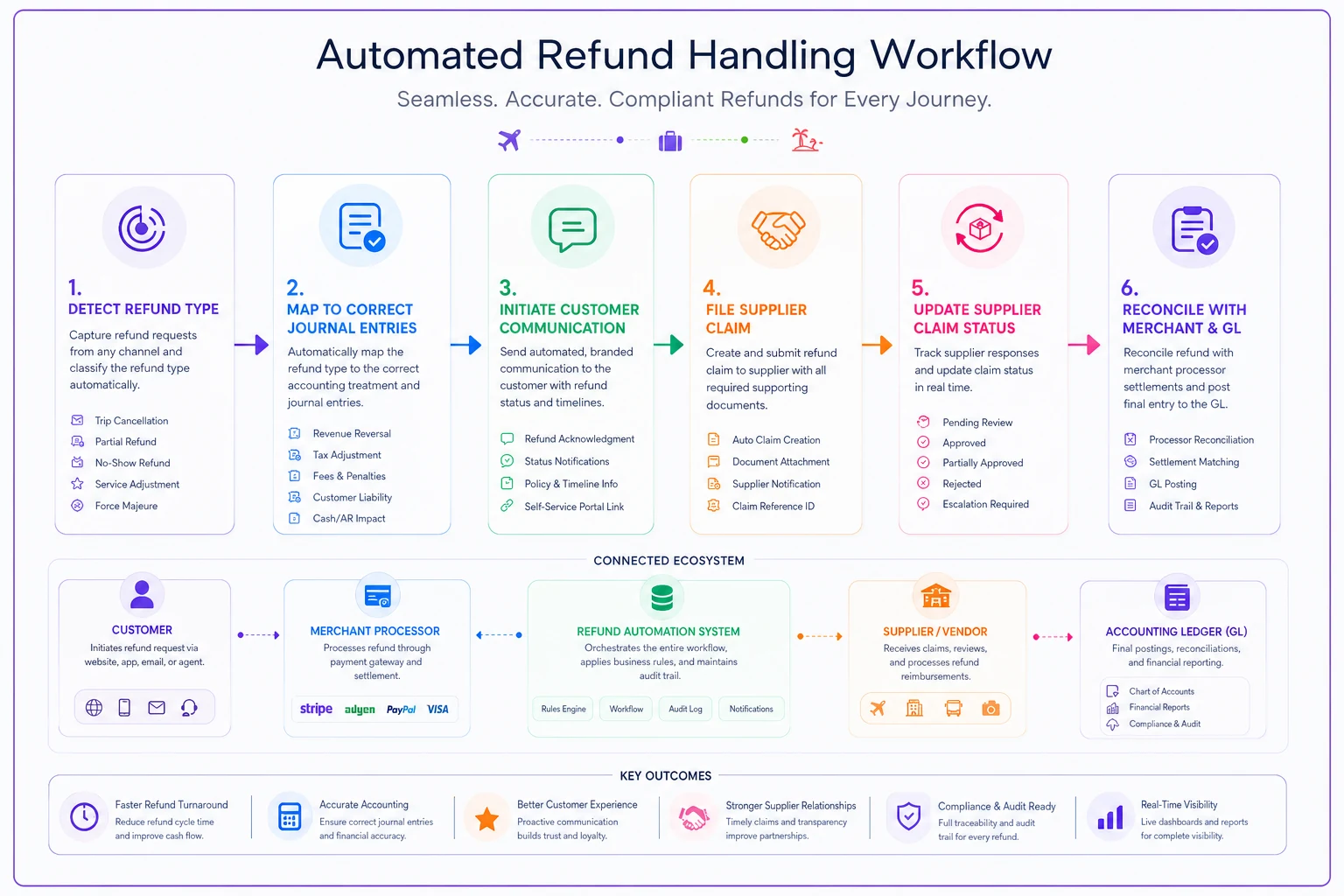
When a weather cancellation comes through, the platform can simultaneously reverse the revenue, initiate customer refunds, file supplier claims, and send rebooking offers — while maintaining the audit trail you'll need at month-end.
The real payoff shows up at reconciliation time. Instead of manually matching three different systems, you get a pre-reconciled view showing exactly which refunds are pending, which supplier claims are outstanding, and where timing differences exist between your books and merchant account. That alone saves a few hours every single month-end.
Stop treating all refunds the same
Refund accounting for tour operators isn't just about recording transactions correctly. It's about building a system that handles each scenario the right way while keeping your books clean and your customers informed.
The decision matrix forces you to think through scenarios before they happen. Proper journal entries ensure your financials reflect operational reality. Message templates prevent customer confusion. The reconciliation checklist catches discrepancies before they turn into real problems.
More importantly, tracking refunds by type reveals patterns. Too many weather cancellations might mean you're booking during risky seasons. A spike in quality-related refunds points to service problems. High last-minute cancellation rates suggest your policies need work.
Your refund data is genuinely useful operational intelligence — but only if you're capturing it at the right level of detail. Start with the decision matrix, implement consistent journal entries, and keep up with the month-end reconciliation discipline. Your books will be cleaner, customer outcomes will be clearer, and your actual operational performance will finally be visible instead of buried in accounting noise.
Refund accounting for tour operators isn't just about recording transactions correctly. It's about building a system that handles each scenario the right way while keeping your books clean and your customers informed.
Ready to elevate your travel business?
Join 500+ travel operators using Touryly to optimize bookings, improve client satisfaction, and grow revenue.