


Most rebooking flows are built backwards. Someone designs a clean UX — a calendar, a few available dates, a big green "Confirm" button — and only later realizes the button is quietly giving away margin, double-holding inventory, or generating refunds that should have been credits. The customer-facing part looks fine. The money and inventory logic underneath is a mess.
For a self-service rebooking tour operator flow to actually protect your business, the UX and the pricing/inventory logic have to be designed together. A date change isn't just a calendar event. It's a price recalculation, an inventory release-and-reacquire, an accounting entry, and possibly a supplier notification — all firing from one guest tap. Get the sequencing wrong and you'll find the leaks at month-end, long after you can do anything about them.
This is a build guide for that plumbing: the anchoring rules, the hold logic, the SLA tiers that decide who gets what, the accounting entries that keep margin intact, and the event wiring that ties it all together.
The three leaks that hide inside a "simple" date change
Before touching any UX, it helps to name exactly where money escapes. Nearly every leaky rebooking flow loses value in one of three places.
Leak 1: Price anchoring to the wrong number. A guest booked a shoulder-season kayak tour at $89. They rebook into a July Saturday that sells for $129. If your flow silently carries the old $89 forward, you just sold peak inventory at off-peak pricing. Multiply that across a season and it's real money. The reverse also happens — someone rebooks from peak into low season and expects a refund of the difference, which you may or may not owe depending on your policy.
Leak 2: Double-held inventory. The guest picks a new date, your system holds the new seat, but the old seat never gets released — or gets released too late. Now you're carrying phantom capacity that looks sold but isn't, or you've released the old seat before the new one is confirmed and a third party grabs it in the gap. Both are inventory accounting failures dressed up as availability bugs.
Leak 3: Refunds where credits belong. Self-service flows default to refunds because refunds are simple to code. But a refund is cash leaving your account and often a payment-processing fee you never recover. A credit keeps the money in your ecosystem. The decision between the two should be a rule, not a default.
None of these show up on the day. They surface weeks later when someone reconciles settlement against bookings and finds the margin doesn't add up. If you've read our take on why a minimum booking→settlement data stack fixes margin leakage, this is the same class of problem showing up at the customer-action layer.
Price-anchoring rules: decide what the guest pays before you build the screen
The single most important decision in a rebooking flow is which price the new booking anchors to. Most operators never write this down explicitly, which is why their flows behave inconsistently.
Never miss a booking or update.
Touryly streamlines your travel bookings, confirmations, and itinerary updates—all in one place.
- Unified booking management
- Automated customer notifications
- Itinerary & staff coordination
No credit card required
There are really only four sane anchoring policies:
| Anchoring rule | What guest pays | Best for | Risk |
|---|---|---|---|
| Original-price lock | Same as first booking | Loyalty-heavy operators, small price spreads | Peak inventory sold at off-peak rates |
| Current-price re-quote | Whatever the new date costs today | Wide seasonal spreads, high-demand slots | Guest friction, more abandoned rebooks |
| Pay-the-difference | Original + delta if new date is pricier; no refund if cheaper | Balanced fairness, protects peak margin | Requires clean delta accounting |
| Banded tolerance | Locked within a price band; re-quote beyond it | Operators who want fairness without giving away peak | Slightly more complex logic |
In practice, pay-the-difference and banded tolerance protect margin best while still feeling fair to the guest. A banded rule looks like this: if the new date's price is within ±15% of the original, honor the original price; outside that band, the guest pays the current rate minus what they already paid. That keeps you from nickel-and-diming someone moving between two similar Tuesdays while stopping the off-peak-to-peak arbitrage.
One thing worth flagging: guests are far more accepting of a "pay the difference" screen when it shows the math. "Your original date: $89. New date (July 12): $129. Balance due: $40." A visible breakdown converts noticeably better than a mysterious new total appearing out of nowhere. Our notes on seasonal pricing rules go deeper on setting those peak differentials — the rebooking flow should inherit whatever price calendar you've already built there, not invent its own.
Hold logic: the sequence that prevents phantom and lost inventory
This is where most self-service flows are quietly broken. The correct sequence for a date change is acquire-then-release, never release-then-acquire, and never both held open indefinitely.
The ordering that avoids both leaks:
-
Guest selects new date. System places a soft hold on the new-date inventory with a short TTL (time-to-live) — somewhere around 8 to 12 minutes.
-
The old-date seat stays committed during this window. You are briefly holding two units. That's intentional.
-
Guest confirms (and pays any difference). System converts the soft hold on the new date to a firm commitment.
-
Only after the new commitment succeeds does the system release the old-date seat back to available inventory.
-
If the guest abandons or the TTL expires, the soft hold on the new date auto-releases and the old booking is untouched.
The critical rule is step 4: the old seat is never released until the new one is locked. This is the opposite of what naive flows do, and it's the difference between "guest rebooked cleanly" and "guest lost both dates and is now emailing you angry."
A hold recipe worth considering for high-demand slots:
-
Soft hold TTL 10 minutes for normal tours, 4–5 minutes for capacity-constrained departures like small boats or permitted routes.
-
Concurrency guard if two guests hold the last seat, first-to-confirm wins; the second gets a graceful "just taken, here are alternatives" screen instead of a failed payment.
-
Payment-pending state if the guest is mid-payment when TTL expires, extend the hold by a short grace period — say 90 seconds — rather than dropping it. Dropping a hold during an in-flight payment is how you create charges with no seat attached.
That last point matters more than it sounds. A charge that lands after the hold expired is one of the ugliest states to untangle, because now finance and operations disagree about whether the guest actually has a booking.
Automated credit vs refund: make it a rule, not a judgment call
If your staff decides case-by-case whether a rebooking gets a credit or a refund, you'll get inconsistency and margin leakage. The decision should be encoded.
A workable decision rule set:
-
Guest-initiated move, new date cheaper issue credit for the difference, not cash. Credit is redeemable against this or a future booking.
-
Guest-initiated move, new date same/pricier collect the difference, no credit or refund involved.
-
Operator-initiated move (you canceled/changed) guest choice of full refund or credit — but bias the UX toward credit with a small incentive (e.g., "keep it as credit and get 10% extra").
-
Weather/supplier disruption governed by your disruption tier, not this flow. If you've built tiered disruption SOPs, the rebooking screen should read from those tiers rather than defaulting to refunds.
-
Outside the free-change window apply the change fee first, then run the difference logic.
The underlying principle: guest-caused changes lean toward credit; operator-caused changes offer refund but nudge toward credit. Cash only leaves the building when you're at fault or legally required.
SLA-tiered rebooking: not every guest gets the same options
Tie the rebooking options to what the guest actually bought. A guest on a fully flexible fare and a guest on a deep-discount non-refundable rate should not see the same screen.
A three-tier structure that works well:
-
Flex tier free date changes up to 24h before, difference-only pricing, credit for downgrades. Sold at a premium.
-
Standard tier one free change up to 72h before, then a flat change fee; pay-the-difference beyond the price band.
-
Saver tier changes allowed but always at current price with a change fee, no credits for downgrades. Non-refundable.
The rebooking flow starts to function as a reason to sell the higher tier. When guests see at checkout that Flex means "change anytime, just pay the difference," a meaningful portion will pay the upsell. You're monetizing the flexibility that used to be a pure cost center.
Accounting wiring: sample journal entries that keep margin honest
This is where rebooking silently corrupts your books if you're not careful. A date change touches deferred revenue, cash, and sometimes a credit-liability account. Here's how the common cases should book.
Case A — Guest rebooks to a pricier date, pays $40 difference:
Dr Cash / Payment clearing 40 Cr Deferred revenue 40
Case B — Guest rebooks to a cheaper date, $30 difference issued as credit:
Dr Deferred revenue 30 Cr Customer credit liability 30
Case C — Operator-caused move, guest takes a $120 refund:
Dr Deferred revenue 120 Cr Cash / Payment clearing 120
The processing fee on the original charge usually isn't recovered — book that fee loss separately so you can see the true cost of operator-initiated changes. If those fee losses are adding up, that's a signal your disruption handling upstream needs work, not your accounting.
The margin-protection habit: never let a rebooking recognize revenue early, and never let a credit be booked as if it were a fresh sale. Both mistakes inflate revenue and hide the real position. Our payments-governance playbook covers the reconciliation side that catches these when they slip through.
Event and webhook wiring: what fires, in what order
A clean rebooking is a small chain of events. Wiring these loosely — or firing them out of order — is how you end up with double-held inventory and mismatched books.
A sensible event flow:
-
rebooking.initiated→ logs the request, snapshots the original price and seat. -
inventory.soft_hold.created(new date) → TTL clock starts. -
pricing.delta.calculated→ determines difference, credit, or fee per your anchoring rule. -
payment.difference.capturedorcredit.issued→ only one fires depending on direction. -
inventory.commit.confirmed(new date) → firm seat. -
inventory.release.completed(old date) → old seat returns to pool. -
booking.updated→ single source-of-truth record now points at the new date. -
supplier.notification.sent→ if the supplier needs the manifest change. -
accounting.entry.posted→ books the journal entry from the case logic above.
For a quick visual, see the workflow below.
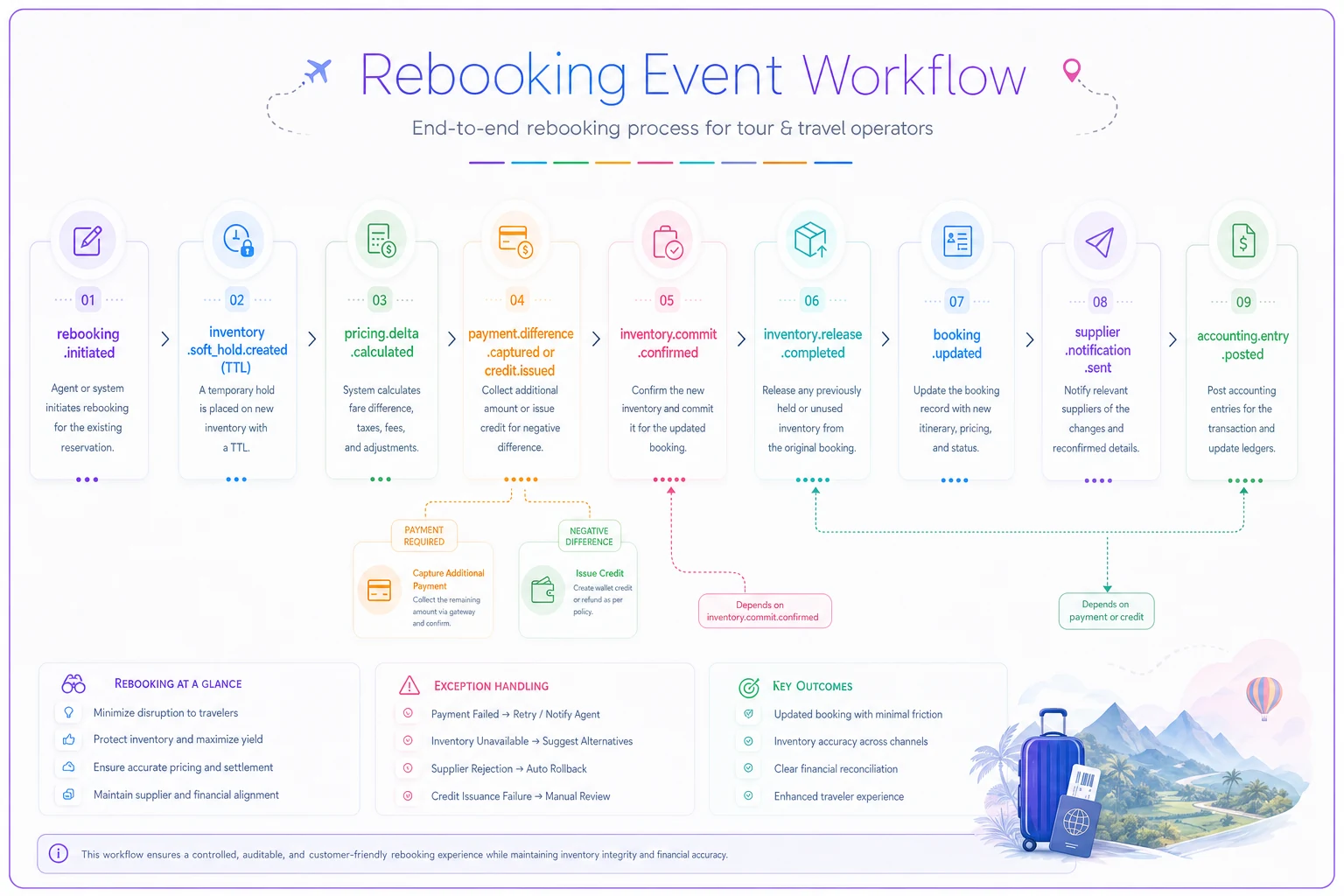
The ordering rule that matters most: step 6 must depend on step 5, and step 9 must depend on step 4. Never release old inventory before new inventory commits, and never post accounting before money or credit actually moves. If you build these as fire-and-forget instead of dependent steps, you'll get seats released into thin air and journal entries for payments that never landed.
For idempotency, tag every event with the rebooking request ID so a retried webhook doesn't double-release a seat or double-post an entry. Duplicate events are the norm in real integrations, not the exception.
A short real scenario
A small adventure operator running e-bike and canyon tours — around 300–350 bookings a month across peak season — had a self-service reschedule link that carried the original price forward and issued refunds for any downgrade. Two things were bleeding: guests were rebooking from $79 weekday slots into $119 weekend slots at the old price, and downgrades were going out as cash refunds, eating processing fees each time.
They didn't rebuild the UX dramatically. They changed three rules: banded price tolerance at ±15%, pay-the-difference beyond the band, and downgrades issued as credit instead of refund. They also fixed the hold order to acquire-then-release.
Over the following season, the recovered margin from correctly-priced weekend rebooks plus the avoided refund fees came to somewhere in the low four figures a month — not dramatic per booking, but it had been vanishing completely before. The double-held-seat complaints stopped almost entirely once the hold sequence was corrected. Nothing about the guest experience got worse; the difference screen actually reduced support tickets because guests could see the math.
When this makes sense — and when it doesn't
When to build full self-service rebooking: you have meaningful rebooking volume, a real price calendar with seasonal spread, and inventory that's constrained enough that hold logic actually matters. If date changes are a regular part of your operation, automating them correctly pays back quickly.
When to keep it manual: very low volume, highly bespoke multi-supplier itineraries where every change requires human coordination, or thin enough margins that any pricing edge case could wipe a booking's profit. For a handful of changes a month, a human applying the same decision rules by hand is cheaper than building and maintaining the wiring.
Who should not do this yet: operators whose booking and settlement data don't reconcile cleanly. If you can't currently trace a single booking from payment to delivery to accounting, adding automated rebooking on top will just automate the confusion. Fix the data foundation first, then wire the rebooking flow onto something solid.
The takeaway
Self-service rebooking is not a UX project with some payment code bolted on. It's a pricing decision, an inventory-sequencing decision, an accounting decision, and a customer-fairness decision — all triggered by one tap. Design the rules first: how price anchors, how holds sequence, when credit beats refund, which tier gets which options. Then wire the events so the money and the inventory can never fall out of sync. Do that, and the green "Confirm" button stops being a slow leak and starts being one of the more profitable interactions your guests have with you.
Ready to elevate your travel business?
Join 500+ travel operators using Touryly to optimize bookings, improve client satisfaction, and grow revenue.