



Peak season hits and suddenly you're watching full tours depart while last-minute bookers wave their credit cards at you. Meanwhile, your shoulder season tours run at 40% capacity because your pricing hasn't adapted. This disconnect between demand patterns and pricing structures bleeds revenue across the entire operation.
Most operators understand basic pricing. The real issue is running pricing systems built for steady businesses when demand swings wildly based on season, group composition, and booking patterns. Add minimum viable group sizes, operational thresholds, and cascade effects of pricing decisions—the math gets complicated quickly.
Why static pricing breaks down at operational scale
Static pricing works when you're running three tours a week with predictable demand. Scale up and watch what happens. A San Diego whale watching company with 12 daily tours discovered their flat $89 pricing left nearly $400k on the table annually. Not because they needed complex revenue management software. Their pricing ignored basic capacity dynamics.
Morning tours (7am and 9am) consistently hit capacity two weeks out during summer. They turned away roughly 1,800 customers between June and September. Their 3pm tours averaged 55% occupancy even in peak season. Same operational cost per seat—same boat, crew, fuel burn. But revenue per departure varied by over 60% based purely on time slot.
Group bookings make this worse. Large groups naturally book less popular slots for availability. Your lowest-demand tours get filled with your most discounted customers.
Consider a 40-seat boat with $50 base operational cost per seat. A full morning tour at standard pricing generates $3,560 gross ($89 × 40). That same boat at 3pm with 22 passengers, where 15 came from a group booking at 20% discount, generates $1,569. Same costs. Less than half the revenue.
This repeats across adventure tours, food tours, cultural experiences—any tour operation with fixed capacity and variable demand. You can't just add capacity to popular slots. Coast Guard regulations, permit restrictions, equipment limitations, and staff scheduling create hard ceilings.
The capacity utilization trap most operators miss
Most operators think about pricing as a demand lever—raise prices to reduce demand, lower them to increase it. Tour operations face a different constraint: minimum viable group thresholds.
Never miss a booking or update.
Touryly streamlines your travel bookings, confirmations, and itinerary updates—all in one place.
- Unified booking management
- Automated customer notifications
- Itinerary & staff coordination
No credit card required
A helicopter tour needs at least 3 passengers to break even on fuel and pilot costs. A food tour needs 6 participants to justify restaurant minimums and guide allocation. A multi-day trek needs 8 people to cover permits, transport, and camp setup. Below these thresholds, you either cancel or run at a loss.
This creates a pricing paradox. Lower prices to hit minimums can reduce total revenue if you're cannibalizing higher-margin bookings. Maintaining high prices risks falling below operational minimums.
Take a sunset sailing tour with these parameters:
-
20-person capacity
-
$1,200 fixed operational cost
-
$80 standard ticket price
-
8-person minimum for departure
| Passengers | Revenue @ $80 | Fixed Cost | Profit | Per-Seat Margin |
|---|---|---|---|---|
| 20 (full) | $1,600 | $1,200 | $400 | $20 |
| 15 | $1,200 | $1,200 | $0 | $0 |
| 10 | $800 | $1,200 | -$400 | -$40 |
| 8 (minimum) | $640 | $1,200 | -$560 | -$70 |
| 7 (cancelled) | $0 | $0 | $0 | N/A |
You lose more money running at minimum capacity than canceling entirely. Yet canceling damages reputation and future bookings. This drives desperate last-minute discounting, which trains customers to wait for deals.
Group pricing thresholds that actually work
Group bookings fill capacity but demand discounts and often book popular slots far in advance. The standard approach—flat percentage discounts based on group size—ignores operational reality.
Timing impact: A group of 12 booking your morning kayak tour three months out anchors your schedule and reduces cancellation risk. That same group booking two days before departure when you're already at 80% capacity? They're taking full-price spots.
Operational efficiency: Groups reduce check-in complexity, simplify logistics, and often have better show rates. A single contact for 15 people beats managing 15 individual bookings. This has real value.
Capacity optimization: Groups can push tours over profitability thresholds. If you need 8 people for profitable departure and a group of 6 books, you only need 2 more individual bookings versus finding 8 scattered bookings.
A threshold structure that maps to operations:
Early booking rewards (30+ days out):
-
6-9 people
10% discount
-
10-15 people
15% discount
-
16+ people
20% discount
Standard window (7-29 days out):
-
6-9 people
5% discount
-
10-15 people
10% discount
-
16+ people
15% discount
Last minute (less than 7 days):
-
Only offer group rates if tour is below 60% capacity
-
Maximum 10% discount regardless of size
-
No discount if tour is above 80% capacity
Group discounts should decrease as departure approaches and increase based on operational value, not just size.
Add-on bundling beyond the upsell
Most operators treat add-ons as pure margin enhancers—photo packages, lunch upgrades, souvenir combos. But add-ons serve a more sophisticated role when structured properly.
Add-ons let you maintain competitive base pricing while capturing additional margin from less price-sensitive customers. They can also smooth operational complexity. A ziplining company added a "skip-the-waiver" package for $15 including pre-completed paperwork, priority harness fitting, and first-run privileges. Forty percent of customers bought it, generating an extra $18,000 monthly while reducing check-in bottlenecks.
Base tour price stays at market rate—say $125 for a canyoning adventure. Create three tiers:
Essential ($125): Just the tour
Enhanced ($155): Tour + photos + dry bag rental
Complete ($195): Everything above + lunch + transport from hotel
The Enhanced package costs maybe $8 to fulfill but adds $30 revenue. The Complete package adds $40 revenue for roughly $15 in additional cost.
With typical adoption rates:
-
35% choose Essential
-
45% choose Enhanced
-
20% choose Complete
Average revenue per customer jumps from $125 to $151 without changing the base price. On 850 monthly bookings, that's an extra $22,100 in mostly pure margin.
The real gain comes from operational smoothing. Complete package buyers don't need separate transport coordination. Enhanced buyers don't slow departure fumbling with phone waterproofing. Bundles reduce friction while increasing revenue.
Dynamic pricing rules that don't require a PhD
Dynamic pricing sounds complex but the minimum viable version is simple. You don't need machine learning. You need rules that respond to basic operational triggers.
Start with time-based adjustments. Track your standard booking curve for each tour type. City walking tours book steadily until 48 hours out, then spike. Adventure tours book in waves at 3 weeks, 1 week, and 24 hours before departure.
When bookings deviate from pattern, prices should adjust:
-
If tour is 70% booked 14+ days out
increase price 15%
-
If tour is 50% booked 7 days out
increase price 10%
-
If tour is below 40% booked 7 days out
decrease price 15%
-
If tour is below 25% booked 48 hours out
decrease price 25%
Capacity triggers:
-
Last 5 spots on any tour
increase price 20%
-
Last 2 spots
increase price 40%
-
If tour hits minimum threshold
lock current price (no more discounts)
Competitive response rules:
-
Monitor 3 closest competitors' pricing weekly
-
If you're 15% higher than average
review and consider adjustment
-
If you're 15% lower than average
test 10% increase
-
Never match competitor desperation pricing in shoulder season
A sunrise hot air balloon operator implemented this using a basic spreadsheet their booking coordinator updates twice daily. Takes 5 minutes. Generated an extra $73,000 their first season just from better capacity utilization.
Here's a simple workflow to visualize how these rules apply.
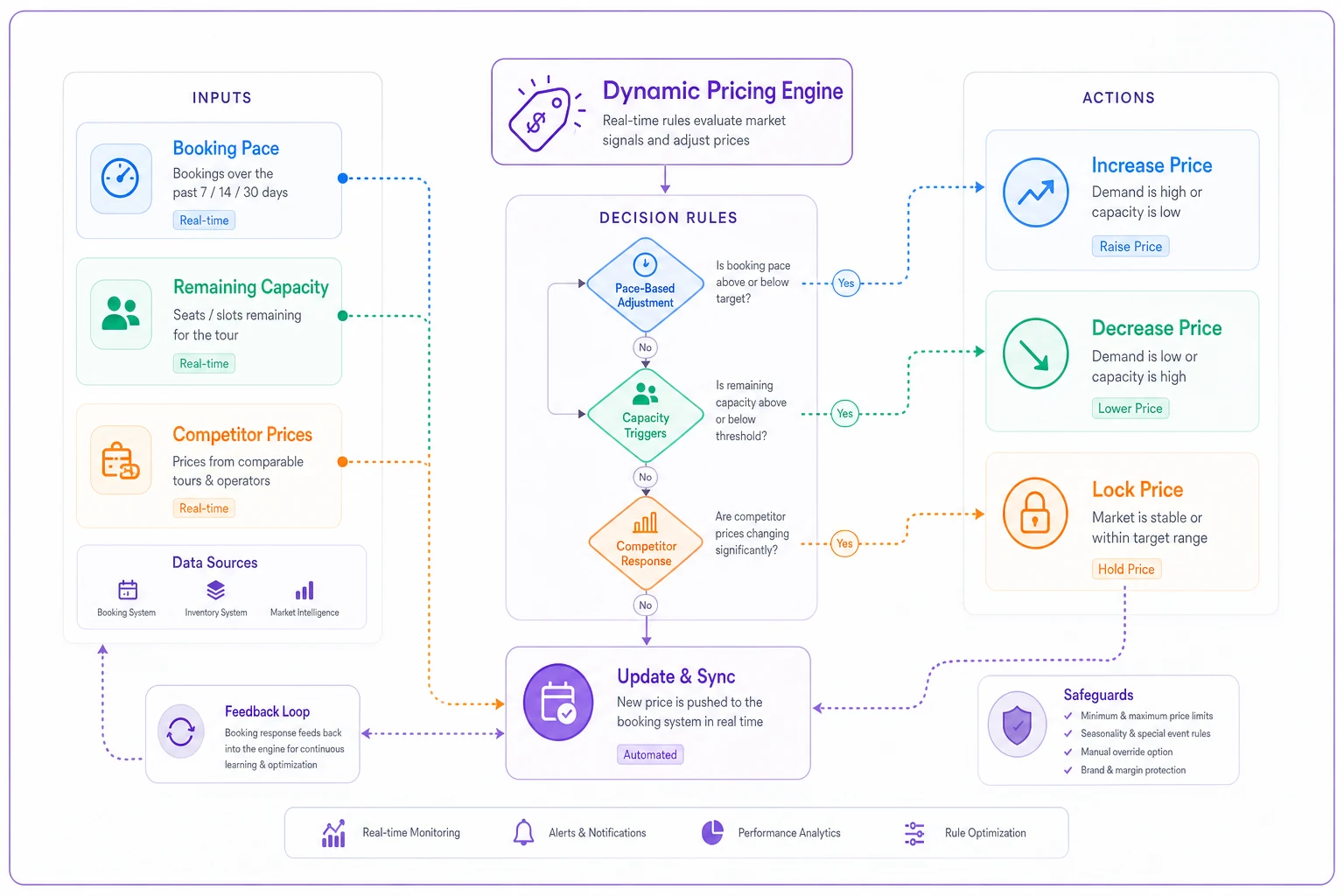
This diagram shows the decision flow for pace, capacity, and competitor triggers.
The cascade effect of integrated pricing ops
Pricing decisions ripple through your entire operation. Change group discount structure and your marketing team needs different messaging. Adjust capacity thresholds and operations scrambles with scheduling. Add dynamic pricing and customer service deals with confusion.
Your pricing architecture needs to connect with:
-
Booking flow
Prices should update automatically across all channels. Manual updates lead to discrepancies and lost revenue. One operator lost $32,000 in a season because their OTA listings didn't reflect website price increases.
-
Staff scheduling
If dynamic pricing fills afternoon tours, you need staff available. Pricing rules should factor in operational constraints. No point driving bookings you can't fulfill.
-
Marketing coordination
Paid ads, email campaigns, and social posts need to align with pricing reality. Nothing kills conversion faster than advertising expired deals.
-
Customer communication
Clear explanation prevents frustration. "Prices vary by departure time and availability" sets better expectations than discovering different prices for the same tour.
Managing these connections manually breaks most pricing initiatives. You need either dedicated revenue management resources or systems that automate the coordination. Most small operators can't justify a full-time pricing analyst, which pushes toward operational software that handles the complexity.
When sophisticated pricing actually hurts
Not every operation benefits from complex pricing:
Low volume operations: If you run 3 tours weekly, dynamic pricing overhead exceeds the benefit. Stick with seasonal adjustments and group discounts.
Commodity experiences: Generic city bus tours compete purely on price and convenience. Complex pricing confuses customers who see minimal differentiation.
Ultra-premium positioning: Luxury experiences sometimes benefit from price stability as a quality signal. Fluctuating prices can cheapen brand perception.
Regulated environments: Some permits or concessions require published rates. Dynamic pricing might violate operating agreements.
If pricing optimization might generate $30,000 annually but requires $40,000 in systems and time, focus elsewhere.
A grounded example with real math
Pacific Kayak Adventures ran 3 daily tours with 12-kayak capacity. Original pricing: flat $65 per person, 20% group discount for 6+, no variation by time or season. Annual revenue: roughly $580,000.
Their stepped approach:
Phase 1: Time-based pricing
-
7am tour
$59 (harder to fill)
-
10am tour
$69 (most popular)
-
2pm tour
$65 (moderate demand)
Result: $34,000 additional revenue
Phase 2: Seasonal adjustments
-
Peak season (Jun-Aug)
+15% on all tours
-
Shoulder (Apr-May, Sep-Oct)
base pricing
-
Off-peak (Nov-Mar)
-10% on all tours
Result: $52,000 additional revenue, better off-season utilization
Phase 3: Dynamic capacity pricing
-
Last 3 spots
+$10 per ticket
-
Below 50% capacity 72 hours out
-$10 per ticket
-
Minimum 6 people or cancel (clearly communicated)
Result: $28,000 additional revenue, 18% fewer cancellations
Phase 4: Bundled add-ons
-
Photo package
+$20 (30% adoption)
-
Wetsuit upgrade
+$15 (25% adoption)
-
Combo with lunch
+$35 (15% adoption)
Result: $67,000 additional revenue
Total impact: $181,000 additional annual revenue on the same operational base. Revenue per tour increased from $528 to $692. The key wasn't any single pricing lever—it was systematic application of multiple approaches aligned with operational reality.
Making pricing operational, not theoretical
The gap between pricing theory and operational execution kills most revenue management initiatives. You can build beautiful models showing 30% revenue uplift, but if your team can't implement them or customers rebel against complexity, you achieve nothing.
Start with one pricing lever. Test it for a full cycle. Measure not just revenue but also:
-
Booking complexity
-
Customer complaints
-
Staff time required
-
System integration challenges
-
Actual vs projected results
Add complexity only when you've proven you can handle what you have. Most tour operators would see meaningful improvement just from moving beyond flat pricing to basic time-of-day adjustments.
Tools matter less than discipline. You can run sophisticated pricing from spreadsheets if you have clear processes. Conversely, expensive revenue management software means nothing if nobody maintains the rules or responds to insights.
Test one pricing lever for a full cycle before adding another to avoid overwhelming operations.
Modern operational software makes the difference not by adding complexity, but by making sophisticated pricing rules simple to execute. When price adjustments flow automatically from booking pace, when group discounts calculate without manual intervention, when add-on bundles integrate seamlessly into booking flow, then pricing optimization becomes operational reality rather than theoretical exercise.
The best tour operators don't necessarily have the most complex pricing. They have pricing that matches their operational reality, adjusts to market conditions, and gets implemented consistently across every booking channel and customer interaction.
Your pricing model is only as good as your ability to execute it. Build from that constraint and you'll capture value others leave on the table, one properly-priced tour at a time.
Ready to elevate your travel business?
Join 500+ travel operators using Touryly to optimize bookings, improve client satisfaction, and grow revenue.