

The worst substitution decisions happen in the 90 minutes before pickup, when a coordinator has three tabs open, a driver texting "where do I go," and a supplier who just said the 14-seat Sprinter turned into an 11-seat van. That's the moment where operators either make a clean call or freeze — and freezing costs more than a wrong answer.
Most operators already have the pieces: a backup supplier list, a customer service inbox, some SLA language somewhere. What's missing is a supplier substitution decision matrix that turns "this feels bad" into a scored, time-boxed decision anyone on the ops team can execute the same way at 6am or 11pm. That's what this playbook builds.
We're not covering the sourcing side here — clause negotiation and substitution windows were already covered in the supplier procurement playbook. This is the operational layer: the supplier already failed or downgraded, the trip runs in hours, and you need a repeatable call.
Why "gut feel" substitutions keep going sideways
The failure pattern is almost always the same. A supplier confirms something inferior — a different hotel category, a smaller vehicle, a guide who doesn't speak the group's language — and the coordinator makes a judgment call based on how stressed they are that day. Two identical situations get handled completely differently depending on who's on shift.
This usually happens because the decision has three moving variables that people weigh inconsistently:
-
Guest impact — how much the swap actually degrades the experience the customer paid for
-
Cost delta — what the substitution does to your margin, in either direction
-
Notice window — how much time you have before the guest is affected
Without a shared scale, the coordinator who hates confrontation accepts substitutions that should've been rejected, and the one who over-communicates blasts a group of 30 with an apology email for a change nobody would've noticed. Both create downstream mess.
There's also a subtle but expensive mistake teams make: treating "cost delta" as only meaning a cost increase. Plenty of substitutions are cheaper for you — the supplier downgraded and still charged full rate. Those need to be flagged just as hard, because that's a supplier claim you're owed, and it evaporates if nobody books it within a day or two.
The scoring model
Score each substitution on three axes, 1–5. Keep the anchors written down so two people score the same situation within a point of each other.
Never miss a booking or update.
Touryly streamlines your travel bookings, confirmations, and itinerary updates—all in one place.
- Unified booking management
- Automated customer notifications
- Itinerary & staff coordination
No credit card required
Keep the anchors written down so two people score the same situation within a point of each other.
Guest impact (1 = invisible, 5 = trip-defining)
-
1 — Guest almost certainly won't notice (same hotel, room facing the car park instead of the garden)
-
2 — Minor, cosmetic (different but equivalent restaurant for one included meal)
-
3 — Noticeable but not a core promise (3-star instead of 4-star, one night only)
-
4 — Touches a headline reason they booked (private guide becomes shared)
-
5 — Breaks a core promise (sea-view suite becomes inland standard; the sunset cruise becomes a daytime one)
Cost delta (score the magnitude, note the direction)
-
1 — Within ±3% of booked cost
-
2 — 3–8%
-
3 — 8–15%
-
4 — 15–30%
-
5 — 30%+
Notice window (time until guest is affected)
-
1 — More than 5 days
-
2 — 2–5 days
-
3 — 24–48 hours
-
4 — 4–24 hours
-
5 — Under 4 hours
One thing most operators miss: notice window shouldn't just measure panic. Short notice reduces your options but also reduces the guest's ability to demand alternatives — so it changes which template and which authority level you use, not automatically whether you accept.
The decision ladder
Add the three scores. The total (3–15) maps to an action band. The total alone isn't enough though — a single 5 on guest impact overrides everything, because a broken core promise is a refund and complaint risk regardless of cost.
| Total score | Guest impact = 5? | Action band | Who decides |
|---|---|---|---|
| 3–6 | No | Auto-accept, log only | Coordinator |
| 7–9 | No | Accept + notify guest | Coordinator |
| 10–12 | No | Accept only with comp, or reject | Ops lead |
| Any | Yes | Reject or escalate for approval | Ops lead / owner |
| 13–15 | Any | Reject, trigger recovery | Ops lead / owner |
"Recovery" means going back to your availability options rather than accepting the swap — the same backup-sourcing logic behind the channel-priority matrix and recovery SOP. The matrix tells you whether to accept; recovery is what you do when the answer is no.
Here's a quick visual of the decision ladder workflow.
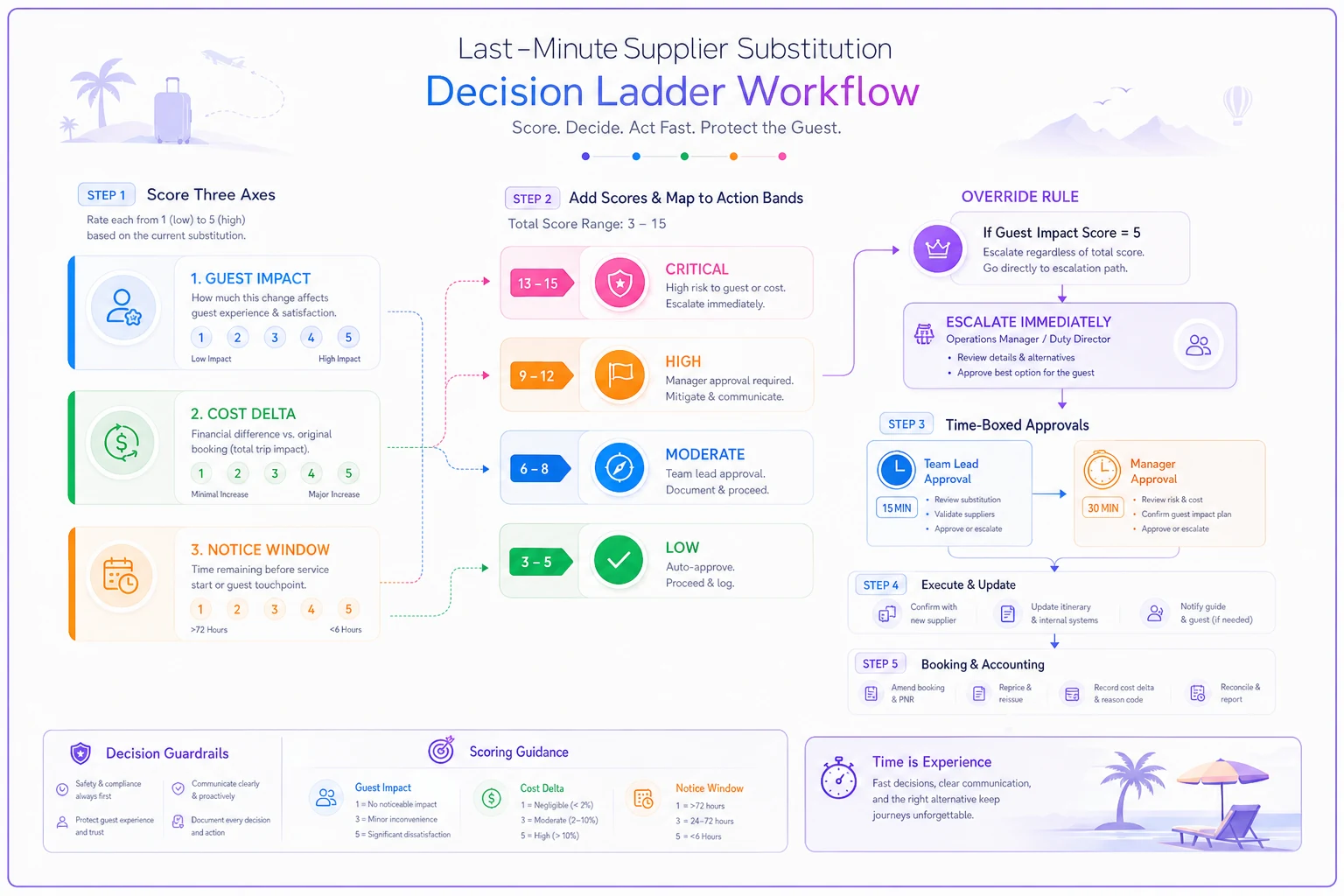
The time-box matters as much as the score. Give each band a clock:
-
Score the substitution — 5 minutes, using the anchors above.
-
Check the guest-impact override — is any single axis a 5? If yes, jump straight to escalation.
-
Match to action band — pick the template, don't rewrite it.
-
If band requires approval — one message to the ops lead with the three scores, not a paragraph of context. They reply accept/reject inside 15 minutes.
-
Book the treatment — accounting entry raised same day, supplier claim flagged if you're owed one.
The whole thing should take under 20 minutes even at a band-4 escalation. If it's dragging past that, someone's debating instead of scoring.
Worked example
A day-tour operator running a small-group food walk (12 guests, €95pp, booked cost per head ~€41). Two hours before start, the wine-pairing venue cancels; the supplier offers a nearby bar that does the same tasting but without the historic cellar the listing photos show.
-
Guest impact the cellar is in the product photos and description → 4
-
Cost delta replacement venue is actually €6/head cheaper → magnitude 2, direction negative (you're owed)
-
Notice window under 4 hours → 5
Total = 11, no single axis hits a 5, so it lands in the 10–12 band: accept only with comp, or reject. The ops lead accepts with a comp — a free digital recipe booklet plus 10% off a future walk — rather than scrambling a fresh venue with two hours' notice. Meanwhile the €6/head owed, €72 total, becomes a supplier claim that needs to be booked today or it's gone.
That last part is where operators quietly leak money. The comp got handled because the guest was right there. The €72 credit disappeared because nobody logged it.
The accounting treatments
Every substitution outcome needs a booked treatment, not just a note in the inbox. Three common outcomes, three journal patterns. These follow the same discipline as the refund accounting decision matrix — the outcome dictates the entry, and it gets raised the same day.
Outcome A — Accepted substitution, you're owed money (supplier downgraded)
Using the example above, €72 owed by supplier:
Dr Supplier claims receivable 72.00 Cr Cost of sales – tours 72.00 When the credit note lands and is applied against the next invoice, clear the receivable against the payable.
Outcome B — Accepted substitution + guest comp issued
Say the comp is a €15 future-tour voucher:
Dr Marketing / goodwill expense 15.00 Cr Voucher liability 15.00 Booking it as a liability rather than a straight expense write-off keeps your outstanding-voucher exposure visible instead of hiding it.
Outcome C — Rejected substitution, guest refunded, claim against supplier for your loss
Guest refunded €95, supplier failed to deliver, contract lets you recover €41 cost:
Dr Refunds payable / cash 95.00 Cr Revenue (reversal) 95.00 Dr Supplier claims receivable 41.00 Cr Cost of sales – tours 41.00
The pattern worth internalizing: an accepted swap that saves you money is still a claim, and a rejected swap that costs a refund is still a recovery. Both get an entry with a receivable, and both die in the inbox if the coordinator's only job is "handle the guest."
Communication templates
Templates aren't about laziness — they're about not writing an apology at 6am that promises something you can't fund. Two guest-facing, two supplier-facing.
Guest — band 7–9, notify only (no comp): > Hi [name], quick heads-up about your [tour] on [date]. Due to a last-minute change on our side, [specific element] will be [substitution]. Everything else runs as planned and we don't expect this to affect your experience. Any questions, reply here and we'll sort it.
Guest — band 10–12, accepted with comp: > Hi [name], we've had to make a change to your [tour] on [date]: [element] is now [substitution]. To make up for the difference, we've added [comp] to your booking. We're confident you'll still have a great time — reply here if you'd rather talk it through.
Supplier — logging a claim you're owed: > Hi [supplier], confirming the substitution on [booking ref] on [date]: booked [X], delivered [Y]. Per our agreement this is a [amount] adjustment. Please issue a credit note against invoice [ref] within [X days]. Confirming receipt of this note today.
Supplier — escalation on a rejected substitution: > Hi [supplier], we can't accept the proposed substitution on [booking ref] — [reason tied to guest impact]. We've had to [refund/re-source] at a cost of [amount], which we're claiming under [clause]. Please confirm by [time].
When this matrix actually earns its keep
This is built for operators running enough volume that substitutions happen weekly and get handled by more than one person. If two different coordinators are handling supplier swaps, you need the shared scale — otherwise your customer experience is basically a coin flip based on who's on shift.
It's overkill for a solo operator running a handful of departures a month. If you're personally making every call and you already remember to log the money side, the scoring ceremony adds friction without much payoff. Use it once you've been burned by a swap someone else waved through — that's usually the trigger.
Who should not lean on this: anyone using it to avoid fixing upstream supplier reliability. If the same supplier is forcing band-4 substitutions three times a month, the matrix is treating a symptom. That's a sourcing and SLA problem, and no amount of clean decision-making downstream fixes a supplier who can't hold availability.
A short real scenario
A regional multi-day operator — around 40 departures a month, four-person ops team — kept eating margin on accommodation downgrades. Suppliers would swap a booked category for something cheaper and still bill full rate, and because the guest-facing side got handled well, nobody chased the difference.
Rough numbers: they were absorbing somewhere around €600–€900 a month in downgrades they were contractually owed, plus inconsistent guest comps that were either too generous or completely absent depending on who was on shift.
After putting the scoring anchors and same-day accounting rule in place, two things shifted. Guest comps got consistent — coordinators stopped over-apologizing on band-7 changes and stopped ignoring band-11 ones. And the supplier-claim receivables actually got booked, so the recovered amounts started showing up instead of leaking. Within a couple of months the "accepted a downgrade and never claimed it" problem basically stopped, mostly because the accounting entry was now step 5 of the ladder instead of something someone might remember later.
The one thing to take away
A substitution isn't just a guest problem or an accounting problem — it's both, and the reason it goes wrong is that ops handles the guest while the money quietly walks out the door.
Scoring on guest impact, cost delta, and notice window gives you a decision anyone can repeat. Forcing a same-day treatment for every outcome closes the leak. Keep the ladder short, keep the clock on it, and don't let a well-handled guest email be the reason you never booked the credit you were owed.
Ready to elevate your travel business?
Join 500+ travel operators using Touryly to optimize bookings, improve client satisfaction, and grow revenue.