


Most operators treat waivers as a single PDF. Guest signs it, it gets stored somewhere, done. That works right up until a guest sprains an ankle on a via ferrata in Italy, and your office in London realises the waiver they signed was written for UK liability law, never mentioned the activity provider's indemnity position, and was translated by someone on the team using Google Translate two seasons ago.
That's the real shape of the problem. Tour operator waivers liability isn't a document issue — it's a system that spans risk classification, the waiver language itself, what your suppliers owe you when things go wrong, and how a claim moves through your operation across borders. When one piece is out of sync with the others, you find out at the worst possible moment: after the incident, when everyone starts reading the fine print.
This article walks through how those pieces fit together, where they break as you scale into new markets, and what a workable system looks like instead of a drawer full of mismatched forms.
Why a single waiver stops working the moment you cross a border
The core issue is that a waiver is only as strong as the law it's enforceable under. A liability waiver that holds up in one jurisdiction can be partially or entirely void in another.
Operators tend to learn this unevenly. You might run kayaking trips in one country for years with a boilerplate waiver, expand into a second market, reuse the same form, and assume you're covered. In reality, some jurisdictions won't enforce waivers that attempt to disclaim gross negligence. Others require specific language, specific font sizes, or a cooling-off period. A few treat consumer-facing waivers very differently from business-to-business indemnity between you and your supplier.
So you end up with a quiet mismatch. The guest signed something. It just doesn't do what you think it does in the market where the incident happened.
Start with risk classification, not with the form
Before you touch waiver language, you need a way to classify what you're actually exposed to. This is the step most operators skip, and it's why their waivers feel generic — because they were written without a clear picture of the risk being transferred.
Never miss a booking or update.
Touryly streamlines your travel bookings, confirmations, and itinerary updates—all in one place.
- Unified booking management
- Automated customer notifications
- Itinerary & staff coordination
No credit card required
A practical risk classification separates activities by severity and by how much control you have over the supplier delivering them. Those are two different axes and they matter for different reasons. Severity drives how aggressive your waiver and insurance need to be. Control drives how hard you push on supplier indemnity.
Here's a simplified version of how that classification tends to shape up:
| Risk tier | Example activities | Severity | Your control over delivery | Waiver + indemnity posture |
|---|---|---|---|---|
| Low | Walking tours, museum visits, tastings | Low | High (often your own guides) | Standard waiver, light supplier indemnity |
| Medium | Cycling, snorkelling, light hiking | Moderate | Mixed | Activity-specific waiver clauses, clear supplier indemnity |
| High | Canyoning, diving, climbing, rafting | High | Low (specialist suppliers) | Strong waiver + mandatory supplier insurance + full indemnity flow-down |
| Severe | Heli-activities, high-altitude, extreme | Very high | Very low | Dedicated agreements, named-insured status, legal review per market |
The important distinction here is that posture isn't just about how dangerous the activity is. A high-severity activity you control directly carries different exposure than the same activity delivered by a third-party specialist. In the first case you need bulletproof waivers and insurance. In the second, you also need the supplier's indemnity to flow through cleanly — because if a guest is hurt, you want their insurer in the room, not just yours.
Once activities are classified, the waiver stops being one document and becomes a base template plus activity-specific modules. That's the structure that scales.
Adjustable waiver templates: the base + module approach
A single waiver that tries to cover everything ends up covering nothing well. It's too generic for high-risk activities and overbuilt for low-risk ones, and it almost never maps properly to the specific market where it's being used.
-
A base layer with the universal clauses
identification, acknowledgement of risk, data handling, emergency contact, medical disclosure.
-
Activity modules that attach based on the risk tier — the canyoning module describes canyoning-specific risks in plain language, the diving module covers certification and medical fitness, and so on.
-
Jurisdiction overlays that adjust enforceability language for the market the tour runs in, not the market the guest booked from.
The jurisdiction overlay is the piece operators consistently underbuild. A guest booking from Germany for a trip in Costa Rica needs the waiver aligned to where the activity happens and where a claim would likely be brought. Getting this wrong doesn't always invalidate the whole waiver, but it creates arguable gaps — and arguable gaps are expensive.
Worth flagging: the medical disclosure and emergency contact fields in your waiver are personal data, and they travel across borders the moment a guest from one country books an activity in another. How you collect, store and retain that information is its own discipline. We've gone deeper on that in the PII lifecycle for tour operators piece, and it's worth lining up your waiver fields with that governance framework rather than treating them as separate concerns.
A quick word on signatures and timing
When the waiver is signed matters as much as what it says. A waiver signed at the trailhead, under time pressure, with a guide waiting, is weaker than one signed at booking with time to read it. Several jurisdictions look unfavourably at waivers presented at the last moment with no real opportunity to decline.
The practical fix is to shift signature to the booking or pre-trip stage for medium-and-above risk activities, and keep the day-of signature only as a confirmation step. That gives you a cleaner evidentiary position and fewer guests claiming they were rushed.
Supplier indemnity: where the money actually moves
This is the part that determines whether a claim becomes your problem or your supplier's. Supplier indemnity is the mechanism by which risk you've accepted from the guest gets passed to the party who actually caused the loss.
In practice, a lot of supplier agreements have indemnity clauses that look fine and function poorly. Common failure points:
-
Indemnity caps that are lower than realistic claim values. A supplier agrees to indemnify you up to their annual contract value. For a severe-tier activity, that's nowhere near a serious injury claim.
-
No requirement to name you as an additional insured. You have an indemnity promise, but if the supplier is undercapitalised or goes under, the promise is worthless. Being a named insured on their policy means you can claim directly against the insurer.
-
Mismatched definitions of negligence. Your waiver disclaims your own ordinary negligence to the guest, but your supplier only indemnifies you for their gross negligence. That gap in the middle is yours.
-
Expired or unverified certificates of insurance. The agreement requires coverage, but nobody checks the certificate is current. Policies lapse. Coverage gets reduced quietly at renewal.
A useful rule: indemnity should flow down in the same shape it flows up. Whatever you've disclaimed to the guest, your supplier's indemnity to you should cover the corresponding supplier-caused version of that risk. When those two don't match, map the gap and either close it in negotiation or price it into the trip.
The verification side is where scale bites. Checking one supplier's certificate of insurance is trivial. Tracking expiry dates, coverage levels and named-insured status across 40 suppliers in six countries is a genuine operational load — and it's exactly the kind of recurring check that falls through the cracks until a claim exposes it. Operational software with built-in tracking earns its place here: not by drafting the indemnity, but by holding the certificate expiry calendar, flagging lapses before they matter, and making sure the current, verified version of each supplier's coverage is attached to every booking that depends on it.
Mapping claims-handling to operational handoffs
A claim is a workflow, and workflows break at handoffs. The moment an incident happens, information has to move from the guide on the ground to the office, to your insurer, to the supplier, and sometimes to a local authority — fast, and without losing anything.
The typical breakdown looks like this. A guide handles the immediate incident well, gets the guest medical help, and then the information sits on the guide's phone for two days because nobody told them who to send it to or when. By the time it reaches the office, the scene details are vague, there are no witness contacts, and the window for clean evidence capture has closed.
The incident-response fundamentals — triage, evidence capture, handover on the day — sit close to the disruption workflows we've covered in the tiered disruption SOPs piece. The claims layer adds a specific set of handoffs on top of that incident response:
-
Guide → Office structured incident report within a fixed window (ideally same day), including photos, witness details, and what the guest was told.
-
Office → Insurer first notification within the policy's required timeframe, which is often shorter than people assume.
-
Office → Supplier formal notice invoking the indemnity clause, in writing, within any contractual deadline.
-
Office → Guest controlled communication that supports the guest without admitting liability prematurely.
A simple workflow diagram helps visualise these handoffs.
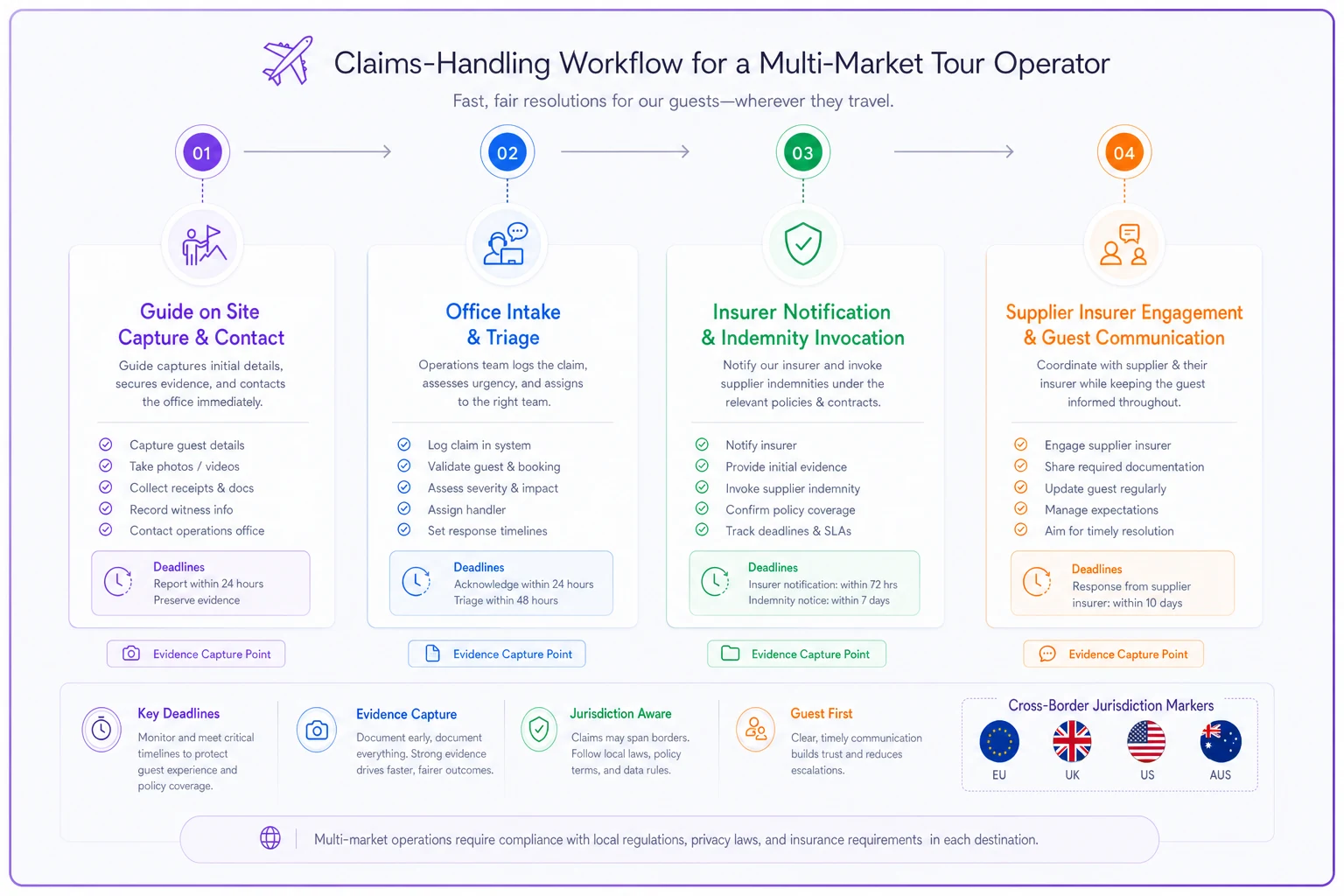
The deadlines are the part people consistently underestimate. Many insurance policies and supplier indemnity clauses have notification windows — notify within X days or lose coverage. Miss the window and a valid claim becomes uncovered. Across multiple markets with different policies and suppliers, those windows vary, and tracking them manually is a losing game.
A cross-border wrinkle that catches operators out
When the incident happens in Country A, the guest is from Country B, and your entity is in Country C, you can be dealing with three sets of expectations at once. Which law governs the claim, where it can be brought, and which insurer responds first are not always obvious. Your supplier agreements should specify governing law and jurisdiction explicitly — leaving it blank means a court decides for you, often in the least convenient place.
When this level of system actually makes sense
Not every operator needs a modular waiver architecture with jurisdiction overlays and named-insured tracking. If you run low-risk walking tours in a single country with your own guides, a well-drafted waiver reviewed by local counsel is genuinely enough.
This matters when:
-
You operate in more than one country, or sell to guests across multiple jurisdictions.
-
You offer medium-or-above risk activities delivered by third-party suppliers.
-
You're scaling your supplier base faster than you can manually track their insurance.
-
You've had even one claim where the indemnity didn't flow the way you expected.
This is probably overkill when:
-
You're single-market, low-risk, and self-delivered.
-
Your supplier relationships are few and long-standing with verified coverage.
The honest signal that you've outgrown the simple setup: when a claim comes in and nobody on the team can immediately say which waiver version the guest signed, which supplier's indemnity applies, and whether the insurance certificate was current — that's when you need the system.
A short real scenario
A mid-sized inbound operator ran adventure trips across three countries, roughly 2,800 guests a season, with around 25 activity suppliers. They used one waiver for everything, translated once, and tracked supplier insurance in a spreadsheet that got updated "when someone remembered."
A guest was injured on a canyoning trip. When they went to invoke the supplier's indemnity, two problems surfaced: the supplier's insurance certificate had lapsed four months earlier, and the waiver — written for a different country's law — didn't clearly cover the activity in that jurisdiction. The operator ended up absorbing a settlement and legal costs in the low five figures that should have sat with the supplier's insurer.
The fix wasn't dramatic. They classified activities into four risk tiers, rebuilt the waiver as a base plus activity modules with per-market overlays, moved high-risk signatures to the pre-trip stage, and put supplier certificate expiry on a tracked calendar with alerts ahead of each lapse. The following season, when a minor incident occurred, the indemnity notice went out within two days, the certificate was current, and the supplier's insurer handled it. No drama, no absorbed cost.
The difference wasn't better lawyers. It was the parts of the system actually talking to each other.
Pulling it together
The mistake that ties all of this together is treating waivers, supplier indemnity and claims-handling as three separate concerns owned by three separate people. They're one risk-transfer chain. Risk classification tells you how hard to push on each link. The waiver transfers risk from the guest. The supplier indemnity transfers it onward to whoever caused it. Claims-handling is the plumbing that moves information fast enough to keep both of those transfers valid.
Break any single link and the chain holds nothing. The guest's signature means less if the waiver doesn't fit the jurisdiction. The indemnity clause means less if the certificate lapsed. And both mean nothing if the claim notice missed its window because the report sat on a guide's phone.
For single-market operators, this can stay simple. For anyone running tours across borders with third-party suppliers, the work is making sure each link is current, each handoff has a deadline and an owner, and the version of every document tied to a given booking is the right one. Get that right, and the rare bad day stays a bad day instead of becoming a bad season.
Ready to elevate your travel business?
Join 500+ travel operators using Touryly to optimize bookings, improve client satisfaction, and grow revenue.