


Most operators don't have a supplier problem. They have a concentration problem that only becomes visible when the calendar turns.
The pattern shows up the same way almost every year: a mid-sized operator runs 60–70% of its high-season activity volume through three or four "anchor" suppliers because those relationships are easy, the rates are decent, and nothing has gone wrong yet. Then July hits. One boat operator loses a vessel to maintenance, one hotel oversells, and suddenly a third of your peak-week departures are hanging on a handful of phone calls that may or may not get returned.
This isn't bad luck. It's an unmanaged portfolio. And the fix isn't "find more suppliers" — it's building a system that treats availability as something you engineer across a book of suppliers, with scoring, coverage targets, and contract terms that actually bite when someone fails. That's what real supplier diversification tours strategy looks like once you get past the buzzword.
Why supplier concentration feels safe until it isn't
Concentration builds up quietly because it's rewarded in the off-season. Fewer suppliers means fewer contracts to manage, better volume pricing, tighter communication, and less operational overhead. When you're running 40% capacity in shoulder months, having three reliable partners feels efficient, not risky.
The problem is that the exact thing that makes concentration efficient in low season — volume commitments funneled to a few partners — is what makes it fragile in high season. When demand spikes, your anchor suppliers are also everyone else's anchor suppliers. Their capacity gets rationed. Your "priority" status is worth less precisely when you need it most, because ten other operators think they're the priority too.
A useful exercise: pull your top 10 activities by peak-season revenue and write down how many usable suppliers you have for each. Not "suppliers who exist," but suppliers you've actually transacted with, who meet your quality bar, and who can absorb overflow within 24–48 hours. Most operators discover that half their revenue rides on single-source or effectively single-source relationships. That number is your real risk exposure, and it's almost always worse than the gut feeling suggested.
Scoring suppliers as a portfolio, not one at a time
Individual supplier scorecards are common now, and if you've built a lifecycle and score-driven remediation system you're already ahead of most. But single-supplier scoring answers the wrong question. It tells you this supplier is a B-minus. It doesn't tell you whether your portfolio can survive that B-minus failing in week 3 of peak.
Never miss a booking or update.
Touryly streamlines your travel bookings, confirmations, and itinerary updates—all in one place.
- Unified booking management
- Automated customer notifications
- Itinerary & staff coordination
No credit card required
Portfolio-level scoring layers a second question on top: if this supplier goes dark, what happens to the trips that depend on them, and who absorbs the volume?
To do that you need to track a few things per supplier that most operators don't bother formalizing:
-
Reliability score — historical fulfillment rate, weighted toward peak-season performance, not annual average
-
Peak-load headroom — how much extra volume they can actually take during your busiest 6–8 weeks
-
Substitutability — how many other suppliers could cover this supplier's specific product at comparable quality
-
Concentration weight — what share of a given product/date band flows through them
-
Recovery speed — how fast they've historically confirmed replacements or resolved a shortfall
The insight most operators miss: a supplier with a great reliability score but zero substitutes is a bigger portfolio risk than a mediocre supplier with three ready alternatives. Reliability doesn't help you when the failure mode is "supplier is fine but full." Substitutability is the metric that actually protects you, and it's the one almost nobody tracks.
A simple workflow can help you move from individual scores to portfolio impact quickly.
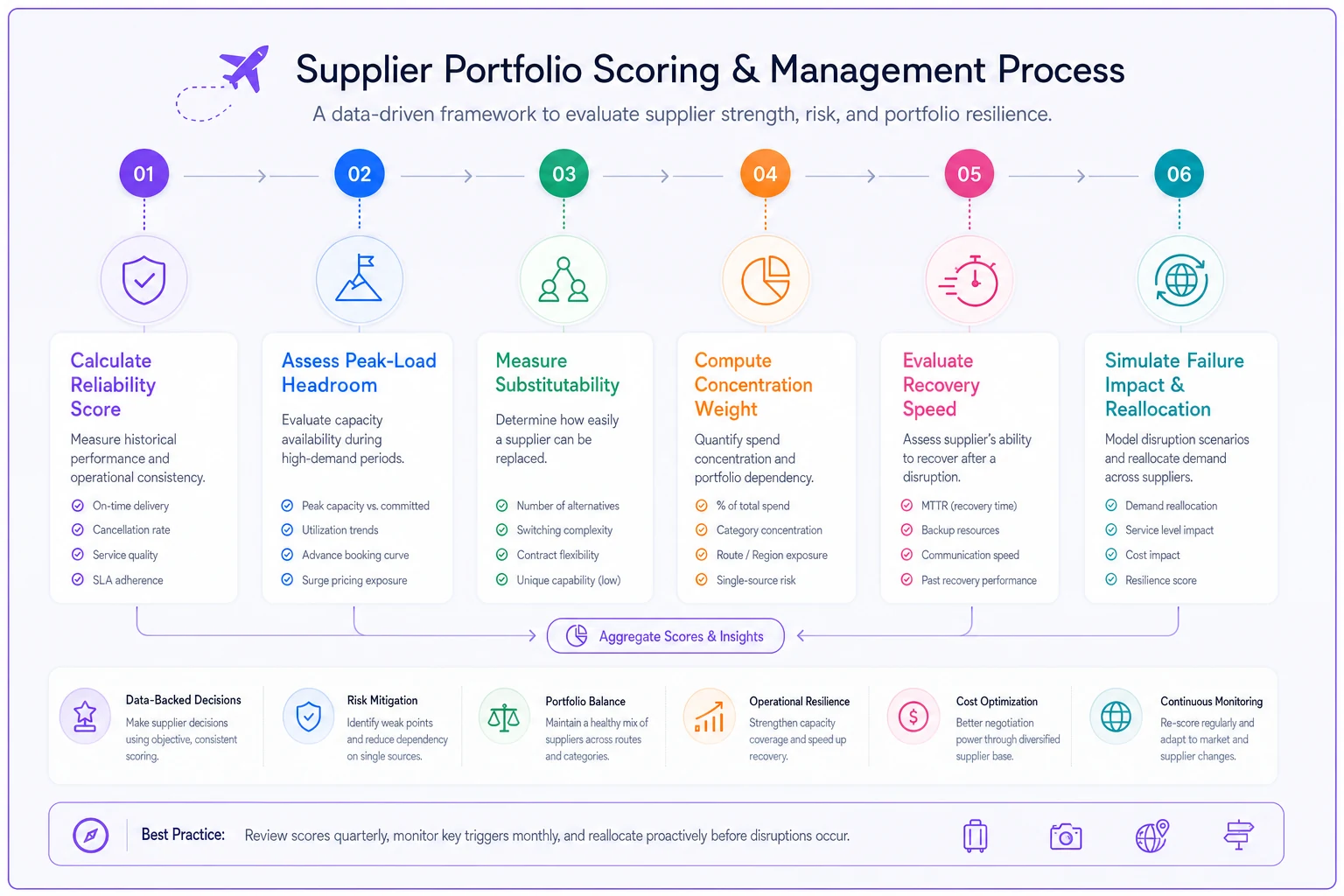
Use the workflow to simulate a supplier failure and see who actually absorbs their volume before you rely on any single partner in peak.
Coverage ratios: the number that should drive your buying
For each product and each season band, you set a target coverage ratio — the amount of confirmed or holdable supplier capacity you carry relative to your forecast demand.
A coverage ratio of 1.0 means you've secured exactly as much capacity as you expect to sell. That sounds prudent and is actually dangerous, because it assumes zero failures and zero forecast error. In high-failure or high-demand-variance products, you want to be over 1.0. In stable, easily-substitutable products, you can run closer to 1.0 or even below and buy on demand.
A rough framework that holds up in practice:
| Product / season profile | Target coverage ratio | Why |
|---|---|---|
| High-demand product, peak weeks, few substitutes | 1.3–1.5 | Failure or overselling is likely; overflow options are thin |
| High-demand product, peak weeks, many substitutes | 1.1–1.2 | You can source late, so carry a modest buffer |
| Stable product, shoulder season | 1.0–1.1 | Low variance, easy to top up |
| Niche/experiential, any season | 1.2–1.4 | Single-source risk; small failures ruin the itinerary |
| Commodity transport/hotel, off-peak | 0.9–1.0 | Cheap and abundant; buy as needed |
The mistake operators make is applying one buffer across everything — either over-buying capacity they'll never use or under-buying on the products that hurt most when they fail. Coverage ratios force you to spend your risk budget where it matters. Your rafting anchor with no backup gets a 1.4; your city hotel with twelve alternatives gets 1.0.
The second mistake is setting the ratio once and forgetting it. Coverage targets should move with the forecast. As bookings for a specific week fill in, the absolute capacity you need to hold shifts, and so does the buffer. This is where a booking-linked view of supplier commitments earns its keep — you want the coverage gap for each product/date to update as sales come in, not to discover in June that your April assumptions were off.
The contingency pool: capacity you pay to keep warm
A contingency pool is the second-source and third-source capacity you keep ready even though you don't expect to use most of it. Operators resist this because it looks like paying for nothing. But you're not paying for capacity — you're paying for speed of recovery when your primary fails during the exact window when everyone else is scrambling too.
There are three practical ways to build a pool, and mature operators use all three:
-
Held allotments with release windows — blocks with a named supplier you can release at defined cutoffs without penalty. Costs you flexibility, not cash.
-
Standby suppliers on a retainer or minimum spend — smaller partners you keep active with a guaranteed floor of business so they'll answer the phone in peak.
-
Pre-negotiated overflow rates — no capacity held, but a signed rate and confirmation-time commitment so you're not negotiating during a crisis.
A typical setup looks like this: an operator running a popular full-day excursion carries their primary supplier at roughly 70% of expected volume, a held allotment with a second supplier covering another 30–40%, and a rate-only overflow agreement with a third for genuine surges. When the primary lost two dates in a heat wave, the second-source allotment absorbed it inside a day because the capacity was already spoken for — no cold outreach, no scramble.
Rotate a small, deliberate share of volume to your contingency suppliers year-round — even at slightly worse economics — specifically so the relationship is live when you need it.
The nuance that separates a working pool from a paper one: your pool suppliers have to stay warm. A standby supplier you haven't sent a booking to in eight months is not a real backup. Rotate a small, deliberate share of volume to your contingency suppliers year-round — even at slightly worse economics — specifically so the relationship is live when you need it. Treat that margin difference as an insurance premium, because that's exactly what it is.
Contracting levers that actually enforce availability
Coverage ratios and pools are demand-side. The supply side is your contract. Most operator-supplier agreements are built for pricing and cancellation, and go quiet on the one thing that matters in peak: guaranteed availability and consequences for shortfall.
If you've worked through a supplier procurement playbook with substitution windows and volume tiers, you already have the commercial skeleton. What seasonal risk management adds is a set of clauses aimed specifically at availability under stress:
-
Committed peak allocation — a guaranteed number of slots reserved for you during defined peak windows, not "subject to availability"
-
Confirmation-time SLAs — a maximum time to confirm or reject a request during peak, with the clock explicitly shorter than off-season
-
Shortfall penalties with teeth — real financial consequences for failing a confirmed booking in peak, ideally scaled to guest impact, not a token credit
-
First-refusal on released capacity — if the supplier frees up space, you see it before the open market
-
Substitution standards — if they substitute, it must meet a defined quality floor, so "replacement" doesn't mean downgrade
The lever operators underuse most is tying penalties to timing, not just occurrence. A supplier cancelling a confirmed slot 30 days out is an inconvenience. Cancelling 48 hours out during peak week is a catastrophe that may cost you the entire trip and the review that follows. Your penalty structure should reflect that curve — cheap to fail early, expensive to fail late. That single change reshapes supplier behavior more than most rate negotiations, because it prices in the thing you actually care about.
What breaks as you scale
At 500 annual departures, one person holds the whole supplier map in their head. They know who's reliable, who to call when the ferry cancels, and which relationships are fragile. Concentration risk exists but it's managed by memory, and that works until it doesn't.
At a few thousand departures across more destinations and seasons, that memory model collapses in specific, predictable ways:
-
The person who "knows the suppliers" becomes a single point of failure worse than any supplier
-
Coverage gaps hide inside aggregate numbers — you look 20% over-covered overall while being dangerously under-covered on your three worst product/date combinations
-
Contract terms drift, because nobody's checking whether the SLAs signed two years ago still match current peak volume
-
Contingency suppliers go stale silently, and you find out the moment you need them
Scale is what turns supplier management from a relationship skill into a systems problem. The operators who handle it well stop tracking suppliers as a list and start tracking them as a portfolio with live coverage ratios, decay warnings on stale backups, and contract terms tied to actual booking data. The point of putting this in software isn't the dashboard — it's that coverage gaps and stale-backup warnings surface before peak instead of during it, when you still have time to act.
When this level of structure makes sense — and when it doesn't
This whole approach has a cost, and it's not right for everyone.
When it makes sense: you run meaningful seasonal peaks, a chunk of revenue concentrates in a few suppliers, and a peak-season failure damages trips rather than just annoying you. If a single supplier going dark in July would hit more than 15–20% of a peak week, you need portfolio-level thinking now, not next year.
When it's overkill: you operate mostly commodity components — abundant hotels, plentiful transport — where substitution is trivial and last-minute sourcing is genuinely easy. Building coverage ratios and contingency pools for products with twenty interchangeable suppliers is process for its own sake.
Who should NOT start here: if you don't yet have basic per-supplier reliability data, start with individual scoring first. Portfolio ratios are built on top of supplier scores. Without the underlying data, you'll be setting coverage targets against numbers you can't trust — which is worse than doing nothing because it feels rigorous while being wrong.
A short real scenario
A regional operator running adventure day-trips did roughly 2,800 departures a year, with about 65% of activity volume in a 9-week summer window. Three suppliers carried the bulk of their two best-selling excursions. Over two prior summers they'd eaten a handful of last-minute supplier failures — cancelled trips, angry guests, refund costs, and the review damage that lingers well past the season.
They reworked the top six products onto coverage targets: 1.4 on the two single-source high-demand excursions, 1.1 on the rest. They stood up a two-tier contingency pool — held allotments for the critical products plus rate-only overflow agreements — and rewrote the anchor supplier contracts with timing-scaled shortfall penalties and confirmation-time SLAs for peak weeks.
The following summer wasn't failure-free — two suppliers still had shortfalls during a demand spike. The difference was that both were absorbed inside a day using pre-held capacity, with no cancelled departures and no refunds triggered by supply. Peak-driven trip failures dropped from several the prior year to effectively none tied to availability. The contingency pool cost them a bit of margin on the volume they deliberately rotated to backups — a low single-digit percentage on those products — which they treated, correctly, as the premium for not blowing up peak week.
Pulling it together
Supplier diversification isn't about collecting more logos. It's about knowing, for every product and every season band, how much capacity you've secured, how fast you can recover if a piece fails, and whether your contracts actually make suppliers show up when demand is highest.
Concentration will always feel efficient in the quiet months and expensive in the loud ones. The operators who stop getting caught are the ones who treat availability as a portfolio they manage on purpose — scored by substitutability, buffered by coverage ratios tuned to real risk, backed by a warm contingency pool, and enforced by contract terms that price failure the way guests actually experience it. Build that once, keep it live against your booking data, and peak season stops being the time of year you brace for.
Build that once, keep it live against your booking data, and peak season stops being the time of year you brace for.
Ready to elevate your travel business?
Join 500+ travel operators using Touryly to optimize bookings, improve client satisfaction, and grow revenue.