
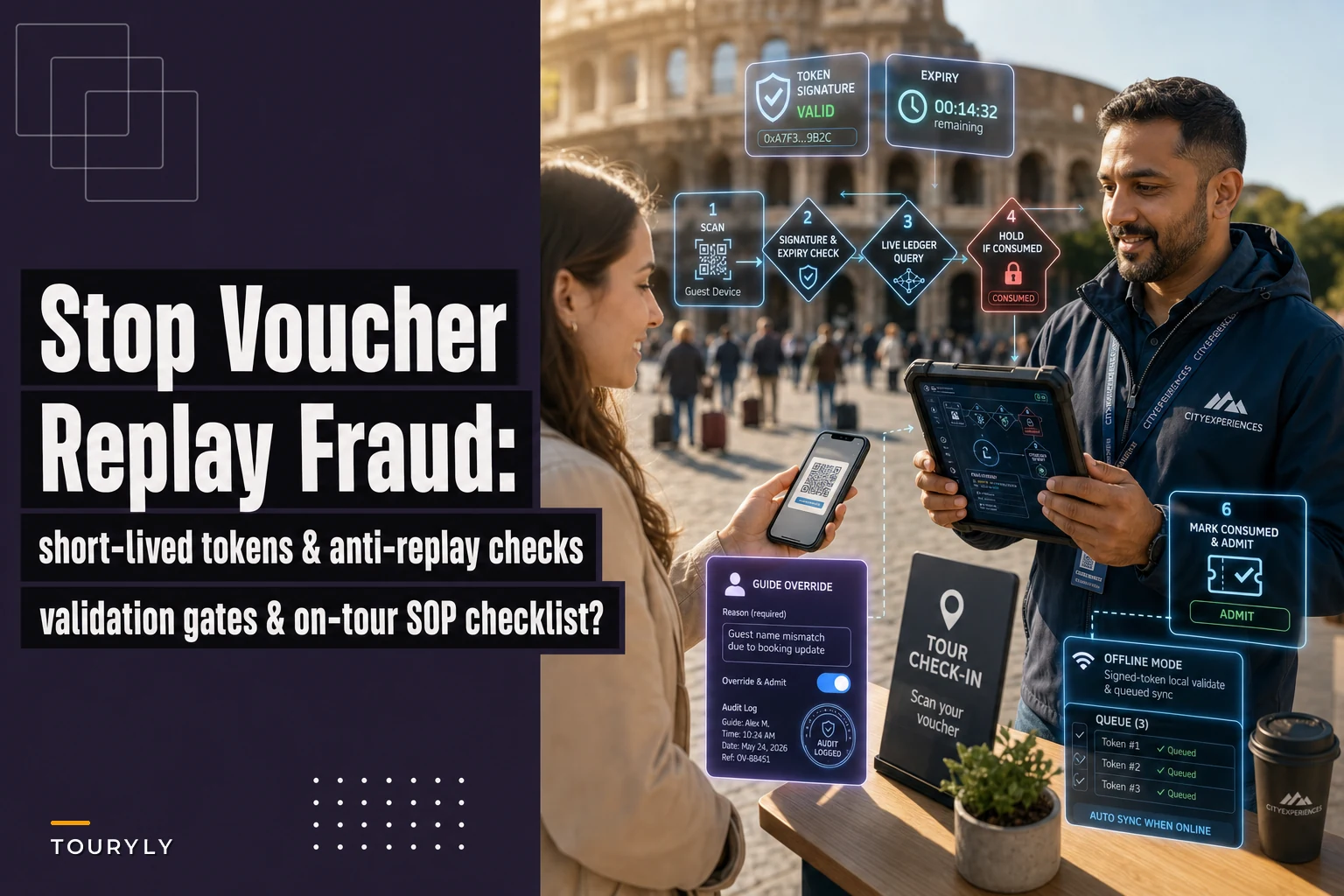

A voucher that scans "valid" three times in one morning isn't a technical curiosity — it's money walking out the door. And most of the time the operator doesn't find out until reconciliation at month‑end shows more redemptions than tickets sold.
The frustrating part is that the fraud usually isn't sophisticated. Someone screenshots a confirmation, forwards a PDF, or drops a QR code in a resale group. Then two, three, sometimes five people show up with the same code. Your guide is standing at a dusty meeting point with 40 people and a phone showing a green check, so they wave everyone through. The problem only surfaces in the numbers weeks later.
This article covers one narrow thing: how to design ticketing security for a tour operator so a token can only be used once, can't be replayed, and doesn't require your reseller partners to rebuild their systems. No general fraud theory, no payment disputes — just the token, the gate, and the SOP that closes the loop.
Why "valid" isn't the same as "unused"
The core confusion behind most voucher replay losses is that operators treat a scan result as a yes/no question — is this code real? — when the actual question is has this specific code already been consumed?
A static QR code printed on a PDF answers the first question forever. It's a real code, so it scans green every time. Nothing about the code itself changes after the first person walks through. If your validation only checks whether the code exists in your system, you've built a door that unlocks with a photograph.
In real operations, this usually happens when a booking flows through several hands: OTA sells it, a reseller repackages it, the customer gets a PDF, and somewhere in that chain the voucher gets forwarded, cached, or screenshotted. By the time it reaches the gate, five copies might exist. Each one is genuine. Only one should work.
The pattern that keeps showing up is operators bolting on "security" at the wrong layer. A fancy encrypted QR, a hologram sticker, a serial number — all of these prove authenticity but do nothing for single‑use enforcement. Authenticity and consumption are two completely different problems, and replay fraud lives entirely in the second one.
The two token designs that actually prevent replay
There are really only a couple of patterns worth your time, and they solve the problem at different points.
Never miss a booking or update.
Touryly streamlines your travel bookings, confirmations, and itinerary updates—all in one place.
- Unified booking management
- Automated customer notifications
- Itinerary & staff coordination
No credit card required
Server‑side single‑use tokens (state lives with you). The voucher carries an opaque reference. When it's scanned, your system atomically marks it consumed — first scan wins, every later scan returns "already redeemed" with the timestamp and location of first use. The token itself never has to be clever. All the intelligence is in your redemption ledger.
Short‑lived signed tokens (state lives in the token). The voucher contains a cryptographically signed payload with an expiry — valid only within a rolling window tied to the tour slot. A screenshot taken yesterday is worthless today because the signature window has passed. This is useful when the gate is sometimes offline and can't call your server in real time.
In practice you want both, layered. Short‑lived signing kills the "old screenshot" and "resold weeks later" attacks even offline. Server‑side consumption kills the "two people, same live code, same morning" attack. Neither alone is enough.
| Pattern | Stops old‑screenshot reuse | Stops same‑day duplicate scans | Works offline | Reseller effort to integrate |
|---|---|---|---|---|
| Static QR / PDF code | No | No | Yes | None |
| Server‑side single‑use only | Partial | Yes | No | Low |
| Short‑lived signed token only | Yes | No | Yes | Medium |
| Signed token + server consumption | Yes | Yes | Yes (degraded) | Low–Medium |
The right‑hand column matters more than most operators expect. If your anti‑replay design requires resellers to run new software, adopt your SDK, or change their checkout, adoption dies. The whole thing only works if the reseller can keep doing what they already do and your gate absorbs the complexity.
Keep reseller integration boring on purpose
The mistake is over‑engineering the reseller side. You do not want to be the operator emailing a 12‑page "voucher security specification" to a partner who sends you 30 bookings a month. They'll ignore it, or worse, break it and blame you when redemptions fail.
Minimal integration means you ask the reseller for exactly one thing: a unique booking reference per sale, delivered at or before time of sale. That's it. Everything else — token generation, signing, expiry, the QR your customer sees — you generate and control.
A clean split looks like this:
-
Reseller sends you the booking reference at time of sale via their existing channel (API push, or even a nightly file for low‑volume partners).
-
You mint the token. Signed payload, tied to the tour date/slot, with a short validity window. You return the QR or link.
-
Reseller delivers your token to the customer, not their own code. They're just passing your voucher through.
-
Your gate validates and consumes. First valid scan wins; the record shows who, when, where.
If your anti‑replay design requires resellers to run new software, adoption dies.
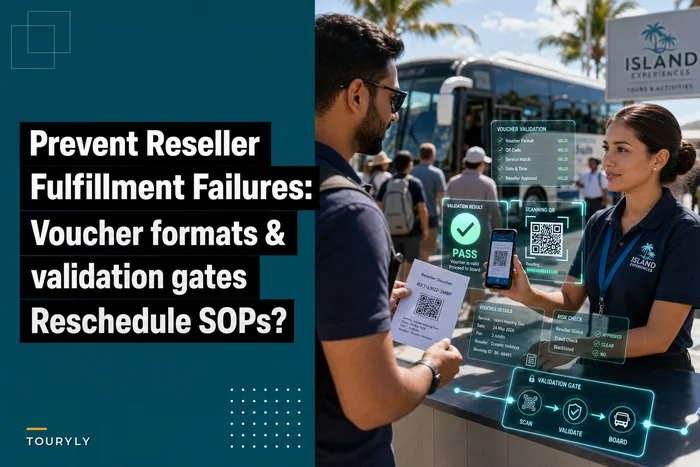
This keeps the reseller "dumb" in the good sense. They can't accidentally issue duplicates because they aren't issuing anything — they're relaying. If you've already mapped how vouchers move through your partners, the voucher formats and validation gate work covered here pairs directly with this token layer; formats decide what the customer holds, tokens decide whether it still works at the gate.
The on‑tour validation SOP (where most of this quietly fails)
You can build perfect tokens and still bleed money if the guide at the meeting point isn't running a real validation gate. What shows up repeatedly across field operations is that the technology holds and the human step collapses.
Guides skip validation for three predictable reasons: the signal is bad, the group is impatient, or the scan says "already redeemed" and they don't know what to do — so they wave the person in anyway. That third one is the killer. A "redeemed" result that leads to admission is functionally identical to having no security at all.
The SOP has to answer one awkward question directly: what does the guide actually do when a scan fails?
-
Scan before contact. Validate at check‑in, not after people are already mingling with the group. Once someone's in the crowd, you can't un‑admit them without a scene.
-
One device is the source of truth. If two guides scan on two phones, define which one holds the authoritative consumption state, or make sure both write to the same live ledger. Split ledgers create the "valid on my phone" gap.
-
Green = admit. Red "already redeemed" = hold and check. The guide asks for the name on the booking and compares it to the redemption record's first‑use timestamp. If the first use was 20 minutes ago at the same point, it's almost certainly a duplicate — polite decline, direct them to buy on the spot or contact the reseller.
-
Red "expired/invalid" = separate script. This is usually a genuine customer with an old link or wrong day, not a fraudster. Different problem, different tone. Don't accuse paying customers.
-
Offline fallback is defined in advance. If there's no signal, the guide validates the signed token locally — that's what short‑lived signing buys you — and queues the consumption record to sync later. Decide the queue rule before the tour, not while 40 people wait.
-
Every override is logged. If a guide admits someone despite a red, that requires a reason typed in. No silent overrides. This single rule changes guide behavior more than any lecture about compliance.
Below is a simplified view of how that gate flow runs end to end, from customer scan to ledger update:
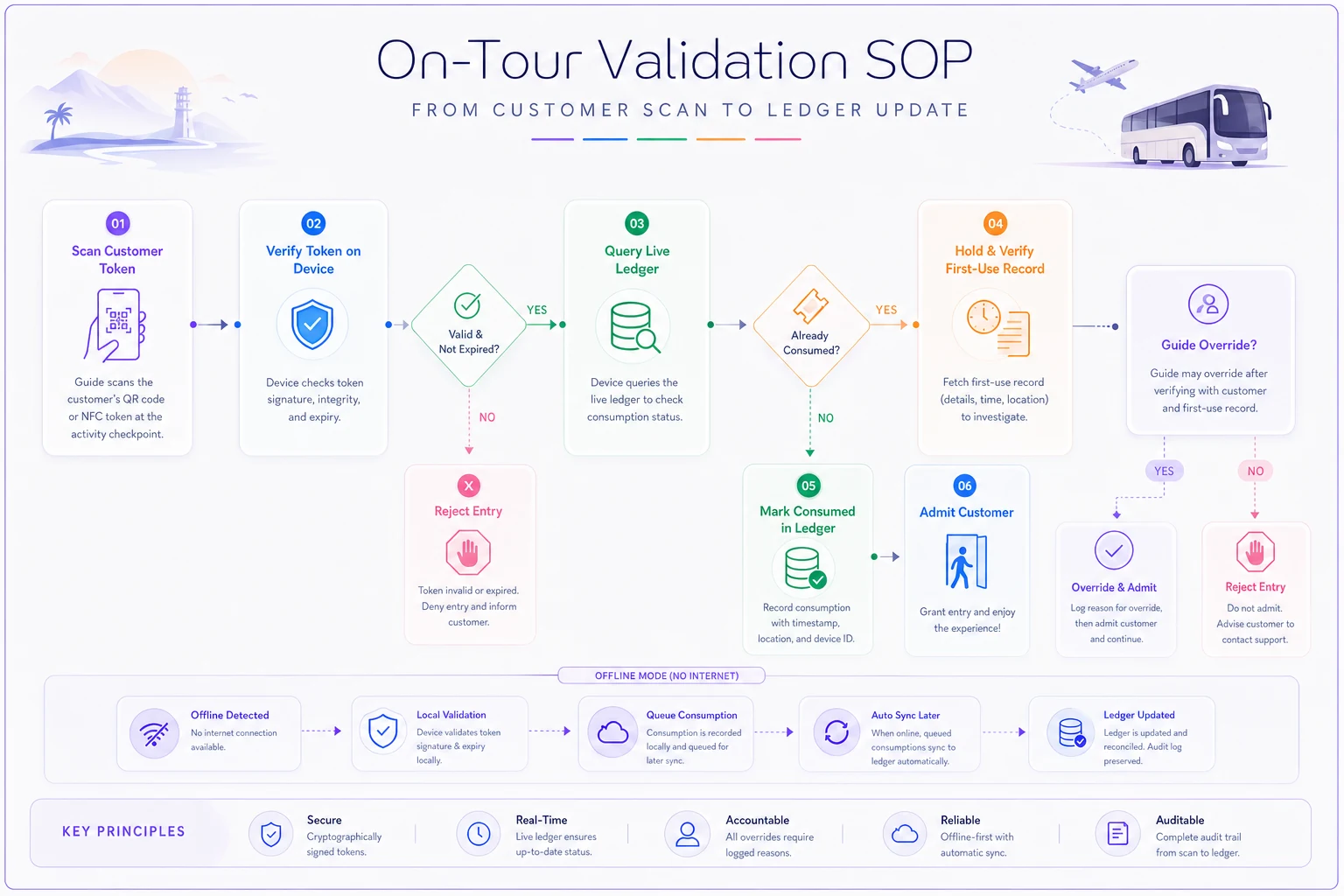
This flow shows the device and guide decisions during a typical on‑tour validation.
[Customer presents QR] ↓ [Device checks token signature + expiry] ↓ Signature valid? / \ No Yes ↓ ↓ [Reject — [Query live ledger] expired/ ↓ invalid] Already consumed? / \ Yes No ↓ ↓ [Hold — [Mark consumed check first in ledger — use record] Admit] ↓ [Guide override requires logged reason]
The offline piece is where signed tokens earn their keep. When the gate can't reach your server, a static code gives the guide nothing to work with. A signed short‑lived token lets the device confirm the voucher was legitimately issued for that slot and hasn't expired — even with zero bars — and the duplicate‑scan check catches up on sync.
A real scenario
A mid‑size day‑tour operator running snorkeling and boat trips — roughly 300–350 departures a month across four resellers — kept seeing a gap between tickets sold and heads counted. Not huge per trip, but consistent. Reconciliation showed somewhere around 15–25 extra redemptions a month with no matching second sale.
The cause was exactly the boring one: static PDF vouchers with a QR that scanned green forever, and guides who admitted anyone with a green check. A handful of customers were forwarding their PDFs to friends, and a couple of codes were quietly circulating in a local resale chat.
The fix wasn't a new platform. They kept the same resellers and the same customer‑facing PDF layout. They switched the QR to a signed short‑lived token tied to the departure slot, and moved consumption to a single live ledger the guides scanned into. The reseller change was one line: send the booking reference at time of sale. Everything else stayed put.
Within about two months the phantom redemptions dropped to near zero. The leftover reds turned out to be genuine wrong‑day customers, not fraud. The recovered margin was modest in absolute terms — a few hundred dollars a month — but it also cleaned up reconciliation, which had been eating staff time chasing discrepancies that no longer existed.
When this makes sense — and when it's overkill
When it's worth building: you sell through resellers or OTAs, your vouchers travel as PDFs or links, and your gate is a guide with a phone at a physical meeting point. That combination is where replay fraud lives. If your redemption count and sales count don't reconcile cleanly, you already have the symptom.
When it's overkill: if you run tightly controlled direct bookings where the customer checks in at a manned desk with photo ID against a live manifest, elaborate token signing adds friction for little gain. The manifest is your single‑use enforcement.
Who should not do this the hard way: very low‑volume operators with one or two trusted resellers and a handful of departures. A live consumption ledger on one device solves most of your exposure without the signing layer. Don't build offline cryptographic validation for a business doing eight bookings a week — spend that energy on the check‑in habit instead.
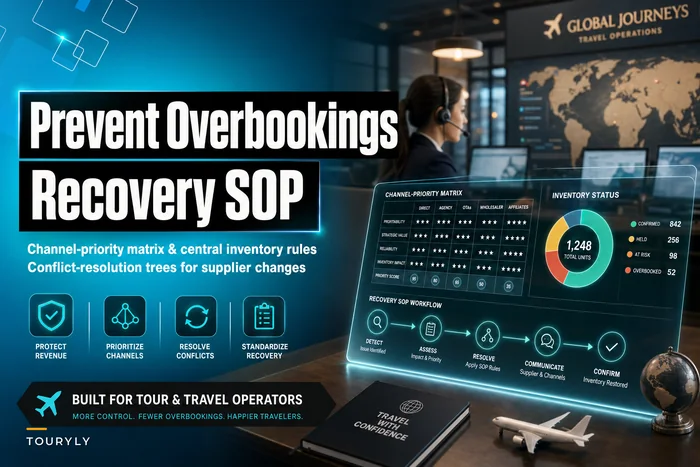
One thing worth flagging: anti‑replay tokens and overbooking controls get tangled together in people's heads because both fail at the gate. They're not the same problem. Replay is the same ticket used twice; overbooking is more valid tickets than capacity. If your gate problems are actually about availability and channel conflicts, the channel‑priority matrix and recovery SOP is the better starting point. Fix the right problem first.
The pattern underneath all of this
Voucher replay fraud persists because operators keep securing the wrong layer — proving the code is real instead of proving it's unused, and building complexity into the reseller side where it breaks instead of into the gate where you control it.
Get three things right and most of it goes away: tokens that expire so old copies die on their own, a single consumption ledger so first scan wins, and a guide SOP that actually defines what happens when a scan turns red. The token design is honestly the easy part. The validation gate at a chaotic meeting point is where the money is really won or lost — so write that SOP for the guide having their worst morning, not their best one.
The token design is honestly the easy part. The validation gate at a chaotic meeting point is where the money is really won or lost — so write that SOP for the guide having their worst morning, not their best one.
Ready to elevate your travel business?
Join 500+ travel operators using Touryly to optimize bookings, improve client satisfaction, and grow revenue.