


Month-end commission reconciliation in tour operations feels like untangling Christmas lights while wearing boxing gloves. You're matching split payments across multiple agents, tracking pass-through commissions from suppliers, dealing with partial refunds from cancelled bookings, and somehow trying to figure out which disputed charges actually belong to which partner.
The real damage happens when you find discrepancies three months later. An agent claims they're owed $4,800 from Q3 bookings, your records show $3,100, and now you're digging through hundreds of transactions trying to figure out who's right. Meanwhile, your accounting team is pulling overtime every month just to close the books.
What makes agent commission reconciliation particularly rough for tour operators is the layered complexity. Unlike retail where commissions flow one direction, tour bookings involve split payments between selling agents and fulfillment partners, pass-through commissions from hotels and activity suppliers, tiered rate structures based on volume, and timing gaps between when bookings happen versus when travel actually occurs.
Why traditional reconciliation breaks down with multi-agent operations
The approach most operators use—dumping everything into Excel at month-end—starts failing around 150 monthly bookings. Booking data lives in your reservation system, commission agreements are buried in Word docs, payment records sit in your accounting software, and dispute notes are scattered across email threads. Your finance person spends the first week just collecting data before they even start reconciling anything.
The process usually looks something like this: export all bookings from the previous month, manually calculate commissions based on each agent's agreement, cross-reference with actual payments received, identify discrepancies, chase down explanations for mismatches, adjust for cancellations and modifications, then somehow create journal entries that make sense to your accountant.
This worked fine when you had three agents and 40 bookings a month. Scale that to 15 agents across different markets, each with their own commission structure, and you're looking at 20+ hours of reconciliation work that still leaves gaps.
The timing problem makes everything worse. Agent A sells a package for travel in three months, but their commission is due at booking. The hotel portion gets cancelled two weeks before travel, triggering a partial refund. You've already paid out the full commission and now need to claw back 30% of it. Your books show one thing, the agent's records show another, and good luck finding that specific adjustment when they dispute it next quarter.
Building a monthly close worksheet that actually works
Operators who maintain clean books all follow a similar structure. They track every commission-generating transaction through consistent stages regardless of payment timing or agent type. It's not complicated—it's just consistent.
Never miss a booking or update.
Touryly streamlines your travel bookings, confirmations, and itinerary updates—all in one place.
- Unified booking management
- Automated customer notifications
- Itinerary & staff coordination
No credit card required
Transaction staging columns:
-
Booking ID and date
-
Agent/partner code
-
Customer name
-
Travel dates
-
Gross booking value
-
Base commission rate
-
Commission amount calculated
-
Payment status (pending/partial/complete)
-
Actual payment date
-
Variance notes
Commission type indicators:
-
Direct sale
-
Referral
-
Pass-through
-
Split booking
-
Group coordinator fee
Reconciliation checkpoints:
-
System-calculated commission
-
Manual override amount
-
Override authorization
-
Payment batch number
-
Dispute flag
-
Resolution date
The worksheet becomes your single source of truth. Every commission-related transaction flows through these columns, creating an audit trail that makes month-end close manageable instead of a fire drill.
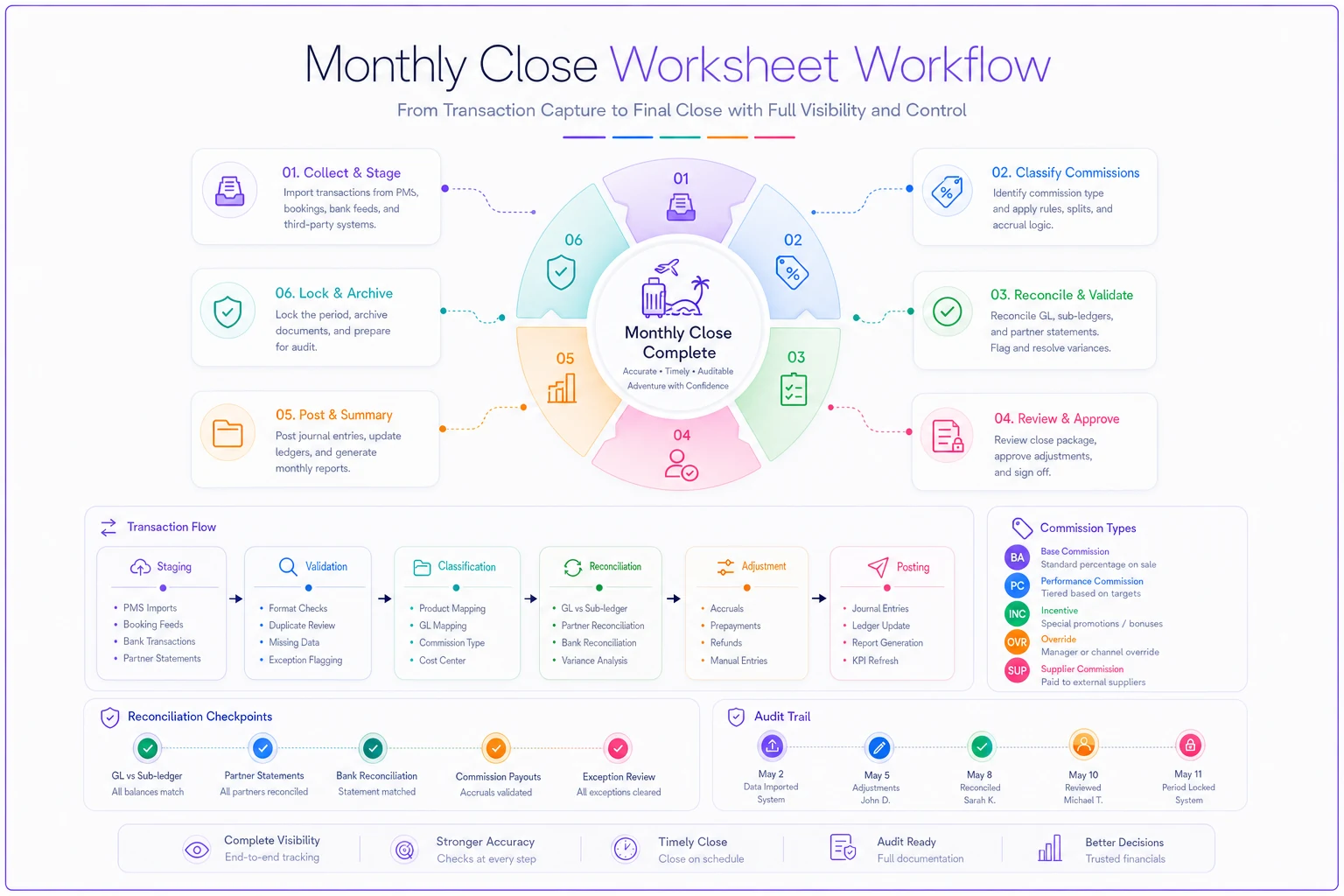
A simple visual that shows the flow from booking to payment and reconciliation.
Sample journal entries for the messiest scenarios
Split payments between agents create accounting headaches because you're recognizing revenue and commission expense at different times. Here's how to structure the entries:
Scenario 1: Two-agent split on $4,000 booking
At booking (May 15): Dr. Accounts Receivable $4,000 Cr. Deferred Revenue $4,000 Dr. Commission Expense - Agent A $400 Dr. Commission Expense - Agent B $200 Cr. Commission Payable - Agent A $400 Cr. Commission Payable - Agent B $200
At travel date (August 10): Dr. Deferred Revenue $4,000 Cr. Tour Revenue $4,000
Upon commission payment (May 31): Dr. Commission Payable - Agent A $400 Dr. Commission Payable - Agent B $200 Cr. Cash $600
Scenario 2: Pass-through commission from supplier
Booking received (June 1): Dr. Accounts Receivable $3,000 Cr. Deferred Revenue $3,000 Dr. Commission Expense - Agent $150 Cr. Commission Payable - Agent $150
Supplier commission received (June 30): Dr. Cash $300 Cr. Commission Revenue $300
Keep supplier commissions separate from agent commissions in your chart of accounts. Otherwise you lose visibility into your actual commission margins, and that problem compounds fast.
Scenario 3: Partial refund after commission paid
Original booking and commission (April): Dr. Commission Expense $500 Cr. Commission Payable $500
Partial cancellation adjustment (May): Dr. Commission Payable $150 Cr. Commission Expense $150
If commission already paid, create receivable: Dr. Commission Receivable - Agent $150 Cr. Commission Expense $150
These entries maintain clear tracking of what's owed in each direction, which becomes critical when disputes come up.
Dispute SLAs that prevent quarter-end surprises
Commission disputes follow predictable patterns. Agents usually claim underpayment around day 10 of the month when they're doing their own reconciliation. Without clear SLAs, these disputes drag into the next closing period and corrupt your numbers.
Tier 1: Current month disputes
-
Submission deadline
15th of following month
-
Resolution target
Within 5 business days
-
Documentation required
Booking IDs, calculated vs. received amounts
-
Approval threshold
Under $500 can be approved by operations manager
Tier 2: Prior period adjustments
-
Submission window
15th to 25th of month
-
Resolution target
Before month-end close
-
Documentation required
Original booking records, payment proof, email approvals
-
Approval required
Finance manager for any amount
Tier 3: Aged disputes (60+ days)
-
Submission requires
Executive approval to reopen
-
Documentation required
Full audit trail plus explanation for delay
-
Resolution
Following quarter
-
Late submission penalty
5% reduction in disputed amount
One operator cut monthly disputes from 12–15 down to 3–4 just by implementing these SLAs. Agents learned to review commissions promptly, and the finance team stopped getting ambushed with prior-quarter adjustments during close week.
The enforcement mechanism matters. Keep a simple dispute log that tracks submission date, resolution date, and approval chain. When agents repeatedly miss deadlines, you've got documentation to enforce the late submission penalties.
Automated reconciliation touchpoints that catch errors early
Manual reconciliation at month-end means you're always playing catch-up. Operators who maintain the cleanest books run checks throughout the month that flag issues while they're still fixable.
Start with daily commission accrual matching. Your booking system calculates commission based on the agent agreement—but does that match what your accounting system expects? A daily export comparing calculated commissions against booked commissions catches rate mismatches immediately instead of three weeks later.
Weekly payment batch reconciliation gives you another checkpoint. Every Friday, run a report showing:
-
Commissions earned week-to-date
-
Commissions paid week-to-date
-
Variance by agent
-
Bookings missing commission data
-
Payments missing booking references
This gives you time to investigate before month-end instead of discovering problems during close week.
Flag commissions unpaid after 45 days for review.
Third, watch commission aging. Any commission unpaid after 45 days should get flagged for review. Sometimes it's a legitimate hold, but often it's just a processing error that slipped through. Catching it at 45 days instead of 65 prevents awkward conversations with agents.
Operational platforms with AI automation can run these checks automatically, surfacing exceptions for review rather than requiring someone to manually pull reports each week. The point is building the reconciliation logic once and letting it run continuously—not cramming everything into month-end.
Pass-through commission tracking without the confusion
Pass-through commissions create a particular reconciliation challenge. You're the middleman—collecting commission from hotels or activity providers, then sharing a portion with your selling agents. The timing rarely aligns. Supplier commissions might arrive 60 days after travel while agent commissions are due at booking.
Track pass-through commissions separately from direct commissions. Create distinct categories:
-
Direct agent commission (you pay from margin)
-
Pass-through commission (supplier pays, you distribute)
-
Override commission (volume bonuses)
-
Referral commission (one-time finder's fees)
Each category needs its own reconciliation timeline. Direct commissions reconcile monthly, pass-through commissions quarterly, override commissions annually.
Here's a working template for pass-through tracking:
| Booking ID | Supplier | Commission Due | Commission Received | Agent Share % | Agent Share Paid | Variance | Notes |
|---|---|---|---|---|---|---|---|
| B-4521 | Hilton Miami | $240 | $240 | 50% | $120 | $0 | Cleared Q2 |
| B-4522 | Marriott Orlando | $180 | $150 | 50% | $75 | -$15 | Disputed rate |
| B-4523 | Activities Inc | $90 | Pending | 40% | $0 | -$36 | Due July 15 |
This separation prevents supplier delays from corrupting your monthly commission accruals. You can close your books knowing exactly what's pending from suppliers versus what you actually owe agents.
Preventing reconciliation bottlenecks during peak seasons
Summer and holiday peaks stress every part of your operation, but commission reconciliation often breaks completely. You're processing 3x normal volume while your finance person is covering for vacations. Errors compound, disputes pile up, and by January you're still cleaning up December's mess.
The prevention strategies for group bookings apply here too—you need systems that scale without adding proportional work. Build your reconciliation process assuming peak volume, not average volume.
Implement commission caps and thresholds before peak season hits. Any single commission over $2,000 requires manager approval. Any agent earning over $10,000 in a month triggers an audit. These controls catch errors when booking volume makes manual review impossible.
Also, freeze commission structure changes from November through January. Agents love negotiating new rates right before peak season, but changing structures mid-stream guarantees reconciliation errors. Set a clear policy: rate changes submitted by October 1st take effect January 1st. No exceptions.
Create a peak season reconciliation calendar that front-loads the work:
-
Week 1
Reconcile all standard commissions
-
Week 2
Process pass-through and overrides
-
Week 3
Handle disputes and adjustments
-
Week 4
Final review and close
This staged approach prevents everything from piling up in the last three days of the month when everyone's stressed and mistakes happen.
Turning Excel chaos into structured operations
The monthly commission scramble doesn't have to be inevitable. Most operators just accepted it as the cost of working with multiple agents—until they hit a breaking point. Usually it's a massive discrepancy that takes weeks to untangle, or an agent relationship that sours over payment disputes.
Building proper validation gates for reseller operations extends to commission management. The same discipline that prevents fulfillment failures can prevent payment disputes.
The shift from Excel chaos to structured reconciliation typically happens in stages. Start with the monthly close worksheet to get all commission data into a consistent format. Then add the dispute SLAs to contain problems. Finally, layer in automated checks to catch errors before they compound.
One operator put it simply: "We went from dreading month-end to finishing commission reconciliation by the 3rd business day. Our agents actually trust us now because they can see exactly how we calculated their payments."
The real payoff is recovered capacity. Instead of your finance team spending 40 hours a month on reconciliation, they're spending closer to 10. That freed time goes toward things that actually move the business—identifying your most profitable agent relationships, optimizing commission structures, negotiating better supplier terms.
AI-assisted platforms now handle much of this reconciliation automatically, matching transactions across systems, flagging discrepancies for human review, and suggesting journal entries based on historical patterns. But even without full automation, these frameworks will meaningfully cut your reconciliation time.
Start before you desperately need it. If you're in the middle of month-end close right now, bookmark this for next month. If you've got two weeks before your next close, that's enough time to implement the worksheet and avoid another painful cycle.
Clean commission reconciliation isn't about perfection—it's about having processes that catch and resolve discrepancies quickly, before they turn into agent disputes or audit problems.
Ready to elevate your travel business?
Join 500+ travel operators using Touryly to optimize bookings, improve client satisfaction, and grow revenue.