



Group bookings are where tour operators either build serious revenue or watch chaos unfold. The difference usually comes down to deposit rules that actually work versus ones that quietly create operational nightmares.
A 40-person corporate retreat looks amazing on paper until half the group backs out three weeks before departure. Or worse—you're holding seats for a school trip while turning away other bookings, only to have the organizer ghost you after the initial inquiry. These situations destroy revenue and team morale at the same time.
Most operators learn these lessons the expensive way. The ones that thrive have specific rules for deposits, automated reminders, seat-hold limits, and waiting lists. The ones that struggle are still chasing payments manually and making one-off exceptions that blow up later.
Why standard deposit rules fail for group bookings
Individual bookings are straightforward—one person, one decision, one payment. Group bookings involve multiple stakeholders, budget approvals, participant confirmations, and payment collection problems that individual bookings never face.
Operators often apply their standard 20% deposit rule to a 35-person booking and wonder why it falls apart. The group organizer puts down $1,400 on a $7,000 total, then spends weeks trying to collect from participants. Meanwhile, you're holding inventory that could have been sold multiple times over.
The real problem usually surfaces around day 45 before departure. The organizer has collected from 22 people but can't reach the other 13. Now you're negotiating partial fulfillment, dealing with participants who did pay on time, and scrambling to fill suddenly empty seats. Your operations team is buried in email threads, your accounting is a mess, and the group organizer is frustrated—despite being the cause of the problem.
What typically happens next makes things worse. Operators start building custom payment plans for each group, tracking them in spreadsheets, and manually following up. Eventually you have 15 different deposit structures across active bookings, and nobody can remember what was promised to whom.
Building deposit schedules that protect revenue
Effective group booking deposits work differently than individual bookings. They need to account for the organizer's collection timeline while protecting your inventory value.
Never miss a booking or update.
Touryly streamlines your travel bookings, confirmations, and itinerary updates—all in one place.
- Unified booking management
- Automated customer notifications
- Itinerary & staff coordination
No credit card required
For groups of 10-20 people:
-
Initial hold
$100 per person (non-refundable after 72 hours)
-
60 days out
40% of total
-
30 days out
Additional 40%
-
14 days out
Final 20%
For groups of 21-40 people:
-
Initial hold
$75 per person (non-refundable after 72 hours)
-
75 days out
30% of total
-
45 days out
Additional 35%
-
21 days out
Additional 25%
-
7 days out
Final 10%
For groups over 40:
-
Initial hold
$50 per person (non-refundable after 48 hours)
-
90 days out
25% of total
-
60 days out
Additional 25%
-
30 days out
Additional 30%
-
14 days out
Final 20%
The declining per-person hold amount for larger groups reflects the reality that organizers need more time to coordinate bigger groups. But the accelerated payment timeline protects you from last-minute mass cancellations.
These schedules shift risk in the right direction. Early deposits are lower but non-refundable, which filters out non-serious inquiries. The bulk of payment arrives while you still have time to resell inventory if something falls apart.
Auto-reminder sequences that prevent payment delays
Manual payment reminders are where group bookings typically break down. Someone sends an email, marks their calendar for follow-up, then gets pulled into something else. The deadline passes, nobody notices for three days, and suddenly you're chasing money while the departure date closes in.
Automated reminder sequences fix this by creating consistent pressure without burning staff time. The cadence matters more than most operators realize.
-
Day -67
"Upcoming payment reminder" with amount and date
-
Day -63
"Payment due this week" with payment link
-
Day -60
"Payment due today" sent at 9 AM
-
Day -59
"Payment processing today" if not received
-
Day -58
"Urgent: Payment overdue" copying sales manager
-
Day -57
"Final notice before cancellation"
-
Day -56
Automatic seat release if threshold not met
Early reminders go to the organizer only. Later ones copy your operations team. Final notices trigger specific actions, not just warnings.
For final payments, compress the timeline:
-
Day -16
Reminder
-
Day -14
Due date notice
-
Day -13
Overdue warning
-
Day -12
"Booking at risk" notice
-
Day -11
Cancellation warning with specific time
-
Day -10
Execute cancellation or exception process
This might feel aggressive, but group organizers generally expect it. They're often using your deadlines to pressure their own participants. When you soften these timelines, you're actually making their job harder.
Seat-hold expiration rules that maximize inventory
Holding seats without deposits is a necessary part of group sales, but it's also where revenue quietly disappears if you're not paying attention. A youth group coordinator might request a 50-seat hold while getting board approval—a process that could drag on for three weeks. Meanwhile, you're turning away other bookings.
| Group Size | Hold Duration (90+ days out) | Hold Duration (45-89 days) | Hold Duration (<45 days) |
|---|---|---|---|
| 10-15 seats | 7 days | 5 days | 48 hours |
| 16-25 seats | 5 days | 3 days | 24 hours |
| 26-40 seats | 3 days | 48 hours | No holds |
| 40+ seats | 48 hours | 24 hours | No holds |
The real optimization comes from partial release rules. Instead of all-or-nothing holds, release inventory in blocks.
A 40-seat hold works like this:
-
Day 1-2
Hold all 40
-
Day 3
Release 10 seats if no deposit received
-
Day 4
Release another 10 seats
-
Day 5
Release all remaining seats
This pressures quick decisions while keeping some opportunity open for the organizer. More importantly, it keeps inventory moving rather than sitting idle.
Shorten hold durations as departure nears to increase inventory turnover and resell chances.
Some operators worry this makes them look inflexible. In practice, the opposite tends to be true. Clear hold policies actually improve group sales because organizers trust operations that run on firm rules—it signals you'll actually deliver the tour.
Waiting list automation for overbooked dates
Peak season dates will overbook if you're doing things right. The question is how you handle the waiting list when group cancellations create sudden availability.
Most operators handle this badly. Names in a spreadsheet, then frantic phone calls when spots open. Half don't answer, others have already booked elsewhere, and premium inventory sits empty for days.
Effective waiting list management works through priority scoring, not just chronological order. A scoring matrix that reflects real value:
Base Priority Points:
-
First to join list
10 points
-
Previous customer
15 points
-
Full payment ready
20 points
-
Flexible on exact seats needed
10 points
-
Referred by past guest
5 points
Multipliers:
-
Booking 30+ seats
1.5x
-
Booking mid-week departure
1.3x
-
Accepting alternative dates
1.2x
When 25 seats suddenly open, notify the top three scorers simultaneously with a 4-hour response window. Non-responders drop to the bottom of the list. This fills inventory quickly while rewarding customers who are actually ready to commit.
The system should also handle partial fulfillment. If 25 seats open and your top waiting-list group needs 35, offer them the 25 with an option to split across two departures. A meaningful portion will accept this, turning one cancellation into actual revenue recovery.
Managing edge cases that destroy operations
The worst group booking scenarios aren't cancellations—they're the edge cases nobody planned for. These create operational problems that ripple for weeks.
Partial no-shows on departure day:
A group of 30 arrives but only 27 show up. The organizer wants a partial refund, the guide has already arranged activities for 30, and lunch is pre-ordered. Without a clear policy, your team makes random decisions that set bad precedents.
The fix: No refunds for day-of no-shows under 20% of group size. For larger no-show percentages, offer credit toward future bookings only. This discourages organizers from over-booking spots they're uncertain about.
Split group requests:
Three weeks before departure, a 40-person group wants to split into two groups of 20 on consecutive days. Your inventory can handle it, but the operational complexity multiplies—different guides, vehicles, meal arrangements, plus modified invoicing.
The rule that works: Split requests accepted until 30 days before departure with a $500 processing fee plus any difference in per-person pricing. After 30 days, splits only allowed if both dates are already running tours.
Payment method changes:
The organizer pays the deposit via credit card then wants to switch to check for the balance to avoid processing fees. Your reconciliation becomes a headache, and the check might bounce after you've already confirmed the booking.
Policy that prevents this: Payment method changes allowed only 45 or more days before departure. One method per booking—no mixing payment types. Check payments require clearance before booking confirmation.
Gradual size reductions:
A booked group of 35 slowly shrinks. First it's "we're actually 32," then "make that 29," until you're at 24 people the week before departure. Your pricing, vehicle allocation, and guide assignments are all based on the wrong number.
The solution: Lock group size at 21 days out. Additions allowed if space permits, but no reductions except for documented emergencies. No downward price adjustments—they pay for their original count as a minimum.
How AI-powered operations handle group complexity
Managing these rules manually means someone on your team is constantly checking deposits, updating spreadsheets, sending reminders, and adjusting holds. It's exhausting work that pulls focus from actually selling tours and delivering good experiences.
Operational software enhanced with AI automation changes this significantly. Instead of your team tracking dozens of deposit schedules across active bookings, the platform monitors payment milestones and triggers actions automatically. When a group organizer misses their 30% payment deadline, the system initiates the reminder sequence, escalates to management if needed, and releases inventory based on your rules—without anyone having to touch a keyboard.
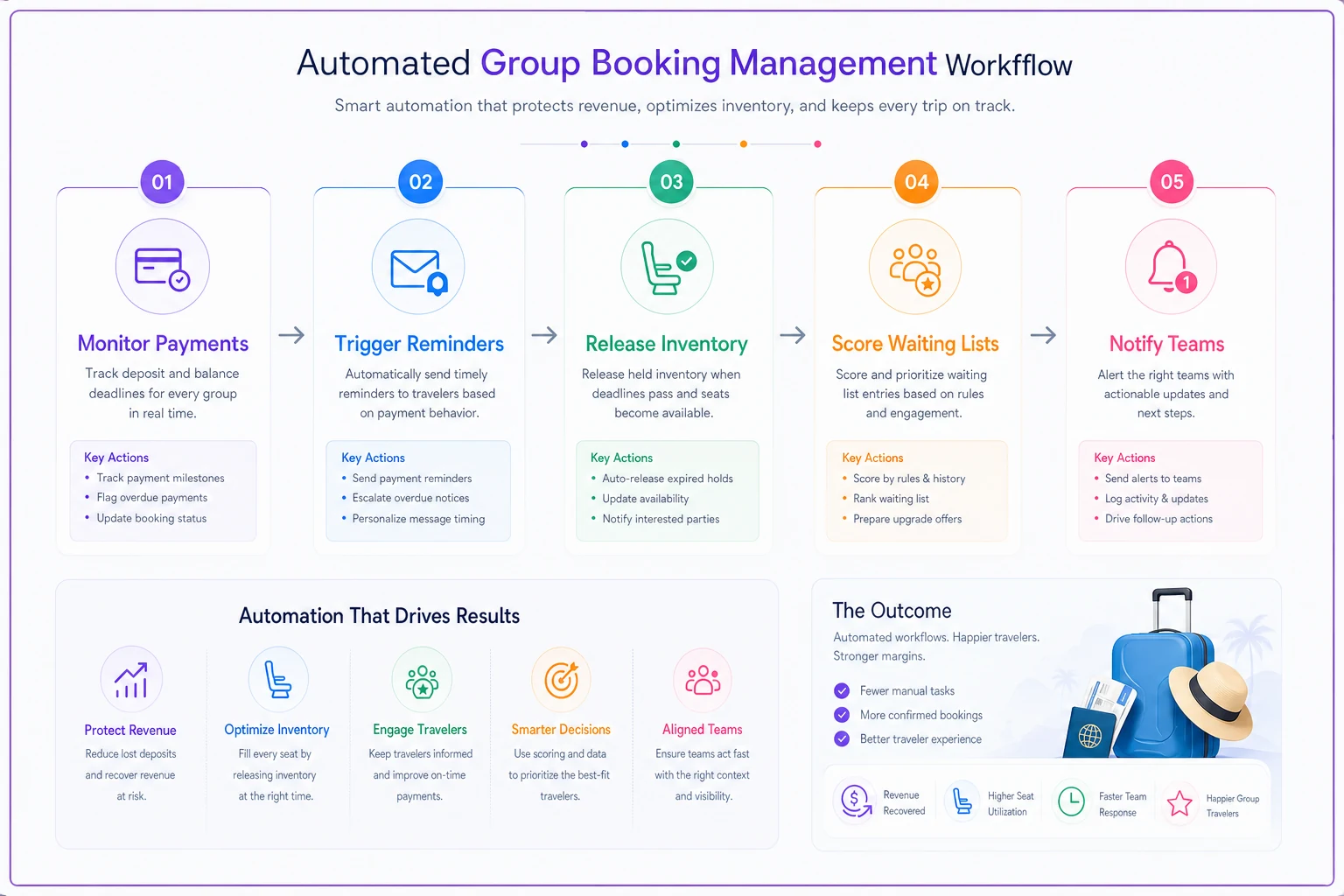
The automation handles the complexity while your team handles relationships. Payment patterns across all group bookings get tracked passively, which means the platform can identify which organizers consistently pay late and adjust reminder timing accordingly. When a waiting list opportunity opens, qualified groups get scored and notified almost instantly based on your priority matrix.
AI-assisted platforms also tend to get more useful over time. After handling a few split group requests or late payment situations, the system surfaces patterns—useful when you're trying to refine policies without relying purely on memory or gut feel.
For operators managing 20 or more group bookings monthly, this kind of automation typically saves somewhere in the range of 15-20 hours per week of administrative work. That's time that can go back into sales, customer relationships, or just keeping your team functional through peak season.
Building your group booking rulebook
The biggest mistake tour operators make is thinking they can work out group booking policies as situations arise. By the time you realize you need stricter deposit schedules, you're already buried in exceptions and frustrated customers.
Start with these non-negotiables:
-
Every group booking needs a deposit within 72 hours
-
Payment schedules accelerate as departure approaches
-
Holds expire automatically—no exceptions
-
Waiting lists use priority scoring, not first-come-first-served
-
Edge cases follow written policies, not emotional decisions
Your policies will evolve. The operator who's been running tours for ten years has handled scenarios you haven't imagined yet. But starting with clear rules beats making it up as you go, every time.
Operations that scale successfully treat group bookings as their own category—not just bigger individual bookings. Specific workflows, dedicated policies, and usually one person who owns the group booking process entirely.
Getting group booking deposits right isn't about being difficult to work with. It's about creating clarity that helps organizers succeed while protecting your business. The corporate planner booking an annual retreat appreciates knowing exactly when payments are due. The school administrator needs your firm deadlines to get budget approved. Clear rules actually make their job easier, not harder.
When deposit schedules, reminder sequences, and hold policies work together, group bookings become a real revenue driver instead of an operational burden. The chaos largely disappears, replaced by predictable processes your team can run without constant supervision. And every properly managed group booking, every efficiently filled waiting list spot, every avoided edge case crisis adds directly to your bottom line.
Ready to elevate your travel business?
Join 500+ travel operators using Touryly to optimize bookings, improve client satisfaction, and grow revenue.