



Most revenue work in this industry happens in a burst. Someone builds a new itinerary, prices it, throws it on the channels, runs a launch promo, and then it just sort of drifts. The tour sells at whatever price it sells, discounts get bolted on when bookings look soft, and nobody circles back to check whether the promo actually made money or just moved bookings around.
That gap is where the real money leaks. Not in the pricing spreadsheet you built on day one, but in the messy middle — the promos you can't measure, the discounts that quietly break your supplier economics, and the settlement lines that never get reconciled against what you thought the promo would do.
This piece is about treating revenue optimization as a closed loop across a tour's whole lifecycle. You test something, you lock the conditions so the test is clean, you measure real uplift (not vanity bookings), and you reconcile the result against settlement and supplier costs. Then you decide what to keep. Most operators do maybe one or two of those steps. Doing all four is what separates a tour that prints margin from one that just stays busy.
The core problem: you can't optimize what you can't attribute
When a promo runs and bookings go up, you actually don't know why. Maybe the promo caused it. Maybe demand was rising anyway. Maybe you pulled forward bookings that would've happened next month at full price. Maybe an OTA quietly boosted your placement that same week.
In real operations, this usually shows up as a manager saying "the 15% early-bird crushed it" — and the number they're pointing at is total bookings, not incremental bookings. Those are wildly different things.
A typical example: a city walking-tour operator runs a "20% off shoulder season" promo. Bookings for those weeks jump from around 180 to 240. Feels like a win. But when you dig in:
-
Roughly 30 of those extra bookings were people who'd normally book full-price closer to the date (cannibalization).
-
Another chunk came from a period where they'd also increased ad spend.
-
The 20% discount applied to all 240 bookings, including the 180 who were going to come anyway.
So the promo gave away 20% margin on 180 bookings it didn't need to discount, to acquire maybe 30 genuinely incremental ones. The math on that is usually ugly, and almost nobody runs it.
That's the whole problem in miniature. Without clean attribution, "it did well" and "it lost us money" look identical on the dashboard.
Uplift math, done the way that actually holds up
Uplift is just: how many more units (or how much more margin) did you get because of the intervention, versus what would've happened anyway. The trick is defining that baseline honestly.
Never miss a booking or update.
Touryly streamlines your travel bookings, confirmations, and itinerary updates—all in one place.
- Unified booking management
- Automated customer notifications
- Itinerary & staff coordination
No credit card required
You don't need a data science team. You need a defensible counterfactual. The three that work in practice:
-
Time-based baseline — same tour, comparable prior period, adjusted for known demand trend. Weakest, but usable when you can't split traffic.
-
Geo or channel holdout — run the promo on some channels/regions and hold others at control. Much cleaner. If your direct site gets the promo but one OTA doesn't, that OTA becomes a rough control.
-
Product holdout — run the test on Tour A and use a similar Tour B (same season, same customer type) as the control group.
Then the actual uplift calculation, in plain terms:
Incremental bookings = Promo-period bookings − (Baseline bookings × trend adjustment)
And the part everyone skips — margin uplift, not booking uplift:
Margin uplift = (Incremental bookings × discounted margin) − (Baseline bookings × margin given away by the discount)
That second term is the killer. It's the margin you handed to customers who were going to buy anyway. A promo can grow bookings and shrink margin at the same time, and until you write that subtraction down, you won't see it.
A quick worked example. Say a day-trip tour normally sells 200 seats at a $40 contribution margin. You run 15% off, which cuts margin to $28. Bookings rise to 250.
-
Margin without promo
200 × $40 = $8,000
-
Margin with promo
250 × $28 = $7,000
You grew bookings by 25% and lost $1,000 in margin. The promo needed to push bookings to around 286 just to break even on margin. Knowing that number before you launch changes the entire conversation.
If this connects to your broader pricing approach — and it usually does — there's more on the seasonal side of this in our piece on pricing rules for tour operators.
Inventory-lock rules: the part that keeps promos from eating your good inventory
A failure mode that shows up once volume grows: you launch a promo to fill soft dates, it works — but it also soaks up your high-demand inventory because you didn't fence it off. Now your peak Saturday departure is full of discounted seats and you're turning away full-price walk-ups.
Promos need inventory-lock rules — hard constraints on what the discount is allowed to touch. Without them, a promo behaves like water: it floods wherever the path is easiest, which is usually your best-selling slots.
-
Allocation caps. Only X% of a departure's seats are promo-eligible. Once the cap is hit, the code stops working for that date, full stop.
-
Date fencing. Discount applies only to specified low-demand departures. Peak dates are excluded at the inventory level, not the marketing level.
-
Booking-window locks. Early-bird only unlocks the discount for bookings made more than N days out. This stops last-minute buyers (who'd pay full) from grabbing the deal.
-
Stack prevention. One promo per booking. The number of operators who discover a customer stacked early-bird + returning-guest + a leftover voucher during reconciliation is higher than you'd think.
Set allocation caps per departure rather than per tour to prevent promo seats from spilling into peak dates.
The insight here: inventory-lock rules are what make your uplift math trustworthy. If a promo can leak onto peak inventory, you can never cleanly separate "this promo filled soft dates" from "this promo cannibalized my best dates." Lock the inventory, and your holdout comparisons actually mean something.
Worth watching for — when a "shoulder season only" promo shows redemptions clustered on your two busiest weekends, your date fencing is broken somewhere in the booking flow. That's usually a channel that isn't respecting the exclusion list.
Where this breaks at scale
At 3 tours and one channel, you can hold all of this in your head. One person runs the promo, eyeballs bookings, and knows roughly what happened.
Coordination breaks first. Different channels apply promos differently. Your direct site honors the date fence; an OTA applies the discount to everything because their system can't read your exclusions. Now the same "promo" is actually three different promos with three different economics, and you're reporting on them as one.
Attribution breaks second. With multiple promos overlapping across multiple tours, you lose the clean holdout. Every tour is running something, so there's no control group left. You've optimized yourself into a fog.
Reconciliation breaks last, and worst. The promo you designed and the promo that settled are different numbers. Discounts get applied at slightly wrong rates. OTA commissions get calculated on the pre-discount or post-discount price inconsistently. Supplier costs don't move even though your selling price dropped, so your real margin is worse than your model said.
That last one is the quiet destroyer. If your booking data and your settlement data don't tie back to the same promo definition, you're flying blind — which is exactly the margin-leakage trap we broke down in why a minimum viable booking→settlement data stack fixes margin leakage.
Reconciliation templates: proving what the promo actually did to settlement
This is the step almost everyone treats as optional, and it's the one that closes the loop. A promo isn't "done" when it ends. It's done when you've reconciled its impact across three ledgers: gross revenue, settlement (what actually hit your account), and supplier cost.
Run this per promo, per channel:
| Line item | Modeled | Actual (settled) | Variance |
|---|---|---|---|
| Bookings (promo-eligible) | 250 | 244 | −6 |
| Avg selling price | $85 | $85 | $0 |
| Discount applied | 15% | 16.2% | +1.2% |
| Gross revenue | $18,062 | $17,373 | −$689 |
| OTA/channel fees | $1,806 | $2,085 | +$279 |
| Supplier cost | $9,760 | $9,760 | $0 |
| Net margin | $6,496 | $5,528 | −$968 |
Look at what the variance column exposes. The discount settled higher than modeled — probably a stacking leak or a rounding issue in one channel. Channel fees came in higher because the OTA charged commission on a base you didn't expect. Supplier cost didn't budge, which it never does, so every dollar of discount came straight out of your margin.
The modeled-vs-actual variance is the whole point. If you only ever look at "did bookings go up," you'd call this promo a success. The reconciliation says you left roughly $968 of expected margin on the table on a single mid-sized promo. Repeat that pattern across a dozen promos a season and the number gets real fast.
The supplier-cost line deserves its own attention. When you discount a bundled tour, your supplier costs are usually fixed per pax — the discount compresses margin on a base that doesn't shrink. Promos on transport-heavy, multi-supplier days hurt disproportionately, and your reconciliation template makes that impossible to ignore.
The closed loop, as an actual workflow
Below is the sequence that turns scattered promo activity into an actual learning system:
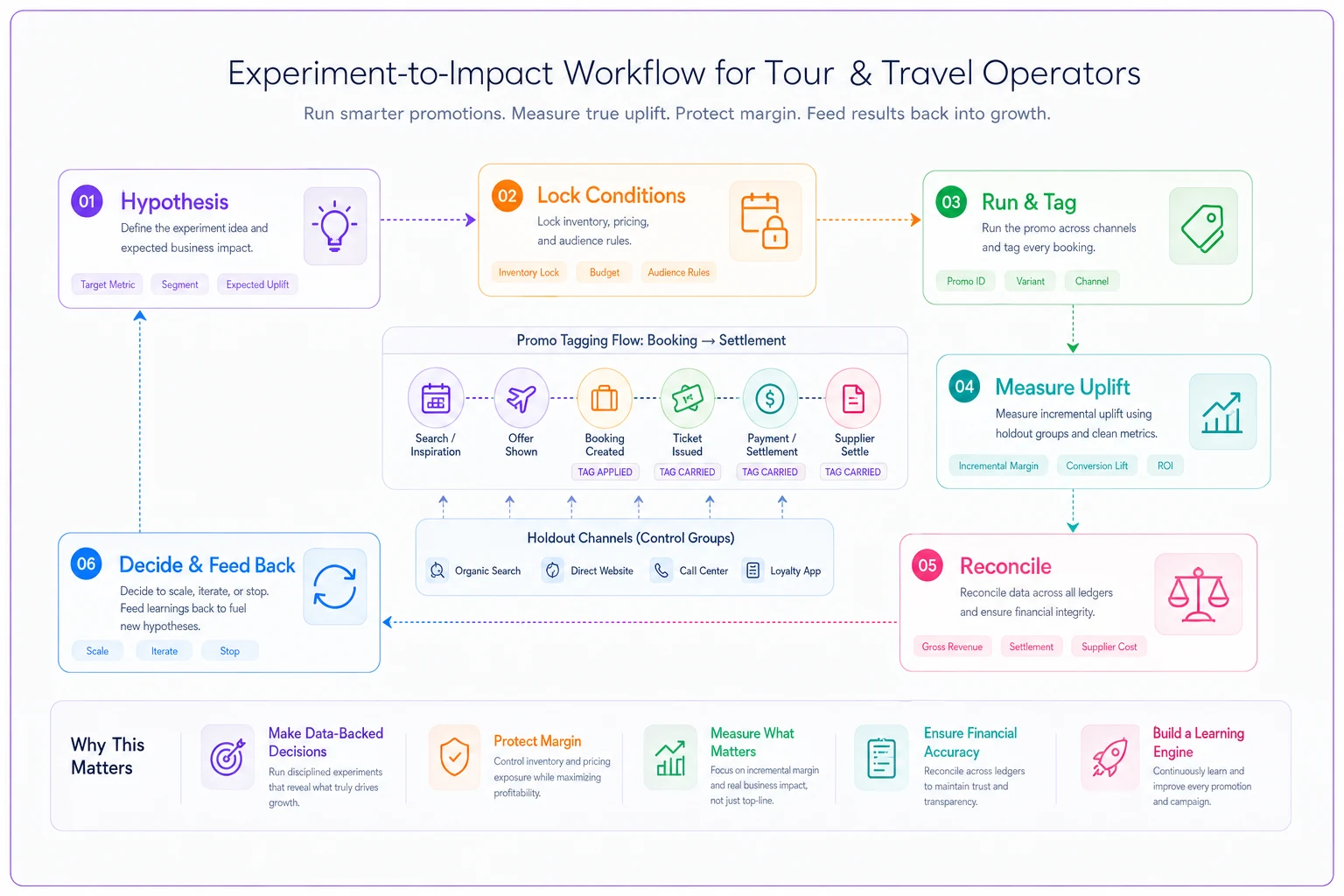
Visual representation of the closed loop workflow.
-
Hypothesis. State what you expect
"20% off Tuesday–Thursday departures in April lifts incremental bookings by 15% without touching weekend inventory."
-
Lock the conditions. Apply inventory-lock rules — allocation cap, date fence, window lock, stack prevention. Set a holdout (a channel or comparable tour left at control).
-
Run and tag. Every booking carries the promo tag through to settlement, so nothing gets orphaned later.
-
Measure uplift. Incremental bookings and, more importantly, incremental margin vs the holdout baseline.
-
Reconcile. Modeled vs settled vs supplier cost. Find the variance and its source.
-
Decide. Keep, kill, or reshape. A promo that hits booking targets but fails margin reconciliation gets reshaped, not repeated.
The magic isn't any single step — it's that the loop feeds itself. Last season's reconciled results become this season's baseline assumptions, which makes each subsequent test sharper. Operators who run this loop for a couple of years develop something most competitors never do: an actual, evidence-based feel for which promos, on which tours, at which discount depth, produce real margin.
Operational software earns its place here mostly in the plumbing — keeping the promo tag attached from booking through settlement, enforcing inventory-lock rules across every channel automatically, and surfacing the modeled-vs-actual variance without someone rebuilding a spreadsheet each month. AI-assisted reconciliation is genuinely useful for one specific thing: flagging variances that don't match your model before month-end, so you catch a broken date fence in week two instead of during a painful quarterly review. But the thinking — the hypothesis, the decision — stays with you. The tooling just stops the loop from leaking.
A real scenario: the shoulder-season promo that looked great and wasn't
A regional multi-day tour operator — 12 core itineraries, mostly direct plus two OTAs — ran a recurring "spring saver" every year. 18% off, applied broadly, no fencing. Bookings for the promo window looked healthy each year, somewhere around 400–450, and the promo was considered untouchable.
When they finally ran real uplift math with an OTA holdout, the picture flipped. The discounted OTA channel and the (accidentally) undiscounted one converted at nearly the same rate — meaning a big share of the discount was pure giveaway on demand that existed anyway. And the reconciliation showed the 18% discount was landing hardest on transport-heavy tours where supplier cost was fixed, so net margin on those departures was thinner than their standard walking tours.
They didn't kill the promo. They reshaped it: dropped the discount to 12%, fenced it to genuinely soft mid-week departures, capped promo seats at 40% of each departure, and excluded the three most supplier-heavy itineraries entirely. Booking volume for the window came down slightly — maybe 10% fewer promo bookings — but reconciled net margin for the season improved somewhere in the range of $14k–$19k, mostly from not discounting demand that never needed it.
The lesson wasn't "run fewer promos." It was that a promo they'd trusted for years was quietly average, and only the closed loop revealed it.
When this level of rigor makes sense (and when it doesn't)
When it's worth it: You're running multiple promos a season, across more than one channel, on tours with meaningfully different supplier-cost structures. That's exactly the situation where blind discounting hides its damage, and where uplift math plus reconciliation pays for itself fast.
When it's overkill: You run one small promo a year on a single tour through one channel. You can probably eyeball it. Building a formal holdout for a single low-stakes discount is effort you don't need yet — though even here, the inventory-lock discipline is still worth keeping.
Who should not start here: If your booking and settlement data don't reconcile at all yet — if you can't reliably tie a settled payment back to the booking that caused it — fix that foundation first. Uplift math built on data you can't trust just produces confident wrong answers, which is worse than no answer.
The operators who win on revenue over the long run aren't the ones with the cleverest launch pricing. They're the ones who treat every promo as an experiment with a real answer at the end — locked conditions, honest uplift, and a reconciliation that ties promo design to what actually hit the bank and what the suppliers actually charged.
Ready to elevate your travel business?
Join 500+ travel operators using Touryly to optimize bookings, improve client satisfaction, and grow revenue.