



The money that leaks on a tour almost never leaves through the front door. It leaves through the glovebox, the guide's jacket pocket, a crumpled receipt that got soaked in the rafting bag, and a WhatsApp message that says "paid supplier 40, will explain tomorrow." By the time that reaches your accounts person, the trail is cold and the number is a guess.
On-tour cash reconciliation is one of those boring operational problems that stays invisible until you add it up across a season. A guide handling two trips a week, taking tips, selling a couple of optional add-ons, and paying a local boat guy in cash can move €8k–€12k of untracked money over a summer. Most of it is legitimate. A slice of it is error. And you usually can't tell which is which, because there's no protocol that survives a real day in the field.
This is a field-first SOP. It assumes the guide has a phone, patchy signal, dirty hands, and about ninety seconds of attention at the end of a long day. Everything here is built around those constraints.
Why on-tour money goes sideways
The failure isn't dishonesty. It's that most operators design their cash controls for the office and then hand them to someone standing in a car park at 9pm.
-
Tips and float get mixed in the same pocket. The guide starts the day with a €200 float, collects €95 in tips, pays €60 to a local partner, and by evening has one lump of cash with no idea which euro belongs to which bucket.
-
Add-ons get sold but not recorded. A guest decides on the spot to add the sunset cruise for €35. The guide takes cash, says "I'll note it later," and later never comes. That's unbilled revenue that your P&L never sees.
-
Supplier cash payments have no receipt. Local partners — a donkey handler, a tuk-tuk driver, a village cook — often don't issue anything. The guide pays, and the only record is their memory.
-
Reconciliation happens at month-end instead of same-day. Trying to reconstruct 20 days of cash movement from a shoebox of receipts is how operators end up writing off "unexplained variance" as a cost of doing business.
The core issue is timing. Cash discrepancies are solvable within a few hours of the trip, while the guide still remembers who paid what. They become unsolvable within a week. A nightly protocol exists to capture the truth while it's still fresh, not to add paperwork.
The three buckets rule
Before any logs or receipts, the guide needs a mental model that works without thinking. The one that holds up in the field is three physical buckets:
Never miss a booking or update.
Touryly streamlines your travel bookings, confirmations, and itinerary updates—all in one place.
- Unified booking management
- Automated customer notifications
- Itinerary & staff coordination
No credit card required
| Bucket | What goes in | Who it belongs to | End-of-day target |
|---|---|---|---|
| Float | Starting cash for supplier payments | The company | Returns to a known number |
| Revenue | Add-on sales, upsells, on-tour purchases | The company | Logged line by line |
| Tips | Guest gratuities | The guide / tip pool | Counted, never spent as float |
The single most common mistake is paying a supplier out of the tip pocket or making change for an add-on from the float. Once the buckets touch, reconciliation breaks.
Label the envelopes and keep them in the same pocket so guides build the habit of separation before the trip starts.
Cheap, boring fix: three actual envelopes, or a wallet with three sections. Physical separation does more for accuracy than any app. The phone records what happened; the envelopes make sure what happened is clean in the first place.
The mobile receipt protocol
This is where guides give up if you make it heavy.
The protocol is: every cash movement gets a photo and one line of text, captured at the moment it happens — not batched at night.
A workable flow looks like this:
-
Money changes hands. Guest pays for an add-on, or guide pays a supplier.
-
Snap a photo. If there's a paper receipt, photograph it. If there isn't — which is half the time with local partners — photograph the cash in hand, or the supplier, or just the location. The photo is a timestamp and a memory anchor, not a legal document.
-
One line of text. Into whatever capture tool you use
OUT €60 boat – Nikos – 4 guests – no receipt. That's it. -
Keep moving. The guide doesn't reconcile anything mid-trip. They just capture.
The discipline that makes this work is capture now, reconcile later. Guides who try to do mental math during the day get distracted and drop records. Guides who just snap-and-note get a complete trail with almost no cognitive load.
For patchy-signal areas, the capture tool has to work offline and sync when the phone reconnects. A guide in a gorge with no bars still needs to log that €60 payment, and it needs to carry the real timestamp — not the time the phone found signal three hours later.
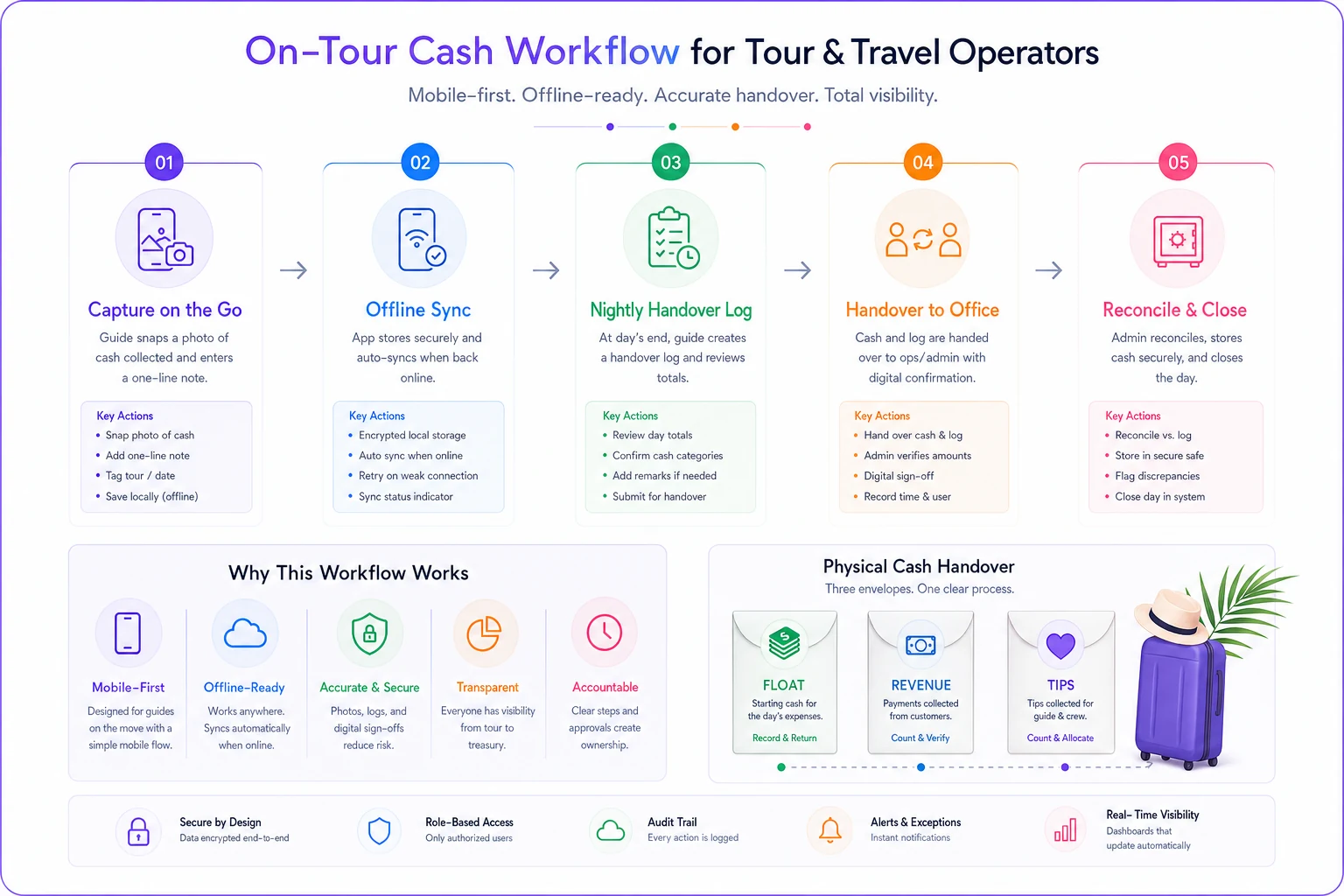
This illustration shows the live capture to nightly-reconcile loop in a single glance.
What a "good enough" field receipt actually contains
You're not chasing accounting perfection on a mountainside. You're chasing enough to reconstruct the truth. A usable field record has:
-
Direction (in or out)
-
Amount and currency
-
Counterparty (guest name or supplier name)
-
Reason (add-on name, supplier service)
-
Whether a formal receipt exists
-
A photo
Six fields. If your form has fifteen, guides will fake half of them.
The nightly handover log
At the end of the day, the guide spends five minutes closing the loop. Not reconstructing the day — just confirming what the running capture already recorded.
The nightly log answers five questions:
-
Float started with , spent , should have , actually have .
-
Revenue collected total of add-on sales, listed by item.
-
Tips total counted.
-
Variance does float-remaining match float-expected? If not, by how much and why?
-
Handover who holds the cash overnight, and where?
The variance line is the whole point. A guide who writes "expected €140, have €135, €5 short — probably gave wrong change on the cruise add-on" has given you a controllable, explainable discrepancy. A guide who hands you a lump of cash at month-end has given you a mystery.
In practice, the useful threshold is small. A €5 variance on a day that moved €300 in cash is noise. A €40 variance is a conversation. Set a tolerance — many operators use something like 2–3% of daily cash handled — and anything inside it gets logged and forgotten. Anything outside it gets reviewed within 24 hours while the guide still remembers the day.
A real scenario
A small adventure operator running canyoning and sea-kayak day trips out of southern Europe had four freelance guides handling cash in peak season. Each guide took a float, sold the occasional wetsuit-boot rental and photo package as add-ons, collected tips, and paid two or three local partners in cash per trip.
Their old process was a WhatsApp group and a month-end collection of receipts. The accounts person spent most of the first week of each month chasing guides for explanations, and they routinely wrote off somewhere around €1,500–€2,500 a season as "unexplained cash variance." Nobody thought anyone was stealing. They just couldn't prove where it went.
They switched to the three-bucket and nightly-log approach. Guides photographed every supplier payment and every add-on sale, closed a five-minute nightly log, and flagged any variance over about €15. Within two months the unexplained variance basically disappeared — it dropped to under €200 for the rest of the season — not because the money had been going missing, but because it was now being recorded. The quieter win: the accounts person stopped losing the first week of every month to detective work, and the add-ons that used to vanish started showing up as real revenue, roughly €90–€130 per week per guide that had previously been collected but never logged.
The lesson isn't "catch the thieves." It's that most cash leakage is a recording failure, and recording failures are fixable with timing and structure, not suspicion.
Simple audit controls that don't require an auditor
You don't need a finance team to keep this honest. You need a few lightweight controls that create friction in the right places:
-
Float is a fixed, known number. Same starting float every trip for a given tour type. Variance is instantly visible because the baseline never moves.
-
Photos are mandatory for payments over a threshold. Say, anything over €20 out needs a photo. Small stuff can be noted without one.
-
Nightly logs are due before the guide's next assignment. No log, no next float. This is the single most effective control, because it ties compliance to something the guide actually cares about.
-
Spot-checks, not full audits. Someone in the office reviews two or three random trips a week in full — matching photos to logs to cash banked. Guides know it's random, which keeps everyone honest without you reviewing everything.
-
Tips never flow through company accounts unless pooled. Decide the tip policy up front and keep it out of the revenue reconciliation entirely. Mixing tips into revenue creates tax and fairness messes that aren't worth it.
The spot-check point deserves emphasis. Full reconciliation of every trip is where operators burn out and quietly abandon the whole system. Random deep-checks give you most of the deterrence for a fraction of the effort.
Sample end-of-day journal entries
Once the nightly log lands, bookkeeping becomes mechanical. Here's how a typical day translates into journal entries. Assume a guide started with a €200 float, sold €105 in add-ons, collected €70 in tips (pooled), and paid €60 to a local boat partner with no formal receipt.
Add-on revenue collected in cash: Dr Cash on hand (guide float) 105.00 Cr Add-on revenue 105.00
Supplier paid in cash, no receipt (recorded against a documented internal voucher + photo): Dr Supplier cost – local partners 60.00 Cr Cash on hand (guide float) 60.00
Tips collected into the pool (liability, not revenue): Dr Cash on hand (guide float) 70.00 Cr Tips payable (staff pool) 70.00
End-of-day cash banked / handed over (float €200 + add-ons €105 + tips €70 − supplier €60 = €315 expected): Dr Cash in transit / office safe 315.00 Cr Cash on hand (guide float) 315.00
If the guide actually handed over €310 instead of €315, the €5 gap books as: Dr Cash over/short 5.00 Cr Cash in transit 5.00
That Cash over/short account is your truth-teller. Watch it over the season. A guide whose over/short trends consistently negative isn't necessarily dishonest — they might just be bad at making change — but the pattern is visible, which is the entire point.
When your guides are working across currencies, the same discipline applies but the reconciliation gets a layer more complex. It's worth reading alongside a proper multi-currency reconciliation SOP so the FX rate used at the point of payment is captured, not guessed at month-end.
When this system makes sense — and when it's overkill
This makes sense when:
-
Guides regularly handle cash floats, tips and on-the-spot add-ons
-
You work with local partners who deal in cash and don't issue receipts
-
You're running enough trips that month-end reconstruction has become painful
-
You have freelance or seasonal guides whose record-keeping habits vary wildly
This is overkill when:
-
Everything is prepaid and cashless, and guides never touch money
-
You run one or two guides who are also the owners
-
Add-ons are booked online in advance, not sold in the field
One thing worth saying plainly: don't bolt this on half-heartedly. Operators who introduce the nightly log but never do the spot-checks are just training guides to write down whatever balances. The control that makes it real is someone occasionally matching the photos to the cash. Without that, you've added paperwork and gained nothing.
Where software quietly helps — and where it doesn't
Most of this is protocol, not technology. The three buckets are envelopes. The discipline is cultural. No app fixes a guide who won't separate tips from float.
Two parts genuinely benefit from the right tooling, though. The first is offline capture that timestamps correctly — a guide in a canyon needs to log a payment with the real time it happened and have it sync later. The second is turning nightly logs into journal entries without manual re-typing. When the capture tool maps each logged line to the correct account automatically, the over/short figure calculates itself and your bookkeeper stops doing data entry.
The same logic applies when you're reconciling guide cash against agent splits and commissions — the templates in this commission reconciliation guide pair naturally with a clean nightly cash log, because both feed the same month-end close.
The point of any tool here is to remove friction at the two moments guides are most likely to quit: capturing in the field, and the five-minute nightly close. Everything else is habit and structure.
The one thing that actually fixes this
Reconcile nightly, not monthly. Every control in this SOP — the buckets, the photos, the one-line notes, the over/short account — exists to serve that one shift in timing.
Cash on a tour isn't hard to track. It's hard to reconstruct. A guide who spends five honest minutes closing the day while the trip is fresh will hand you a clean trail. A month of guesswork hands you a write-off and a vague worry about whether someone's skimming. Move the reconciliation to the field, keep it brutally simple, and the mystery money problem mostly disappears on its own.
Ready to elevate your travel business?
Join 500+ travel operators using Touryly to optimize bookings, improve client satisfaction, and grow revenue.