

Most tour operators collect NPS and CSAT religiously. They post the monthly number in a Slack channel, someone says "nice, we're at 62," and then nothing really happens. The score goes up, the score goes down, and nobody can point to a single guide who got better or a single supplier who got dropped because of what the feedback said.
That's the real failure. Not collecting feedback — everyone does that. The gap is that raw scores never get connected to the two things that actually move guest experience: the people running your tours and the suppliers feeding them. A closed loop means every detractor score triggers a specific action against a specific owner, and you can trace the whole chain from a bad survey to a coaching session or a supplier penalty.
This is the piece most operators skip because it's operationally annoying to build. But once it's running, your feedback stops being a vanity metric and starts quietly raising your margins — because coaching your worst guides and remediating your worst suppliers is cheaper and faster than replacing either.
Why raw scores don't survive contact with real operations
An NPS number is an average, and averages hide everyone who matters. If you run 200 tours a month and land at a 58 NPS, that figure blends your best city-walking guide with the one who keeps showing up late, and your reliable transport supplier with the one whose van broke down twice in July.
What tends to happen is that the feedback arrives fine — survey response rate is decent, comments are detailed — but it dies at the routing stage. Nobody decided in advance who owns a detractor comment about a specific guide, or what happens when a supplier gets tagged in three separate negative surveys in a week.
There's also a timing problem. A guest fills out a survey four days after the tour. By the time someone reads it, that guide has already run six more tours making the same mistake, and the supplier has delivered two more disappointing transfers. Feedback that isn't triaged within a tight window is basically a post-mortem, not a correction.
The NPS action loop for a tour operator only works when three things are true: feedback is tagged consistently, it's routed automatically to a named owner, and it triggers a pre-agreed action based on thresholds you set before the season starts — not decided in the moment when everyone's already stretched.
Start with a feedback taxonomy, or nothing downstream works
You can't route what you can't categorize. Before any coaching or remediation logic makes sense, every piece of feedback needs to be tagged against a fixed taxonomy. Free-text comments alone don't scale — you'll never manually read 600 survey responses a month and reliably spot the pattern.
Never miss a booking or update.
Touryly streamlines your travel bookings, confirmations, and itinerary updates—all in one place.
- Unified booking management
- Automated customer notifications
- Itinerary & staff coordination
No credit card required
A workable taxonomy for tour operators usually splits into a few clear buckets:
-
Guide performance — knowledge, pacing, punctuality, communication, group management, safety handling
-
Supplier quality — transport condition, timeliness, accommodation, restaurant/venue, equipment
-
Itinerary/product — over-packed schedule, wait times, value-for-money, misleading listing
-
Booking & pre-trip — confirmation clarity, communication before the tour, meeting-point confusion
-
Operational/logistics — group size, weather handling, incident response
The important design rule: every tag must point to an owner. A "guide performance – punctuality" tag maps to that guide and their team lead. A "supplier quality – transport condition" tag maps to the supplier account and whoever manages that relationship. If a tag doesn't map to someone who can fix it, it's a useless category — merge it or cut it.
A mistake operators make here is building a taxonomy with 40 categories because it feels thorough. In practice, half of them never get used and tagging becomes inconsistent. Keep it tight — 15 to 20 tags, each with a clear owner — and you'll get far cleaner data.
Linking scores to the actual guide and supplier
This is the part that separates a real loop from a dashboard: each survey has to carry the metadata to attribute it. Every NPS/CSAT response needs to be joined to the tour instance, and through that instance to the specific guide who ran it and the specific suppliers who serviced it.
Sounds obvious, but this is where a lot of setups quietly break. If your survey just asks "how was your tour?" and you can't tie the response back to guide ID and supplier IDs, you're stuck at the aggregate level forever. You need the booking-to-tour-to-resource links intact so a score flows down to the right people automatically.
A typical example looks like this:
| Entity | 30-day avg CSAT | Detractor rate | Open triage items | Status |
|---|---|---|---|---|
| Guide – Marco | 4.7 / 5 | 3% | 0 | Healthy |
| Guide – Priya | 4.2 / 5 | 11% | 2 | Watch |
| Guide – Tom | 3.6 / 5 | 22% | 4 | Coaching required |
| Supplier – CityVans | 3.4 / 5 | 26% | 5 | Remediation |
| Supplier – LakeBoats | 4.6 / 5 | 4% | 0 | Healthy |
The moment you can see this table, decisions stop being political. You're not arguing about whether Tom is struggling — the detractor rate says he is, measured against the same taxonomy you use for everyone else. This is also where AI-assisted tagging earns its keep: instead of a human reading and categorizing every comment, an operational platform can classify free-text feedback into your taxonomy and update these rolling scores as responses come in, so the table stays live rather than something you rebuild at month-end.
Triage rules and thresholds: decide before the season, not during it
The heart of the system is a set of automated triage rules that fire based on thresholds. The whole point is to remove the "should we do something about this?" conversation. If a threshold is crossed, an action is created and assigned. No debate.
Thresholds should work on two axes: severity of a single event and pattern over time. A single 0-out-of-10 with a safety comment is an immediate escalation regardless of the guide's average. A guide who never triggers a single-event alarm but drifts to an 18% detractor rate over three weeks is a slow-burn problem that also needs action.
-
Instant escalation — any survey mentioning safety, harassment, or being stranded → flagged within the hour, routed to ops lead, tour reviewed same day.
-
Detractor with named guide — any score ≤ 6 tagged to a guide → auto-created coaching note, assigned to team lead, must be actioned within 72 hours.
-
Guide pattern trigger — detractor rate above ~15% over a rolling 20-tour window → mandatory coaching session scheduled.
-
Supplier single-fail — any score ≤ 4 tagged to supplier quality → logged against supplier scorecard, no action yet.
-
Supplier pattern trigger — 3+ supplier-tagged detractors in 14 days, OR 30-day supplier CSAT below 3.8 → remediation protocol opens with the supplier.
-
Repeat-offender trigger — same taxonomy tag hitting the same entity 4+ times → escalate one level (guide → performance review, supplier → contract review).
The pattern-based triggers are what most operators miss. They react to individual angry emails but never catch the guide whose scores are quietly sliding, because no single tour was bad enough to flag. Set the rolling-window thresholds and those slow declines surface automatically.
For the escalation tier, the mechanics overlap heavily with how you'd handle a live incident. If you've already built SLOs and runbooks for resilient live tour operations, your severe-feedback escalation should plug straight into the same on-call structure rather than living as a separate process nobody remembers to follow.
Closed-loop coaching: what happens after the trigger fires
A trigger that creates a task and then sits there is not a loop. Closing the loop means the coaching happens, gets documented, and feeds back into the score so you can tell whether it worked.
-
Trigger fires → coaching note auto-created with the guide, the tour, the specific tags, and the guest comments attached (anonymized).
-
Team lead reviews within the SLA window and books a short 1
1 — not a formal review, a working conversation.
-
Coaching session happens using a script tied to the specific tag, not a generic "do better" talk.
-
Agreed action is logged (shadow a senior guide, adjust pacing, arrive earlier, etc.).
-
Follow-up window set — the next 5–8 tours for that guide are watched against the same tag.
-
If scores recover, the item closes. If not, it escalates to the repeat-offender path.
The follow-up step is the one people drop. Without it, you coach someone, feel good about it, and never confirm the behavior actually changed. Steps 5 and 6 are where the real value lives — proof the coaching landed, not just that it happened.
Sample coaching scripts
Punctuality tag:
> "Three guests on the Old Town walk last week mentioned the tour started 10–15 minutes late. I know the meeting point gets chaotic — what's making the start slip? Let's figure out a routine that has you at the point 15 minutes early so the count is done before start time."
Pacing tag:
> "A couple of recent surveys said the museum section felt rushed while the plaza dragged. Your knowledge scores are great, so this is purely rhythm. Can we walk through where you're spending time and rebalance it? I'd like you to shadow Marco's afternoon run — his pacing is what we're aiming for."
Group management tag:
> "Feedback mentioned the larger group struggled to hear you near the fountain. Let's talk about positioning and whether we get you a better headset for groups over 12. This isn't a performance issue — it's a setup issue we can fix."
Notice the tone: specific, non-punitive, and always pointing at a concrete adjustment. Coaching that feels like discipline just makes guides game the survey or discourage feedback, which poisons your data.
Supplier remediation playbooks
Suppliers can't be coached the way guides can — you don't manage their staff. The remediation path is different: it's about escalating structured pressure while protecting your guests, and having the evidence to back it up.
-
Stage 1 – Notice. Supplier CSAT dips below threshold or hits the pattern trigger. Send a factual summary: dates, tour references, tagged issues, guest comments (anonymized). No penalties yet — you're establishing the record.
-
Stage 2 – Corrective plan. If the pattern continues past a couple of weeks, request a written corrective action with a date. This is also when you quietly line up a backup supplier for those routes.
-
Stage 3 – Volume reduction. Still not improving? Start shifting bookings to alternatives. Reduced volume is the pressure that actually gets attention.
-
Stage 4 – Contract review / penalty. Hit the penalty triggers in your SLA, or begin offboarding.
The evidence trail matters enormously here. When you tell a transport supplier "your vehicles generated a 26% detractor rate across 14 tours in June," and you can attach the tagged feedback and tour references, the conversation is completely different from "we've had some complaints." One is a business case; the other is an argument.
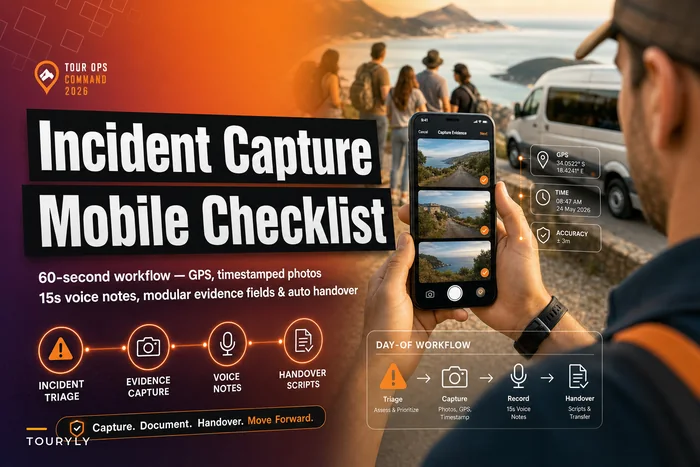
This is also where day-of incident data compounds the value. When your guides are already capturing structured notes and evidence through a day-of mobile checklist for guides, that on-the-ground record lines up with the guest survey data — so a supplier can't wave away a pattern as "just one grumpy customer."
A real scenario
A mid-sized operator running city and day tours — roughly 180–220 tours a month across a dozen guides and about eight suppliers — was sitting at a company NPS in the low 50s and couldn't move it. They collected surveys but read them ad hoc, and coaching happened only when a guest complaint got loud enough to reach the owner.
They rebuilt the flow: a 16-tag taxonomy, every survey attributed to guide and suppliers, threshold-based triage with a 72-hour coaching SLA. Two things surfaced almost immediately. One guide with an "average" reputation actually had a detractor rate near 20% driven entirely by pacing — invisible before because no single survey was catastrophic. One transport supplier accounted for a disproportionate share of low scores, concentrated on early-morning transfers.
Over the following quarter, the guide's pacing scores recovered after two coaching sessions and a few shadow runs. The supplier got a Stage 1 notice, didn't improve, and lost the early-morning routes to a backup whose scores came in noticeably higher. Company NPS moved into the low-to-mid 60s. But the more useful outcome was that detractor comments dropped in the exact categories they'd targeted. The number went up because specific things got fixed, not by accident.
When this makes sense — and when it doesn't
When it's worth building: You're running enough volume that patterns exist to find — roughly 100+ tours a month — and you have multiple guides and suppliers where quality genuinely varies. At that scale, the aggregate NPS is actively hiding decisions you should be making.
When it's overkill: If you're running a handful of tours a week with one or two guides you know personally, a formal triage engine is bureaucracy. You already know who's struggling. Spend the effort on the feedback itself, not the routing machinery.
Who should not do this: Operators who won't commit to the coaching side. If you build the triggers but never actually run the sessions or enforce the supplier stages, you've just created a queue of ignored tasks — which is worse than nothing, because staff learn the system is theater. The loop only works if the "action" in action loop is real.
Making it run without drowning your team
The honest obstacle isn't designing this — it's the manual overhead of tagging every response, tracking every threshold, and remembering every 72-hour SLA and follow-up window. Done by hand, it collapses during the first busy week of high season.
Automate tagging and triage so season peaks don't collapse your manual process.
This is where an AI-assisted operational platform carries real weight: classifying incoming feedback into your taxonomy, updating rolling per-guide and per-supplier scores in real time, firing triage rules the moment a threshold is crossed, and generating the coaching note or supplier notice with the evidence already attached. The judgment stays human — the actual coaching conversation, the decision to drop a supplier — but the routing, tracking, and reminders stop depending on someone remembering to check a spreadsheet.
The goal isn't to automate away the relationship work. It's to make sure no detractor score falls through the cracks and every trigger reliably becomes an action with an owner and a deadline.
Bringing it together
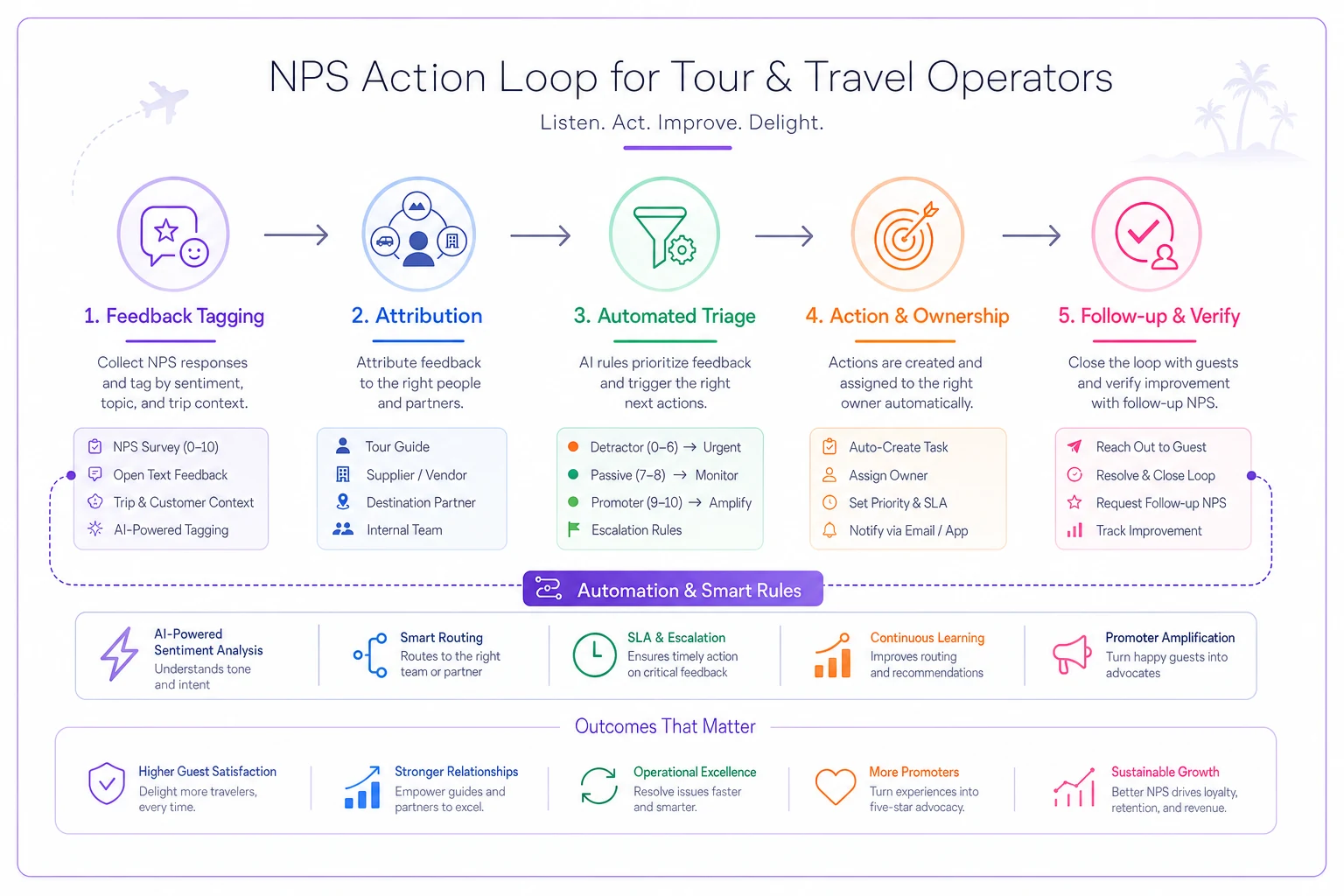
An NPS number on its own tells you almost nothing you can act on. The value is entirely in the chain behind it: consistent taxonomy → attribution to real guides and suppliers → thresholds decided in advance → triggered coaching and remediation → follow-up that proves it worked. Skip any link and the loop breaks, and you're back to staring at an average that moves for reasons you can't explain.
Build the full loop and something changes in how the whole operation feels. Guides get specific, fair feedback instead of vague pressure. Weak suppliers face a documented case instead of a shrug. And your feedback data finally does the one job it was always supposed to do — tell you exactly where to spend your attention next.
Build the full loop and something changes in how the whole operation feels. Guides get specific, fair feedback instead of vague pressure. Weak suppliers face a documented case instead of a shrug. And your feedback data finally does the one job it was always supposed to do — tell you exactly where to spend your attention next.
Ready to elevate your travel business?
Join 500+ travel operators using Touryly to optimize bookings, improve client satisfaction, and grow revenue.