



Bundled tours break accounting in a very specific way: the money arrives as one lump, but the value gets delivered across weeks, across suppliers, and sometimes across two tax jurisdictions. A guest pays $2,400 for a 6-day package. That single payment quietly contains hotel nights, a guided day trip, airport transfers, three dinners, and your margin. Your P&L has no idea how to handle that until someone tells it — and if nobody does, month-end becomes a guessing exercise.
This post is narrow on purpose. It's about revenue recognition for tour packages where the package is a bundle of separately-delivered components, often from different suppliers, and how to write journal entries and reconciliation rows that a controller can actually drop into close without re-deriving your logic every month.
If you already handle refunds well, you've seen half of this problem before — the accounting for refunds and cancellations uses the same deferred-revenue plumbing. This is the delivery-side counterpart.
The specific thing that goes wrong
A package sells for one price. The booking system records one line: "Amalfi 6-Day — $2,400." Payment clears. Someone recognizes the full $2,400 as revenue on the booking date because that's when the money moved. Costs, meanwhile, land whenever suppliers invoice — the hotel bills after checkout, the transfer company bills weekly, the restaurant never sends anything because it was prepaid through a voucher.
So in the month of booking, you show $2,400 of revenue and maybe $200 of cost. Great margin! Then two months later, when the trip actually happens, $1,700 of supplier costs hit with zero associated revenue. Terrible margin. Neither month is real. Your monthly P&L is now fiction, and any pricing decision made off it is guesswork.
The second failure mode is subtler. Even operators who do defer revenue correctly often recognize the whole bundle on the trip end date. That's better, but it still hides which components are actually profitable. If your day-trip add-on runs at 8% margin and your hotel block runs at 34%, a blended package number will never tell you to renegotiate the day trip. You need the revenue split by component, not just deferred in aggregate.
Why bundles resist clean accounting
Three reasons, and they compound.
Never miss a booking or update.
Touryly streamlines your travel bookings, confirmations, and itinerary updates—all in one place.
- Unified booking management
- Automated customer notifications
- Itinerary & staff coordination
No credit card required
The price isn't itemized to the customer. You sold "one experience" for marketing reasons. But accounting needs a defensible way to allocate that single price across performance obligations satisfied at different times. Under the revenue standards most operators work within, each distinct component — a hotel stay, a guided tour, a transfer — is generally its own performance obligation, recognized when delivered.
Supplier costs arrive on their own schedule. Nobody coordinates their invoicing to your close calendar. A DMC might bill 30 days after the tour. A hotel might charge a deposit at booking and the balance at checkout. So even your cost side needs accruals, not just cash.
Multi-supplier itineraries mix principal and agent revenue. For some legs you're the principal — you took inventory risk, you're on the hook. For others you're earning a commission and the supplier is the principal. Those get recognized differently (gross vs. net), and jamming them into one "package revenue" line makes your top-line meaningless.
What tends to happen across a lot of operators' books is that the deferral question gets solved first, and the allocation question — splitting the price fairly across components — gets ignored for years because it's tedious. That's the part this post pushes on.
The allocation methods, and when each one fits
You have three realistic ways to split a bundle price across its components. Pick based on what data you actually have, not what's theoretically purest.
| Method | How it works | Best when | Weakness |
|---|---|---|---|
| Standalone selling price (SSP) | Allocate the bundle price in proportion to what each component sells for on its own | You sell components separately too (day trips, transfers) so you have real standalone prices | Requires maintaining a price list per component |
| Cost-plus / adjusted cost | Allocate based on each component's supplier cost, marked up to reflect margin | You rarely sell components alone, but you know your supplier costs precisely | Can misstate value if margins vary wildly by component |
| Residual | Price the observable components at SSP, dump the leftover into the one hard-to-value component | One component has no standalone price (a custom guided experience) but the rest do | Only defensible when exactly one component is genuinely un-priceable |
The one that holds up best in review is SSP, because it's grounded in observable market prices. Most operators can reconstruct it even without formal price lists: what would a guest pay to buy just the airport transfer? Just the two hotel nights at rack rate? You don't need perfection — you need a consistent, documented basis.
One practical note: allocate on percentages, not fixed dollars. If a booking gets a partial refund or a component gets substituted, percentage-based allocation keeps recalculating cleanly. Fixed-dollar allocation forces a manual redo every time the total changes.
A worked allocation
Take that $2,400 Amalfi package. Standalone prices, if bought separately:
-
Hotel, 5 nights
$1,300
-
Guided day trip (Pompeii)
$520
-
Airport transfers (round trip)
$180
-
Three dinners
$300
-
Sum of standalone
$2,300
The bundle sells for $2,400, so there's a $100 premium over the sum of parts (or it could be a discount — same math). Allocate the actual $2,400 by each component's share of the $2,300:
-
Hotel
1,300 / 2,300 = 56.5% → $1,357
-
Day trip
520 / 2,300 = 22.6% → $542
-
Transfers
180 / 2,300 = 7.8% → $188
-
Dinners
300 / 2,300 = 13.0% → $313
Those four numbers, not the single $2,400, are what flow into your deferred revenue schedule — each released when that component is delivered.
Here's a simple workflow to visualize the allocation and release process.
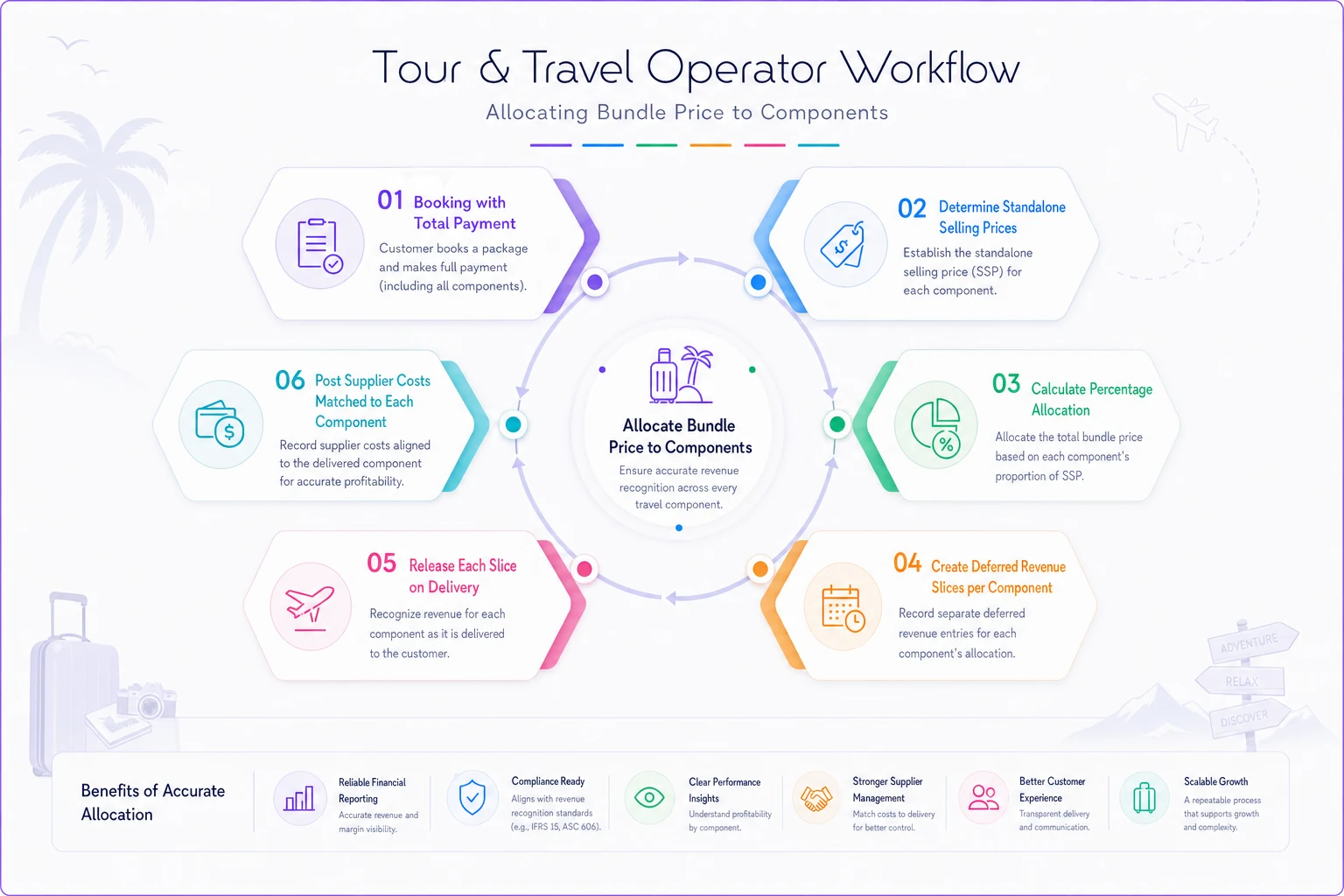
The workflow shows the allocation happening at booking, then the component-level releases on delivery, and finally the matching of supplier costs to each released component.
Sample journal entries by bundle type
These are the entries operators can actually adapt. Amounts use the Amalfi example above.
Type 1: All-principal bundle (you carry all the inventory)
At booking / payment ($2,400 received): Dr Cash / Merchant clearing 2,400 Cr Deferred revenue 2,400
Transfers delivered (arrival day, $188 allocated): Dr Deferred revenue 188 Cr Transfer revenue 188 Dr Transfer cost of sales 120 Cr Accrued supplier payable 120
Hotel nights delivered (checkout, $1,357 allocated): Dr Deferred revenue 1,357 Cr Accommodation revenue 1,357 Dr Accommodation cost of sales 910 Cr Accrued supplier payable 910
Repeat the same shape for the day trip and dinners on their delivery dates. By the time the trip closes, deferred revenue for this booking nets to zero and every component has landed revenue and cost in the same period.
Type 2: Mixed principal/agent bundle
Say the day trip is actually resold on commission — the DMC is the principal, you keep 15%. That leg is recognized net. The $542 allocated to the day trip isn't your revenue; only your commission is. Day trip delivered (agent leg): Dr Deferred revenue 542 Cr Supplier payable (DMC) 461 Cr Commission revenue 81
You never book the $461 as your revenue or your cost — it flows straight through. This is the entry that keeps your top line honest. Operators who book agent legs gross inflate revenue by exactly the pass-through amount, and it distorts every revenue-based metric you rely on.
Type 3: Deposit-only bundle at period end
Guest paid a $600 deposit, trip is next month, balance not yet due. At deposit: Dr Cash 600 Cr Customer deposits (liability) 600
Nothing hits revenue. At close, Customer deposits should equal the sum of all un-started bookings' collected amounts — which is your first reconciliation control.
Reconciliation rows operators can drop into close
This is the part most posts skip. Journal entries are useless if nobody can prove they tie out. Here are the reconciliation lines to build into your month-end workbook, each with the check it enforces:
-
Deferred revenue roll-forward — Opening balance + new bookings collected − revenue recognized this month − refunds = closing balance. This closing figure must match your GL deferred revenue account to the dollar.
-
Customer deposits vs. un-started bookings — Sum of deposits on bookings with a start date after period end should equal the
Customer depositsliability. A gap means a deposit got recognized early or a started trip never released. -
Component release completeness — For every booking that ended this month, all allocated component revenue should be released. Any deferred balance sitting on a completed booking is a stuck entry.
-
Accrued supplier payables vs. expected cost — Recognized cost of sales should have a matching accrual or invoice. Recognized revenue with no matching cost is the classic "revenue landed, supplier bill missing" leak.
-
Principal vs. agent split check — Total gross revenue minus net (agent) revenue lines should reconcile to your commission income. If agent legs crept into gross, this won't foot.
Carry a booking reference on every journal line. When the deferred roll-forward is off by $313, you want to find the one booking, not scroll the whole ledger.
Carry a booking reference on every journal line.
Traceable line-level detail is the difference between a 20-minute reconciliation and a lost afternoon — the same principle behind keeping a tight booking-to-settlement data stack so every dollar can be traced from checkout to the ledger.
Allocation keys for multi-supplier itineraries
When one itinerary spans several suppliers and several currencies or tax zones, you need a stable allocation key — the identifier that ties a component's revenue slice, its supplier cost, and its recognition date together.
A workable key structure looks like:
BOOKING-REF | COMPONENT-CODE | SUPPLIER-ID | DELIVERY-DATE | CURRENCY
So one line might be AML-4471 | HOTEL | SUP-Rossi | 2025-06-14 | EUR. Every journal entry, every accrual, and every reconciliation row references that key. When the hotel invoices in EUR and you booked the package in USD, the key lets you match the cost to the exact revenue slice and handle the FX difference against the right component rather than smearing it across the whole booking.
The discipline here is that the allocation happens at booking time, not at close. The percentages get locked when the sale is made, using standalone prices as of that date. Trying to reconstruct allocation two months later — after prices changed and a component got substituted — is where errors breed.
A short real scenario
A mid-sized inbound operator running roughly 90–110 multi-day packages a month had been recognizing full package revenue at booking. Their monthly margins swung between 12% and 41% depending purely on the timing gap between booking months and travel months. Pricing meetings were basically arguments about which month's number was "the real one."
They moved to component-level SSP allocation with deferred release on delivery. The first two closes were slower — building the standalone price reference and back-filling in-flight bookings took real work. By the third month, monthly gross margin settled into a stable 26–29% band, and they finally spotted that their transfer component was running near break-even after a supplier rate increase nobody had caught. That single finding paid for the whole exercise. The margin was never actually swinging — the accounting was swinging, and it was masking a real cost problem underneath.
When this level of detail makes sense — and when it doesn't
Do the full component-level allocation when: you sell genuine bundles across multiple suppliers, your components have meaningfully different margins, or you span more than one tax jurisdiction. The more your bundle mixes principal and agent legs, the less optional this becomes.
You can skip it when: you sell mostly single-supplier day tours delivered same-day. If revenue and cost land in the same period anyway, elaborate deferral machinery adds work without adding truth. A same-day $95 walking tour does not need a five-line allocation key.
Who should be careful: very small operators with no accounting support. If nobody owns the deferred revenue roll-forward monthly, a component-level system creates more stuck entries than it prevents. Start with correct deferral of the whole bundle first, then split into components once the monthly discipline is stable.
Where tooling quietly helps
None of this requires fancy software — a disciplined spreadsheet and a consistent close process will get you there. But the tedious parts are exactly the parts worth automating: locking allocation percentages at booking, generating the component release entries on each delivery date, and producing the reconciliation roll-forward with booking references intact.
Operational platforms that connect bookings to the ledger can carry the allocation key from sale through to close, so the deferred schedule releases itself instead of someone rebuilding it by hand every month. The value isn't magic — it's that the boring, error-prone steps stop depending on someone remembering to do them.
Getting bundle revenue recognition right doesn't just clean up your audit trail. It means your monthly P&L finally tells you the truth about which components make money and which quietly don't — early enough to actually do something about it.
Ready to elevate your travel business?
Join 500+ travel operators using Touryly to optimize bookings, improve client satisfaction, and grow revenue.