



Most operators don't fail at localization because their translations are bad. They fail because localization gets treated as a task — hand the copy to a translator, paste it back into the booking flow, ship it — instead of a system that touches pricing, support, legal, availability, and every automated message a guest receives from quote to post-trip survey.
That gap is where the money leaks. You launch German-language pages for your Iceland tours, conversion looks fine for two weeks, then refund requests spike because the localized cancellation policy quietly said something different from the English one. Or your Spanish confirmation email renders a date as 03/04 and a guest shows up a month late. None of these are translation problems. They're workflow problems that a translation happened to expose.
Why localization breaks differently than English content
The core reason multilingual operations get messy: your English content is authoritative and everything else is derived. Every language you add creates a copy that can drift. And in a tour business, content isn't marketing fluff — it carries operational meaning. Meeting points, what's included, age limits, cancellation windows, deposit terms, weather policies. When a derived asset drifts from the source, you don't just have a typo. You have a contractual and safety mismatch.
What tends to happen across operators expanding beyond their first language is a predictable sequence. It starts clean because there are only two or three languages and one person eyeballs everything. Then a fourth language gets added for a big OTA push, the person who "just checks it" goes on leave, and suddenly nobody actually knows which version of the refund policy is live in Italian.
-
Source updates that don't propagate. You change the meeting point in English. Five other languages still show the old café that closed.
-
Partial translations shipped as complete. The tour description is translated, but the fine print, the automated SMS, and the error messages are still English.
-
Locale formatting bugs. Dates, currency symbols, decimal separators, time formats (24h vs 12h), address order. These almost never get caught in a text review because they're structural, not linguistic.
The insight most people miss: the highest-risk strings are the shortest ones. Nobody proofreads a "Book now" button or a validation error like "Invalid card." But those tiny strings are what break the actual transaction.
The translation workflow as a pipeline, not a handoff
If you think of translation as "send file → get file back," you will always be reacting. The operators who scale cleanly treat it as a pipeline with defined states, and every string moves through the same states regardless of language.
Never miss a booking or update.
Touryly streamlines your travel bookings, confirmations, and itinerary updates—all in one place.
- Unified booking management
- Automated customer notifications
- Itinerary & staff coordination
No credit card required
Here's the workflow that actually holds up as you grow:
-
Extract and freeze the source. Pull every guest-facing string — pages, emails, SMS, app strings, PDF vouchers, error messages — into one place with a version tag. If you can't list every string that needs translating, you can't guarantee coverage.
-
Mark string context and constraints. A translator needs to know that this string is a 20-character button, that string is a legal cancellation clause, and that one contains a variable like
{guest_name}. Context missing here is where most bad translations come from. -
Translate. Human, machine-assisted, or both depending on tier (more on tiering below).
-
Review against acceptance criteria. Not "does it read well" — a structured check against a rubric (covered further down).
-
Locale QA in-context. Render the string where it actually lives. A translation that fits in a spreadsheet cell but overflows the mobile button is not done.
-
Stage behind a gate. Nothing goes live until it passes the release gate for that market.
-
Track for drift. When the source string changes, every derived version flips to "needs review" automatically.
That last step is the one manual processes never survive. When you have three languages and change one source string, you can remember to update three files. At eight languages across four markets, you're tracking dozens of downstream dependencies per edit, and human memory is not a dependency system.
Visualized, the pipeline looks like a sequence of extract → contextualize → translate → review → QA → gate → drift-tracking.
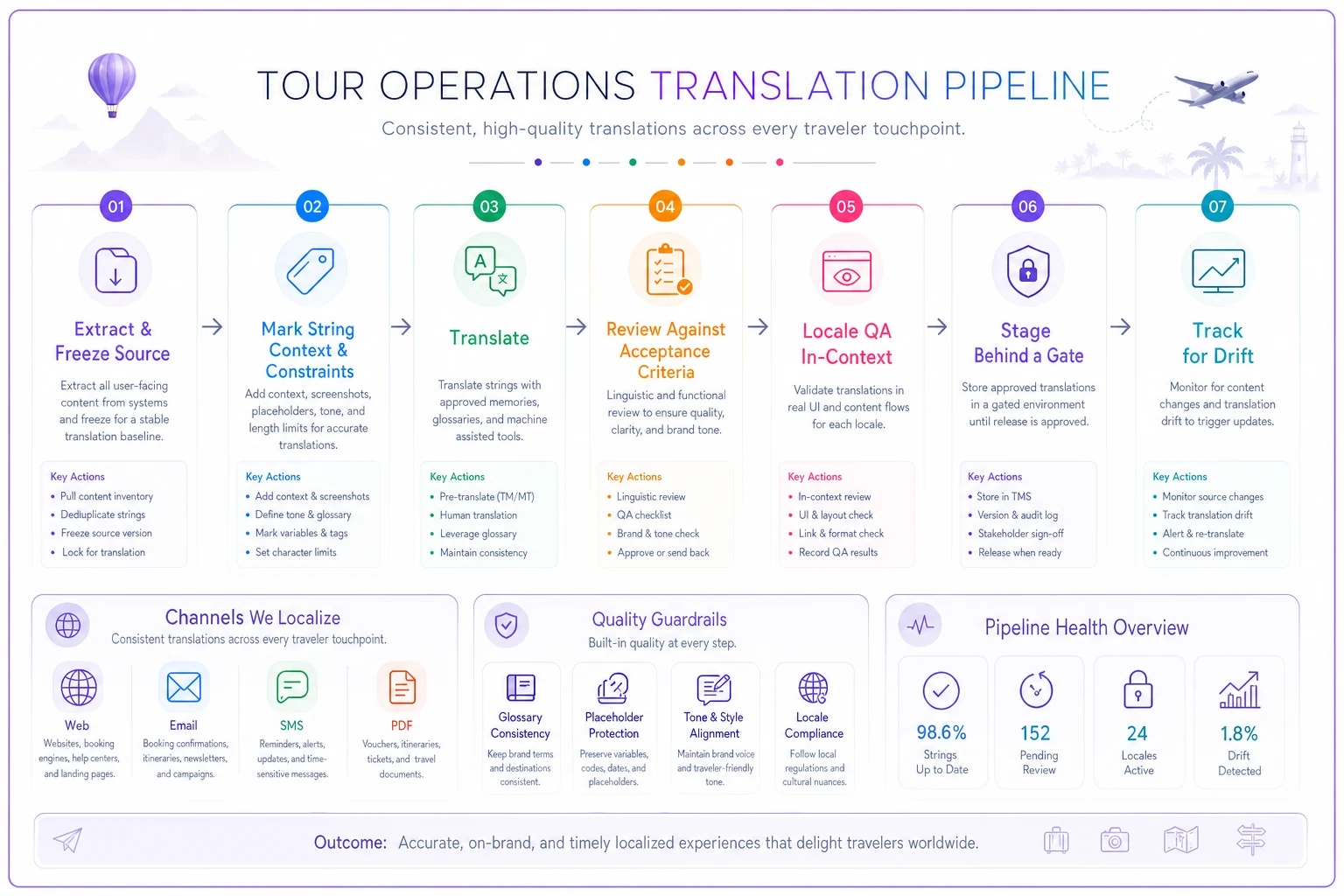
This is where AI-assisted operational tooling earns its place — not by writing the translations, but by keeping the map of what depends on what, auto-flagging every derived asset the moment a source string moves, and drafting first-pass translations for low-risk strings so human reviewers spend their time on the clauses that carry legal weight. The automation isn't the translator. It's the thing that makes sure nothing silently rots between edits.
Message fallbacks: what a guest sees when localization fails
Here's a scenario that plays out constantly and almost nobody plans for. A guest books in Portuguese. Their trip gets disrupted — weather cancellation, supplier no-show — and your system fires an automated message. But the disruption template was only fully translated into your top four languages. Portuguese isn't one of them.
What happens? In a badly designed system: nothing sends, or a raw template variable like {new_time} shows up, or the guest gets a blank. In a well-designed system: a fallback chain kicks in.
| Situation | Bad default | Proper fallback |
|---|---|---|
| Language missing entirely | Send nothing / send broken template | Fall back to market's second language, then English, and log it |
| String exists but variable failed | Show {new_time} | Suppress send, alert ops, route to manual |
| Partial translation (mixed languages) | Send the Frankenstein message | Send clean English version + note translation pending |
| Time-critical disruption message | Wait for translation | Send English immediately, follow up localized within SLA |
The principle: for critical, time-sensitive messages, delivery beats perfection. A guest whose tour just got cancelled needs the information now, in imperfect English if necessary, not a perfectly localized message that arrives after they've already left for the wrong meeting point. This is closely tied to how you handle disruption messaging generally, which overlaps with the drills in tabletop exercises and failure-mode drills for tour operators — fallback behavior is exactly the kind of thing you want tested before a real peak-season cancellation storm.
Teams tend to obsess over getting all languages perfect and never define what happens when a language is absent. The absence case is more common than the perfect case, especially in your first six months in a new market.
SLAs for localized assets
Once you have more than a couple of languages, "when will the translation be ready" stops being answerable by feel. You need SLAs, and they need to be tiered by how much operational damage a delay causes.
Not every string deserves the same urgency. A blog post can wait a week. A legally-required cancellation term update cannot wait at all. Tiering prevents both under-reacting to critical strings and over-spending on cosmetic ones.
-
Tier 1 — Transactional & legal (booking flow, payment errors, cancellation terms, safety info): localized version live within 24–48 hours of source change. Until then, fallback to English is mandatory and logged, never blank.
-
Tier 2 — Lifecycle & operational (confirmations, reminders, disruption templates): within 3–5 business days. Fallback allowed but flagged to ops.
-
Tier 3 — Marketing & discovery (landing pages, descriptions, SEO content): within 2 weeks. Can stay English or hidden until ready.
The pattern worth internalizing: SLA breaches should be visible, not silent. The failure mode isn't usually a missed deadline — it's a missed deadline nobody noticed until a guest complained. Whatever tracks your localization work should surface "Tier 1 string in Dutch has been in 'needs review' for 40 hours" the same way you'd surface an overdue supplier payment.
Language scoring and acceptance criteria for new-market launches
The single biggest new-market mistake: deciding a language is "ready" based on vibes. Someone bilingual on the team reads it, says "yeah looks good," and you launch. Then reality hits — the reviewer knew the language conversationally but missed that the formal/informal register was wrong for a paid service, or that a regional term meant something odd.
Acceptance criteria turn "looks good" into a repeatable score. Here's a scoring rubric that separates linguistically fine from launch-ready:
-
Accuracy — meaning matches source, no contractual drift on terms/policies
-
Completeness — every Tier 1 string translated, zero placeholders remaining
-
Register & tone — correct formality level for a commercial service in that culture
-
Locale formatting — dates, currency, time, numbers, addresses all correct in-context
-
Rendering — no overflow, truncation, or layout break on mobile and desktop
-
Functional — booking flow completes end-to-end in the language, confirmation actually arrives localized
A market doesn't launch until it clears a threshold — say, no zeros on any dimension and a total above your bar. The important part isn't the exact numbers; it's that "ready" becomes a decision with evidence instead of one person's gut.
One realistic pattern for who scores what: linguistic dimensions get scored by a native reviewer who is not the original translator (self-review misses too much), while formatting and functional dimensions get scored by whoever runs QA, because those are structural and don't require fluency to verify.
A quick real scenario
A mid-sized day-tour operator running around 330–360 bookings a month in English-only decided to launch French and German for a Rhine-region push. First attempt, they translated the pages and emails and went live in roughly a week. Within the first month they saw a cluster of problems: German date formatting caused a handful of guests to note the wrong day, the French cancellation text omitted the 48-hour window entirely, and the automated reminder SMS never localized at all because those strings lived in a different system nobody had extracted.
The visible cost was maybe four or five disrupted bookings and a chunk of goodwill — small in count, but two of them turned into chargeback threats over the cancellation-window mismatch, which ends up costing far more than the booking value.
On the relaunch, they did it differently: extracted every string first (including the SMS system), applied the scoring rubric with a second native reviewer, and gated the launch behind a checklist. It took closer to three weeks instead of one. But French and German bookings ran with roughly the same refund and complaint rate as English from the start, and the SMS localization issue — the one that would've quietly annoyed every single guest — got caught before launch instead of after. Slower launch, dramatically cleaner operations.
Localization QA checklist and release gates
The release gate is the last line before a guest sees the asset. It should be boring, mechanical, and non-negotiable. If it relies on someone remembering to check things, it will fail during your busiest week — which is exactly when you're most likely to be launching a new market.
Pre-launch QA checklist (run per language, per market):
-
[ ] Every Tier 1 string translated and reviewed; zero remaining placeholders or English fragments
-
[ ] Cancellation, refund, deposit, and age/safety terms verified line-by-line against source meaning
-
[ ] Dates render in correct locale format in every channel (page, email, SMS, PDF voucher)
-
[ ] Currency displays with correct symbol, position, and decimal/thousands separators
-
[ ] All variables (
{guestname},{tourdate},{meeting_point}) tested with real sample data -
[ ] Full booking completed end-to-end in the language on mobile and desktop
-
[ ] Confirmation, reminder, and one disruption message received and read correctly in-language
-
[ ] Fallback chain tested
deliberately trigger a missing string and confirm graceful fallback + log
-
[ ] Second native reviewer sign-off on register and tone
-
[ ] Formatting/rendering checked on smallest common mobile screen (button overflow is the usual culprit)
Test variables with real sample data across channels early to catch template failures before launch.
Release gate rule: the market launches only when the checklist is fully green and the scoring rubric clears threshold. No partial launches to "just get it live." A partial launch means the fallback and drift systems are now carrying weight they weren't verified for.
The connection people underestimate: release gates and staffing are linked. Launching a new language means someone can now field support in that language, and disruption messages will generate replies in that language. Lining up that coverage is part of the launch, not an afterthought — the same forecasting logic in a forecast-to-roster staffing system applies to language coverage, not just seat coverage. A launched language with nobody who can answer a Tuesday-evening question in that language isn't really launched.
When a full localization system makes sense — and when it doesn't
Not every operator needs this whole apparatus, and building it too early is its own waste.
When it's worth building the full system:
-
You're past two or three languages, or planning to be within a year
-
Your content carries real operational/legal meaning (policies, safety, deposits)
-
You operate across channels — web, email, SMS, app, PDF vouchers — where strings live in different places
-
You've already been burned by a drift or formatting bug
When it's overkill:
-
Single market, one or two languages, one person who genuinely owns all content
-
Mostly static content that changes a few times a year
-
You're still validating whether a market even converts — do a lightweight manual test first, systematize only once it's proven
Who should NOT rush this: operators still figuring out product-market fit in a new region. If you don't yet know the market works, spend on a clean manual translation of your core booking flow, verify it converts, and only then invest in the pipeline, SLAs, and gates. Building localization infrastructure for a market that doesn't pan out is money you'll wish you'd kept.
Pulling it together
Localization in tour operations is not a content problem, it's a coordination problem wearing a content costume. The translation itself is the easy part. The hard part is keeping every derived asset in sync with the source, defining what happens when a language is missing, holding vendors and internal teams to SLAs on the strings that actually carry risk, and refusing to launch a market until it's cleared a real gate rather than a gut check.
The operators who expand cleanly into new markets aren't the ones with the best translators. They're the ones who built the plumbing — the extraction, the drift-flagging, the fallback chains, the scoring, the gates — so that adding the ninth language is roughly as controlled as adding the third. Everything scales when the system holds. It's when localization stays a manual handoff that the fifth market quietly starts eating the margin the first four earned you.
Ready to elevate your travel business?
Join 500+ travel operators using Touryly to optimize bookings, improve client satisfaction, and grow revenue.