

Most accessibility failures on tours don't come from bad intentions. They come from a broken telephone game between the guest, the sales agent, the ops team, and the supplier. Somebody ticks "accessible" in a booking form, three weeks pass, and nobody ever confirmed whether the "accessible" boat has a ramp that works at low tide or just a wide doorway.
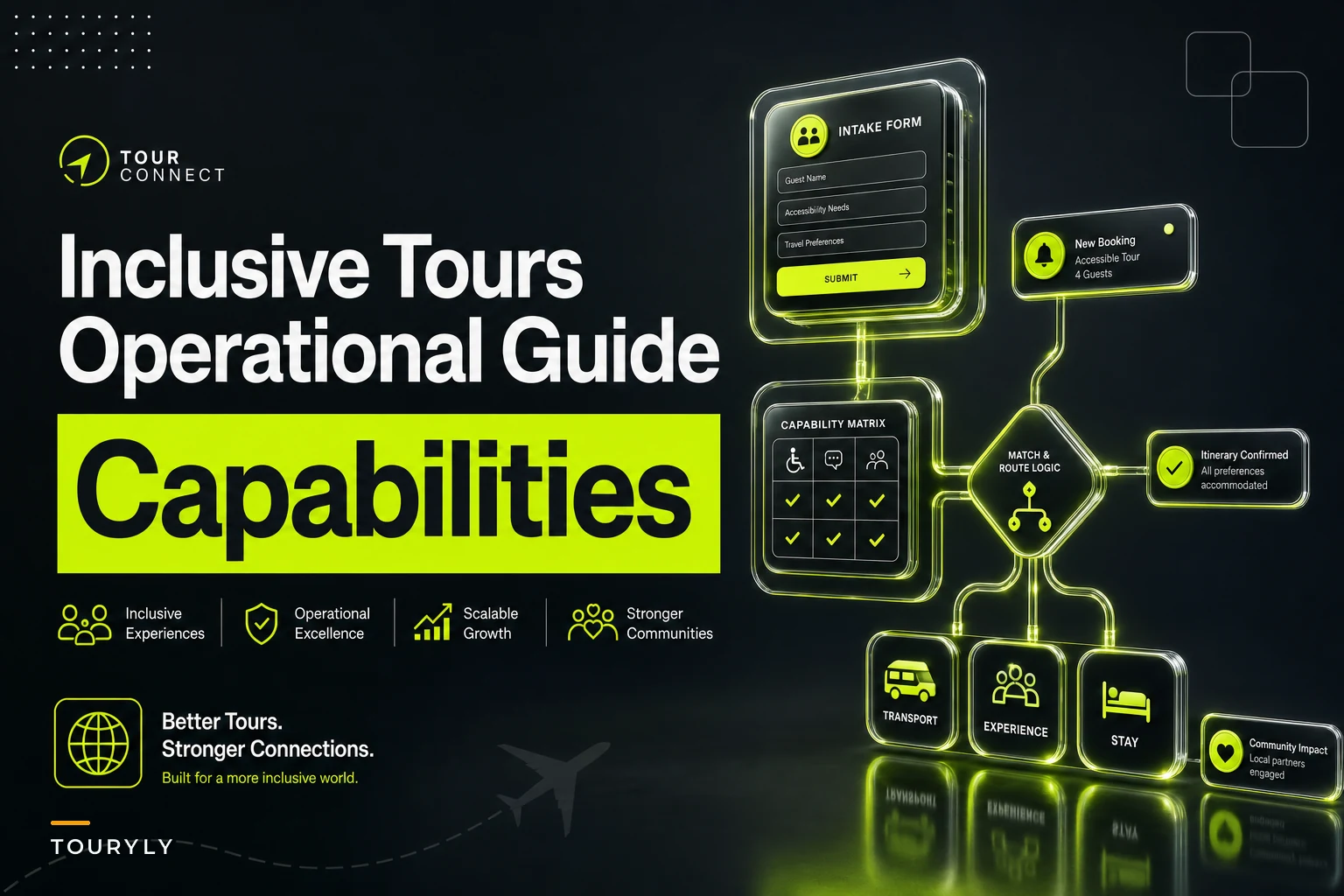
That's the specific problem this article is about: the handoff failures that turn a well-meaning accessibility promise into a guest stranded at a curb. Not accessibility philosophy, not compliance law in the abstract. The actual forms, matrices, and scripts that keep a guest's real needs attached to the booking all the way through to the guide on the ground.
Where the promise actually breaks
The pattern is almost always the same. A guest calls or emails and says something like "my mother uses a walker and gets tired easily." The agent, wanting to close the sale, says "no problem, our tours are very relaxed." That reassurance never gets written down in a structured way. It lives in an email thread or, worse, in the agent's memory.
By the time the itinerary is assembled, the walker has vanished from the record. The supplier gets a headcount, not a needs profile. The guide shows up with a route that includes 40 stairs and a 20-minute uphill walk on gravel.
In real operations, this usually happens for three reasons:
-
Free-text notes. Accessibility needs get typed into a general "comments" box that nobody parses. A wheelchair, a nut allergy, and "celebrating an anniversary" all end up in the same field.
-
No structured mapping to supplier capability. Even when the need is recorded, there's no system connecting "needs step-free access" to "which of our 14 suppliers can actually deliver that."
-
The confirmation never loops back. The guest is told "we'll sort it out," but nobody re-contacts them to confirm the specifics before departure.
Vague reassurance at the sales stage is genuinely worse than saying "let me check." A confident "no problem" removes the guest's own incentive to plan around the issue, then fails them anyway.
Accessible tour SOPs start with an intake form that forces specifics
Generic accessibility checkboxes are useless because "accessibility" isn't one thing. Someone who is deaf, someone who uses a manual wheelchair, and someone with severe arthritis have almost nothing in common in terms of what they need from your tour.
Never miss a booking or update.
Touryly streamlines your travel bookings, confirmations, and itinerary updates—all in one place.
- Unified booking management
- Automated customer notifications
- Itinerary & staff coordination
No credit card required
A good pre-booking intake form does two things: it replaces yes/no checkboxes with capability questions, and it captures the guest's own words alongside structured fields.
Here's the structure that actually works. Ask about function, not diagnosis:
-
Mobility over distance — "Can the guest walk 500 meters on uneven ground without resting? With rests? Not at all?" This is far more useful than "wheelchair: yes/no."
-
Steps and elevation — "Are stairs manageable (how many), or is step-free access required throughout?"
-
Transfer ability — Critical for boats, coaches, and small vehicles. "Can the guest transfer independently, with one person assisting, or requires a lift/hoist?"
-
Sensory needs — Vision, hearing, and whether the guest travels with an assistance animal.
-
Cognitive and pacing needs — Some guests need predictable structure, quieter environments, or extra processing time. This one gets ignored more than it should.
-
Equipment dimensions — The actual width and weight of the mobility device. A "wheelchair" can be a 60cm folding manual chair or a 75cm powered chair weighing 150kg. That difference decides whether it fits in a van.
-
Medical and medication logistics — Refrigeration for insulin, timing constraints, emergency contacts.
That last-mile detail is where most operators fall short. Asking "do you use a wheelchair?" instead of "how wide is your wheelchair and how much does it weigh?" — one answer you can plan around, the other you can't.
Keep a free-text field at the end: "Anything else we should know to make this work for you?" People will tell you things your form didn't anticipate. Read it.
The supplier capability matrix
This is the piece most operators skip, and it's the piece that makes everything else work. You cannot promise accessibility you haven't verified with the supplier who actually delivers it.
A supplier capability matrix is a living document that records, per supplier and per product, exactly what they can and can't accommodate. Built once, updated after every audit, and referenced every time an accessibility need comes through.
Here's a simplified version of what one looks like:
| Supplier / Product | Step-free access | Max device width | Transfer support | Accessible restroom on site | Assistance animals | Advance notice needed | Last verified |
|---|---|---|---|---|---|---|---|
| Harbor Cruise Co. | Ramp (tide-dependent) | 70cm | Crew assist, no hoist | Yes | Yes | 72h | Mar 2024 |
| Old Town Walking | Partial (2 detours) | N/A | N/A | Public only | Yes | 48h | Feb 2024 |
| Mountain Coach | Lift-equipped coach (1 of 4) | 75cm | Lift + 2 staff | Onboard | Yes | 5 days | Jan 2024 |
| Vineyard Tour | No — gravel + steps | N/A | None | No | Yes | — | Mar 2024 |
Two things about this matrix are non-negotiable.
First, the "last verified" column matters as much as the capability itself. Suppliers change equipment, staff, and venues. That lift-equipped coach gets sold. The ramp gets damaged in a storm. A capability recorded 18 months ago is a guess, not a fact. Re-verify annually at minimum, and immediately after any supplier flags a change.
Second, record the caveats, not just the yes/no. "Ramp (tide-dependent)" is honest. "Accessible: yes" is a trap. The tide-dependent note is what stops you from booking a low-tide sailing for a wheelchair user.
The questions you send suppliers to build this matrix should be as specific as your intake form:
-
"Can a guest who cannot walk board your vessel/vehicle, and exactly how?"
-
"What's the maximum mobility device width and weight you can physically accommodate?"
-
"Is there an accessible toilet on site or on board, or only nearby public facilities?"
-
"How much advance notice do you need to prepare for a guest with mobility needs?"
-
"Has your accessibility setup changed in the last 12 months?"
When suppliers can't answer these precisely, that's information too. A supplier who says "we're pretty accessible, don't worry about it" is a supplier you haven't verified.
Getting suppliers to hold up their end connects directly to how you structure agreements with them. The same discipline that goes into preventing reseller fulfillment failures with clear validation gates applies to accessibility commitments. If it's not written and verifiable, it doesn't exist.
Matching intake to matrix: the workflow
The whole point of having both documents is to make accessibility a decision before the guest pays, not a hope on the day.
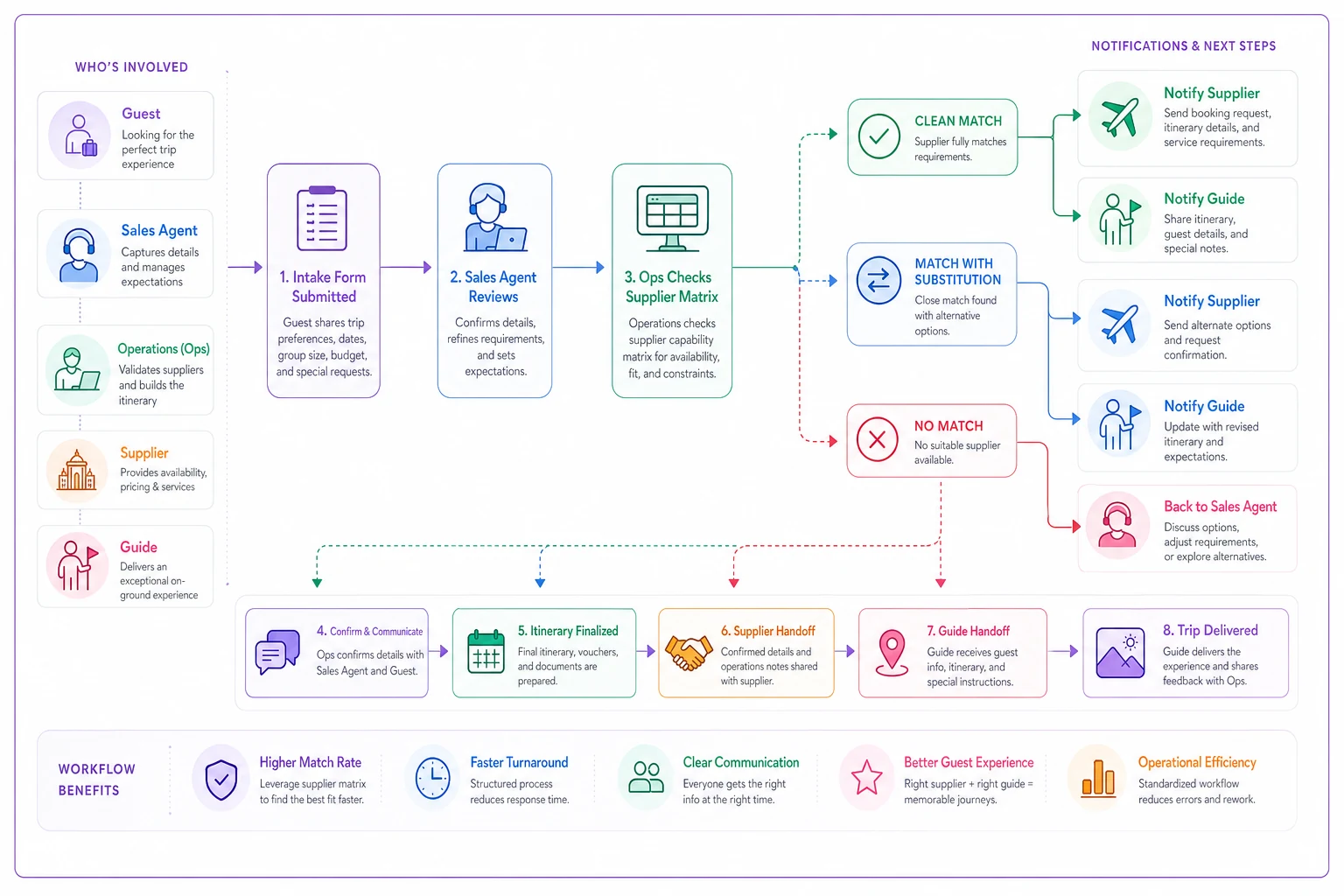
An accessibility need comes in on the intake form. Before confirmation, ops pulls the capability matrix and checks the specific products in the itinerary against the specific needs recorded. Three outcomes are possible:
-
Clean match — the supplier can accommodate. Confirm, note the advance-notice requirement, and flag it to the supplier in writing.
-
Match with substitution — the primary product can't work but an equivalent can (the lift-equipped coach instead of the standard one). Book the substitute, adjust pricing if needed, tell the guest what's changing and why.
-
No match — nothing in your inventory delivers what the guest needs. This is the moment to be honest. Telling a guest "this particular tour won't work well for you, but here's what would" is a far better outcome than a ruined day and a refund fight.
That third outcome is the one operators avoid, and it's why they get burned. Saying no to a booking you can't deliver is cheaper than saying yes and failing. The guest who's told the truth early rebooks something suitable. The guest who's stranded writes the review that costs you fifty future bookings.
A quick visual helps map the decision flow and handoffs.
For group bookings, this matching gets more complicated — you're balancing one guest's needs against the whole group's itinerary. The same coordination tension comes up in managing group-booking logistics like deposit schedules and seat-holds. One wheelchair user in a group of 20 can mean the whole group needs the accessible coach, which affects capacity and pricing.
On-tour adjustment SOPs
No matter how good your pre-trip process is, things go wrong on the day. The ramp is broken. The weather makes the accessible path unsafe. The guest's condition is different than described. Your guides need SOPs for these moments, not improvisation.
The core principle: guides should have pre-authorized adjustment options, not a requirement to call the office and wait. A guide who has to phone HQ for permission while a guest waits in the rain is going to make a bad call under pressure.
A short decision framework guides can actually use:
-
If the planned route becomes inaccessible the guide has a pre-approved alternate route or activity for each product, already checked against the matrix. Not "figure something out" — an actual named plan B.
-
If a supplier can't deliver on the day the guide contacts the supplier's designated accessibility contact (recorded in advance), and if unresolved within a set window, moves to the alternate and logs it.
-
If the guest's needs exceed what was disclosed the guide's job is safety and dignity, not enforcement. Pre-authorize them to skip a segment, arrange seated waiting, or issue a partial adjustment without a debate.
Log every on-tour adjustment the same day so the capability matrix can be updated promptly.
Write these as short scripts. Guides under stress default to whatever's easiest to say. A prompt like: "I want to make sure this works for you — would you rather take the level path and meet the group at the viewpoint, or stay here with a seat while I bring the group back?" gives the guest agency instead of making them feel like a problem.
Every on-tour adjustment should get logged the same day — what happened, what the guide did, whether it worked. That log feeds straight back into the capability matrix. If the "tide-dependent ramp" stranded a guest, that's not a one-off, that's a matrix update.
Liability and waiver language
Standard waivers usually make accessibility worse, not better. They're written to protect the operator from everything and end up implying the guest assumes all risk for needs the operator never actually planned for. That's bad ethics and, in many jurisdictions, unenforceable.
A few practical principles. This is not legal advice — get specific wording reviewed by a lawyer in your jurisdiction — but these are worth raising with them:
-
Separate genuine inherent risk from operator responsibility. A waiver can reasonably cover the inherent risks of boarding a boat in open water. It cannot excuse failing to provide an accommodation you confirmed you'd provide.
-
Document the accommodation as a commitment, not a courtesy. When you confirm "step-free access throughout, accessible restroom on site," that confirmation is part of what the guest paid for. Reflect that in your terms.
-
Be explicit about what you can't guarantee, and why. "Ramp access depends on tide conditions on the day of sailing; if conditions prevent boarding, we will [alternative/refund]." Honesty here is protective, not risky.
The mistake operators make is treating the waiver as a shield instead of a record. The best protection is a documented trail: the intake form, the confirmed accommodation, the supplier's written agreement, the guide's on-tour log. That paper trail protects you far more than a broad disclaimer ever will.
A real scenario
A small city tour operator running walking and boat combos — roughly 200 to 260 bookings a month in season — kept hitting the same wall. Accessibility requests came in through the general comments box, got a friendly reply, and then fell through. Over one summer they had a handful of genuinely bad days: a guest with a walker sent on a stair-heavy route, a wheelchair user who couldn't board a boat because the ramp was out at low tide. Two turned into refund disputes and one into a rough public review.
They didn't overhaul everything. They built the intake form with function-based questions, spent a couple of weeks calling their main suppliers to fill in a capability matrix, and wrote three short guide scripts for on-tour adjustments.
The change wasn't dramatic in volume — accessibility requests were maybe 6 to 9% of bookings. But the failures basically stopped. Over the following season they had no accessibility-related refund disputes, and a few of those guests came back with family groups. The quieter win was this: agents stopped over-promising, because now they had a matrix to check instead of a gut feeling. "Let me confirm and call you back" replaced "no problem, don't worry."
Where software helps, and where it doesn't
The forms and matrices above work on paper. The reason they fail in practice is usually that the information doesn't move — intake data sits in one system, supplier capabilities live in a spreadsheet nobody opens, and the guide gets a printout that's already a week out of date.
Where an AI-powered operations platform earns its place is in keeping these connected: structured intake fields that flag accessibility needs automatically, a supplier capability record that surfaces at booking time, and adjustment logs that route back to update the matrix. When a booking with a mobility need is confirmed, the right people and suppliers get notified in writing without someone having to remember to do it manually. That's the difference between a good SOP that lives in a binder and one that actually runs.
But no software fixes a vague intake question or a supplier you never verified. The tooling amplifies a good process — it can't replace one. Get the questions right, verify your suppliers, give your guides real authority to adjust. Then worry about automating the handoffs.
The one thing to fix first
If you do nothing else, replace the accessibility checkbox with capability questions and start a supplier matrix, even a rough one in a spreadsheet. Those two changes catch the majority of failures, because most disasters trace back to either a need that was never captured specifically or a promise made against a capability that was never confirmed.
Accessibility on tours isn't primarily a compliance exercise or a technology problem. It's an information-handoff problem — keeping a guest's real, specific needs attached to their booking, matched honestly against what your suppliers can actually deliver, all the way to the person standing with them at the meeting point.
Accessibility on tours isn't primarily a compliance exercise or a technology problem. It's an information-handoff problem — keeping a guest's real, specific needs attached to their booking, matched honestly against what your suppliers can actually deliver, all the way to the person standing with them at the meeting point.
Ready to elevate your travel business?
Join 500+ travel operators using Touryly to optimize bookings, improve client satisfaction, and grow revenue.