

The booking looked normal enough. Full payment cleared three weeks before a Santorini wine tour. Passport details submitted. Contact info verified. Standard stuff.
Then departure morning arrived. The guest never showed up. Phone went straight to voicemail. The hotel confirmed they'd checked out two days earlier. By the time we pieced together what happened, the supplier had already charged for the no-show, the slot couldn't be resold, and we were stuck eating a $420 loss on what should have been a routine booking.
This happens more than operators want to admit. Not fraud exactly—just bookings that fall apart somewhere between confirmation and departure day. Sometimes it's a genuine emergency. Sometimes people book multiple options and ghost on the ones they don't choose. Sometimes they just forget.
Running pre-trip verification for tour operators means building checkpoints that catch these problems before they cost you money. Not paranoid security theater—practical operational gates that protect both revenue and the customer experience.
The real cost of verification gaps
Most operators treat booking verification as binary. Either a booking looks suspicious enough to reject upfront, or it passes initial checks and gets treated like any other reservation until departure day.
That creates a massive blind spot. Between booking confirmation and departure, a lot can change. Credit cards expire. Phone numbers disconnect. Travel plans shift. Medical emergencies happen. Each change increases the risk that your carefully planned tour ends up running with empty seats.
The financial hit goes beyond just the lost booking revenue. When someone no-shows:
-
You've already paid or committed to supplier minimums
-
The slot can't be resold at the last minute
-
Other guests on group tours get a degraded experience
-
Your team wastes time tracking down missing guests
-
Guide resources get misallocated
-
Operational chaos damages your reputation
A no-show on a $200 day tour stings but won't sink you. On a $3,000 multi-day package or a premium small-group experience, the losses compound fast.
Why standard verification fails
Traditional verification fails because it's static. You check documents once at booking, send a confirmation email, then hope everything stays stable until departure.
Never miss a booking or update.
Touryly streamlines your travel bookings, confirmations, and itinerary updates—all in one place.
- Unified booking management
- Automated customer notifications
- Itinerary & staff coordination
No credit card required
But customer situations aren't static. Someone who books in January for a July tour goes through six months of life changes—job losses, health issues, competing travel plans, financial pressures. Any of these can quietly turn a solid booking into a no-show.
What makes it worse is that customers rarely communicate those changes. They don't call to cancel. They don't reply to emails. They just disappear, and you find out when it's too late to do anything about it.
Standard fraud detection—which I covered in more detail in which booking signals predict fraud—catches obviously suspicious bookings. It doesn't catch the gradual degradation of legitimate ones over time.
Building a staged verification funnel
The solution isn't more aggressive upfront screening. It's building verification stages that match the natural progression from booking to departure.
Think of it like a series of health checks rather than a single security gate. Each stage has different goals, different red flags, and different recovery options.
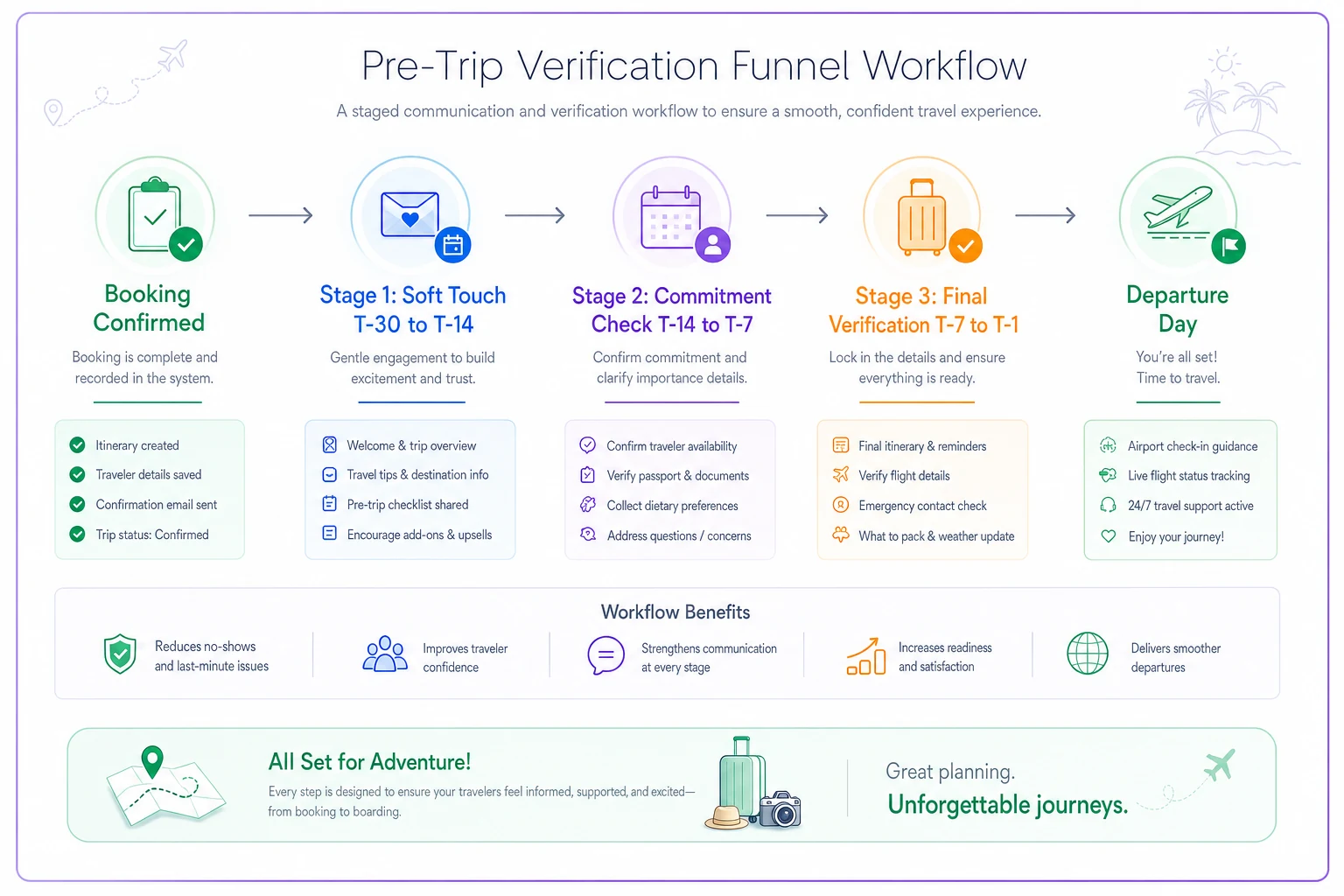
This diagram shows the staged funnel and timing.
Stage 1: Soft touch verification (T-30 to T-14 days)
The first stage focuses on gentle engagement without creating friction. You're not questioning the booking—you're confirming excitement and gathering updates.
Timing: 30 to 14 days before departure Goal: Surface any major changes early enough to address them Channel: Email primarily, SMS for time-sensitive tours
The messaging matters a lot here. Instead of "Please confirm your booking," try something like: "Your Santorini wine tour is coming up in 3 weeks! We're finalizing arrangements with our local partners. Quick question—is your group size still 4 people? And is the WhatsApp number you provided still the best way to reach you on tour day?" That feels helpful, not suspicious. You're gathering operational details, not interrogating anyone.
Red flags at this stage:
-
Email bounces after previously working
-
No response to multiple touchpoints
-
Phone number disconnected
-
Credit card decline on a deposit
Recovery actions:
-
Try alternative contact methods
-
Check social media for recent activity
-
Review booking notes for companion contact info
-
Flag for elevated monitoring going forward
Stage 2: Commitment verification (T-14 to T-7 days)
Timing: 14 to 7 days before departure Goal: Secure active confirmation of travel plans Channel: Multi-channel required (email + SMS/WhatsApp)
The script changes here to create mild urgency without alarm: "Hi Sarah, your wine tour is next Tuesday! Our guide needs final numbers for restaurant reservations. Please confirm by clicking this link by Friday, otherwise we may need to release your spots. Takes 30 seconds: [confirmation link]"
What you're actually tracking:
-
Click-through on the confirmation link
-
Response time to messages
-
Completeness of required info
-
Payment method validity
Score thresholds and actions:
| Risk Score | Indicators | Action Required |
|---|---|---|
| Low (0-3) | Responds quickly, all info current | Standard pre-trip email |
| Medium (4-6) | Delayed response, some info outdated | Phone call attempt, backup contact |
| High (7-9) | No response, payment issues | Hold replacement guest, prep refund docs |
| Critical (10+) | Complete ghost, card declined | Release spot, activate waitlist |
The table above is a starting point. You'll calibrate these bands based on your actual no-show data over time—don't treat the numbers as fixed.
Stage 3: Final verification (T-7 to T-1 days)
Timing: 7 days to 1 day before departure Goal: Lock in attendance or execute replacement Channel: Phone calls become mandatory for non-responses
Soft touches end here. Your message becomes direct: "Tomorrow's wine tour departs at 9 AM from the cruise port. We haven't heard from you and need to confirm your attendance by 6 PM today. If we don't hear back, we'll need to offer your spots to waitlisted guests. Please call us at [number] or reply CONFIRMED to this message."
Evidence capture template for no-shows:
-
Screenshot all sent communications with timestamps
-
Document all contact attempts (calls, emails, messages)
-
Note any bounces or disconnected numbers
-
Save any partial responses or system interactions
-
Record when spots were released to waitlist
Building this evidence trail matters more than most operators realize—especially when disputes or refund requests come in after the fact.
Operational handoffs between stages
The biggest failure point in most verification funnels isn't the checks themselves—it's the handoffs. Information gets lost, context disappears, and nobody quite knows who was supposed to follow up on that risky booking flagged two weeks ago.
Here's the handoff structure that actually works:
From Sales to Operations (post-booking):
-
Risk score from initial booking
-
Any unusual booking patterns noted
-
Special requests or concerns mentioned
-
Preferred communication channel
From Stage 1 to Stage 2:
-
Current risk score with specific flags
-
All contact attempts and responses
-
Updated contact information
-
Payment status changes
-
Next action required with deadline
From Stage 2 to Stage 3:
-
Go/no-go recommendation
-
Replacement readiness status
-
Financial exposure if no-show
-
Guide notification requirements
-
Recovery documentation prepared
Each handoff needs an owner and a deadline. "Someone should probably check on this" guarantees nothing gets done. "Julie owns this verification, due Thursday 3 PM" gets results.
Messaging scripts that actually work
Generic template messages get ignored. Here are scripts that generate responses:
Initial soft check (T-21 days): "Quick logistics check for your Santorini tour on [date]—our port pickup driver needs to know if you're coming from a cruise ship or hotel. Also, any food allergies we should notify the winery about? Just reply with pickup location + any allergies. Thanks!"
Escalated check (T-10 days): "Hi [name], tried reaching you about your tour next week. Your credit card was declined for the final payment. Need to sort this out by tomorrow to keep your spots. Here's a payment link: [link] or call us: [number]"
Final warning (T-2 days): "Your tour is in 48 hours and we can't reach you. If this is still happening, please respond with YES by tonight. Otherwise we're releasing your spots to our waitlist. No hard feelings if plans changed—just let us know."
Post no-show documentation: "We held your spots for today's tour but you didn't arrive. Hope everything is okay. For our records, please let us know what happened. If this was our error, we'll make it right."
Technology integration without full automation
You don't need complex AI systems to run effective verification. But trying to manage this manually in spreadsheets will bury your team—especially during peak season when you're running thirty-plus departures a week.
The sweet spot is semi-automated verification that combines systematic tracking with human judgment. Your operational platform should:
-
Automatically trigger verification stages based on departure dates
-
Score bookings based on response patterns
-
Flag high-risk bookings for manual review
-
Track all communication attempts in one place
-
Generate handoff reports between stages
-
Maintain evidence trails for disputes
What you don't want is full automation sending robotic messages without context. A personalized message from a real person, informed by good data, beats an automated blast every time.
This connects to the broader fulfillment challenges around voucher formats and validation gates. The same systematic approach that prevents reseller failures can power your verification funnel.
Setting score thresholds and escalation triggers
Not all tours need the same verification intensity. A $50 walking tour doesn't justify three phone calls. A $5,000 private yacht charter absolutely does.
Low-value tours (under $200 per person):
-
Single email verification at T-7 days
-
Auto-release spots at T-2 days if no response
-
No phone calls unless specifically requested
Mid-value tours ($200-$1,000 per person):
-
Soft check at T-14 days
-
Commitment confirmation at T-7 days
-
Phone call at T-2 days for non-responses
-
Hold spots until T-1 day
High-value tours (over $1,000 per person):
-
Initial engagement at T-30 days
-
Soft check at T-14 days
-
Commitment verification at T-7 days
-
Daily contact attempts in the final 3 days
-
Never auto-release without manual review
Risk multipliers that trigger escalation:
-
First-time customer (+2 to risk score)
-
Booking made over 90 days in advance (+1)
-
International customer (+1)
-
Payment method problems (+3)
-
No response to first check (+2)
-
Group larger than 6 people (+1)
These multipliers add up fast. A first-time international customer who books four months out and doesn't respond to your T-14 message is already sitting at a risk score of 6 before you've even picked up the phone.
Practical implementation challenges
The biggest obstacle to implementing staged verification isn't technology or process design. It's team resistance.
Your sales team will worry that verification feels pushy and might cause cancellations. Operations will complain about extra work. Customer service will fear negative reviews.
These concerns are valid but manageable. Frame verification as customer service, not security. You're helping ensure their trip happens smoothly, not questioning their integrity.
Start with high-value bookings only. Prove the system prevents losses without creating friction. Track metrics closely—no-show rates, customer complaints, revenue recovered. Once you can show that verification actually improves customer experience while protecting revenue, the resistance tends to fade.
The other challenge is consistency. Verification can't be something you do when you remember. It needs to be systematic, scheduled, and non-negotiable. This is where operational software earns its keep—it enforces the process even when your team is drowning in peak season chaos.
Measuring verification effectiveness
Track these metrics to make sure your funnel is actually working:
Response rates by stage:
-
Stage 1 response rate (target
70%+)
-
Stage 2 confirmation rate (target
85%+)
-
Stage 3 final confirmation (target
95%+)
Operational metrics:
-
No-show rate pre-verification vs. post
-
Revenue recovered from prevented no-shows
-
Spots successfully resold from early detection
-
Customer complaints about verification
-
Time spent per booking on verification
Financial impact:
-
Average loss per no-show
-
Revenue saved through early detection
-
Cost of the verification process
-
Net ROI of the verification system
A well-running verification funnel should cut no-shows by somewhere in the range of 50-70% while adding less than 5 minutes of work per booking. That ratio—time invested versus revenue protected—is what makes this worth building.
Beyond basic verification
Once your basic funnel runs smoothly, you can layer in more advanced techniques:
Behavioral scoring: Track how quickly customers respond, which channels they prefer, and how complete their answers are. Fast, thorough responses indicate engaged customers. Slow, minimal ones suggest risk.
Social proof checks: For high-value bookings, a quick social media check can surface red flags. Did they post about canceling their trip? Are they still in their home city when they should be en route?
Payment velocity monitoring: Multiple payment changes close to departure—especially card swaps—can signal financial stress or potential fraud.
Companion verification: For group bookings, verify with multiple party members. If only one person in a group of six responds to any of your outreach, that's worth paying attention to.
None of these need to be formal systems at first. A spreadsheet and thirty minutes of manual checks per week on your highest-value upcoming departures is enough to get started.
The competitive advantage of verification
Most tour operators treat no-shows as an inevitable cost of business. They bake that loss into pricing, which means every paying customer subsidizes the ones who don't show up.
Operators who run systematic pre-trip verification don't have to do that. You can price more aggressively because you have less deadweight loss. You can guarantee availability because you know who's actually coming. Your guides operate more efficiently because they're not standing around waiting for someone who isn't coming.
And the customers who do show up get better experiences. No awkward delays. No half-empty group tours. No last-minute scrambles to adjust logistics.
The operational discipline required to run staged verification pays off beyond just preventing no-shows. The same systematic thinking improves every customer touchpoint from booking through departure.
Making verification scalable
As you grow from dozens to hundreds of monthly bookings, manual verification stops being realistic. But full automation loses the human touch that makes verification work in the first place.
The middle ground is augmented operations—using AI-powered platforms to handle routine checks while flagging exceptions for human review. Your system tracks every booking, triggers stage-based verifications, and scores responses. Your team focuses on high-risk bookings and the nuanced situations that need actual judgment.
Start simple. Pick your highest-value tours. Build a basic three-stage funnel. Track results for a month. Refine based on what you learn. Then gradually expand as you build confidence and process.
The path forward
Pre-trip verification isn't about treating customers like suspects. It's about building operational discipline that protects both your business and your guests' experiences.
Start tomorrow with one simple change: send a friendly check-in message to everyone with bookings in the next two weeks. See who responds. Note who doesn't. Build from there.
The most expensive no-show is the one you could have prevented. Every empty seat is lost revenue and a missed opportunity to deliver an experience to someone who actually wanted to be there.
Your verification funnel is really a commitment funnel—helping uncertain bookers become confident travelers while surfacing the ones whose plans have genuinely changed. When you frame it that way, it stops feeling like a necessary evil and starts feeling like good customer service.
The operators who thrive in competitive markets aren't always the ones with the best tours or the lowest prices. They're the ones who run tighter operations, waste fewer resources on no-shows, and deliver consistent experiences because they know exactly who's walking through the door. That operational edge starts with knowing which bookings will actually become trips.
Ready to elevate your travel business?
Join 500+ travel operators using Touryly to optimize bookings, improve client satisfaction, and grow revenue.