


Your payment processor just flagged another chargeback. The booking looked completely normal—card went through, confirmation sent, customer seemed fine. Three weeks later you're staring at a dispute notification, scrambling for evidence you didn't think to collect, and eating the cost of a tour that already ran.
The frustrating part? That booking had warning signs. The billing address was 2,000 miles from the IP location. They booked and canceled three different tours within 48 hours before settling on the expensive one. The email domain was created last week. Individually, none of that screams fraud. Together, it's a pretty clear picture.
Most tour operators treat fraud like weather—unpredictable, unavoidable, just part of doing business. They absorb chargebacks as a cost of operations, maybe tighten their cancellation policy, and move on. Operators who actually understand fraud patterns catch suspicious bookings before they turn into disputes, saving thousands a year and hours of administrative pain.
Why traditional fraud checks fail tour operators
Credit card authorization tells you almost nothing about booking fraud. The card might be valid, stolen, or about to be reported as fraudulent next week. By the time you find out, your tour already ran, your guide got paid, and you're holding an empty bag.
The standard approach breaks down at multiple points. Manual review catches obvious red flags but misses subtle patterns. Staff judgment varies—one agent flags international bookings while another waves them through. During peak season, volume overwhelms whatever review process exists. Legitimate customers get caught in overly aggressive filters while sophisticated fraudsters slip through basic checks.
Tour booking fraud also operates differently than retail fraud. Someone buying electronics wants physical goods they can resell. Tour fraud often involves money laundering, testing stolen cards, or just causing financial damage. Fraudsters sometimes actually show up to the experience, then dispute the charge weeks later claiming they never made the purchase.
The economics hurt more than retail too. When someone disputes a physical product, you might recover the item. When they dispute a tour that already ran, you've paid your guides, covered insurance, held spots legitimate customers wanted, and now you're paying chargeback fees on top of the lost revenue.
The five-minute fraud scoring system that catches most suspicious bookings
Start with geographic mismatches. When the billing zip places someone in Phoenix but their IP shows Mumbai, that's worth a second look. Not automatically fraud—plenty of legitimate reasons exist. Business travelers book from hotel WiFi. Assistants book tours for executives. Adult children book experiences for parents. But the mismatch deserves attention.
Never miss a booking or update.
Touryly streamlines your travel bookings, confirmations, and itinerary updates—all in one place.
- Unified booking management
- Automated customer notifications
- Itinerary & staff coordination
No credit card required
Layer in velocity patterns. Normal customers don't typically book, cancel, and rebook multiple times in rapid succession. They don't run three different credit cards through one transaction. They don't create fresh email addresses specifically for your booking form. When you see rapid-fire behavior—especially with increasing transaction amounts—you're often watching someone test stolen card numbers or probe your system's limits.
Email domain age is another signal worth watching. Legitimate customers usually book with established accounts—work email, longtime Gmail, ISP address. Fresh domains created days before booking, especially ones with random character strings, suggest someone creating distance between their real identity and the transaction.
Here's a basic scoring framework operators can start using today:
-
IP/billing mismatch (different countries)
+40 points
-
IP/billing mismatch (different states)
+20 points
-
Email domain less than 30 days old
+30 points
-
Multiple cards attempted
+25 points
-
Booking/cancellation within 24 hours
+20 points
-
First-time customer over $500
+15 points
-
Expedited booking (same-day or next-day)
+15 points
-
Generic email providers with random strings
+10 points
Action Thresholds:
-
0–30 points
Auto-approve
-
31–60 points
Soft verification (email confirmation required)
-
61–80 points
Manual review required
-
81+ points
Hold for enhanced verification
This isn't about catching every single fraudulent booking. It's about creating friction at the right moments without tanking legitimate conversion rates.
Building verification workflows that don't annoy real customers
The challenge with fraud prevention isn't just catching bad actors—it's avoiding false positives that frustrate legitimate high-value customers. Nobody wants their $2,000 wine tour booking delayed because they happened to book from hotel WiFi.
Smart verification creates graduated friction based on risk signals. Low-risk bookings flow through normally. Medium-risk bookings trigger lightweight verification—a text confirmation or time-limited email link. High-risk bookings get human review with specific requirements.
For medium-risk bookings scoring 31–60, automated soft verification works well. Send an email right after booking with a verification link that expires in 4 hours. Frame it like a normal confirmation, not a fraud check: "Thanks for booking! Please confirm your tour details to secure your spots." Most legitimate customers click through without thinking twice. Fraudsters using fake emails never receive it.
Frame verification messages as confirmations rather than fraud checks to keep conversion high.
High-risk bookings need a human touch, but with clear protocols. Train your team to look for conversation patterns, not just documentation. Fraudsters often give vague responses to specific questions. Ask about their travel dates, hotel, or why they chose this particular tour. Legitimate customers answer naturally with real details. Scammers give generic responses or get defensive.
Proportional response matters too. Don't treat someone booking a $40 walking tour the same as someone reserving a $3,000 helicopter package. Don't apply the same scrutiny to a repeat customer that you'd apply to a first-time booker from a high-risk geography.
When chargebacks hit: evidence templates that actually win disputes
Even solid prevention won't catch everything. When disputes land, evidence quality determines whether you eat the loss or recover the revenue. Most operators submit weak packages—a confirmation email, maybe a signature, some tour photos. Payment processors side with customers when evidence feels thin.
Strong dispute evidence tells a complete story. It shows the customer actively engaged with the booking, understood what they were purchasing, and actually participated in the experience.
Here's what a winning evidence package looks like:
Booking Documentation:
-
Original booking confirmation with timestamp
-
IP address and device information at booking
-
Email delivery and open receipts
-
Any booking modifications with timestamps
-
Communication history (questions about the tour, special requests)
Verification Records:
-
Verification email/SMS and response
-
Customer responses to risk-related questions
-
Photo ID if collected (redact sensitive info)
-
Phone call logs or recordings if available
Participation Evidence:
-
Check-in records (timestamp, location, method)
-
Waiver signatures with timestamp
-
Photos showing customer on tour (if available and consent given)
-
Guide notes about customer participation
-
Any special accommodations provided
Post-Tour Engagement:
-
Thank you email delivery confirmation
-
Review requests and any responses
-
Customer complaints or feedback (shows they participated)
-
Social media posts about the experience
Package this as a clear narrative. Don't just dump documents—write a short cover letter explaining the customer journey, highlighting key evidence points, and directly addressing the dispute reason. If they claim they never made the booking, show the verification steps. If they say they didn't receive services, show participation evidence.
Implementing guardrails without overhauling everything at once
The biggest mistake operators make is trying to implement full-scale fraud prevention overnight. They buy expensive detection services, create 20-step verification checklists, and watch conversion rates crater while staff struggles with unfamiliar processes.
Start narrow. Pick your highest-risk booking type—multi-day packages over $1,000, for example—and apply basic scoring just there. Watch for a month, adjust thresholds based on false positives and missed fraud, then expand from there.
Build fraud prevention into existing workflows rather than creating entirely new ones. Your confirmation email already goes out—add a verification link there. Staff already handles customer questions—give them a simple three-question protocol for suspicious bookings. Your payment system already logs transaction data—start actually reviewing those logs weekly for patterns.
Create automatic holds for obviously suspicious combinations. Any booking where the billing country and tour country differ and the amount exceeds $500 should pause for review. Any customer attempting more than three different credit cards should trigger enhanced verification. Any booking made with an email domain created in the last 48 hours for a same-day tour should require phone verification.
Balance automation with human judgment, though. Sometimes a CEO's assistant in New York is legitimately booking a tour in Bangkok. Sometimes a parent runs multiple cards because they're splitting costs with other families. Rigid rules without override options kill legitimate sales.
The goal isn't zero fraud—that's impossible without turning away a lot of real customers. The goal is making fraud expensive and difficult enough that scammers find easier targets.
The hidden patterns that predict friendly fraud before it happens
Not all chargebacks come from criminal fraud. Friendly fraud—when legitimate customers dispute valid charges—causes just as much damage but needs a different approach. These aren't criminals with stolen cards. They're real customers who completed tours and then decided to claw back their money.
Certain booking patterns predict this with surprising consistency. Customers who haggle aggressively on price before booking show higher dispute rates. Those who ask extensive questions about refund policies often look for loopholes later. Groups where one person books for everyone else frequently lead to disputes when other participants claim they never authorized the charge.
Watch for entitlement signals during pre-booking communication. Customers who demand exceptions to your policies, threaten negative reviews for leverage, or cite irrelevant competitors' practices often become dispute problems down the line. They've already shown willingness to bend rules.
Post-booking behavior can be telling too. Customers who immediately request modifications after booking—especially repeated changes—sometimes build a paper trail for future disputes. Those who document every minor issue during the tour are occasionally building a case.
The best defense is proactive documentation. When customers complain during tours, have guides document the complaint and any resolution offered. If someone seems dissatisfied, follow up post-tour before things escalate. A simple "How was your tour today?" text with a thumbs-up response becomes real evidence later.
Turning fraud prevention into a competitive advantage
Most operators treat fraud prevention as pure defense—stop the bleeding, minimize losses, move on. But systematic fraud prevention creates real competitive advantages beyond just saving money on chargebacks.
Lower fraud rates mean lower processing fees. Payment processors adjust rates based on your dispute ratio. Drop from 1% to 0.3% chargebacks and processing costs decrease by 20–30 basis points. On $2 million annual revenue, that's somewhere between $4,000 and $6,000 straight to the bottom line before you even count avoided chargeback fees.
Fraud prevention data also reveals market signals. Notice increased suspicious bookings from specific regions? There might be legitimate demand worth pursuing with better localized payment options. Seeing patterns in friendly fraud from certain tour types? Your descriptions might need clarification, or guides might need different training.
The operational discipline required for good fraud prevention improves other things too. The same systems tracking booking anomalies can surface operational problems. Evidence collection for chargebacks becomes quality control for tour delivery. Verification workflows teach your team to pay closer attention to customer details that improve service overall.
The three-week implementation plan that reduces chargebacks significantly
Week one: Implement basic scoring and holds. Pull your last 90 days of bookings and chargebacks. Identify common patterns in disputed bookings. Build a simple scoring system targeting just those patterns. Set conservative thresholds that would have caught roughly half your past fraud without blocking more than 5% of legitimate bookings. Apply it only to new bookings above your average transaction value.
Week two: Build evidence collection into operations. Update booking confirmations to capture and store IP addresses. Add verification links to confirmation emails. Train guides to note customer attendance. Create a simple template for dispute responses. Start saving all customer communication. Set up automatic screenshots of social media mentions. None of this requires new software—just consistent process.
Week three: Close the feedback loop. Review every booking flagged by your scoring. Were they actually suspicious? Adjust thresholds based on reality, not theory. Review any chargebacks that slipped through—what signals did you miss? Track your false positive rate. Keep adjusting until you find the right balance.
After three weeks, you'll have a functioning fraud prevention system. Not perfect, not comprehensive, but dramatically better than what most operators run. More importantly, your staff will start noticing suspicious patterns naturally. Your operations will collect better evidence by default. Legitimate customers will barely notice, while fraudsters find easier targets.
A simplified version of how this process flows in practice:
Below is a quick reference summary of how risk tiers map to action and evidence priorities:
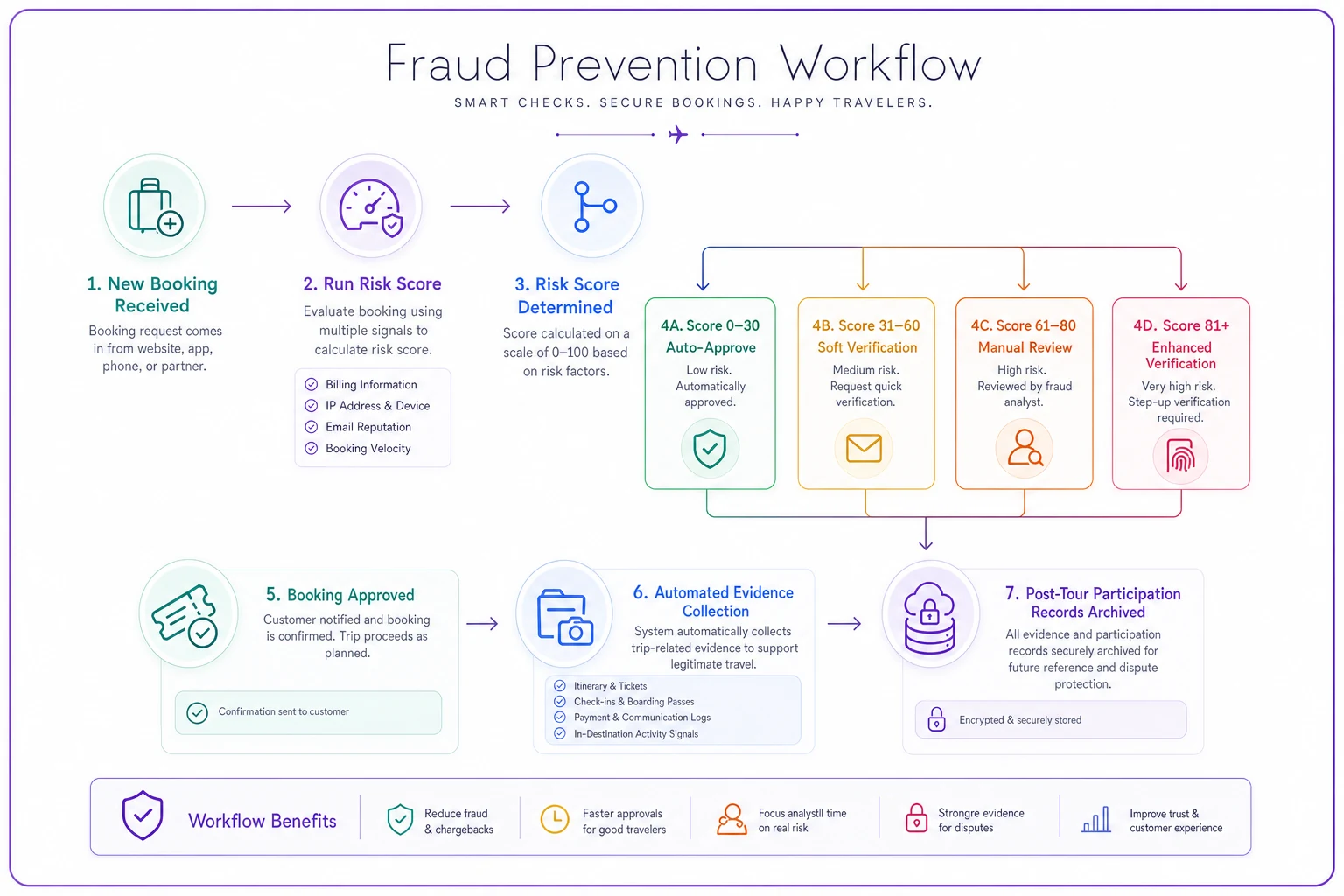
This flow shows how evidence collection starts at booking and continues through post-tour follow-up.
-
New Booking Received
-
Run Risk Score (billing, IP, email, velocity)
-
Score 0–30
Auto-Approve → Send Confirmation
-
Score 31–60
Soft Verification Email → Awaiting Click
-
Score 61–80
Manual Review → Staff Calls/Checks
-
Score 81+
Enhanced Verification → Phone + ID Required
-
All approved bookings → Evidence collection begins automatically
-
Post-tour
Participation records archived → Ready for disputes
The key thing this flow reinforces is that evidence collection isn't something you do reactively when a dispute lands—it starts at the moment of booking and runs through to post-tour follow-up.
| Risk Tier | Score Range | Action | Key Evidence to Collect |
|---|---|---|---|
| Low | 0–30 | Auto-approve | IP, email delivery, confirmation timestamp |
| Medium | 31–60 | Soft verification | Above + verification link response |
| High | 61–80 | Manual review | Above + communication logs, staff notes |
| Critical | 81+ | Enhanced verification | Above + phone verification, photo ID |
Having this documented and visible to your team makes the whole process more consistent—especially during busy seasons when individual judgment tends to slip.
Beyond basic prevention: operational software that learns from your patterns
Rigid rules eventually get figured out by sophisticated fraudsters. AI-powered operational software identifies subtle patterns humans miss—the billing address might match the IP, the email might be established, the amount might be normal, but the combination of device fingerprint, booking velocity, and behavioral patterns still surfaces a flag worth investigating.
The real advantage isn't any single detection capability. It's in how AI automation integrates fraud prevention with your entire operational flow. Suspicious patterns automatically trigger enhanced verification workflows. Evidence collection happens in the background without anyone manually remembering to do it. Dispute responses pull from accumulated data rather than requiring staff to hunt down records under pressure. Your team focuses on borderline cases and customer service while obvious fraud gets caught early and clean bookings flow through without friction.
These platforms also learn from every booking, every dispute, every successful tour. They identify emerging fraud patterns before they become expensive problems. They adjust risk scoring to your specific business rather than applying generic rules that misfire constantly. The balance between preventing fraud and maintaining conversion improves over time in ways static rule sets simply can't match.
The bigger advantage is time. Instead of staff manually reviewing bookings, hunting down dispute evidence, and updating spreadsheet rules, they're selling tours and serving customers. The operational efficiency alone often justifies the investment before counting fraud prevention value.
Fraudsters will always exist, but they don't have to be your ongoing problem. With smart scoring rules, systematic evidence collection, and the right tools, you can make your business an expensive, frustrating target while legitimate customers enjoy smooth booking experiences.
Your next chargeback notification doesn't have to trigger panic. With proper preparation, it becomes a minor administrative task with a predictable outcome. The evidence is already collected. The response is ready. The patterns that might have predicted it are already being tracked.
You're not reacting to fraud anymore—you're preventing it, and building a more efficient operation in the process.
Ready to elevate your travel business?
Join 500+ travel operators using Touryly to optimize bookings, improve client satisfaction, and grow revenue.