
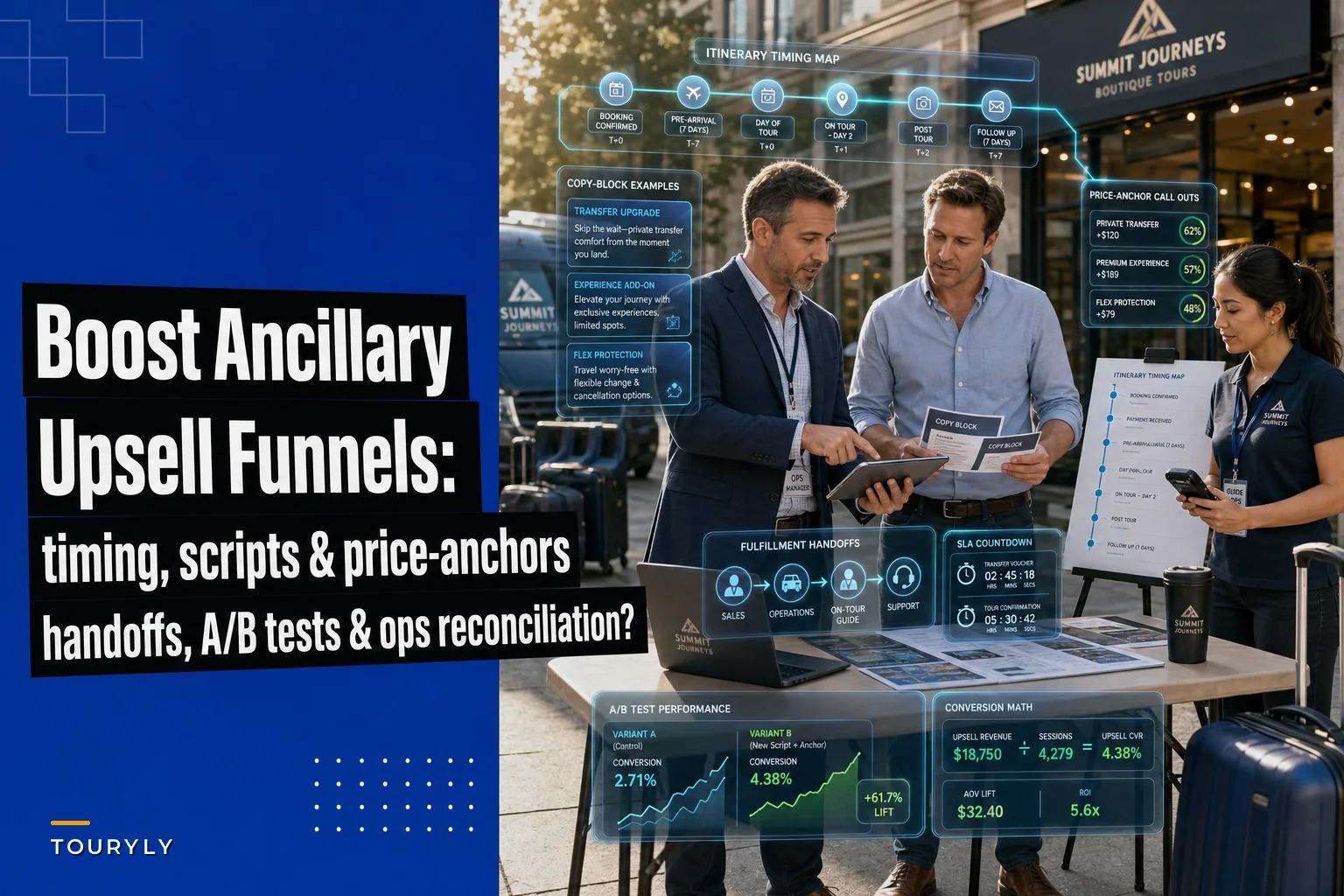

Most tour operators treat upsells like a bolt-on. A checkbox at checkout. A "would you like to add insurance?" line that nobody reads. Then they wonder why ancillary revenue sits at 4–6% of booking value when it could comfortably run 12–18% on the right product mix.
The problem isn't that guests won't buy extras. It's that operators ask at the wrong time, with the wrong framing, and then hand off the sale to a fulfillment process that falls apart the moment someone actually says yes. That last part matters more than most people think. An upsell that creates an ops mess costs more than the margin you earned on it.
This post covers getting the whole chain right — when to ask, what to say, the math that tells you whether it's working, and how to handle the operational load so your yes-rate doesn't quietly become a refund-rate.
Start with the timing map, not the offer
The single biggest lever in tour operator upsell funnels isn't the discount or the copy. It's when the ask lands relative to where the guest is emotionally and logistically in their trip.
Think of the booking lifecycle as a sequence of moments, each with a different buying posture. A guest at the point of booking is in "commit and move on" mode. A guest three days before departure is in "I want this trip to be perfect" mode. Those are completely different states, and they respond to completely different offers.
Here's a timing map that works for a typical multi-day tour:
| Trigger event | Guest mindset | Best upsell type | Why it converts here |
|---|---|---|---|
| At booking (cart) | Commit, minimize friction | Low-cost, no-brainer add-ons (airport transfer, seat upgrade) | Already in payment flow; small adds feel trivial |
| Booking +24–48h | Excitement, planning | Experience upgrades (private guide, premium room category) | Emotional high; researching the trip |
| T-14 days | Anticipation, logistics | Insurance, equipment rental, meal plans | Practical mindset; solving "what do I need" |
| T-3 to T-5 days | Peak anticipation | Photography package, celebration extras, excursions | "Make it special" window |
| On-tour (day 1–2) | In the experience | Next-day add-ons, extensions, premium meals | Trust is established; guide can sell naturally |
| Post-tour +2 days | Reflection, satisfaction | Rebook discounts, referral credits, photo purchases | Emotional peak after a good experience |
The mistake that comes up constantly: operators cram every offer into the checkout page. Insurance, transfers, upgrades, excursions — all stacked at the moment the guest just wants to confirm and close the tab. Conversion on everything tanks because the guest is overwhelmed and in the wrong headspace.
Spread the asks across the timeline and each one lands when the guest is actually ready to hear it.
The copy blocks that move the needle
Once the timing is right, the copy does the rest. And most upsell copy reads like a product spec sheet when it should read like a helpful nudge from someone who knows the trip.
Never miss a booking or update.
Touryly streamlines your travel bookings, confirmations, and itinerary updates—all in one place.
- Unified booking management
- Automated customer notifications
- Itinerary & staff coordination
No credit card required
Frame around the experience, not the feature. "Add airport transfer — $45" converts worse than "Skip the taxi queue after your flight — private transfer waiting at arrivals, $45." Same product, same price. The second version sells the relief, not the ride.
Anchor against a worse alternative. Guests have no internal reference for what a private guide "should" cost. Give them one.
> Private guide for your group > Most guests on this route book a shared group tour (up to 16 people). For a more personal pace, upgrade to a private guide for just your party. > ~~Comparable private tours elsewhere: $340/day~~ > Your upgrade: $180/day — because you're already booked with us.
The crossed-out anchor gives the $180 meaning. Without it, $180 is just a number the guest has to evaluate cold. With it, $180 looks like a deal.
Use the "complete the trip" framing for T-3 offers. By the time someone is three days out, they've mentally committed to a full experience. Copy like "Your trip is almost here — one thing most guests wish they'd added…" taps the anxiety of a less-than-perfect trip without being pushy.
Keep the on-tour upsell human. The guide selling a next-day excursion shouldn't be reading from a script. The highest-converting on-tour upsell copy is really a prompt for the guide: "Mention the sunrise hike at dinner on day 1 — only if the group's energy is high. Frame it as optional, small group, books out fast." The guide fills in the warmth.
Worth noting: the copy that converts at checkout almost never converts on-tour, and vice versa. Operators who reuse the same offer language across every touchpoint leave a lot on the table. Write the block for the moment.
The fulfillment handoff is where upsells quietly die
This is the part nobody plans for and everybody regrets.
-
Confirm guide availability for that date
-
Pull the guest off the group roster
-
Adjust the vehicle/seat allocation
-
Notify the local supplier
-
Update the guide's manifest
-
Make sure the guide actually knows before day 1
In a lot of operations, this handoff is a Slack message or an email that a coordinator may or may not catch in time. When it breaks, the guest shows up expecting a private experience and gets put on the group bus. That's not a lost upsell — that's a refund, a bad review, and a chargeback risk all at once.
Operators who handle this well have one thing in common: every upsell SKU has a defined fulfillment path before it's ever offered. If you can't reliably fulfill the private guide upgrade in your T-14 window, don't offer it at T-14. Offer it at booking, when there's enough lead time to arrange it properly.
A workable fulfillment handoff in plain terms:
-
Guest purchases upsell → system flags the booking with the SKU and fulfillment deadline.
-
The flag routes to the right owner automatically — guide ops for upgrades, supplier desk for excursions, finance for anything that changes the invoice.
-
Owner confirms availability within an SLA window (24h for T-14 offers, 2h for on-tour offers).
-
If availability fails, an auto-refund or substitute offer triggers before the guest ever notices.
-
The confirmed add-on writes back to the guide manifest and the supplier booking.
That "if availability fails" step is the one most operators skip, and it's the one that saves you from the worst outcomes. Selling something you can't deliver is worse than never selling it. The same discipline that keeps group logistics from imploding applies here — if you've already built structured rules around holds and allocation like in avoiding group-booking chaos with deposit schedules and seat-holds, extend that same thinking to upsell inventory.
Here's a simple workflow view to keep in your ops playbook.
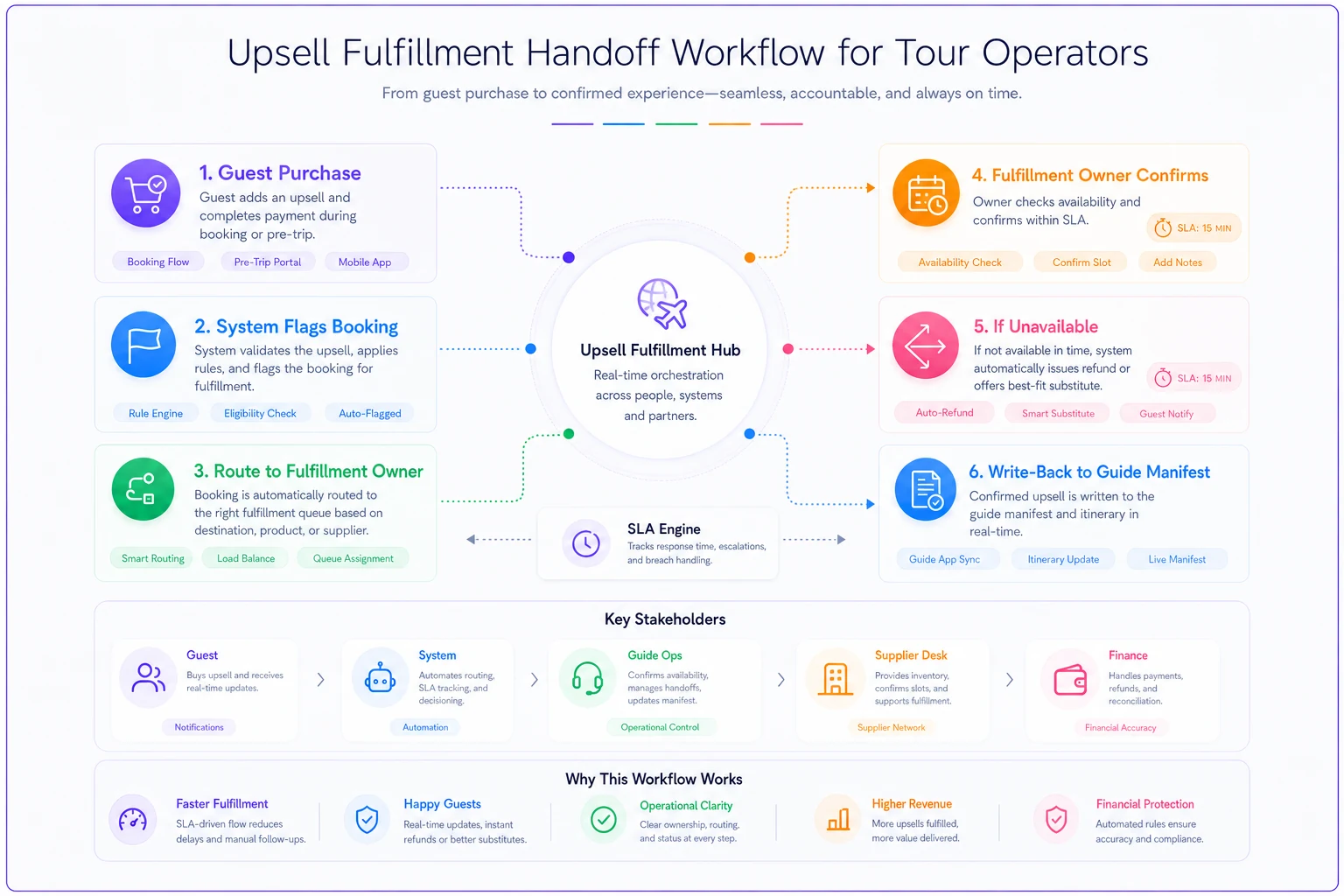
When that handoff is automated, coordinators stop spending hours reconciling add-ons by hand and refund rates drop because nothing slips through.
The conversion math, done properly
A lot of operators fool themselves here. They see a 20% take-rate on an upsell and call it a win, without checking whether that upsell is net-positive after fulfillment cost, refunds, and ops time.
Scenario: "Sunrise hike" on-tour add-on
-
Monthly guests exposed to the offer
~420
-
Take-rate
18% → ~76 purchases
-
Price
$65
-
Gross ancillary revenue
~$4,940
-
Supplier cost per hike (extra guide + permit)
$28 → cost ~$2,128
-
Refunds/no-shows (weather, overslept)
~9% → ~$445 refunded
-
Net contribution
roughly $2,370/month
Now the part operators forget — the ops cost. If each purchase takes a coordinator roughly 4 minutes of manual handling (confirming the extra guide, updating the manifest) and refunds take around 10 minutes each to process, that's 5–6 hours of staff time a month on this one SKU alone. Not a dealbreaker for one product, but multiply that across 8–10 upsell SKUs and you're burning most of a part-time role just reconciling add-ons.
That's the number that decides whether an upsell program actually scales. Gross revenue looks great until you account for the manual drag.
A rule of thumb that holds up: an upsell SKU is worth keeping if net contribution per staff-hour of fulfillment load beats your blended labor cost by a comfortable margin. If a SKU earns $200/month but eats 6 hours of coordinator time, it's barely breaking even and probably not worth the cognitive overhead.
A/B test frameworks you can actually run
You don't need a data science team. You need clean, honest tests on one variable at a time. The two tests worth running first:
Test 1 — Timing test (same offer, different moment) Hold the copy and price constant. Send the private-guide upgrade to one cohort at booking, another at T-14. Measure take-rate and fulfillment success rate. Operators are often surprised to find the higher take-rate window also has the higher failure rate — which flips the winner.
Test 2 — Anchor test (same offer, different framing) Variant A: "Private guide — $180/day." Variant B: the anchored block with the $340 comparison. Run for a fixed number of exposures — not a fixed time period — so you're comparing equal sample sizes.
Keep the framework honest:
-
One variable per test. Change timing OR copy OR price. Change two things at once and you learn nothing.
-
Define the sample size before you start. Decide you'll judge after ~600 exposures per variant, not "when it looks promising."
-
Measure net, not gross. Track take-rate, refund rate, and fulfillment success together. A copy variant that lifts take-rate but doubles refunds is a loss.
-
Run during comparable demand periods. Testing one variant in peak week and another in a shoulder week corrupts the result. If you're adjusting offers by season, keep that logic separate from your A/B logic — the two interact, as covered in pricing rules for seasonal peaks.
The most common testing mistake isn't statistical — it's declaring a winner after 40 bookings because the early numbers looked exciting. Early results swing hard. Hold the line on sample size.
Reconciling the ops impact
Every yes creates work downstream. Operators who run profitable upsell programs treat reconciliation as part of the funnel, not something to sort out later.
What reconciliation should check, ideally weekly:
-
Sold vs. fulfilled. How many upsells were purchased vs. actually delivered? A gap here is your early warning system for brewing refunds.
-
Revenue vs. supplier cost per SKU. Margin drift happens quietly when supplier prices creep and your upsell price doesn't follow.
-
Refund rate by SKU and timing window. If on-tour, weather-dependent add-ons refund at 15%+, that's a pricing or policy problem — not bad luck.
-
Staff-hours per SKU. The hidden cost that kills scaling. Track it even roughly.
-
Guide manifest accuracy. Did every sold add-on make it onto the guide's day-of sheet? A manifest miss turns a sale into a service failure.
This is where decent operational software earns its place — not as a magic upsell engine, but as the thing that routes each purchase to the right fulfillment owner, enforces the SLA, triggers the auto-refund when availability fails, and writes the add-on back to the guide manifest without anyone retyping it. When that handoff is automated, coordinators stop spending hours reconciling add-ons by hand and refund rates drop because nothing slips through. The revenue was always sitting in the funnel. The automation just stops it from leaking out the back end.
A short real scenario
A small adventure operator running roughly 380–420 guests a month had an upsell take-rate around 7%, almost all of it transfers sold at checkout. Ancillary revenue sat near 5% of booking value. Their coordinator was manually handling every add-on and quietly refunding a chunk of them because confirmations got missed.
They did three things. Spread offers across the timeline — transfers at checkout, upgrades at T-14, excursions on-tour through the guides. Rewrote the upgrade copy with proper price anchors. Defined a fulfillment path and SLA for each SKU so nothing got sold without a confirmation route.
Over about two months, blended take-rate moved into the 14–16% range and ancillary revenue climbed to roughly 11% of booking value. The part that actually made it sustainable: refund rate on upsells dropped by more than half because the handoffs stopped breaking. The coordinator went from drowning in add-on admin to spending that time on guest experience.
Nothing exotic happened. They stopped asking at the wrong time, started framing offers with a reference price, and refused to sell anything they couldn't reliably fulfill.
When this is worth it — and when it isn't
It makes sense when you have enough monthly volume to run honest A/B tests, a product mix with natural upgrade paths, and the ops discipline to fulfill what you sell.
It's a bad idea when your fulfillment is already shaky. Layering upsells onto a broken ops process just multiplies your failure points. Fix the handoff first.
Who should hold off: very low-volume operators running a handful of departures a month. You won't get clean test data, and the manual fulfillment load per sale won't justify the complexity. For those situations, one well-placed, well-written upsell at booking beats a full funnel.
Ancillary revenue isn't a growth hack you bolt on. It's a funnel you design — matched to the itinerary, written for the moment, priced against an anchor, and backed by a fulfillment path that holds when guests say yes. Get those four things working together and the extra margin shows up on its own.
Ready to elevate your travel business?
Join 500+ travel operators using Touryly to optimize bookings, improve client satisfaction, and grow revenue.