

The gap between operators who survive a serious incident and operators who lose 30% of their bookings the following season usually has nothing to do with how bad the incident actually was. It comes down to what happened in the first ninety minutes, and whether anyone knew who was supposed to say what.
A minibus rollover with three injuries can be handled with grace and barely dent your reputation. A delayed ferry with zero injuries can spiral into a viral thread, a refund war, and a wave of one-star reviews — purely because nobody controlled the message. The difference is a communications system that's wired into your incident response before anything goes wrong.
Most tour operators treat crisis comms as improvisation. Someone in the office starts drafting a Facebook post, someone else is on the phone with an angry guest's spouse, and the guide on the ground is answering questions they have no business answering. That's not a plan. That's chaos with good intentions.
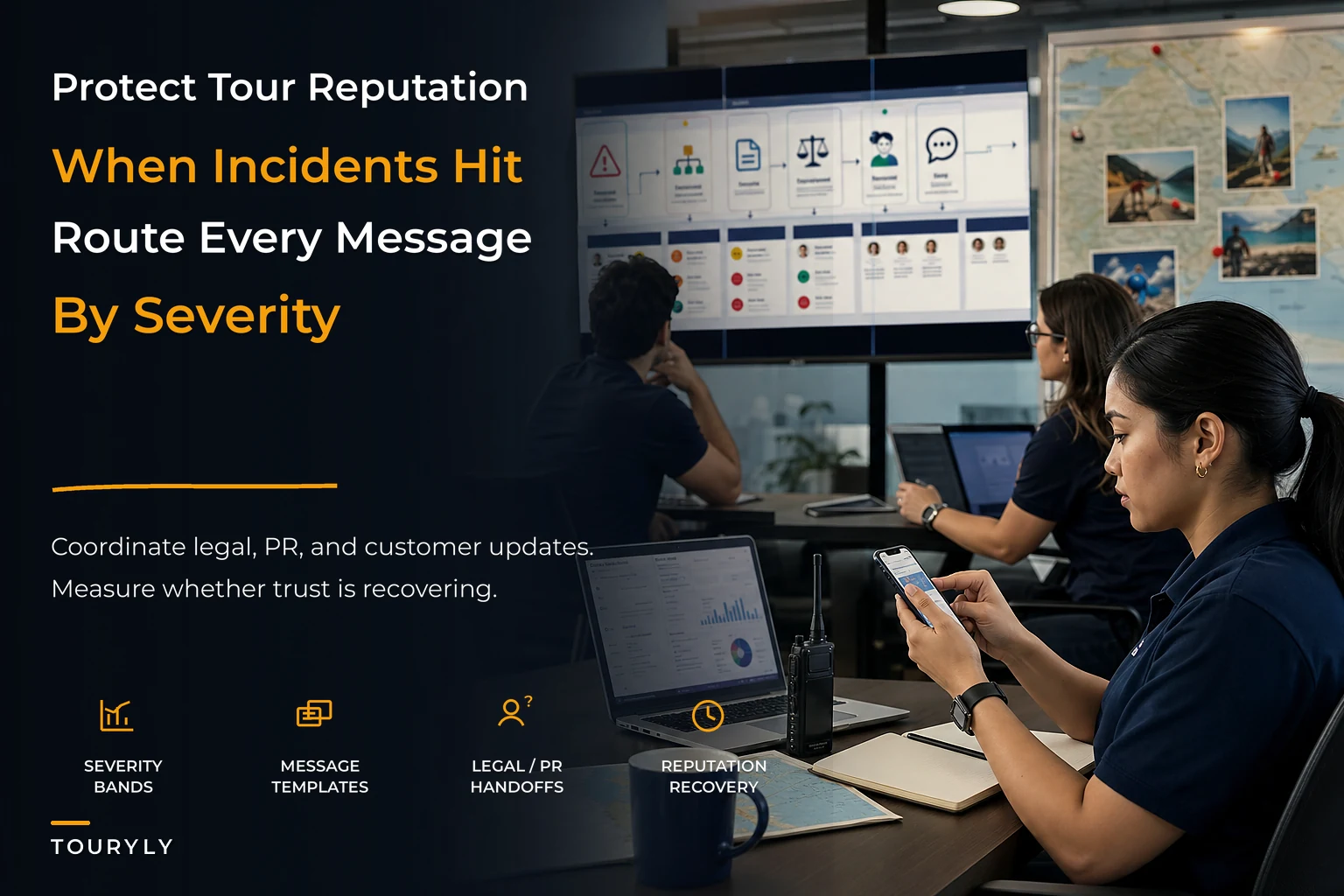
This is about building the actual machinery: severity bands that tell everyone how big this is, templates that are already written and legally cleared, clean handoffs between operations, legal, and PR, and a feedback loop that tells you whether your messages actually worked.
Why the message breaks down
Why the message breaks down before the incident does
The operational side of incident response is often decent — guides know first aid, there's an emergency contact list, suppliers get called. The communications side is where you find a vacuum.
The reason is structural. Communications sits at the intersection of three functions that rarely talk to each other in a small business: operations (who knows what happened), legal (who knows what you can admit), and marketing (who owns the public channels). During normal operations, those three barely overlap. During a crisis, they all need to move as one unit within minutes.
What breaks first is authority. A guest posts something inflammatory at 9:14 PM. Your social media is managed by a part-timer who sees it at 9:20 and, wanting to be helpful, replies with an apology that accidentally admits fault. By the time anyone with real authority sees it, the screenshot is already circulating. The apology becomes the story.
The second thing that breaks is consistency. The guide tells the family one thing on the ground. The office tells the media something slightly different. Your insurer's statement contradicts both. Now you don't just have an incident — you have the appearance of a cover-up, which is almost always worse than the incident itself.
The third failure is speed in the wrong direction. Operators either freeze completely (silence reads as guilt) or overreact and flood every channel with panicked statements they later have to walk back. Both are symptoms of the same root cause: no pre-defined thresholds for what triggers which response.
Severity bands
Severity bands: the thing that should exist before anything else
Never miss a booking or update.
Touryly streamlines your travel bookings, confirmations, and itinerary updates—all in one place.
- Unified booking management
- Automated customer notifications
- Itinerary & staff coordination
No credit card required
You cannot make good decisions about tone, speed, and who gets involved while your adrenaline is spiking. Severity bands solve this by deciding, in advance, what "how bad is this" actually means and what each level unlocks.
| Band | Triggers | Comms posture | Who's involved | First response target |
|---|---|---|---|---|
| 1 – Service disruption | Delays, minor itinerary changes, weather reroutes, single unhappy guest | Reassure, inform, no public statement needed | Ops lead + guide | Within 30 min to affected guests |
| 2 – Serious disruption | Cancellation of full-day tour, supplier failure stranding guests, minor injury (first aid only) | Proactive guest comms, monitor social, internal alignment | Ops manager + comms owner | Within 20 min to guests, hold on public |
| 3 – Injury / significant harm | Hospitalization, multiple injured guests, guest missing, significant property incident | Controlled statements only, legal looped in immediately | Owner/director + legal + comms | Immediate internal, external only after alignment |
| 4 – Fatality / mass-casualty / criminal event | Death, mass casualty, assault, event drawing media | Full crisis mode, single spokesperson, legal-led | Owner + legal + external PR + insurer | Internal in minutes, external strictly gated |
The value here isn't the table itself — it's that everyone in the company knows which band they're in before they open their mouth. A guide who radios in "we've got a Band 3" has communicated more, faster, than a five-minute panicked phone call. The band is the shorthand.
Review misclassifications after the fact the same way you'd review any operational miss.
One thing worth flagging: over-banding is a real problem. If your team starts calling every grumpy customer a Band 2, the whole system loses meaning and people stop taking real escalations seriously. Bands need discipline. Review misclassifications after the fact the same way you'd review any operational miss.
Pre-approved templates
Pre-approved templates, and why "we'll write it when it happens" fails
The single most valuable asset in this whole system is a set of message templates that legal has already read and signed off on. Not because you're trying to be robotic, but because the words you'd naturally write under stress are almost always wrong in one of two ways: they admit liability, or they promise something you can't deliver.
You want templates for each severity band, split by audience, with clearly marked blanks for the specifics. The structure matters more than the eloquence.
> "We're aware of an incident involving [tour name] earlier today. Our immediate priority is the safety and care of everyone involved, and our team is on-site working alongside [local emergency services / authorities]. We're in direct contact with affected guests and their families. We'll share verified updates as soon as we're able. For questions, please contact [dedicated line], not our general booking channels."
Notice what that does and doesn't do. It shows you're acting. It doesn't assign cause. It routes inquiries away from your booking team, who need to keep functioning. And it sets the expectation that updates come from you, on your timeline — which is how you stay ahead of speculation.
-
Guest-direct holding message (per band) — reassurance, next steps, single point of contact
-
Affected family notification — warmer, more personal, still liability-safe
-
Public / social holding statement — for when the incident is already visible
-
Media inquiry response — short, points to spokesperson, never "no comment"
-
Internal staff briefing — what happened, what to say, what NOT to say, who to route inquiries to
-
Supplier / partner notification — keeps your DMC or resellers from freelancing their own messaging
-
All-clear / resolution message — the one people forget to prepare, and often need most
The "never say" list deserves its own document. Phrases like "we take full responsibility," "this has never happened before," or "we're confident no one was at fault" are landmines. Legal should give you the banned-phrase list once, and it should live inside your templates as inline warnings.
Legal and PR handoff
The legal and PR handoff — where most operators lose control
The handoff between operations and legal/PR is the seam where things tear. Ops has the facts. Legal has the constraints. PR has the channels. If those handoffs aren't rehearsed, you get delay, contradiction, or someone talking who shouldn't be.
The clean version works like a relay, not a committee:
-
Guide/ops captures facts — what happened, who's affected, current status, using the evidence-capture discipline your team should already have from day-of incident procedures.
-
Ops lead classifies the band and triggers the corresponding contact tree. No debate about whether to escalate — the triggers decide.
-
For Band 3+, legal is looped before any external word goes out. Their job is to redline the pre-approved template against the actual facts, not to write from scratch — that's why the templates exist.
-
A single spokesperson is named. One voice. Everyone else routes to them. This is the rule most often broken and most damaging when it is.
-
PR/comms owner controls the channels — decides what goes where, monitors response, and holds the timeline for updates.
-
Insurer is notified in parallel, because many policies require prompt notification and some restrict what you can say publicly.
The insurer point trips people up. A well-meaning apology can, under some policies, complicate or even void coverage. That's not a reason to sound cold — it's a reason to have legal pre-clear your empathetic language so you can be human and protected at the same time. Those aren't mutually exclusive.
For small operators without in-house legal or PR, the handoff still applies — you just pre-arrange the external relationships. Have a lawyer on retainer who knows your business exists before you need them at 10 PM. Same with a PR contact for Band 4 situations. The worst time to find these people is during the crisis.
Wiring comms
Wiring comms into the incident runbook
Communications shouldn't be a separate document you dig for. It should be embedded in the same runbook your team already uses for operational incident response. If your ops runbooks and SLOs live in one place, your comms triggers belong right next to them — the moment an incident is logged, the relevant band's comms actions should surface automatically alongside the operational steps.
The wiring looks like this in practice. An incident gets logged (ideally from the field, on mobile). The severity band gets tagged. That tag does three things at once: it fires the right contact tree, it pulls up the matching template set, and it starts a timestamped log of every message sent. That log matters later — for insurers, for regulators, and for your own post-incident review.
This connection between operational response and communications is exactly the kind of thing that surfaces during rehearsal. If you run tabletop exercises and failure-mode drills, comms should be a scored part of every scenario, not an afterthought. It's remarkable how often a team nails the operational response in a drill and then completely fumbles who's supposed to post what. Better to discover that in a conference room than during a real Band 3.
-
Minute 0–5 Incident logged, band tagged, contact tree fires, spokesperson named
-
Minute 5–15 Facts confirmed, template pulled, legal redlines if Band 3+
-
Minute 15–30 First guest/family message out; public holding statement staged (not necessarily published)
-
Ongoing Single spokesperson handles inquiries; comms owner monitors channels; every message logged
-
Post-resolution All-clear message sent; timeline archived; review scheduled
A short visual of that workflow helps.
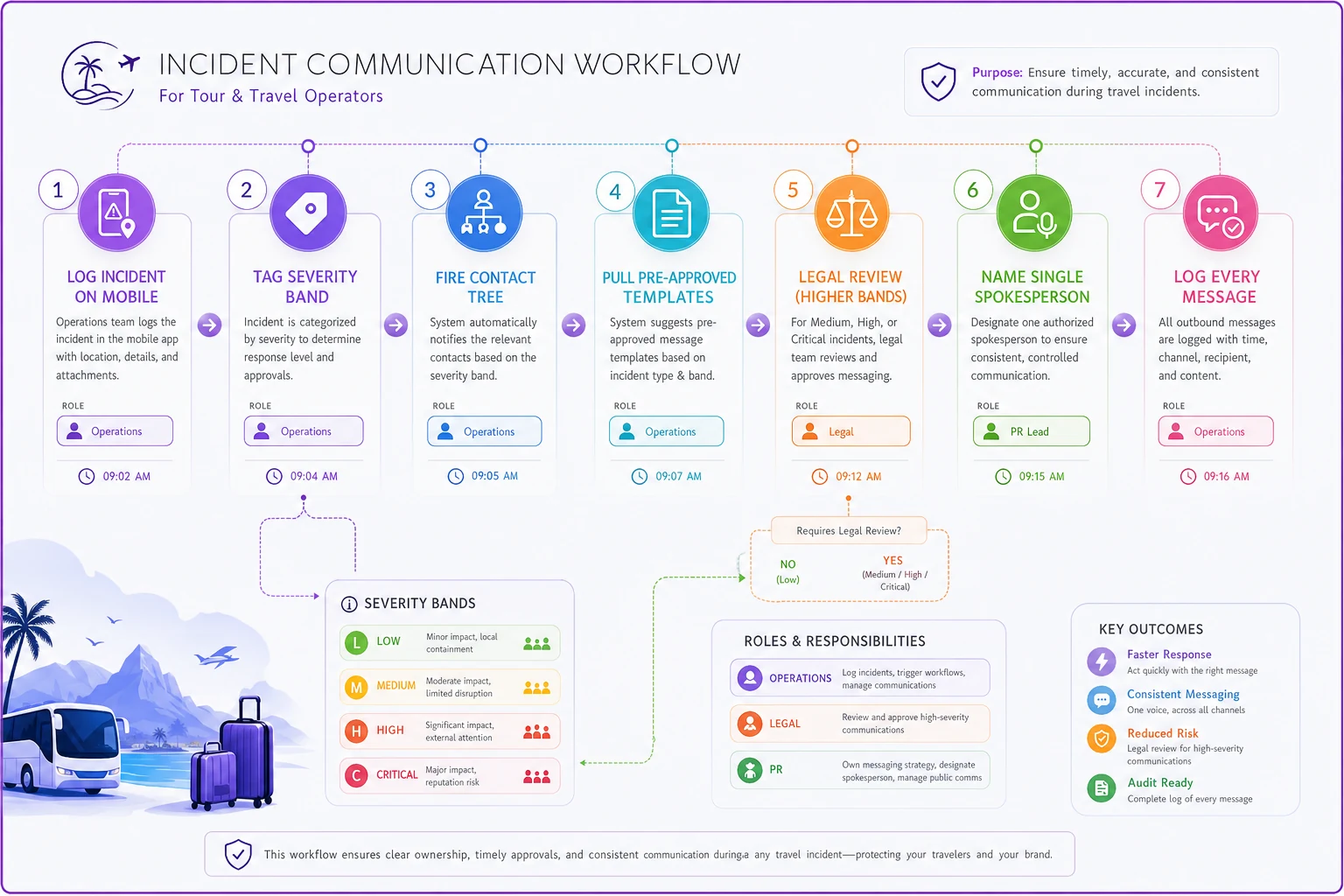
This connection between operational response and communications is the thing rehearsals surface and improve.
Measuring impact
Measuring whether your messages actually worked
Almost nobody does this part, and it's the difference between a playbook that improves and one that ossifies. After an incident, you need to know whether your communication reduced the damage or added to it.
-
Response time to first contact — did affected guests hear from you before they went looking for answers elsewhere?
-
Sentiment shift — review and social sentiment before, during, and after. Did your messaging calm things or inflame them?
-
Inquiry volume and routing — did inquiries land where they were supposed to, or did your booking line get flooded?
-
Refund/complaint escalation rate — how many affected guests escalated versus accepted the resolution?
-
Rebooking behavior — do affected guests come back, and does your broader booking pace recover to seasonal baseline?
One pattern worth watching: the operators who recover fastest are almost always the ones whose first guest message went out before the guest had a chance to post publicly. Once someone has publicly complained, they're emotionally committed to that position and much harder to bring back. Speed of proactive contact matters more than the polish of the message.
Feed these findings back into the bands and templates. If a Band 2 kept escalating to Band 3 territory, your thresholds are wrong. If a particular template consistently generates confused follow-up questions, rewrite it. The playbook is a living thing.
Real scenario
A real scenario
A mid-sized adventure operator running canyoning and via ferrata trips — roughly 4,000 guests a season, small office team of six — had a guest fracture an ankle badly enough to need helicopter evacuation. No fault on the operator's part; the guest slipped on a section they'd been briefed about.
The first time something like this happened, two years earlier, it went badly. The office posted a defensive statement, the guide told the family the company would "sort out the medical costs" (which wasn't the company's to promise), and the story bounced around a regional hiking forum for weeks. The estimated fallout was somewhere around €18k–€22k in cancellations and refunds over the following month, plus a batch of reviews they're still living with.
The second time, they had bands and templates in place. Guide radioed "Band 3," ops classified it instantly, the owner became the single spokesperson, the pre-cleared family message went out within about 20 minutes, and the guide was explicitly told to comfort but not to promise. The family got consistent updates. No public statement was ever needed because the story never spread — the family felt taken care of and had no reason to broadcast. Bookings didn't visibly dip. The whole thing resolved quietly.
Same severity of incident. Completely different outcome. The difference was entirely in the communications system, not the operational response — which was solid both times.
When structure makes sense
When this level of structure makes sense (and when it's overkill)
If you run higher-risk activities — anything with water, height, vehicles, or remote locations — you need the full four-band system with pre-cleared legal templates. The exposure is real and the cost of getting it wrong is measured in tens of thousands plus lasting reputation damage.
If you run low-risk products — city walking tours, food tours, museum visits — you can compress this. Bands 1 and 2 will cover the vast majority of your incidents, and you may never realistically hit Band 4. Don't build machinery you'll never use. But even a walking-tour operator should have pre-written guest and public holding statements, because a medical emergency or a guest altercation can happen anywhere.
Who should not over-invest here: a solo operator running a handful of trips a season. The retainer costs and template maintenance won't pay off. What that operator needs is simpler — a one-page severity guide, three template messages, a lawyer's number, and the discipline to be the single voice. The principle scales down; the apparatus doesn't have to.
Pulling it together
Your reputation during a crisis is decided less by what happened and more by how it looked while you were handling it. Guests forgive incidents. They don't forgive feeling abandoned, misled, or ignored.
A crisis communications system for a tour operator isn't about sounding corporate or hiding behind lawyers. It's about removing improvisation from the moments when improvisation does the most damage — getting the right words, from the right person, to the right people, faster than the internet can fill the silence. Build the bands, pre-clear the templates, rehearse the handoffs, and wire it all into the same incident process your team already uses. Pair that with solid SLOs and runbooks for your operational response, and the two systems reinforce each other. Then, ideally, never need any of it.
Ready to elevate your travel business?
Join 500+ travel operators using Touryly to optimize bookings, improve client satisfaction, and grow revenue.