



Most operators are flying blind on one simple question: which customers are worth chasing, and through which channel? They know their blended CAC. They know their average booking value. But ask them what a price-sensitive solo traveler acquired through a flash-sale OTA is actually worth over three years versus a group-booker who came through a referral, and you get a shrug.
That gap is expensive. Marketing budget gets allocated on gut feel, upsell offers go out to everyone identically, and lifecycle investment — the emails, the loyalty perks, the concierge touches — spreads evenly across customers who will never rebook and customers who would rebook anyway.
The fix isn't a fancier dashboard. It's a working CLTV model that connects segment definitions, cohort math, and attribution all the way from booking to settlement. This article walks through how that system fits together, where it breaks, and how to build it without pretending you have perfect data.
Why a single blended CLTV number is useless for a tour operator
A blended lifetime value figure averages your best and worst customers into one number that describes nobody. For a tour operator this is especially misleading because your customer base isn't one population — it's at least three or four populations with wildly different economics.
A couple booking a $4,000 multi-day private itinerary behaves nothing like a backpacker grabbing a $45 walking tour on a discount site. The group organizer booking 18 seats for a corporate retreat behaves differently again — high transaction value, long lead time, and a decent chance of repeat if you treat the organizer as a relationship rather than a transaction.
When you average these together, you get a number that tells you to spend roughly the same on everyone. That's how operators end up pouring retargeting spend at price-sensitive one-timers who were never coming back, while under-investing in the group-booker who could have been worth five figures across two years.
The point of segmentation isn't academic tidiness. It's to stop you from making the same offer, through the same channel, to people with completely different payback profiles.
Operator-focused segment definitions that actually mean something
Marketing textbooks will hand you demographic segments. Those are nearly worthless operationally. What you want are segments defined by booking behavior and economics, because those are the things you can act on.
Never miss a booking or update.
Touryly streamlines your travel bookings, confirmations, and itinerary updates—all in one place.
- Unified booking management
- Automated customer notifications
- Itinerary & staff coordination
No credit card required
Price-sensitive one-timers. Booked during a promotion or through a discount-heavy channel, low or no add-ons, little engagement after the trip. High volume, low margin, low repeat probability. Not worthless — but you should know you're acquiring them cheaply and not over-invest in winning them back.
Experience-maximizers. Mid-to-high ticket, consistently buy upgrades (private guide, premium transfers, photo packages). Moderate repeat rate but very high per-trip margin. These people respond to offers, not discounts.
Group-bookers / organizers. One person controlling many seats. The booking value is large, but the real asset is the organizer relationship. A single wedding planner or corporate coordinator can be worth several bookings a year if you keep them happy. The failure mode is treating the organizer like one customer when they're really a distribution channel.
Loyal rebookers. Lower acquisition cost (you already paid once), predictable repeat, strong referral behavior. These quietly produce the best CLTV even when their average order value isn't the highest.
Dormant-but-reachable. Booked once 18+ months ago, consented to contact, no recent activity. Cheap to reactivate relative to acquiring net-new, and most operators completely ignore them.
When modeling CLTV, treat group organizers as distribution channels rather than single transactions — their value compounds through referrals and repeat group bookings.
The mistake that comes up constantly is defining segments by trip type instead of customer economics. "Day-tour customers" isn't a segment — a price-sensitive one-timer and a loyal rebooker might both buy the same day tour. The behavior is the segment, not the product.
Cohort CLTV: the template that keeps this honest
Lifetime value only becomes useful when you slice it by cohort. A cohort is simply the group of customers acquired in the same window (month or quarter) through the same channel. You track what each cohort spends over time.
| Field | What it holds | Why it matters |
|---|---|---|
| Cohort month | Acquisition period | Lets you compare maturity fairly |
| Acquisition channel | OTA, referral, direct, paid social, agent | Ties value back to spend |
| Segment | One of the behavioral segments above | Different payback curves |
| Cohort size | # customers acquired | Normalizes everything else |
| Net revenue M0 | First-trip margin after supplier cost | Your real starting point, not gross |
| Net revenue M3 / M6 / M12 / M24 | Cumulative margin at each interval | Shows the shape of the payback curve |
| Repeat rate by interval | % who've rebooked | Separates one-timers from compounders |
| Blended CAC | Spend ÷ cohort size for that channel | The number CLTV has to beat |
A few things this template forces you to confront:
-
Use net margin, not gross revenue. Supplier costs, FX, and payment fees eat a shocking amount of a tour booking. A $500 booking might net you $120. If your CLTV math uses the $500, every channel looks profitable and you'll overspend.
-
Track cumulative, not per-period revenue. You want the running total so you can see at what month a cohort "pays back" its acquisition cost.
-
Keep repeat rate separate per interval. A cohort hitting 30% repeat by month 12 is a very different animal from one stuck at 6%.
A realistic pattern looks like this: a referral cohort might start lower in M0 (smaller first bookings) but overtake a paid-OTA cohort by M12 because repeat and referral behavior compounds. If you only looked at M0, you'd defund the better channel.
Wiring attribution from booking to settlement
This is where most CLTV projects quietly die. You build the segments, you build the cohort template, and then you realize you can't reliably connect a given customer's channel to their actual settled margin. The booking system knows the channel. The finance system knows the settled amount. Nothing stitches them together.
This is the same underlying problem that shows up in margin leakage and reconciliation work — if your booking data and your settlement data don't share a clean key, every downstream number is a guess.
The attribution chain you need to preserve:
-
Booking event — capture source/channel, promo code, segment signals (party size, add-ons at checkout, lead time), and a stable customer ID.
-
Fulfilment — note cancellations, no-shows, substitutions, and any on-trip upsells. These change actual margin materially.
-
Settlement — record the real money that landed after supplier payouts, refunds, FX movement, and payment fees.
-
Join — tie all three back to the same customer ID and cohort so settled margin (not booked revenue) flows into the CLTV model.
Below is a simple workflow diagram.
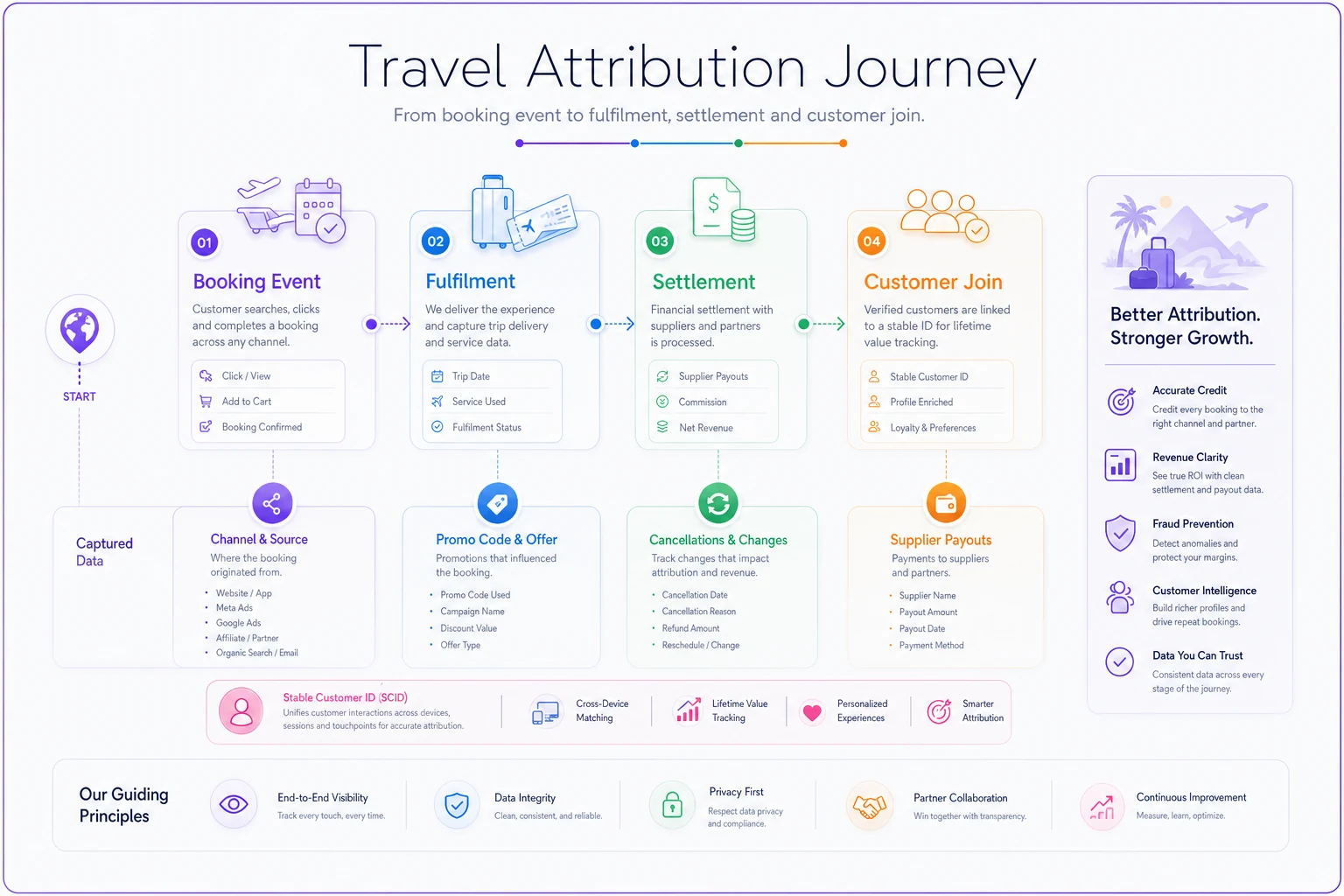
The single biggest attribution error is letting a customer get a new ID every time they book through a different channel. The couple who found you on an OTA, then booked direct the following year, looks like two separate one-timers. Your repeat rate reads artificially low, direct looks weaker than it is, and the OTA gets credit it didn't earn. Identity resolution — even a scrappy match on email plus phone — recovers a lot of CLTV that was hiding in plain sight.
This attribution backbone is also what makes your channel-allocation decisions defensible rather than political. When someone argues to pour more into a high-volume OTA, you can show the settled-margin payback curve for that channel's cohorts versus the alternatives.
Turning the model into channel, upsell, and lifecycle playbooks
A CLTV model that doesn't change what you do next week is a vanity project. The output has to drive three categories of decision.
Channel prioritization. Rank channels by payback period on settled margin, not booking volume. A channel that delivers huge volume but whose cohorts never pay back past M0 should be capped, not celebrated. A channel with modest volume but fast payback and high repeat gets more budget. The uncomfortable truth for a lot of operators: the channel that brings the most bookings is often the one producing the least lifetime value.
Upsell targeting. Match the offer to the segment. Experience-maximizers get premium add-ons and early access to new itineraries. Price-sensitive one-timers get low-friction, low-cost add-ons at checkout — they're not buying a $300 upgrade, but they might add a $25 transfer. Sending the same upsell to both wastes the offer and trains your best customers to expect discounts.
Lifecycle investment. This is where the money leak is biggest. Lifecycle touches — nurture emails, concierge calls, loyalty perks — cost real money and staff time. Spread evenly, they're a rounding error of waste per customer that adds up fast at volume. Concentrate them where CLTV justifies it:
-
Loyal rebookers and experience-maximizers get the human touches.
-
Group organizers get a dedicated relationship owner, because their lifetime value sits in the next group, not this one.
-
Price-sensitive one-timers get cheap, automated, low-cost sequences — don't put a human on them.
-
Dormant-but-reachable get a periodic, inexpensive reactivation nudge.
The sequencing of these lifecycle touches is a topic on its own. If you haven't mapped them yet, booking-triggered lifecycle maps are the natural companion to this segmentation work — the segments tell you who, the lifecycle map tells you when.
A quick checklist before you trust your CLTV numbers
Run through this before you let the model drive budget decisions:
-
[ ] CLTV is built on net settled margin, not gross booking value
-
[ ] Customers keep a stable ID across channels and repeat bookings
-
[ ] Cohorts are compared at the same maturity (M6 vs M6, not M6 vs M24)
-
[ ] Refunds, no-shows, and chargebacks are subtracted, not ignored
-
[ ] Supplier cost, FX, and payment fees are reflected in margin
-
[ ] CAC is attributed to the right channel per cohort, not blended
-
[ ] Group bookings are modeled at the organizer level, not per-seat
-
[ ] The model updates on a schedule, not only when someone asks
If more than two of these fail, your CLTV numbers are telling you a story, not the truth.
A realistic scenario
A mid-sized day-tour and multi-day operator — roughly 4,000 bookings a year, split across two OTAs, direct, and a handful of travel agents — was putting about 60% of its marketing budget into the OTA that produced the most bookings.
When they finally cohorted by settled margin, the picture flipped. That high-volume OTA produced bookings netting around $90–$110 each after supplier and payment costs, with repeat rates stuck near 7% at twelve months. The channel essentially paid back once and stopped. Meanwhile referral and direct cohorts netted a bit less up front but hit roughly 25–30% repeat by M12, and a chunk of those repeaters were group organizers worth several bookings.
They didn't abandon the OTA — it still filled low-season capacity. But they capped its spend, shifted a slice of budget into a referral incentive and a reactivation sequence for dormant past guests, and assigned one person to own organizer relationships. Over the following two cohorts, blended payback period shortened noticeably and the share of revenue from repeat customers climbed into the low-twenties. Nothing dramatic month-to-month — it was the drip of compounding repeat behavior finally showing up in the numbers because they were finally measuring it right.
When this is worth building — and when it isn't
When it makes sense: You're doing enough volume that channel and segment differences are statistically real (very roughly, a few thousand bookings a year across more than one channel). You have repeat customers. You're spending enough on acquisition and lifecycle that misallocation actually costs you money.
When it's premature: If you're doing a few hundred bookings a year through essentially one channel, a full cohort CLTV model is over-engineering. You'll spend more time maintaining it than you'll save. Track repeat rate and net margin, and revisit segmentation once you have multiple channels competing for budget.
Who should not do this yet: Operators whose booking and finance data can't be joined on a reliable key. Build the attribution backbone first — a CLTV model on top of broken attribution just gives you confident wrong answers, which is worse than admitting you don't know.
Pulling it together
CLTV for a tour operator isn't a metric you look up — it's a system. Behavioral segments tell you who you're dealing with. Cohort math on settled margin keeps you honest about what each group is really worth over time. Attribution wiring from booking to settlement is the plumbing that makes the whole thing trustworthy. And the playbooks — channel caps, segment-matched upsells, concentrated lifecycle investment — are the only part that actually moves money.
The operators who get this right aren't the ones with the most sophisticated model. They're the ones who stopped treating every customer and every channel as interchangeable, and started spending where the payback curve actually bends upward.
Start with net margin and a stable customer ID. Everything useful in this model is built on those two things being correct.
Start with net margin and a stable customer ID. Everything useful in this model is built on those two things being correct.
Ready to elevate your travel business?
Join 500+ travel operators using Touryly to optimize bookings, improve client satisfaction, and grow revenue.