


Most operators think of the customer relationship in three lumpy phases: the sale, the trip, and "hopefully they come back." That mental model is exactly why so much rebooking revenue leaks out quietly. The traveler had a great time, told two friends about it verbally, and then never heard from you again until a generic newsletter showed up in March.
The gap isn't effort. Operators send plenty of emails. The gap is timing tied to itinerary events. When your messages fire based on where the traveler actually is in their journey — 72 hours before arrival, the morning of the hardest hiking day, 48 hours after they land back home — everything lands differently. Same message, radically different response rate, purely because of when it hit.
This is the part of the tour operator customer lifecycle that gets under-engineered. People obsess over the booking funnel and then let the post-sale experience run on manual guesswork. Here's an actual event-triggered system you can map out and run.
Why the "three phases" model quietly loses money
The pattern across small and mid-sized operators is pretty consistent. The booking confirmation is polished. There's maybe a payment reminder. Then a long silence until the trip. During the trip, communication is whatever the guide happens to do in the field. And after? A single "thanks, please review us" email, sent whenever someone remembers to send it.
The problem is that a customer's willingness to rebook and refer isn't a flat line. It spikes and collapses at very specific moments:
-
Excitement peaks in the 3–5 days before departure, not at booking
-
Satisfaction peaks during a standout itinerary moment (summit, dinner, the dive) — not at the end
-
Referral willingness peaks in the first 3–4 days after returning home, then decays fast
If your messaging calendar ignores those spikes, you're spending marketing budget re-warming people who were already warm and you let go cold.
A typical example: an operator running about 40 departures a year sends the review request roughly 10–12 days post-trip, because that's when the ops person clears their inbox. By day 10 the traveler is back at work, the photos are buried, and the emotional peak is gone. Review response rate sits around 8–11%. Move that same email to 48 hours post-return and it's not unusual to see it climb into the 20s. Nothing changed except the trigger point.
Anchor everything to itinerary events, not calendar dates
The core shift is this: stop scheduling lifecycle touchpoints off the booking date and start scheduling them off itinerary events.
Never miss a booking or update.
Touryly streamlines your travel bookings, confirmations, and itinerary updates—all in one place.
- Unified booking management
- Automated customer notifications
- Itinerary & staff coordination
No credit card required
A booking-date system says "send email 7 days after purchase." Fine for a payment nudge, useless for anything experiential — because someone who books 11 months out and someone who books 3 weeks out get the same drip regardless of how close their trip actually is.
An event-anchored system says:
-
"Fire the packing + weather prep message T-minus 5 days from arrival"
-
"Fire the in-trip highlight nudge on the morning of the summit day"
-
"Fire the referral offer T-plus 2 days from departure end"
Now the timing is relative to the trip itself. A traveler who books early and a traveler who books last-minute both get the pre-trip excitement message at exactly the right moment. This is the single biggest structural improvement most operators can make, and it costs nothing but a rethink of how triggers are defined.
The lifecycle map: triggers, timing, and what to actually say
Here's a working skeleton you can adapt. Timing is relative to itinerary events, not booking date.
| Phase | Trigger event | Timing | Purpose | Copy angle |
|---|---|---|---|---|
| Pre-trip | Booking confirmed | Immediate | Reassure, set expectations | "You're in. Here's exactly what happens next." |
| Pre-trip | Balance due | T-minus 30–45 days | Payment + soft excitement | "We're finalizing your spots — quick step to lock everything in." |
| Pre-trip | Final prep window | T-minus 5 days | Logistics + build anticipation | Weather, packing, meeting point, "get excited" tone |
| Pre-trip | Day before arrival | T-minus 1 day | Reduce day-of chaos | Guide name, phone, exact meeting time + a photo |
| In-trip | Signature moment | Morning of the highlight day | Capture peak emotion | "Today's the big one — tag us / here's the best photo spot" |
| In-trip | Mid-trip check | Middle day | Catch problems early | Short "how's it going?" with a real reply channel |
| Post-trip | Return home | T-plus 2 days | Review + referral at emotional peak | "That view still living in your head? Here's a friend link." |
| Post-trip | Reflection | T-plus 3–4 weeks | Rebook seed | "Where to next? Loyal-guest pricing inside." |
| Post-trip | Anniversary | T-plus 11 months | Rebook for same season | "A year ago today you were on the ridge…" |
Notice the two post-trip touches that most operators skip entirely: the anniversary trigger and the reflection-window rebook seed. Those two alone often recover more repeat revenue than the entire pre-trip sequence, because they hit people who already trust you.
The mid-trip check is the most underrated trigger
Everyone focuses on pre and post. The in-trip mid-point message is the quiet money-maker — and not because it drives a sale. It catches the traveler who's mildly unhappy before they get home and write a 3-star review. A guest who tells you on day 3 that their room was too far from the group is a problem you can fix. That same guest, silent until the post-trip survey, is a review liability and a lost rebook.
A short, human "how's everything going so far — reply straight to me" from the guide or ops lead does two things: it surfaces fixable issues, and it makes the traveler feel personally looked after. The response you get is also perfect referral fuel later.
Visual workflow of event-anchored triggers:
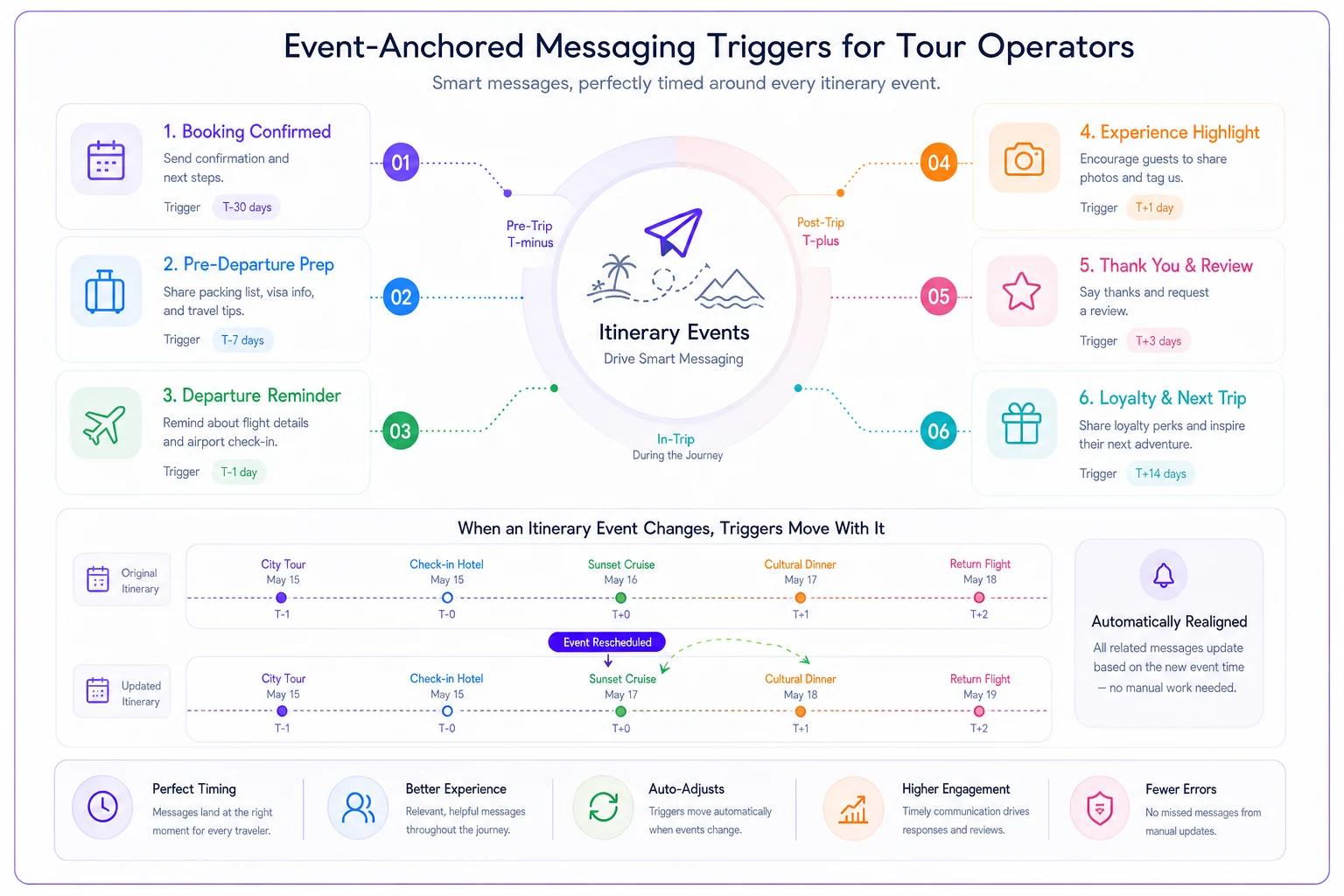
This simple diagram shows how messages shift when itinerary events change, keeping timing aligned with the traveler experience.
Referral mechanics that actually get shared
Referral programs fail for boring reasons. Either the reward is confusing, the timing is wrong, or the sharing takes too much effort. Fix all three.
Timing: fire the referral ask at T-plus 2 days, riding the post-trip high, and again lightly at the reflection window. Don't bury it inside the review request — pick one primary CTA per email.
Effort: give a one-tap personal link, not a code they have to remember and retype. "Send a friend $50 off, get $50 toward your next trip" attached to a link that pre-fills at checkout converts far better than a promo code buried in body text.
Reward structure matters more than reward size. A double-sided reward (both people benefit) outperforms a one-sided one almost every time, because it removes the social awkwardness of "hey, I get paid if you book."
Here's a simple referral flow that works:
-
Traveler returns home; T-plus 2 days the referral email fires
-
One tap generates their personal share link (SMS, WhatsApp, email)
-
Friend clicks, sees the referrer's name and the discount already applied
-
Friend books; both rewards trigger automatically at settlement
-
Referrer gets a "your friend just booked!" notification — which itself nudges more sharing
That last step is the one everyone forgets. Telling a referrer their share worked is what turns a one-time referrer into a repeat one.
A quick pre-trip checklist you can steal
Before you build any of this, make sure your pre-trip sequence covers the operational basics that reduce day-of headaches:
-
Confirmation with a genuinely clear "what happens next" section
-
Balance-due reminder that doesn't feel like a collections notice
-
T-minus 5 prep message
weather, packing, physical expectations
-
T-minus 1 message
guide name + direct phone + exact meeting point + one photo
-
A single reply-to channel a human actually monitors
-
A fallback if they don't open anything (SMS backup for the day-before message)
That last SMS fallback matters more than people expect. Roughly a third of travelers never open the day-before email, and those are exactly the people who show up late or at the wrong location.
What breaks when you scale this manually
At 15–20 departures a year, one organized person can run this off a spreadsheet and reminders. It's painful but survivable. The wheels come off somewhere around 40–60 departures, especially when trips overlap and staff rotate.
The failure modes are predictable:
-
The anniversary trigger never fires because nobody's tracking dates a year out
-
In-trip messages tied to specific days (summit morning) get skipped when the itinerary shifts due to weather
-
Referral rewards get lost because the person who ran the promo left and nobody reconciles them at settlement
-
Duplicate or wrong-name messages go out when two departures overlap and the manual send gets confused
The core issue is that event-anchored timing is genuinely hard to run by hand, because the anchor keeps moving. A weather delay pushes the summit day, which should push the in-trip highlight trigger — a spreadsheet won't recalculate that. This is where a workflow platform that ties messaging triggers to live itinerary events earns its keep: when the itinerary event moves, the dependent messages move with it, and the anniversary and referral-settlement triggers fire without anyone needing to remember.
Tie messaging triggers to live itinerary events so schedule changes automatically shift dependent messages without manual updates.
The goal isn't to automate the warmth out of your communication. It's to make sure the well-timed, human-feeling message actually goes out on the day it should, even when three trips are running at once and someone's on holiday.
A real scenario: mid-size adventure operator
An adventure operator running roughly 50 multi-day trips a year had solid trips but flat repeat business — repeat and referred bookings sat around 18–20% of total volume. Their post-trip effort was a single review email sent whenever ops got to it, usually a week or more after return.
They rebuilt around itinerary-event triggers: a T-minus 5 prep message, a summit-morning in-trip nudge, a T-plus 2 combined thank-you-with-referral-link, a reflection-window rebook seed at about three weeks, and an anniversary message.
Over the following season, referral bookings roughly doubled off a small base, and the repeat-and-referred share of total bookings climbed into the high 20s to low 30s. The single biggest contributor wasn't the fancy referral mechanics — it was moving the post-trip touch from "whenever" to T-plus 2, and adding the anniversary trigger that recovered old guests they'd previously written off.
When this makes sense — and when it doesn't
When it makes sense: you run repeat-friendly trips (adventure, cultural, small-group, anything with a "where to next" logic) and you have enough volume that manual timing is already slipping. If you're missing anniversary rebooks and your reviews come from a delayed generic email, this pays back fast.
When it's a bad idea to over-engineer: if you run a handful of highly custom, one-off luxury itineraries a year, a full triggered system is overkill. Your rebooks come from personal relationships, and a rigid drip can actually feel cold. A couple of well-timed personal messages beat an automation here.
Who should not do this yet: operators whose confirmation and balance-due emails aren't even reliable. Fix the foundational transactional messages first. Layering lifecycle triggers on top of a broken booking sequence just spreads the mess wider.
Where to start this week
You don't need the whole map on day one. Do two things first, because they have the highest return for the least work: move your post-trip review-and-referral message to T-plus 2 days, and set up an anniversary trigger for past guests. Those two touches hit people at their warmest and their most forgotten, respectively.
Then build outward — add the T-minus 5 prep message, the day-before SMS fallback, and the mid-trip check. Anchor every one of them to itinerary events, not booking dates, so the timing stays right no matter when someone books.
Operators who win at rebooks and referrals aren't sending more messages than everyone else. They're sending the right message at the moment the traveler is most ready to hear it. Get the timing tied to the trip, and the lifecycle starts working for you instead of leaking quietly in the background.
Ready to elevate your travel business?
Join 500+ travel operators using Touryly to optimize bookings, improve client satisfaction, and grow revenue.