


Most operators don't have a distribution strategy. They have a pile of channels they signed up for over the years — Viator, GetYourGuide, a couple of DMCs, a few resellers, their own website — and inventory flows into whatever channel happens to fill first. That's not allocation. That's leakage disguised as reach.
The core question in any distribution mix for a tour operator (OTA vs direct) isn't "which channel is best." It's "which seat, on which departure, should go to which channel — and when should I cut a channel off?" Those are completely different questions, and answering the second one is where the money actually is.
This piece lays out a channel-allocation matrix built around three axes that matter operationally: volume, margin, and control. Then it covers the throttle and blackout rules that stop a high-volume OTA from eating your best departures, the contract levers that give you room to maneuver, and two worked examples — one seasonal product, one evergreen — because they genuinely need opposite treatment.
Why "reach everywhere" quietly destroys your margin
The instinct makes sense. More channels, more visibility, more bookings. But channels aren't neutral pipes. Each one carries a cost profile and a control profile, and when you treat them as interchangeable, three things tend to happen at scale.
Your highest-demand departures get sold through your lowest-margin channels. OTAs are fast and frictionless, so they fill first. That means your 9am Saturday summer slot — the one you could sell direct at full price with zero commission — gets grabbed by an OTA at a 20–30% take. You've handed your scarcest, most valuable inventory to your most expensive channel.
You also lose the customer relationship exactly where it matters most. OTA customers are the OTA's customers. No email, no remarketing, no upsell on the next trip. For a one-off tourist, that's manageable. For a product where repeat and referral drive real revenue, you've paid a premium to rent a customer you'll never see again.
Third, coordination breaks. When five channels can all sell the same seat with no priority logic, you're one sync delay away from an overbooking. If you haven't already built priority rules around availability, the channel-priority matrix and recovery SOP for overbookings is the foundation this whole allocation model sits on.
The pattern that comes up repeatedly: an operator doing solid volume, technically profitable, but bleeding 6–10 margin points because their allocation is accidental. Nobody decided to sell peak inventory cheap. It just happened, one booking at a time.
The three axes: volume, margin, control
Before you allocate anything, score each channel on three axes. Not gut feeling — actual numbers you can defend.
Never miss a booking or update.
Touryly streamlines your travel bookings, confirmations, and itinerary updates—all in one place.
- Unified booking management
- Automated customer notifications
- Itinerary & staff coordination
No credit card required
-
Volume
How much throughput does this channel realistically drive? Bookings per month, and how reliably.
-
Margin
Net margin after commission, payment fees, FX, and the admin cost of servicing that channel. Gross booking value is a trap here.
-
Control
Do you own the customer data? Can you set pricing freely? Can you throttle or blackout dates without penalty? Can you enforce your own cancellation terms?
Here's roughly how common channels stack up for a mid-sized operator. Treat these as starting points — your actual numbers will shift things.
| Channel | Volume | Net margin | Control | Best used for |
|---|---|---|---|---|
| Large OTA (Viator/GYG) | High | Low (commission 20–30%) | Low | Filling shoulder/off-peak, new product discovery |
| Niche/vertical OTA | Medium | Medium | Low–Medium | Targeted audiences, specific activity types |
| DMC / B2B wholesale | Medium–High | Low–Medium | Low | Predictable bulk, contracted rates |
| Reseller / affiliate | Low–Medium | Medium | Medium | Incremental reach, low fixed cost |
| Direct (website) | Variable | High (no commission) | High | Peak inventory, repeat customers, upsell |
| Direct (repeat/referral) | Low | Highest | Highest | Your best margin — protect this |
The thing most operators miss: volume and control are usually inversely correlated. The channels that fill fastest are the ones where you have the least say over price, data, and dates. So an allocation strategy is really a negotiation between "I need bookings" and "I need to protect my best inventory." You don't resolve that once. You resolve it per departure, per season.
Throttle and blackout rules: the actual control mechanism
This is the part almost nobody sets up properly, and it's where allocation goes from theory to something operational.
A throttle limits how much inventory a channel can access. A blackout cuts a channel off from specific dates or departures entirely. Together they're how you stop OTAs from consuming your best inventory while still using them for what they're actually good at — filling seats you'd otherwise run empty.
The logic works in layers:
-
Reserve a direct-only allocation on high-demand departures. For a peak Saturday morning tour with 24 seats, hold back 8–10 seats that only your website can sell. OTAs never see them. If direct doesn't move them by a set trigger point, they release into the OTA pool.
-
Set a release schedule. Direct-held seats aren't held forever. A common rule: hold direct-only until T-14 on peak departures, then release unsold inventory to OTAs. You capture high-intent early bookers direct, then use OTAs to clean up the tail.
-
Throttle OTAs on constrained inventory. When a departure hits 70%+ full, pull OTA access back or cut it. The last seats on a nearly-full tour are your most valuable — no reason to pay 25% commission on inventory that's selling itself.
-
Blackout premium dates from low-margin channels from the start. New Year's Eve, a festival weekend, the one date everyone wants — if you know it'll sell direct, blackout OTAs on day one, not as an afterthought.
Tie throttle triggers to pace (fill rate vs prior cycles) rather than fixed percentages so you can open or close channels quickly when demand shifts.
The mistake is treating throttle rules as static. Demand shifts. A rule that worked in a strong booking year will strangle you in a soft one. Throttle rules should be tied to pace — how fast a departure is filling relative to the same point last cycle — not fixed percentages. Behind pace? Open the throttle and let volume in. Ahead of pace? Tighten it and protect margin.
Contract levers that make throttling possible
None of this works if your OTA contracts don't allow it. Operators get trapped here constantly: they sign standard terms, then find out they can't blackout dates, can't hold direct inventory, or are locked into rate parity that kills any direct pricing advantage.
-
Rate parity carve-outs. Standard OTA contracts usually demand parity — you can't undercut the OTA on your own site. Push for exceptions: closed-user-group pricing, member rates, or "package" exemptions so your direct channel can actually be competitive.
-
Allocation control clauses. Explicit language that you control inventory volumes per channel and can adjust them. Without this, some connectivity setups default to full availability sync regardless.
-
Blackout rights. The contractual right to close specific dates without penalty.
-
Commission tiers by season. Negotiate lower commissions on off-peak inventory in exchange for volume — you don't need to give away peak margin to get shoulder-season fills.
-
Data access. Even limited customer data (an email for trip logistics) changes what a channel is worth to you long-term.
A practical note: OTAs will concede more than operators expect, if you bring volume and ask specifically. "Can we get better terms" gets a no. "We'll commit our full off-peak shoulder inventory in exchange for blackout rights on 12 peak dates and a 3-point commission reduction" starts a conversation.
Worked example: a seasonal product
Take a whale-watching operator. Season runs roughly May through September. Two boats, around 40 seats each, up to three departures a day at peak. The rest of the year, effectively nothing.
Seasonal products have a brutal constraint: you can't build volume slowly. You have a narrow window to fill everything, and empty seats are gone forever. So the temptation is to throw everything at OTAs early to guarantee load.
-
Early season (May, shoulder) Open wide to OTAs. You want volume here, margin is secondary. Empty boats are the enemy. Throttle fully open.
-
Peak (July–August, weekends) Aggressive direct holds. Reserve 40–50% of weekend departures direct-only until T-10. Blackout OTAs from the top handful of peak Saturdays entirely. These sell direct regardless.
-
Late shoulder (September) Reopen OTAs, pace-based throttle. Better to fill at 25% commission than sail empty.
A rough before/after: one operator in this category was running nearly everything through OTAs at around 26% blended commission on roughly 11,000 seats a season — about £480k gross. After building peak direct-holds and blackouts, direct climbed from around 15% to close to 35% of bookings on peak weekends. Blended commission dropped to roughly 19%. On the same total volume, that's somewhere in the £30k–£35k range that stayed in the business — with no extra marketing spend, just reallocated inventory.
The seasonal-specific lesson: throttle rules have to move fast because the window is short. A soft July means opening OTAs back up within days, not weeks. Pace monitoring isn't optional. Pricing discipline matters just as much — the pricing rules for seasonal peaks pair directly with allocation, because a direct-held peak seat is only worth protecting if it's priced to reflect the scarcity.
Worked example: an evergreen product
Now flip it. A city walking-tour operator, daily, year-round. Demand is steadier, less spiky, and the product is discoverable — tourists searching "things to do in [city]" find it on OTAs constantly.
Evergreen products have different economics. OTA discovery is genuinely valuable here because a real chunk of customers don't know you exist until they see you in a marketplace. Cutting OTAs hard would cost volume you can't easily replace from somewhere else.
-
Keep OTAs open broadly — they're doing discovery work.
-
Treat every OTA booking as a lead. Where contracts allow, capture what data you can and build a direct rebooking path for the next tour.
-
Reserve modest direct holds only on genuinely constrained slots — the popular sunset tour, weekend mornings.
-
Compete on direct with things OTAs can't offer
bundles, private options, small-group upgrades that only live on your site.
For evergreen, the win isn't dropping OTA share dramatically. It's slowly shifting repeat business direct while letting OTAs keep handling discovery. An operator here might move from 70% OTA to 55% over a year or two — not by blocking OTAs, but by converting first-time OTA customers into direct repeat bookers. On margin, that shift is quiet but it compounds.
Seasonal products fight over inventory allocation. Evergreen products fight over customer ownership. Same matrix, completely different pressure point.
When aggressive channel control is a bad idea
This whole approach assumes you have leverage. You often don't, and forcing it backfires.
-
New product, no brand. If nobody's searching for you, OTAs are your marketing. Blacking them out to "protect margin" protects margin on seats that stay empty. Take the volume first.
-
Thin direct capability. If your website can't take a booking cleanly, or you have no email flow, direct holds just create empty seats and last-minute scrambling. Fix the direct funnel before you starve OTAs.
-
No way to monitor pace. Throttle rules that nobody adjusts are worse than no rules at all. If you can't watch fill rates and react, static holds will strangle you in a soft season.
There's a real risk of getting too clever with this. Operators who over-optimize allocation before they have the demand or the direct infrastructure to back it up end up with lower total revenue and a spreadsheet full of rules that hurt them. Volume first, control second — in that order, until you've earned the right to flip them.
Making the allocation actually run
The reason most operators don't do this isn't that they don't understand it. It's that manually managing throttles, direct-holds, release triggers, and blackouts across five channels is genuinely hard. Availability drifts out of sync. Someone forgets to release a direct hold and the departure sails half-empty. A blackout date gets missed and an OTA sells your NYE slot at 25% commission.
A simplified operational workflow looks like this.
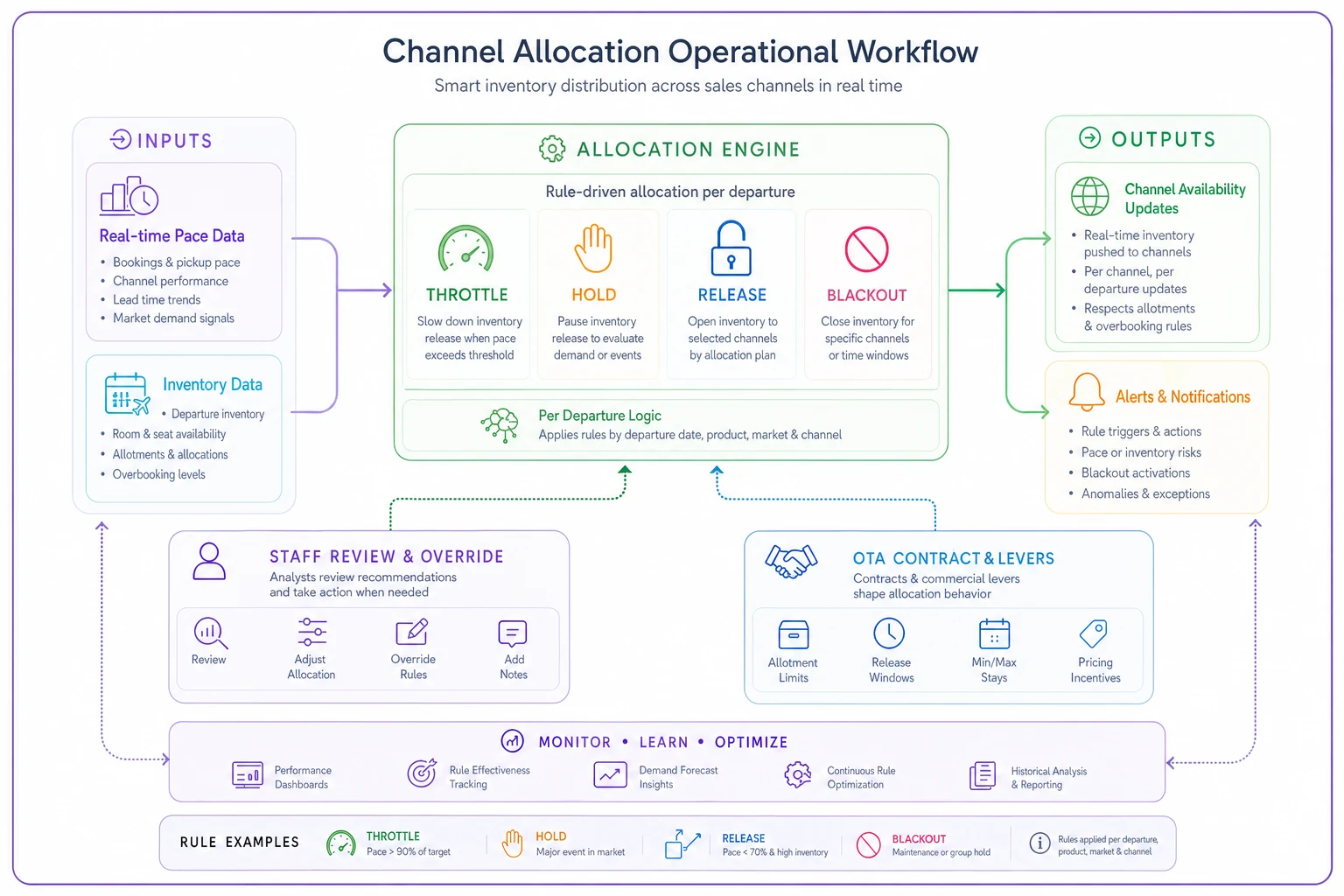
This is where centralizing inventory and pace data in one operational platform earns its keep. When your channel rules — release triggers, pace-based throttles, blackout dates — live in one place and update against live fill data instead of someone's memory, allocation stops being a quarterly spreadsheet exercise. AI-assisted pace monitoring can flag when a departure is behind and needs OTAs reopened, or ahead and ready to throttle, before anyone would've caught it manually.
The point isn't automation for its own sake — it's that allocation logic only creates value if it executes every day, on every departure, without depending on someone remembering to do it.
Pulling it together
A distribution mix isn't a fixed ratio you set once. It's a live decision — per departure, per season — about trading volume for margin and control. OTAs are good at what they do: discovery and filling seats you can't fill yourself.
The failure isn't using them. It's letting them take your best inventory by default because you never built the throttle, blackout, and hold rules to say otherwise. Score your channels honestly on volume, margin, and control. Negotiate the contract levers that give you room to move. Then set allocation rules that fit your product type — protect scarce peak inventory if you're seasonal, migrate customer ownership if you're evergreen. Do that, and the same booking volume quietly starts leaving more money in the business, which is the whole point.
A distribution mix isn't a fixed ratio you set once. It's a live decision — per departure, per season — about trading volume for margin and control. OTAs are good at what they do: discovery and filling seats you can't fill yourself.
The failure isn't using them. It's letting them take your best inventory by default because you never built the throttle, blackout, and hold rules to say otherwise. Score your channels honestly on volume, margin, and control. Negotiate the contract levers that give you room to move. Then set allocation rules that fit your product type — protect scarce peak inventory if you're seasonal, migrate customer ownership if you're evergreen. Do that, and the same booking volume quietly starts leaving more money in the business, which is the whole point.
Ready to elevate your travel business?
Join 500+ travel operators using Touryly to optimize bookings, improve client satisfaction, and grow revenue.