

Most tour operators lose chargebacks they should have won. Not because the booking was fraudulent, not because the customer had a point — but because nobody acted in the first 48 hours, the evidence lived in four different inboxes, and by the time the response went out it was a jumbled PDF with a confirmation screenshot and a prayer.
Card networks give you a window. It's short, it's rigid, and the representment either lands clean inside that window or it doesn't land at all. For travel, the problem is worse than retail because your "proof of delivery" isn't a tracking number — it's a guide's attendance log, a supplier voucher scan, a check-in timestamp, and sometimes a WhatsApp thread with the lead traveler. That evidence is scattered across people who don't even know a dispute is happening.
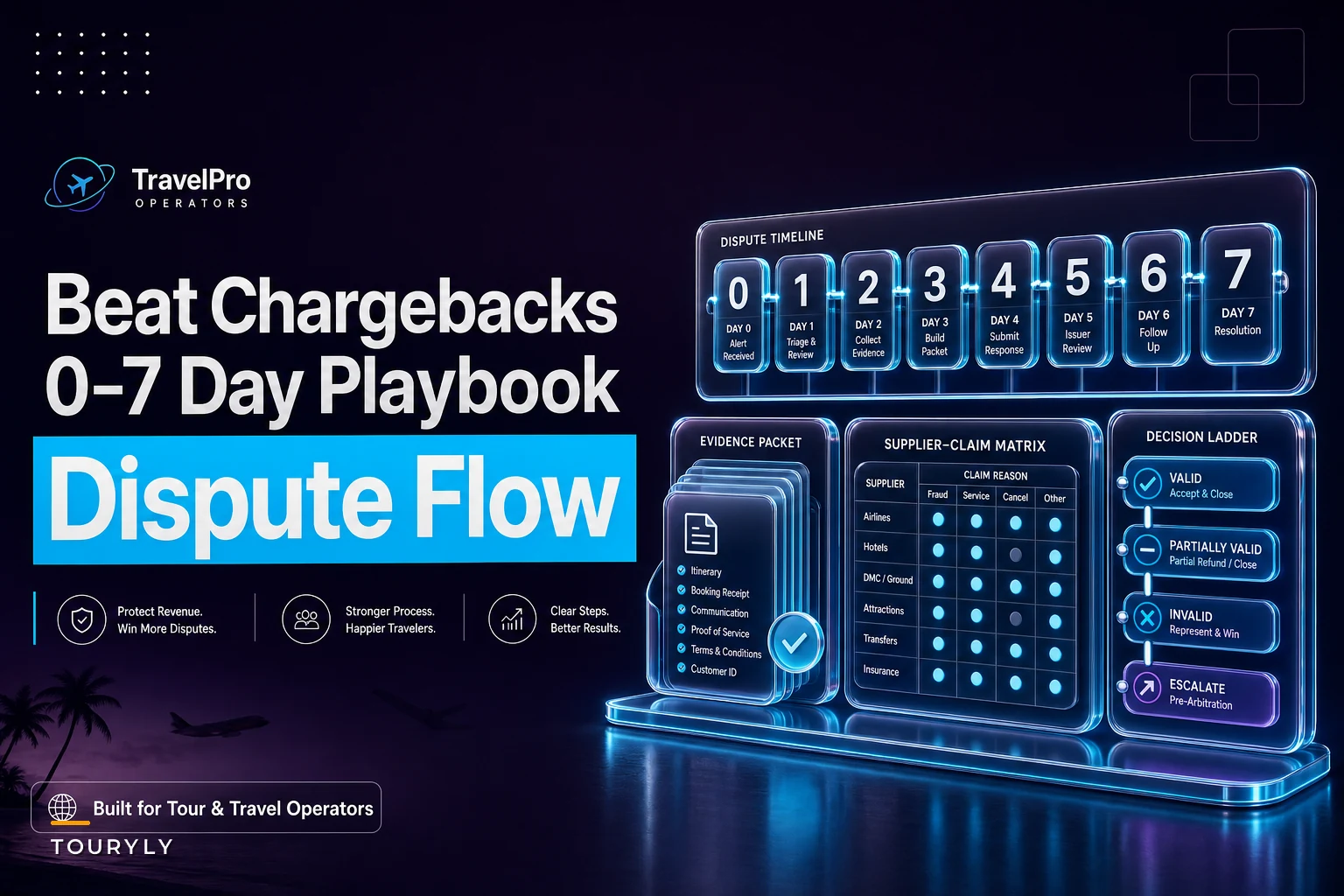
This is a timeline. Day 0 to Day 7. What happens each day, who owns it, what goes in the packet, and how you chase the supplier for recovery at the same time — because the money you refund or lose to a chargeback is often recoverable from the supplier who actually failed to deliver.
Why travel operators lose winnable disputes
The first is latency. The chargeback notification comes through the processor dashboard or a forwarded email, and it sits. Finance assumes ops saw it. Ops assumes finance is handling it. Three days evaporate. By the time anyone assembles evidence, you've burned half your window and you're rushing.
The second is fragmented evidence. In a tour business, the booking confirmation is in one system, the supplier booking is in another, the guide's day-of notes are on their phone, and the customer comms are split between email and a chat widget. Nobody has a single view. Pulling a clean packet becomes an archaeology project.
The third — and this is the expensive one — is treating the chargeback and the supplier failure as two separate events. Say a customer disputes because the boat tour was cancelled. You refund or lose the chargeback. Fine. But the operator who cancelled that boat tour owes you money, and if you don't file a recovery claim inside their SLA window, you eat the full loss. The chargeback timeline and the supplier recovery timeline run in parallel, and most operators only run one.
The fourth is sloppy categorization. Not every dispute is the same animal. A "services not rendered" dispute needs different evidence than a "fraudulent transaction" dispute, which needs different evidence than a "not as described" dispute. Operators send the same generic packet to all three and wonder why their win rate sits around 25%.
If you've already built out your red-flag rules and dispute-evidence templates for risky bookings, you're ahead of most — this playbook is the operational layer that sits on top of that, turning templates into a timed, coordinated response.
The 0–7 day timeline
Day 0 — Intake and triage (same day, non-negotiable)
Never miss a booking or update.
Touryly streamlines your travel bookings, confirmations, and itinerary updates—all in one place.
- Unified booking management
- Automated customer notifications
- Itinerary & staff coordination
No credit card required
The notification arrives. Within the first few hours, someone has to do three things: log it, classify it, and freeze the clock.
Log it. Record the dispute with the transaction ID, booking reference, amount, card network, reason code, and the actual deadline the processor gave you. Not the network's generic window — the specific date on this dispute.
Classify it. Assign one of four buckets. This drives everything downstream:
-
Fraudulent / unauthorized — "I didn't make this charge"
-
Services not rendered — tour cancelled, supplier no-show, trip didn't happen
-
Not as described — trip happened but materially different from what was sold
-
Credit not processed — customer was promised a refund they never got
Freeze the clock. Set a hard internal deadline at Day 5, giving you two days of buffer before the real one. This single habit — internal deadline two days early — wins more disputes than any evidence template.
Set your internal deadline two days earlier than the processor deadline to give a reliable buffer for missing evidence or supplier delays.
One note on the credit-not-processed bucket: these are almost always self-inflicted. The customer was told a refund was coming, your accounting didn't process it in time, and they went to their bank. If your refund accounting workflow has a clean decision matrix and journal entries, you'll catch most of these before they ever become disputes.
Day 1 — Evidence summons
Now you pull the packet. The mistake here is trying to gather everything yourself from systems. Half the strongest evidence lives with people — the guide, the supplier, the agent who took the booking.
Send the evidence request to everyone who touched the booking the same day. Give them a 24-hour turnaround and tell them exactly what you need. Not "send me anything you have" — specific items:
-
Guide
attendance record, day-of photos with timestamps, any traveler communication
-
Supplier
the booking voucher, confirmation, and (if it was cancelled) their cancellation notice and reason
-
Sales/agent
the original quote, T&Cs the customer accepted, any special requests confirmed
Day 2–3 — Packet assembly
By now evidence is flowing in. Assemble it into a structured packet matched to the dispute category. A packet with ten irrelevant documents loses to a packet with four relevant ones. Issuers' analysts spend a couple of minutes per case — make those minutes count.
Day 4 — Parallel track: file the supplier recovery claim
This is where most operators leave money on the table. If the root cause was a supplier failure, file the recovery claim now — not after the chargeback resolves weeks later. Supplier SLA windows are often tighter than card windows, and they start from the date of failure, not the date of dispute.
Day 5 — Internal deadline: review and submit
Your self-imposed deadline. Review the packet, confirm it's complete, submit the representment. Two days of buffer remaining.
Day 6–7 — Customer remediation decision and accounting entry
Even after you submit, decide how to treat the customer and how to book the accounting. More on both below.
A simple visual of this flow helps teams understand ownership and timing.
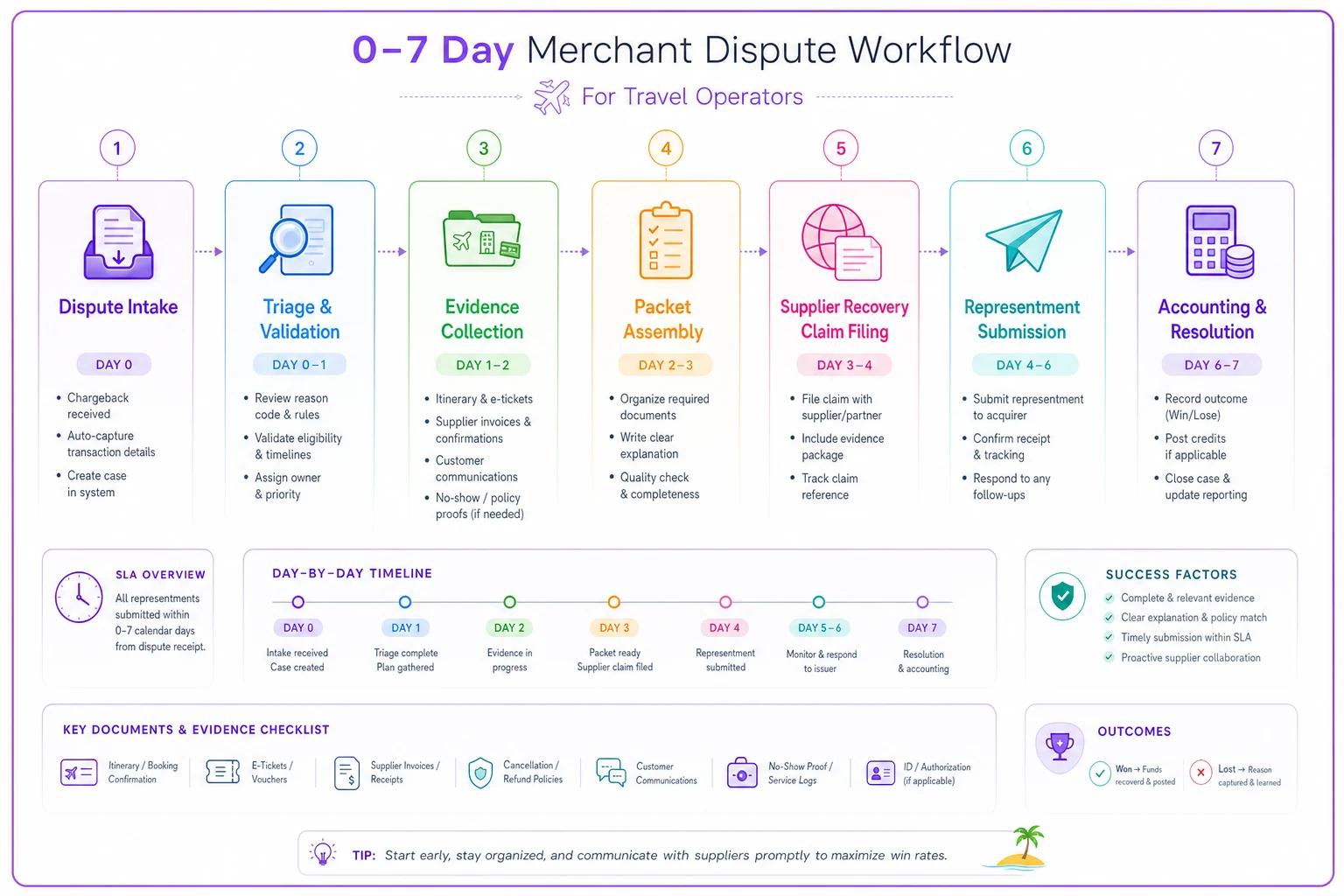
Keep the diagram focused on handoffs: who emails the supplier, who assembles the packet, who approves representment, and who files the supplier claim.
Merchant evidence packet templates
Here's what actually goes into each packet, by category. Keep these as literal templates your team fills in — don't rebuild them per dispute.
Fraudulent / unauthorized
The goal is proving the real cardholder made and benefited from the booking.
-
AVS and CVV match results from the original authorization
-
IP address and device data at time of booking (geolocation vs. billing address)
-
Email and phone confirmation trail
-
Evidence the service was consumed by someone who could only be the cardholder (check-in ID, boarding scan)
-
Any prior bookings on the same card
Services not rendered
This is the hardest category for travel because you have to prove the trip happened.
-
Signed booking confirmation with T&Cs
-
Guide attendance log / check-in timestamp
-
Supplier voucher showing the service was fulfilled
-
Dated, geotagged photos from the tour
-
Communication showing the customer participated (post-trip thank-you, mid-trip messages)
Not as described
You're proving the delivered experience matched what was sold.
-
The exact itinerary and inclusions from the sales page or quote
-
Supplier confirmation of what was delivered
-
Any pre-trip communication where the customer confirmed understanding
-
Photos / records showing delivery matched the description
-
The cancellation and change policy the customer accepted
Credit not processed
Usually a losing fight if the credit genuinely wasn't processed — so the real play is proof you did process it.
-
Refund transaction ID and date
-
Processor confirmation of the credit
-
Communication to the customer notifying them of the refund and expected timeline
Keep these templates literal and pre-formatted so the first responder can drop evidence into the right slots without debate.
The supplier recovery claims matrix
Running the recovery claim in parallel is the difference between absorbing a loss and recovering it. Use a matrix so staff know, at a glance, whether a claim is worth filing and what it needs.
The claims matrix:
| Failure type | Recoverable from supplier? | Evidence needed for claim | Typical SLA window | Priority |
|---|---|---|---|---|
| Supplier cancelled (no fault of operator) | Yes — full | Cancellation notice, booking voucher, customer refund proof | Often 7–14 days from cancellation | High |
| Supplier no-show / didn't deliver | Yes — full | Guide report, timestamped evidence of non-delivery, voucher | Often 14–30 days | High |
| Supplier delivered reduced/wrong service | Partial | Itinerary vs. delivered, guide notes, customer complaint | Varies by contract | Medium |
| Weather / force majeure cancellation | Depends on contract | Contract clause, weather record, cancellation notice | Per contract | Medium |
| Customer no-show (not supplier fault) | No | N/A — pursue customer, not supplier | N/A | Low |
| Operator booking error | No | N/A — internal loss | N/A | Low |
The pattern worth internalizing: the recovery claim and the chargeback defense draw on overlapping evidence, but they go to different parties on different clocks. A supplier cancellation notice is both your proof against the customer dispute and the anchor document for your supplier claim. Capture it once, use it twice.
The claims that get missed most often are the "partial" ones — supplier delivered something but not what was sold. Staff see that the trip "happened" and assume there's no claim. There is. The reduced-service claim is small per incident but adds up fast across a season.
The operational decision ladder
Two decisions sit at the end of every dispute: what you do for the customer, and how you book it. Make these deliberately, with a ladder — not case by case on gut feel.
Customer remediation ladder
-
Dispute is clearly fraudulent and you'll win → defend fully, no customer outreach needed
-
Dispute is a misunderstanding, trip was delivered → reach out, explain, offer to resolve the dispute directly (customers often withdraw)
-
Legitimate grievance, partial fault → offer partial credit or future-trip voucher; defend the remainder
-
Clear operator or supplier failure → accept the chargeback or refund proactively, file supplier recovery, log for remediation
-
Repeat disputer / abuse pattern → defend, flag the customer, review booking history for a pattern
Fighting a dispute you'll lose costs you the representment fee, goodwill, and staff time. Rung 4 — accepting cleanly and recovering from the supplier — is often the cheaper, smarter outcome even though it feels like losing.
Accounting treatment ladder
-
Dispute received, outcome uncertain → move the amount to a disputed-funds holding account; don't recognize the loss yet
-
Representment submitted, win likely → keep in holding, note contingent recovery
-
Lost the dispute → write off to chargeback expense; if supplier claim is filed, book a receivable for the expected recovery
-
Supplier recovery received → clear the receivable against cash
-
Won the representment → release holding back to revenue
This mirrors the discipline in any solid refund-accounting process. The mistake operators make is recognizing the loss immediately and then forgetting to book the supplier receivable — which means the recovery, when it arrives, looks like mystery income nobody can reconcile at month-end.
A real scenario
A small inbound operator running day tours and multi-day packages — roughly 300–350 bookings a month — was sitting at a chargeback win rate around 22%. Most losses weren't fraud. They were "services not rendered" disputes where a supplier had cancelled and the operator either refunded late or defended with a thin packet.
The bigger leak was invisible: they almost never filed supplier recovery claims. When a boat operator or transfer company cancelled, they ate the refund and moved on. Across a season, that was somewhere in the range of $8k–$12k in recoverable money just sitting with suppliers.
They changed three things. Day-0 triage with mandatory same-day classification. Category-matched evidence packets instead of one generic PDF. And a parallel supplier-claim step at Day 4, using the same cancellation notices they were already collecting.
Over the next couple of quarters, the representment win rate climbed to somewhere north of 45% — not dramatic, but it roughly doubled. The supplier recovery alone brought back a few thousand dollars that had simply been slipping away each season. The win rate gain was nice. The recovery discipline was the real money.
When this tight a timeline makes sense — and when it doesn't
When it makes sense: You're processing enough volume that disputes are a recurring line item, not a once-a-quarter surprise. You work with suppliers whose cancellations and failures drive a meaningful share of your disputes. You have staff who can own Day 0 triage reliably.
When it's overkill: You're tiny, disputes are genuinely rare, and your supplier relationships settle informally. A full parallel-track system with holding accounts is more process than you need — a simple log and a 48-hour response habit covers you.
Who should not run this as-is: Operators with no clean supplier evidence trail. If you can't produce a cancellation notice or a voucher scan on demand, fix your supplier documentation first — the recovery matrix is useless without the evidence that feeds it. Build the capture habit, then layer the timeline on top.
Pulling it together
Chargebacks in travel aren't really a payments problem — they're a coordination problem with a deadline attached. The money gets lost in the gap between the notification and the response, in evidence scattered across people, and in supplier claims nobody files because the trip "already happened."
The timeline fixes the coordination. The evidence templates fix the fragmentation. The claims matrix recovers money that was quietly being written off. And the decision ladders stop your team from defending unwinnable disputes while letting winnable ones expire.
Start with the one change that costs nothing: same-day triage and an internal deadline set two days early. Then add the parallel supplier claim. Those two moves alone will shift your numbers before you touch anything else.
Ready to elevate your travel business?
Join 500+ travel operators using Touryly to optimize bookings, improve client satisfaction, and grow revenue.