

Running an inbound tour operation means juggling suppliers across multiple jurisdictions, each with different VAT tour operator rules that shift based on where services get delivered, who's buying, and whether you're acting as principal or agent. Get the VAT treatment wrong on a €50,000 hotel block booking and you've just created a €10,000 hole in your quarterly tax filing.
The complexity hits hardest when you're processing hundreds of supplier invoices monthly. A UK operator booking Italian hotels for German corporate groups needs to determine whether to apply reverse charge, pass through local VAT, or treat it as zero-rated. Meanwhile, that same operator buying transport from a French coach company for leisure travelers faces completely different rules.
Most operators discover their VAT mistakes during quarterly filing when their accountant flags discrepancies. By then you're looking at penalties, interest charges, and the nightmare of correcting months of transactions. The real damage comes from embedded VAT you can't reclaim because you treated pass-through services as margin scheme bookings.
Why standard accounting software creates VAT blind spots
Tour operators face a VAT challenge that standard bookkeeping platforms simply weren't designed to handle. When processing supplier invoices, the system needs to understand not just the supplier's location and VAT status, but also your customer type, the place of supply rules, and whether you're operating under TOMS margin scheme or standard VAT accounting.
Take a typical scenario: booking ground transport in Spain for a B2B client from Belgium. Your accounting software sees a Spanish supplier invoice with 21% IVA. But correct treatment depends on factors the software can't determine automatically. Are you the principal or intermediary? Is this part of a package or standalone? Where does transport actually occur? Is your Belgian client VAT registered?
Complexity multiplies with mixed supply situations. A single booking might include accommodation (place of supply where property is located), transport (where performed), and guide services (where physically carried out). Each component follows different rules, yet they arrive on a single supplier invoice your team needs to split correctly.
Manual workarounds using spreadsheet mapping tables break down at scale. Operators typically maintain separate trackers for VAT treatment by supplier type, customer location matrices, and TOMS calculation sheets. These disconnected systems create reconciliation nightmares when invoice coding doesn't match VAT return calculations.
The decision tree that determines VAT treatment
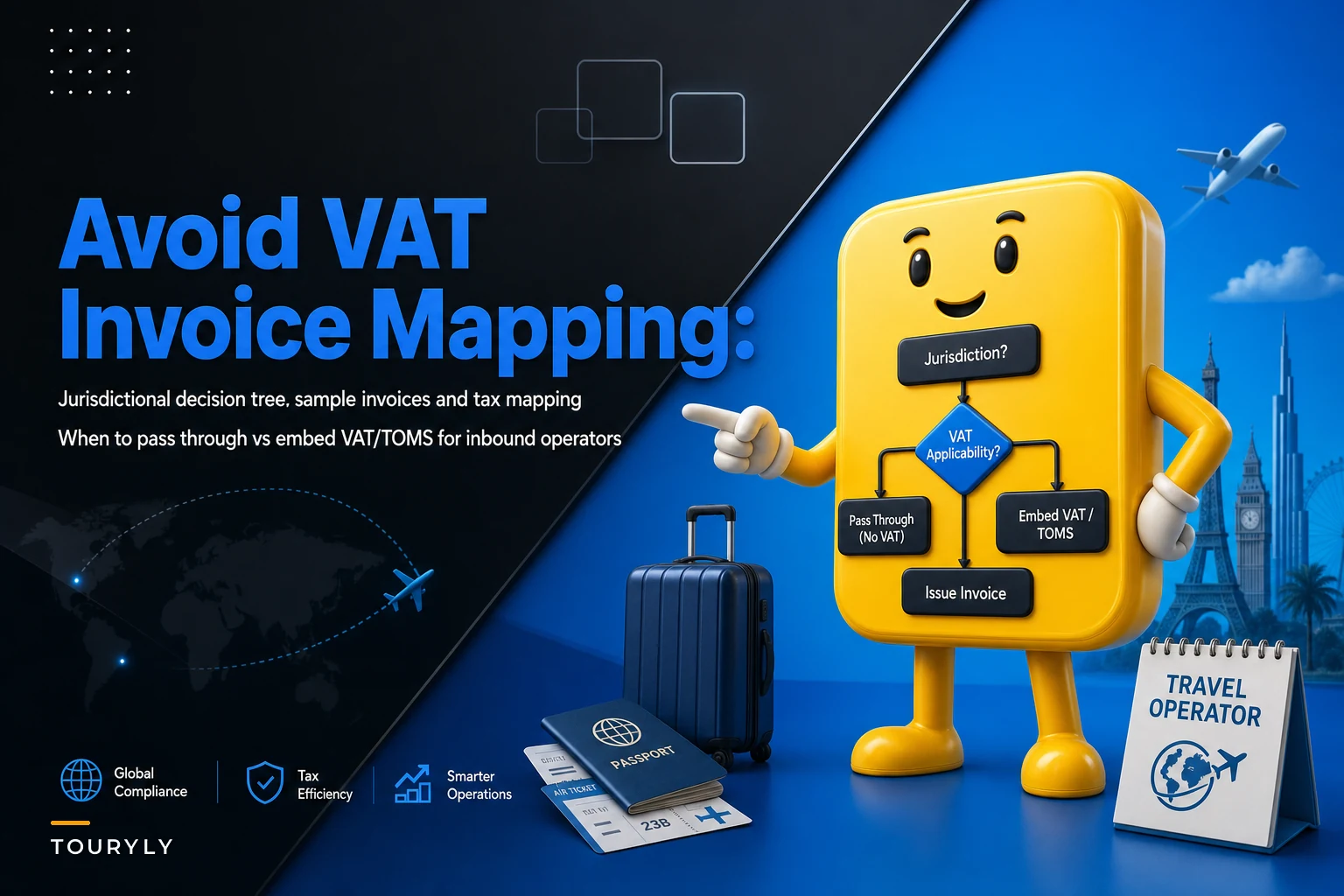
Building a reliable VAT decision process starts with understanding the hierarchy of rules that apply to each transaction. The first branch determines whether you're operating as principal (buying and reselling in your own name) or as an agent (transparent intermediary). This fundamental distinction drives all subsequent VAT treatment.
Never miss a booking or update.
Touryly streamlines your travel bookings, confirmations, and itinerary updates—all in one place.
- Unified booking management
- Automated customer notifications
- Itinerary & staff coordination
No credit card required
For principal transactions, the next decision point is whether services fall under Tour Operators Margin Scheme (TOMS). If you're selling travel services to non-business customers where services are enjoyed outside your country of establishment, TOMS typically applies — meaning you account for VAT only on your margin, not the full selling price.
Here's the practical decision flow for a UK operator:
Step 1: Determine your role
-
Principal
You contract with suppliers in your own name, customer has no direct relationship with supplier
-
Agent
You facilitate the booking, customer knows the actual supplier, commission-based model
Step 2: If principal, check TOMS applicability
-
B2C sale of travel services enjoyed outside UK → TOMS applies
-
B2B sale to VAT registered business → Usually outside TOMS
-
Domestic services only → Standard VAT rules
Step 3: For non-TOMS principal supplies
-
Accommodation
VAT at place where property is located
-
Transport
VAT where transport is performed
-
Services
VAT where physically carried out
Step 4: For agent supplies
-
Your commission
UK VAT applies
-
Pass-through amounts
Not your supply, no VAT accounting
The decision tree gets more complex with mixed supplies. A seven-day Italy tour package sold B2C triggers TOMS for the margin. But add a UK airport transfer and that domestic element sits outside TOMS and needs standard UK VAT treatment.
Supplier invoice examples that trip up operators
Real supplier invoices rarely arrive in clean, easy-to-process formats. Understanding how to read and code them prevents expensive errors that compound over months of bookings.
Example 1: Italian hotel invoice for UK operator FATTURA N. 2024/0847 Hotel Bella Vista SpA Via Roma 45, Florence P.IVA: IT98765432100 Destinatario: TourCo UK Ltd 10 rooms x 3 nights @ €120 Totale Imponibile: €3,600 IVA 10%: €360 Totale Fattura: €3,960
For a B2C package under TOMS: You cannot reclaim the €360 Italian VAT. This becomes part of your cost base for margin calculation. The invoice gets coded as a TOMS purchase with embedded VAT.
For a B2B booking outside TOMS where your client handles their own VAT: You still can't reclaim the Italian VAT (place of supply is Italy), but you charge your client the full €3,960 as a disbursement with no UK VAT added.
Example 2: French coach operator invoice with reverse charge FACTURE 2024-1823 Transport Mercier SARL N° TVA: FR12345678900 Client: TourCo UK Ltd (GB123456789) Service: Transport 45 pax Paris-Loire Valley Montant HT: €2,800 TVA: Article 44 - Autoliquidation Total: €2,800
The "autoliquidation" notation means reverse charge applies. You self-account for UK VAT on this B2B service. For B2C TOMS bookings, no UK VAT to reverse charge — the margin scheme applies. For B2B non-TOMS, you must add this €2,800 to Box 6 and Box 4 of your VAT return at 20% UK rate.
Example 3: Spanish DMC bundled services invoice
FACTURA ES-2024-445 Destination Management SL CIF: B87654321 Ground services package:
-
Airport transfers
€400
-
Walking tour guide
€300
-
Monument entries
€250
Base: €950 IVA 21%: €199.50 TOTAL: €1,149.50
This bundled invoice needs careful analysis. Under TOMS for B2C, the entire amount including Spanish IVA becomes your cost base. But for a B2B supply to a German company, you might need to split the components — transport and guide services could be reverse charge (no Spanish IVA), while monument entries remain standard rated in Spain.
Mapping VAT treatment by supplier type and customer location
A comprehensive VAT mapping matrix prevents costly coding errors when processing high volumes of bookings. The matrix needs three dimensions: supplier type, customer type, and place of supply.
Accommodation suppliers follow the simplest rules — VAT applies where the property sits. But the reclaim position changes based on your role:
| Customer Type | Your Role | Supplier VAT Treatment | Your VAT Position |
|---|---|---|---|
| B2C Individual | Principal under TOMS | Pay local VAT | Cannot reclaim, forms cost base |
| B2C Individual | Agent | Not your supply | No VAT accounting needed |
| B2B Company | Principal outside TOMS | Pay local VAT | Cannot reclaim, recharge as disbursement |
| B2B VAT registered | Principal with reverse charge | No local VAT | Self-account in customer country |
Transport suppliers create more complexity because place of supply depends on journey type:
| Service Type | Route | B2C TOMS Treatment | B2B Treatment |
|---|---|---|---|
| Coach hire | Single country | Local VAT embedded in margin | Reverse charge if B2B supplier |
| Coach hire | Cross-border | Proportional by distance | Complex apportionment |
| Rail tickets | Domestic | Standard VAT rules | Standard VAT rules |
| Rail tickets | International | Proportional by distance | Often zero-rated |
Activity and guide services typically follow place of performance:
-
Museum entries
Always local VAT where venue is located
-
Walking tours
VAT where the tour occurs
-
Virtual experiences
VAT at customer location (B2B) or supplier location (B2C)
The mapping gets genuinely difficult with multi-component packages. A Rhine cruise starting in Switzerland, crossing through France and Germany, and ending in the Netherlands requires distance-based apportionment of VAT across four jurisdictions. Without automated rules handling this, you're looking at hours of manual calculation per booking.
Common scenarios where operators lose thousands
Scenario 1: Treating agent bookings as principal supply
A UK operator regularly books Italian villas for clients, earning 15% commission from the property owner. They've been treating these as TOMS sales, charging UK VAT on the total rental value. Problem: they're acting as disclosed agent. The rental isn't their supply to VAT account for. They should only be charging UK VAT on their commission.
Impact: Over-collected VAT on €400,000 of villa bookings means roughly €80,000 of VAT that was never due. Plus they've been calculating TOMS margin on transactions that weren't even their supply.
Scenario 2: Missing reverse charge on B2B transport
An operator books coach services from EU suppliers for corporate groups, accepting invoices with local VAT and treating it as an embedded cost. Correct treatment: B2B transport services to a UK business require reverse charge. The operator should receive invoices without EU VAT, then self-account for UK VAT (which they can reclaim if VAT registered).
Monthly impact: around €8,000 of unnecessary EU VAT paid that can't be reclaimed. Over a year, that's close to €100,000 of margin quietly disappearing.
Scenario 3: Mixing TOMS and non-TOMS in packages
A UK operator sells packages to German businesses including Italian hotels and UK airport transfers. They apply TOMS to everything since most services are abroad. But TOMS shouldn't apply to B2B sales, and even if it did, UK domestic services sit outside the margin scheme.
The outcome: VAT inspectors discover three years of incorrectly applied TOMS to B2B sales. Assessment comes in at £47,000 plus penalties. The German businesses can't reclaim VAT that shouldn't have been charged in the first place, and some request credit notes going back two years — creating a reconciliation disaster.
Building invoice validation gates that catch errors
Effective operators implement validation checkpoints before invoices enter their accounting system. This stops VAT errors from embedding themselves in financial records where they're harder and more expensive to fix.
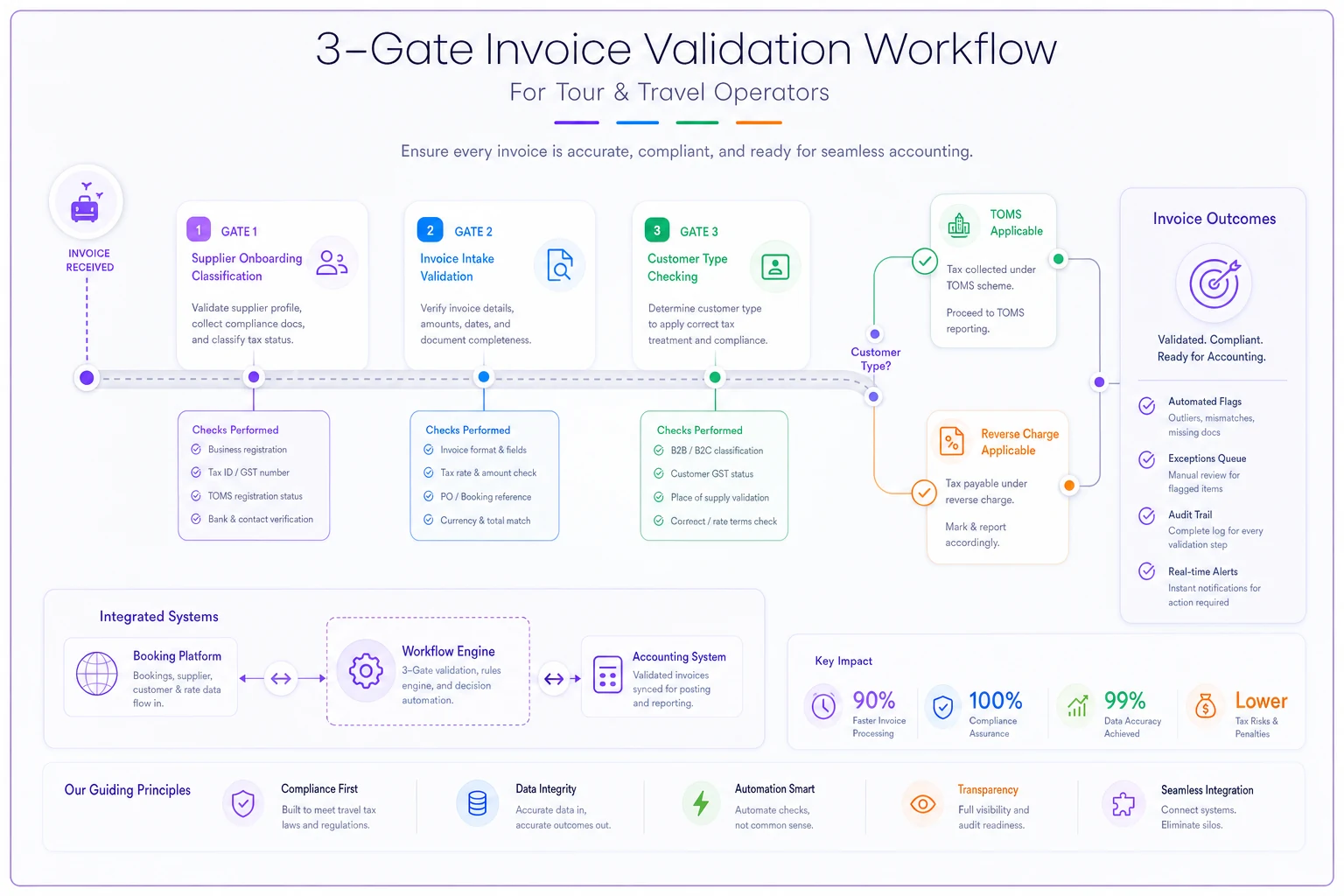
There are three gates worth building into your process:
-
Supplier classification on onboarding. When adding new suppliers, capture their VAT registration status, country of establishment, and service type. This feeds your automated VAT treatment rules. A French transport company gets flagged for reverse charge on B2B bookings. An Italian hotel gets marked for non-recoverable local VAT under TOMS.
-
Invoice intake validation. Before posting, verify the VAT treatment matches expected rules. Spanish hotel charging 10% IVA for accommodation? Correct. French coach company adding 20% TVA to a UK operator invoice? Should be reverse charge. German DMC invoice showing "VAT to be accounted by recipient"? Correct reverse charge notation.
-
Customer type checking. The same supplier invoice gets different treatment based on your end customer. Booking for leisure travelers? TOMS rules apply. Booking for a VAT-registered business? Check if reverse charge is needed. Mixed group with business and leisure? Split treatment required.
These gates work best when integrated into your operational workflow. As teams process bookings, the system flags unusual VAT patterns. A hotel invoice from Greece showing 13% instead of 24% VAT triggers a review. Portuguese ground transport missing VAT when it should show 23% gets queued for verification.
Manual validation starts breaking down somewhere around 50–60 invoices a week. Beyond that you need systematic rules built into your booking platform that automatically determine correct VAT treatment based on supplier type, customer details, and service location.
Quarterly VAT return reconciliation process
Most operators discover VAT errors during quarterly filing when numbers don't reconcile. A monthly pre-check process catches issues before they compound into major adjustments.
Start with a TOMS margin calculation review. Pull all B2C package sales, subtract the bought-in costs including embedded VAT, calculate UK VAT on the margin. Common red flags: negative margins (usually means costs miscoded), margins over 40% (possible missing supplier costs), inconsistent margin percentages across similar packages.
Next, validate reverse charge completeness. List all B2B EU supplier invoices, verify each has corresponding entries in both input and output VAT. Missing reverse charge entries often hide in transport and professional services invoices where suppliers forget to note the reverse charge requirement.
Cross-check agent commission versus principal sales. Agent commission should only attract UK VAT on your fee, not the full transaction value. If your VAT on "accommodation sales" exceeds 20% of your actual commission income, you're probably VAT accounting for supplies that aren't yours.
The reconciliation between your booking system and accounting platform reveals most issues. When a €5,000 Italian hotel booking shows different VAT treatment in each system, there's a classification problem. These mismatches multiply quickly — ten miscoded bookings a week means around 120 errors by quarter end.
Monthly spot-checks on high-value transactions prevent nasty surprises. Any booking over €10,000 deserves a second look at VAT treatment. Stop month‑end commission chaos: reconciliation templates for agent split‑payments become even more critical when VAT treatment varies by booking type.
Operational fixes that prevent VAT surprises
Better training and more careful invoice review only gets you so far. Sustainable VAT compliance requires systematic changes to how booking operations handle supplier onboarding, invoice processing, and customer classification.
Supplier onboarding automation
Build VAT validation into your supplier setup process. When adding a new hotel in Spain, the system should automatically set VAT treatment rules: local IVA applies, not recoverable under TOMS, reverse charge possible for B2B direct bookings. This removes guesswork from invoice processing entirely.
Dynamic invoice coding rules
Instead of manually selecting VAT treatment, let booking details drive the classification. A French coach booking for German corporate clients automatically triggers reverse charge logic. The same coach booking for UK leisure travelers routes to TOMS margin treatment. Your team focuses on operational details while the system handles tax classification.
Customer classification at booking
Capture whether bookings are B2B or B2C at order entry, not during invoice processing. Get VAT registration numbers for business bookings upfront. This information flows through to supplier orders and invoice coding, ensuring consistent treatment across the booking lifecycle.
Automated reconciliation workflows
Build daily feeds between your booking platform and accounting system that flag VAT discrepancies immediately. When today's Spanish hotel invoice gets coded differently than the original booking, you catch it tomorrow — not three months later during VAT return preparation. Stop FX headaches: a multi-currency reconciliation SOP for tour operators becomes even more relevant when VAT adds another layer to cross-border transactions.
The real improvement comes from centralizing these rules in your operational platform rather than relying on spreadsheet lookups and manual decisions. When your booking system understands the tax implications of each supplier relationship and applies the correct treatment automatically based on customer type and service location, VAT compliance becomes a byproduct of good operations rather than a separate administrative burden.
The quarterly cleanup routine that saves thousands
Even with solid processes, errors creep in. A structured quarterly review catches problems before they trigger tax authority attention or accumulate into something much harder to fix.
Run through these steps starting two weeks before quarter end:
-
Pull a sample of around 20 high-value bookings from each major supplier category — accommodation, transport, activities. Verify the VAT treatment matches your decision matrix. Finding errors in 3–4 bookings out of 20 suggests a systematic issue needing broader correction.
-
Review your TOMS calculations for reasonableness. Calculate margin percentage by product type. Beach resort packages typically run 12–18% margins, city breaks 15–22%, adventure tours 20–28%. Outliers need investigation — either costs are missing or sales are miscategorized.
-
Examine credit notes and refunds carefully. When you refund a TOMS booking, you need to adjust your margin scheme calculation. For reverse charge supplies, both the input and output VAT need reversing. Credit notes from suppliers might also change your VAT recovery position if the original treatment was wrong.
-
Check your evidence trail for B2B reverse charge supplies. You need proof the customer is VAT registered to justify reverse charge treatment. Missing or invalid VAT numbers mean you might owe output VAT on supplies you thought were zero-rated.
-
Update your supplier matrix based on what you've learned. That Italian DMC who started charging VAT on services they previously zero-rated? Update their default treatment rules. The Portuguese hotel group that moved from 6% to 13% VAT? Adjust their coding logic.
Automate flagging of bookings over your high-value threshold so they always get a manual second review before quarter end.
Done properly, this quarterly discipline typically recovers somewhere between £8,000 and £15,000 per review through corrected filings and avoided penalties. More importantly, it stops the accumulation of errors that create massive year-end adjustments and draw tax authority scrutiny.
From VAT chaos to operational control
VAT complexity isn't going away. If anything, the rules keep getting more intricate as tax authorities tighten compliance requirements and digital reporting expands. Operators who build systematic VAT handling into their workflows avoid the expensive surprises that hit during quarterly filings.
The decision tree approach turns overwhelming complexity into manageable rules. Instead of guessing at VAT treatment, your team follows clear logic: Is this B2B or B2C? Are we principal or agent? Does TOMS apply? Where is the place of supply? Each answer leads to the next decision point until the correct treatment becomes obvious.
Smarter operators are moving beyond manual invoice checking toward integrated platforms that embed VAT logic into booking workflows. When your operational software understands the tax implications of each supplier relationship and applies the correct treatment automatically based on customer type and service location, VAT compliance becomes a byproduct of good operations rather than a separate administrative burden.
Avoiding just one quarterly VAT assessment saves enough to fund better systems. Preventing reverse charge errors on B2B transport preserves margins that manual processes quietly leak away. Most importantly, getting VAT right consistently means you can focus on growing bookings instead of fixing tax problems every quarter. The operators who handle this complexity without it becoming a crisis share one trait: they stopped treating tax compliance as a back-office problem and started building it into how they operate day to day.
Avoiding just one quarterly VAT assessment saves enough to fund better systems. Preventing reverse charge errors on B2B transport preserves margins that manual processes quietly leak away. Most importantly, getting VAT right consistently means you can focus on growing bookings instead of fixing tax problems every quarter. The operators who handle this complexity without it becoming a crisis share one trait: they stopped treating tax compliance as a back-office problem and started building it into how they operate day to day.
Ready to elevate your travel business?
Join 500+ travel operators using Touryly to optimize bookings, improve client satisfaction, and grow revenue.