


Corporate retreats, wedding parties, student tours — group sales are some of the most profitable work a tour operator can land. They're also the most operationally fragile. Deals fall apart not because your product isn't right, but because the gap between "we're interested" and "here's our deposit" stretches across weeks, multiple decision-makers, and more touchpoints than anyone tracks properly.
The challenge isn't closing the sale. It's managing everything that happens before you get there.
Why group bookings fall apart during the quote-to-deposit phase
Group bookings run on completely different timelines than individual reservations. A family books a sunset cruise in a day or two. A corporate events manager planning a team-building retreat might take weeks navigating internal approvals, budget sign-offs, and stakeholder input.
That extended timeline creates real vulnerabilities. Your sales team sends an initial quote — then what? Three days pass. Does anyone follow up? What if the client requested modifications? When does a soft inventory hold become a hard block? When does a non-responsive lead get moved to inactive?
Most operators handle this reactively. Someone remembers to check in. Someone notices inventory sitting in limbo. Different sales reps follow up at different intervals based on gut feel. The result: perfectly viable group bookings quietly die while the team chases fresh leads.
The financial hit compounds fast. A 40-person corporate retreat at $180 per head is $7,200. Lose two of those monthly from poor follow-up coordination, and you're looking at roughly $170k annually left on the table — before factoring in the cost of holding inventory for deals that never close.
Dissecting a real group sales workflow that actually converts
Below is an operational framework that addresses these friction points directly. Not theoretical — based on patterns from real group booking scenarios.
Never miss a booking or update.
Touryly streamlines your travel bookings, confirmations, and itinerary updates—all in one place.
- Unified booking management
- Automated customer notifications
- Itinerary & staff coordination
No credit card required
Phase 1: Initial inquiry to first quote (0-24 hours)
The clock starts when a group inquiry comes in. Every group lead needs immediate triage. A wedding party booking for next month gets handled differently than a school group planning a year out.
Your intake process should capture:
-
Group size range (not just their target number)
-
Decision timeline
-
Budget indicators
-
Whether they're comparing other options
-
Who makes the final call versus who's just gathering information
Send the first quote within 24 hours. But the quote isn't just pricing — it's your first chance to set operational expectations and build confidence that you actually have your act together.
Phase 2: The follow-up cadence (Days 1-14)
This is where deals live or die. Too aggressive, you annoy people. Too passive, they forget about you or assume you're not that interested.
Day 3 after quote: First check-in. Not "following up on my quote" — something actually useful: "I noticed your dates fall during festival season. Here's how we handle crowds for private groups."
Day 7: Availability update. "We're now at 60% capacity for your requested dates. No pressure, but didn't want you caught off-guard if things fill up."
Day 10: Alternative options if relevant. "Based on what you mentioned about budget, here's a modified package that might work better."
Day 14: Soft close. "I'll need to release the informal hold on your dates by end of week. Should I keep them reserved, or would a different timeframe work better?"
Each touchpoint provides something useful, not just "checking in" energy.
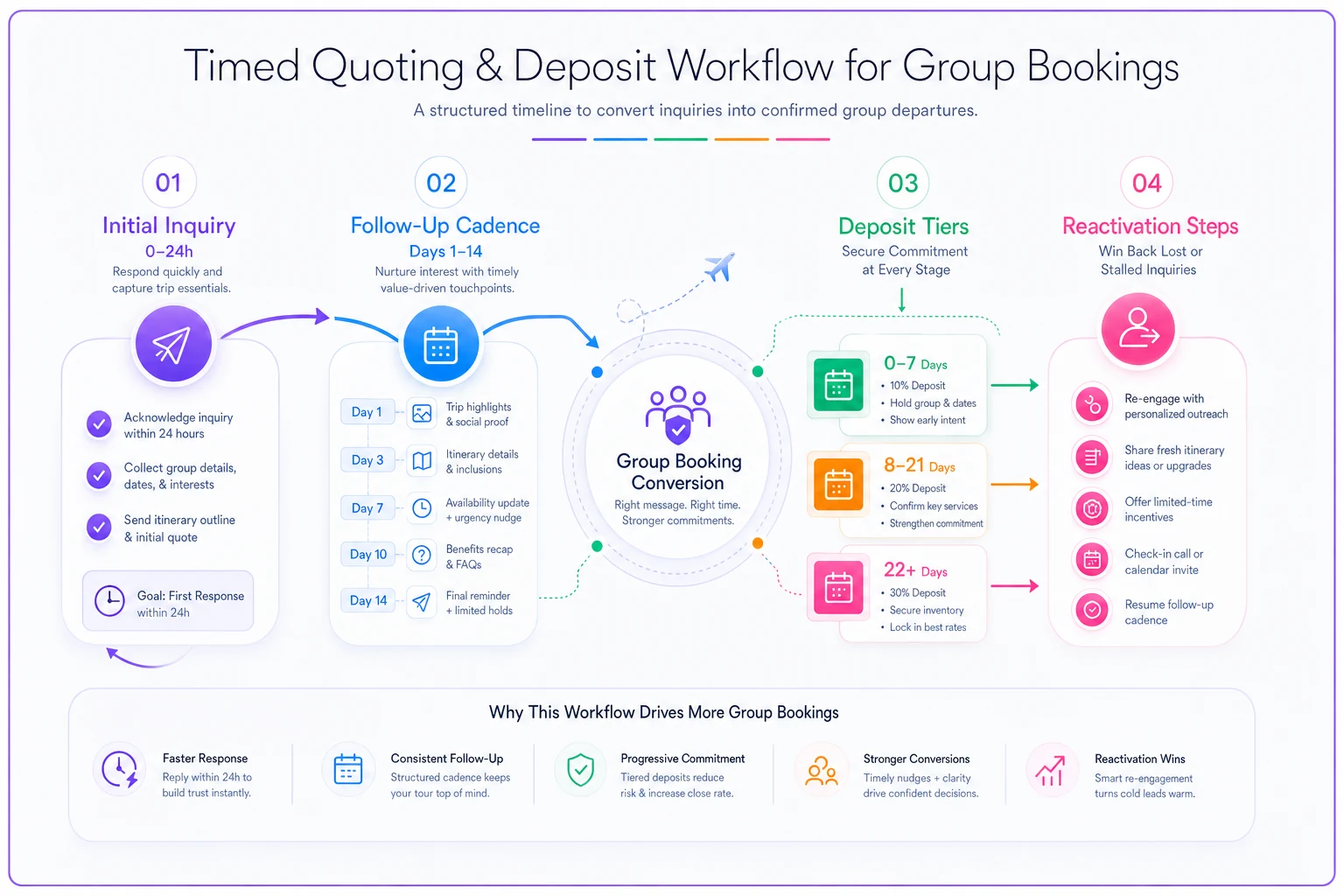
This visual maps the sequence and handoffs so teams can follow it without guessing.
Deposit tiers and inventory management logic
Managing group inventory requires more nuance than individual bookings. A tentative 50-person inquiry can't be treated the same as a confirmed 10-person reservation. Here's a tiered approach that balances revenue protection with operational flexibility:
Tier 1: Soft hold (0-7 days)
No deposit required. Inventory marked as "pending" but still visible for individual bookings. If someone wants to book individually, flag for manual review. This gives groups time to get initial approvals without costing you potential revenue.
Tier 2: Provisional booking (8-21 days)
10% deposit required. Inventory blocked, refundable. A small commitment filters serious inquiries from browsers. The amount is low enough that many corporate clients can approve it without full budget authorization.
Tier 3: Confirmed booking (22+ days out)
25% deposit, non-refundable portion kicks in. Inventory fully blocked. Payment schedule triggered for the remaining balance.
For last-minute groups (under 21 days), compress the tiers but keep the structure. Consistency matters — your team needs clear rules about when to move between stages.
Clearly document the triggers that move a lead between tiers so your team applies them consistently.
Consistency matters — your team needs clear rules about when to move between stages.
Sample email templates that actually get responses
Generic follow-ups get ignored. Here's what works:
Day 3 Check-in: "Hi Sarah, Quick update on your July 15 whale watching request for 35 people. We've had two other groups inquire about that date, but you reached out first so you have priority. The morning slot (8 AM departure) actually tends to have calmer seas — might be better for your mixed-age group. Also, since you mentioned dietary restrictions, our catering partner needs 10 days notice for special menus. Just flagging so we can plan accordingly. Any questions coming up as you discuss internally? Best, Mark"
Day 7 Availability Update: "Hi Sarah, Heads up — July 15 is now at about 70% capacity between individual and group bookings. Your morning slot is still held, but the afternoon is no longer available if you were considering options. If your group size might fluctuate, let me know. We can hold space for up to 40 people without affecting price, but beyond that triggers our large group pricing (actually works in your favor — 10% discount kicks in at 45+). Also attached our wet weather policy since you mentioned that was a concern. Short version: full refund if we cancel for weather, date change if you'd prefer not to sail in rain. Talk soon, Mark"
Notice how both emails give the client something useful rather than just nudging them to respond.
Conversion nudges that don't feel pushy
The best conversion tactics solve real concerns. Group organizers face different pressures than individual bookers — they're spending someone else's money, coordinating multiple schedules, and their reputation is on the line if things go sideways.
Address those anxieties directly:
Social proof specific to groups: "We hosted Microsoft's product team last month — 42 people, similar sunset cruise format. Happy to share how we handled their specific requirements."
Risk reversal for organizers: "If more than 10% of your group cancels due to illness or travel issues, we'll adjust your final invoice accordingly (up to 7 days before)."
Flexibility signals: "We can hold two date options until you confirm final schedules" or "Payment can be split across multiple credit cards if that helps with reimbursements."
Early bird incentives tied to planning cycles: "Groups confirming 45+ days out get complimentary transport coordination" (which also helps you plan operations).
When groups go dark: the reactivation sequence
Every group sales process needs a clear "gone dark" protocol. After the day 14 follow-up, if nothing comes back:
Day 21: Status change email. "Hi Sarah, haven't heard back so I'm releasing the hold on July 15 to open for other bookings. If you're still interested, let me know — we might have other dates that work."
Day 30: Alternative offer. "Saw July 15 passed without your group booking with us. If budget was the concern, September rates are 20% lower. If timing didn't work, we have a lot more flexibility in the fall. Would either help?"
Day 45: Final touchpoint. "Closing out your file but wanted to share — we just launched private charter options that might fit better. Different price point, more flexibility. Details here if useful for future events."
Each message acknowledges the silence without being weird about it.
A breakdown of one operator's group workflow transformation
Here's what this looked like for a whale watching operator in Monterey handling roughly 200 inquiries monthly, with 15-20 being group requests.
Before structured workflows:
-
Group conversion rate
around 12%
-
Average response time to modifications
3-4 days
-
Inventory held without deposits
~40% of capacity during peak season
-
Revenue from groups
roughly $28k monthly
The problems were obvious in their CRM data. Quotes sent without follow-up for weeks. Multiple versions of pricing floating around. Sales reps making different promises about what's included. Inventory held indefinitely for "maybes."
After implementing the tiered system:
-
Group conversion rate
up to around 22%
-
Response time to modifications
same day
-
Inventory held without deposits
down to ~15% of capacity
-
Revenue from groups
roughly $46k monthly
The difference wasn't better salespeople or fancier marketing. It was operational consistency — every group inquiry followed the same process, every deposit tier had clear rules, every follow-up happened on schedule.
The worksheet that keeps group sales organized
A simple tracking sheet transforms chaos into process:
| Lead Details | Timeline | Status | Next Action |
|---|---|---|---|
| Company/Group Name | Inquiry date | Soft hold/Provisional/Confirmed | Specific task + date |
| Contact person | Quote sent | Inventory status | Owner |
| Group size | Last contact | Deposit received | Notes |
| Event date | Days in pipeline | Balance due | |
| Total value | Target close date | Special requirements |
Track these metrics weekly:
-
Average days from inquiry to deposit
-
Follow-up completion rate
-
Inventory utilization vs holds
-
Conversion rate by group type
Not about micromanaging — it's about spotting patterns. Maybe corporate groups need longer runways. Maybe wedding parties convert better with payment plans. Maybe your day 10 follow-up is too late for last-minute bookings.
Why manual coordination eventually breaks
As volume grows, manual tracking becomes unsustainable. Not because people aren't trying, but because human attention doesn't scale linearly. Managing 5 group quotes at various stages? Fine. Managing 20? Things slip. Managing 50? System breakdown.
This is where proper deposit and inventory management systems become critical. You need inventory that releases itself when deposits don't arrive on time. Follow-ups that queue based on timeline rules. Triggers that fire without someone manually checking a spreadsheet.
The challenge is that generic CRMs weren't built for tour operations. They can't distinguish a soft hold that should release after 7 days from a provisional booking needing different handling. They don't account for weather-dependent cancellation terms versus indoor experiences.
Operational platforms built specifically for tour operators handle these nuances — tracking aging quotes, flagging inventory held too long, surfacing overdue follow-ups. AI automation can draft context-aware follow-ups based on where a group sits in your pipeline and what concerns they've raised. The goal isn't removing humans from group sales; relationships still matter a lot here. It's handling the operational coordination so your team can actually focus on those relationships instead of chasing spreadsheet entries.
Common mistakes that sabotage group conversions
Even with solid processes, certain patterns consistently kill conversion rates:
Over-quoting initial requests. Group organizers often start with ambitious numbers. Quote for 50 when they ask for 50, but also include pricing for 35 and 40. Shows flexibility without needing another full round of quotes.
Ignoring invisible stakeholders. The person emailing you might not be the decision maker. Include language like "feel free to forward this to your team" and build quotes that make sense to someone who wasn't on the initial call.
Treating deposits as all-or-nothing. Offer payment structures that match how organizations actually approve spending. Some can approve $500 immediately but need board sign-off for $5,000. Work with their constraints rather than around them.
Abandoning leads after the event date passes. That corporate retreat that didn't book for July? They'll probably need something in October. A brief quarterly check-in costs almost nothing.
Making modifications painful. Groups always change — size fluctuates, dates shift, requirements evolve. Build buffer into your operations and make changes straightforward until the final deadline.
Building your own group sales workflow
Start with your current baseline. How many group inquiries come in monthly? What's your conversion rate? What's the average deal value? That's your starting point.
Then implement in phases:
Week 1-2: Standardize your quote template. Include deposit schedules, cancellation terms, and modification policies upfront. Make it clear enough that someone who's never spoken to you understands exactly how booking works.
Week 3-4: Implement the follow-up cadence. Set calendar reminders if that's all you have. Day 3, Day 7, Day 10, Day 14. Stick to it for a month before adjusting anything.
Week 5-6: Add deposit tiers. Start simple — soft hold for a week, then require 10%. Track how it affects conversion before tweaking.
Week 7-8: Build your tracking worksheet. Review it weekly. Look for patterns in what converts and what doesn't.
Measure everything for the first 90 days. You'll quickly figure out which touchpoints matter most for your specific market.
The reality of group sales operations
Group bookings will always be more complex than individual reservations. More stakeholders, longer timelines, higher stakes. But that complexity is exactly why getting the operational flow right pays such large dividends.
Most tour operators treat group inquiries like bigger individual bookings. They're not. They're a different operational challenge that requires different workflows, different communication patterns, and different systems.
Operators who build structured group sales workflows — clear quote templates, timed follow-up cadences, and smart deposit management — consistently outperform those who handle it ad hoc. Not through better salesmanship, but through better operations.
Your next group inquiry is probably sitting in someone's inbox right now, waiting on follow-up. What happens next depends entirely on whether you have a system or just hope.
Your next group inquiry is probably sitting in someone's inbox right now, waiting on follow-up. What happens next depends entirely on whether you have a system or just hope.
Ready to elevate your travel business?
Join 500+ travel operators using Touryly to optimize bookings, improve client satisfaction, and grow revenue.