

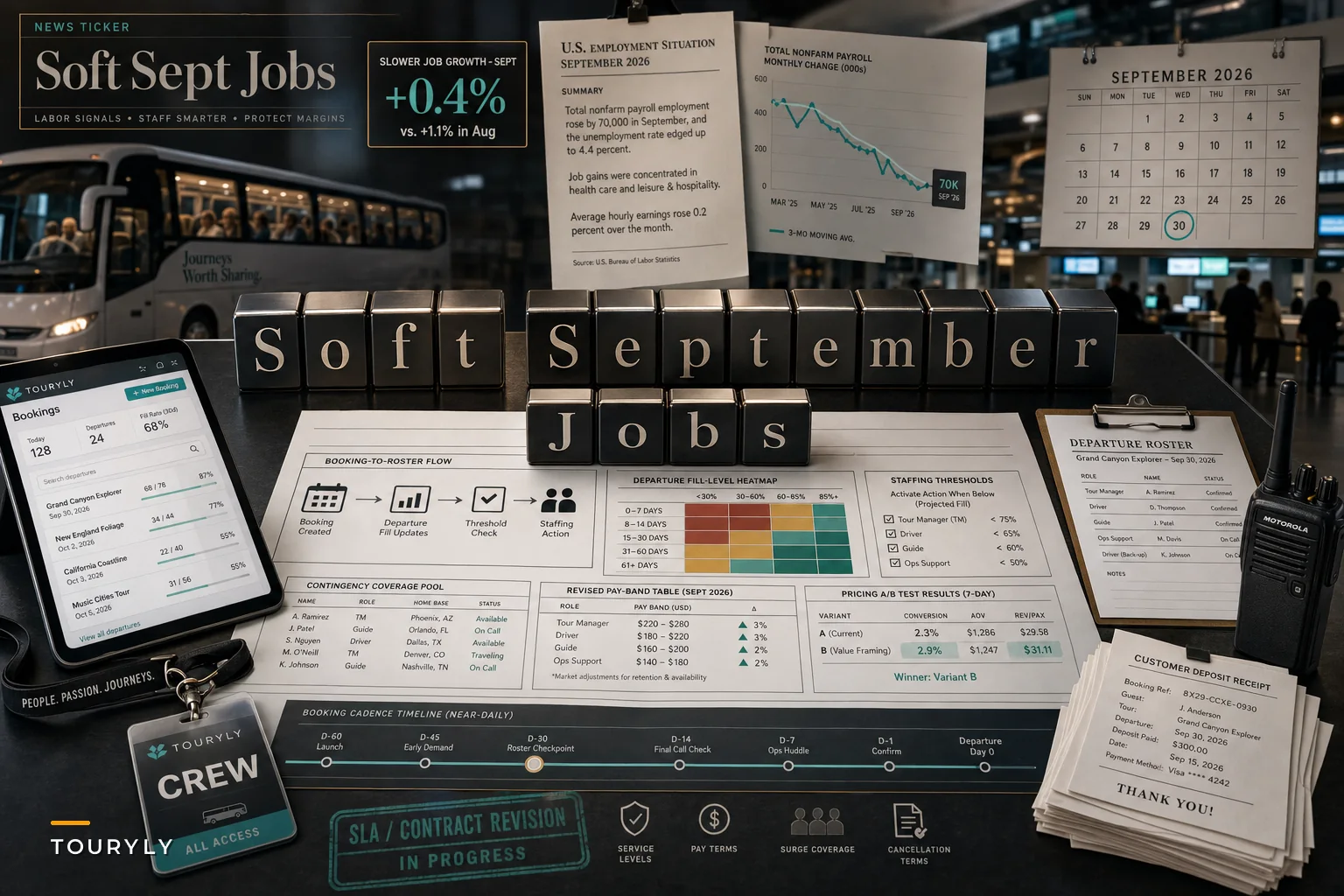

The September numbers landed softer than almost anyone expected. Nonfarm payrolls rose by just 29,000, and unemployment ticked up to 4.2%, according to the Bureau of Labor Statistics and follow-up coverage from CNBC. For most industries that's a macro footnote. For tour operators heading into peak fall foliage, holiday markets, and winter season trips, it's more immediate: the labor and demand environment you planned your rosters around in July may not be the one you're actually operating in by November.
A soft jobs report doesn't tell you to do one clean thing, though. It pulls in two directions at once. Hiring gets harder and slower in some roles, while customer demand gets twitchier and more price-sensitive. React to only one side and you end up exposed on the other. This post is about how to read both signals and adjust tour operator staffing, rostering, and pricing without overcorrecting.
The two-sided squeeze most operators miss
When the labor market softens, the instinct is usually "great, hiring will get easier." Sometimes it does. But a slowdown this shallow — payrolls still positive, unemployment only nudging up — doesn't flood your applicant pool with great seasonal guides. What it actually does is make the market uneven in ways that are easy to misread.
What tends to happen in practice:
-
Critical skilled roles stay tight. Certified guides, multilingual staff, drivers with commercial endorsements — these people don't suddenly reappear just because overall hiring cooled. If anything, when businesses get nervous they hold onto their good people harder, so poaching gets more expensive, not less.
-
General frontline roles loosen a bit. Greeters, check-in staff, van loaders, gear handling — you may see more applicants, but also more flakiness as candidates shop around in an uncertain market.
-
Consumer confidence wobbles first in discretionary spend. Leisure travel sits near the top of the list of things households delay when the news feels shaky. You often see it in booking pace before it shows up in cancellations.
So you've got a situation where your hardest-to-fill roles get no easier, your easy roles get slightly easier but less reliable, and your demand gets softer and more price-sensitive all at once. That combination is exactly what breaks a roster built on last season's assumptions.
The underlying problem: your roster is a forecast, and the forecast just changed
Most staffing pain in this business isn't really a hiring problem. It's a forecasting problem that only shows up as a hiring problem the day someone doesn't show.
Never miss a booking or update.
Touryly streamlines your travel bookings, confirmations, and itinerary updates—all in one place.
- Unified booking management
- Automated customer notifications
- Itinerary & staff coordination
No credit card required
A roster is a bet. You're betting on how many departures will run, how full they'll be, how many guides you'll need, how much buffer you have for sick calls. When the macro picture shifts mid-season, every input in that bet moves at once — and a lot of operators are still staffing to the forecast they locked in during a more confident summer.
The expensive version of this looks like running three guides on a departure that sold at 60% capacity because you committed the shifts weeks ago and didn't want to cut hours. Or the reverse: scrambling for a last-minute replacement on a sold-out premium tour because your contingency pool quietly evaporated.
We go deep on building rosters that bend instead of break in our forecast-to-roster staffing system for tour operators, and the core idea matters even more right now: your staffing plan needs to be tied to live booking signals, not to a spreadsheet you filled out in better-feeling times.
Step one: re-tier your roles before you touch the roster
Before adjusting a single shift, separate your roles by how the labor market actually affects them. Lumping everyone together is the mistake.
| Role type | Labor availability now | What to do |
|---|---|---|
| Certified / skilled guides | Still tight, possibly tighter | Protect, retain, lock in early commitments |
| Multilingual / specialty staff | Scarce, high replacement cost | Build redundancy, cross-train, pre-book |
| General frontline / support | Slightly looser, less reliable | Widen your bench, expect more churn |
| Admin / back-office | Stable | Low priority for change |
The point isn't the categories themselves — it's that a soft labor market is not a uniform event across your payroll. Your retention budget and your hiring energy should go to the top two rows. Trying to "take advantage" of looser hiring at the bottom while neglecting the top is how operators wake up in late November without a Spanish-speaking guide for a fully booked group.
Step two: rebuild your contingency pool while it's cheap-ish
The contingency pool — on-call, flex, and casual staff — is the first thing that quietly disappears when people get nervous about their income and go find steadier work. Counterintuitively, a softer market is a decent window to rebuild that bench, because some capable people are between things and want flexible hours.
A practical sequence:
-
List every departure for the next 90 days and flag which ones have zero backup coverage today.
-
Rank them by revenue and reputational exposure — a sold-out premium multi-day trip ranks far above a half-empty afternoon walking tour.
-
Assign a target bench size per departure type, not per day. You don't need a universal number; you need coverage proportional to risk.
-
Reach out to lapsed seasonal staff first. People who already know your routes and SOPs are worth more than new hires right now, and a soft market makes them more reachable.
-
Lock loose commitments with small retainers or guaranteed-minimum-hours offers for your highest-risk dates. A modest guarantee is cheaper than a blown departure.
Operators who handle slowdowns well don't scramble for staff in the moment. They've already converted an uncertain labor market into a deeper, pre-committed bench before demand and availability both move against them.
Step three: adjust pricing for a more price-sensitive customer — carefully
A lot of operators overreact here. The instinct when demand softens is to discount broadly, and that's usually the wrong move. It trains customers to wait for deals and erodes margin exactly when margin matters most.
-
Hold your headline price, add value instead. A free upgrade, a small inclusion, or flexible rebooking terms protects your price integrity while still addressing hesitation.
-
Use deposit structure as a demand lever. Lower or more flexible deposits reduce booking friction for nervous customers without cutting your actual price. Softer way to fight a slowdown than discounting.
-
Protect peak dates, discount shoulder dates. If fall foliage weekends are still selling, don't touch them. Apply any flexibility to the midweek and off-peak departures that are genuinely soft.
-
Watch booking pace, not just volume. A slower pace at the same final volume means you need deposits and follow-up working harder, not a price cut.
When discounting actually makes sense
Discount when you have genuine, perishable inventory that will otherwise run empty on a fixed-cost departure — a chartered boat, a reserved venue, a guide already committed. Filling a seat on a trip that's running anyway recovers marginal revenue. Discounting a departure you could simply cancel or consolidate just gives away money.
When it's a bad idea
If your departures can flex — if you can consolidate two half-full tours into one, or cancel with enough notice — don't discount. Adjust the roster instead. Cutting price to run an under-filled, fully-staffed departure is the most expensive way to respond to soft demand.
Step four: tighten the link between bookings and shifts
The whole adjustment falls apart if your rostering and your booking data live in separate worlds. In a stable season you can get away with a weekly manual reconciliation between what sold and who's scheduled. In a shifting market, that lag is where the money leaks.
Here's a quick visual of the workflow.
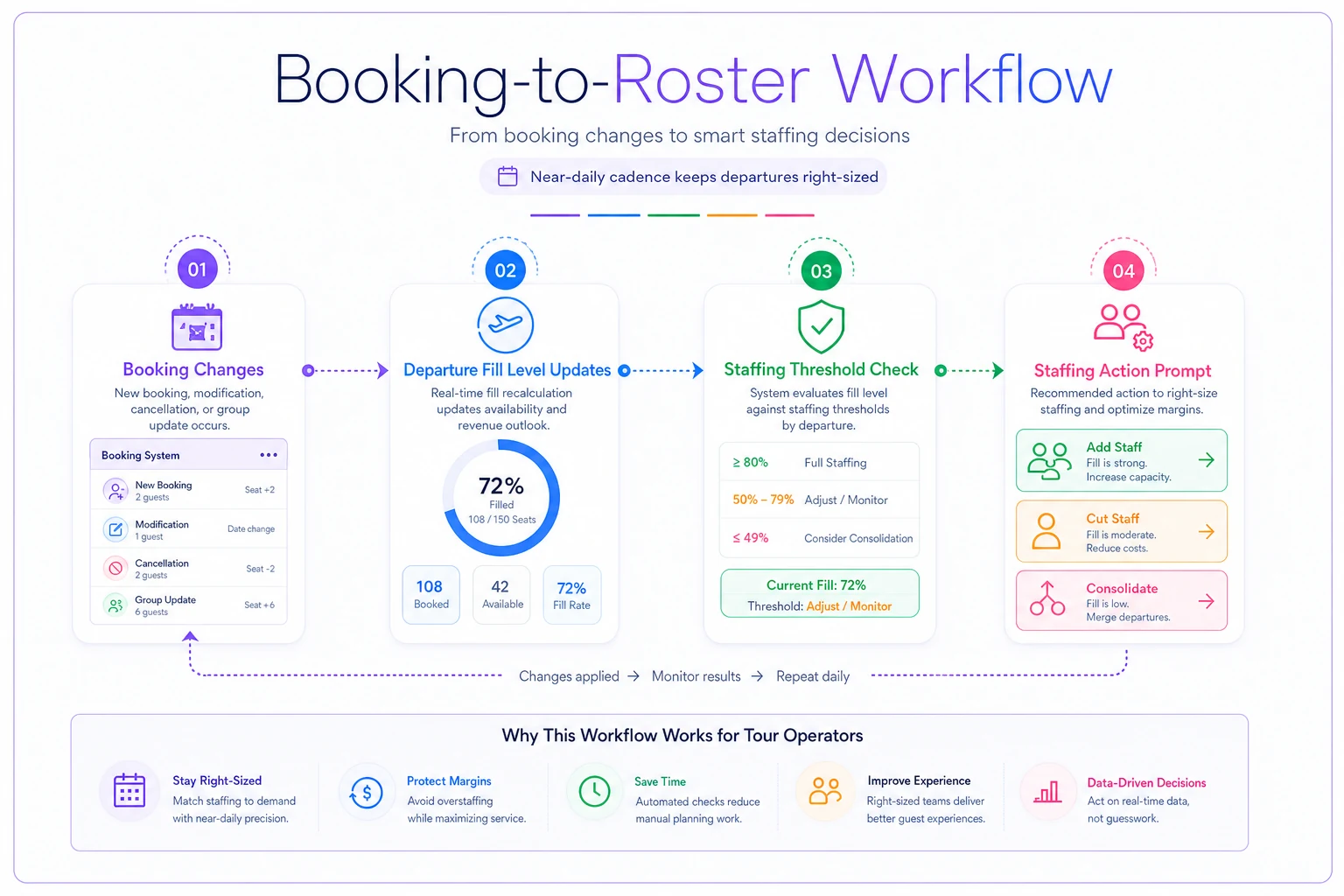
The workflow that holds up looks like this: a booking changes → the departure's fill level updates → a staffing threshold is checked → someone is prompted to add, cut, or consolidate before the shift locks. Whether that's handled inside your operations platform or stitched together more manually, the principle is the same — shift decisions need to respond to booking reality on a near-daily cadence during uncertain periods, not weekly.
Set automated alerts for departures approaching your consolidation or minimum-staff thresholds so you can act in days, not hours.
This is where AI-assisted operational tools earn their keep without any drama. Instead of a manager eyeballing a spreadsheet, the system watches fill rates against your coverage thresholds and flags the departures drifting toward over- or under-staffing. It's not replacing the judgment call — someone still decides whether to consolidate two tours or hold both — it just makes sure that call gets made before the day of, instead of after.
A real scenario
A mid-sized city tour operator running roughly 40–50 departures a week heading into fall noticed booking pace slowing about three weeks after the softer jobs data hit the news cycle. Their rosters were still built on the summer's confident forecast — three guides on most premium departures, generous frontline coverage.
Instead of discounting, they did two things. They re-tiered roles and protected their four certified multilingual guides with early commitments and a small guaranteed-hours offer. Then they shifted to reviewing fill rates against staffing thresholds every couple of days instead of weekly, consolidating under-filled midweek departures and reallocating guides rather than running half-empty trips.
Over about six weeks they trimmed somewhere in the range of 15–20% of guide-hours on soft departures without a single blown premium tour, and kept headline pricing intact by leaning on flexible deposits instead of cuts. Nothing dramatic — just the difference between reacting on the day-of and adjusting a few days ahead.
A quick checklist before your next roster lock
-
[ ] Re-tier roles by real labor availability, not headcount
-
[ ] Identify every departure in the next 90 days with zero backup coverage
-
[ ] Rebuild your flex bench now, starting with lapsed seasonal staff
-
[ ] Protect peak dates; apply flexibility only to genuinely soft ones
-
[ ] Use deposit structure and value-adds before touching headline price
-
[ ] Move from weekly to near-daily fill-vs-staffing checks during uncertainty
-
[ ] Decide your consolidate-vs-discount rule before a departure goes soft
Nothing dramatic — just the difference between reacting on the day-of and adjusting a few days ahead.
Bottom line
A softer labor market isn't a single instruction. It's a signal that the assumptions baked into your current rosters and pricing are probably stale, and that both sides of your business — cost of staffing and sensitivity of demand — are moving at the same time. Operators who read it as "hiring got easier" or "time to discount" tend to get caught on whichever side they ignored.
The ones who come through fine do something less flashy: they tie staffing to live booking signals, protect the roles that stay scarce, rebuild their bench while they still can, and use deposit structure and consolidation before reaching for the blunt instrument of price cuts. The macro number is just the nudge. The real work is making sure your roster can actually bend with it.
Ready to elevate your travel business?
Join 500+ travel operators using Touryly to optimize bookings, improve client satisfaction, and grow revenue.