


Most operators don't actually choose between a single‑vendor suite and a best‑of‑breed stack. They inherit one. Someone bought a reservation system five years ago, bolted on a payment gateway, added a CRM because sales kept complaining, and now the "decision" is really just whatever accumulated over time. Then growth hits, cracks show, and suddenly the question of single‑vendor travel suite vs best‑of‑breed becomes urgent — usually at the worst possible moment, like heading into peak season with a backlog of manual reconciliation.
So this guide skips the textbook definitions. You already know a suite tries to do everything in one platform, and best‑of‑breed means stitching specialist tools together. What you actually need is a way to decide which path fits your scale and growth trajectory — without learning the hard way after signing a three‑year contract.
We'll work through the dimensions that actually matter, then give you a tradeoff matrix, a PoC checklist, a few real operator scenarios, and a clear "do this next" based on where you are.
The decision nobody frames correctly
The mistake that costs operators the most: treating this as a one‑time architecture choice instead of a phased commitment that changes as you grow.
A 2,000‑booking‑a‑year operator and a 40,000‑booking operator have completely different right answers. And the same operator will often need a different answer at different stages. The suite that felt like a gift at 3,000 bookings becomes the ceiling you bang your head on at 25,000. The best‑of‑breed stack that gives a large operator surgical control will quietly bankrupt a small team in integration maintenance and engineering overhead.
-
Where you are now — booking volume, team size, in‑house technical capacity.
-
How fast you're actually growing. Not the pitch‑deck number. The real one.
Everything below gets interpreted through those two facts.
The seven dimensions that actually decide it
1. Time to market
Never miss a booking or update.
Touryly streamlines your travel bookings, confirmations, and itinerary updates—all in one place.
- Unified booking management
- Automated customer notifications
- Itinerary & staff coordination
No credit card required
Suites win here, almost always. You get reservations, payments, basic CRM, and reporting working in weeks, not quarters. For a new product line or a market you're testing, speed matters more than elegance.
Best‑of‑breed stacks are slower to stand up because integration is the project. Connecting a specialist inventory engine to a separate payments platform to a separate finance tool means building and testing the glue. The first integration takes roughly three times longer than anyone estimates — because nobody budgets for reconciliation edge cases. Partial refunds, multi‑currency settlements, voucher voids. These don't surface in demos.
A booking flow demos in a day. Handling a split‑payment group booking that partially cancels across two suppliers takes weeks.
2. Total cost of ownership (TCO)
This is where suite pricing deceives people. The license looks clean and predictable. But suites charge for modules, per‑seat add‑ons, API call tiers, and premium support. A mid‑size operator who started at roughly $1,800/month on a suite can find themselves at $5k–$7k/month two years later as they unlock modules they didn't know they'd need.
Best‑of‑breed TCO is messier to calculate but more controllable. You pay each specialist vendor directly — less bundling markup — but you carry the integration maintenance cost, which is real money whether it's a contractor or internal engineering time. Budget realistically: a stack of four to six integrated tools usually needs the equivalent of a part‑time engineer just to keep connectors healthy.
-
Suite
license + modules + support tier + overage fees
-
Best‑of‑breed
sum of tool subscriptions + integration build + ongoing connector maintenance + internal coordination time
The honest comparison isn't license vs license. It's:
3. Operational control
Best‑of‑breed wins here. When you can swap your payments routing logic or pricing engine independently, you control your own operational destiny. When pricing rules, FX handling, or dispute SLAs live inside a suite's black box, you're limited to whatever the vendor's roadmap allows.
A concrete example: operators managing real FX exposure often hit a wall where the suite's multi‑currency handling rounds or settles in ways that quietly erode margin, with no way to override it. A specialist payments layer gives you direct control over routing and reconciliation. If margin control is core to your model — and under the cost pressures reshaping travel demand, it increasingly is, as we covered in how rising cost-of-living pressures are reshaping summer bookings — this dimension deserves serious weight.
4. Vendor lock‑in
The quiet killer. Suites make lock‑in feel comfortable until the day you want to leave. Your data model, historical bookings, customer records, and reporting logic all live in their structure. Exports are often incomplete — you get the booking records but not the state history, the audit trail, or the custom fields that actually run your ops.
Best‑of‑breed isn't immune, but the blast radius is smaller. If your CRM vendor disappoints, you replace one tool, not your entire operation. Lock‑in cost isn't the migration — it's the leverage the vendor has over you while you stay. Suite vendors know switching is painful, and pricing conversations reflect that.
5. Scalability
This splits into two kinds, and conflating them is a common mistake.
-
Volume scalability — can the system handle 10x the bookings? Most modern suites and specialist tools handle this fine. Rarely the real constraint.
-
Complexity scalability — can the system handle new product types, new markets, new channels, new compliance regimes? This is where suites bend and break.
A suite is optimized for the business model it was designed around. Push it toward multi‑day itineraries with supplier dependencies, or into a new country's tax and consent rules, and you hit features that "sort of" work. Best‑of‑breed lets you add a specialist tool for the new complexity without re‑architecting everything.
6. Implementation complexity
Suites are simpler to implement but harder to customize. Best‑of‑breed is harder to implement but more flexible once built.
The hidden factor nobody prices in: implementation complexity never ends at go‑live. Every new supplier, channel, or product feature re‑triggers integration work. In a suite, you wait on the vendor. In a stack, you do the work yourself. Which pain you prefer depends entirely on whether you have — or plan to build — internal technical capacity.
7. Ongoing maintenance
Suites externalize maintenance — the vendor patches, updates, and maintains. That's genuinely valuable for a lean team. The tradeoff is you're subject to their update schedule and their breaking changes.
Best‑of‑breed internalizes maintenance. API versions change, connectors break, and a payment provider's update can silently break your reconciliation at 2am during peak. This is manageable, but it's a real operational function that needs an owner. The operators who regret going best‑of‑breed are almost always the ones who treated integration maintenance as a one‑time project instead of a standing responsibility.
The one‑page tradeoff matrix
Print this.
| Dimension | Single‑Vendor Suite | Best‑of‑Breed Stack |
|---|---|---|
| Time to market | Fast (weeks) | Slow (integration is the project) |
| TCO (predictability) | Predictable base, creeping module/overage costs | Variable, more controllable, carries maintenance cost |
| Operational control | Limited to vendor roadmap | High — swap components independently |
| Vendor lock‑in | High — data model and leverage | Lower — smaller blast radius per tool |
| Volume scalability | Good | Good |
| Complexity scalability | Weak — bends to new models | Strong — add specialists as needed |
| Implementation | Simpler upfront, vendor‑dependent after | Harder upfront, self‑directed after |
| Ongoing maintenance | Externalized to vendor | Internalized, needs an owner |
| Best fit | Small/lean teams, standard model, speed‑first | Larger teams, complex/multi‑market, control‑first |
When a vendor demo makes everything look equal, this matrix is what keeps you honest.
When each path actually makes sense
When a single‑vendor suite is the right call
-
You're under roughly 8,000–10,000 bookings a year with a fairly standard product model.
-
Little or no in‑house technical capacity, and no plans to build it.
-
Speed to launch matters more than long‑term flexibility right now.
-
Your operation is predictable enough that you won't need frequent custom workflows.
A lean operator running a focused set of tours is often better served by one good suite than by a stack they can't maintain. The control you'd gain from best‑of‑breed is control you don't have the hands to use.
When best‑of‑breed is the right call
-
You're past roughly 15,000 bookings and complexity is climbing — multiple markets, channels, or product types.
-
Margin control, payments routing, or FX handling is core to your competitiveness.
-
You have (or will hire) someone who owns integrations and data flow.
-
You've already hit the ceiling of a suite and felt the pain of its black boxes.
When it's a bad idea either way
-
Don't go suite if you already know your model is going to fragment into multiple product types and markets within 18 months. You'll just be scheduling a painful migration.
-
Don't go best‑of‑breed if you're a four‑person team with no technical owner. You'll spend more time babysitting connectors than running tours, and a broken reconciliation during peak will hurt far more than a suite's limitations ever would.
The worst outcome is the "half‑stack" — a team that bolts three specialist tools onto a suite they refuse to leave, inheriting the cost of both approaches and the benefits of neither.
A real scenario: the ceiling that arrives quietly
A regional multi‑day adventure operator was running on a single suite, doing around 6,000 bookings a year. The suite was fine — genuinely fine — for three years. Reservations, payments, reporting, all in one place, maintained by someone else, roughly $2,200/month all‑in.
Then they expanded into two new countries with different VAT treatment and consent rules, and added a group‑booking product with deposit schedules the suite couldn't model. The workarounds piled up fast: a spreadsheet for group deposits, a separate tool for one market's invoicing, manual reconciliation every month‑end that ate close to two full days of someone's time.
The hidden cost wasn't the license. It was roughly 15–20 hours a month of senior‑person time spent patching gaps the suite couldn't fill, plus margin leaking through manual FX handling they couldn't control. Call it $3k–$4k a month in loaded labor and leaked margin — more than the software itself.
They didn't rip everything out. They moved payments and finance to specialist tools, kept the suite as the reservation core, and built clean integration between them. Month‑end reconciliation dropped from two days to a few hours. The suite hadn't failed at volume. It failed at complexity — and they'd been paying for that failure in labor for almost a year before they named it.
Two more short operator patterns
The small operator who over‑engineered. A team doing under 3,000 bookings decided to go full best‑of‑breed because a competitor had. They stitched together five tools, spent most of a year on integration, and burned through two contractors. The connectors broke repeatedly, nobody owned them, and bookings occasionally failed to sync to finance. They eventually consolidated back onto a suite and got their weekends back. At their scale, the control was worthless because they couldn't actually operate it.
The large operator who waited too long. An operator past 30,000 bookings stayed on a suite well past the point of pain because migration felt terrifying. The lock‑in leverage showed up at renewal: the vendor raised prices sharply, knowing switching would take most of a year. They'd traded short‑term stability for long‑term hostage status. By the time they moved to a modular stack, the migration cost more than it would have two years earlier — because two more years of data and custom workflow had accumulated inside the black box.
Proof‑of‑concept and migration checklist
Don't let a slick demo be the thing that tips your decision. Vendors optimize demos for the happy path — clean data, standard bookings, no edge cases. Your actual operation is not a demo. A proper PoC means running your hardest, messiest workflows on the candidate system and seeing where it buckles.
A compact PoC workflow looks like this.
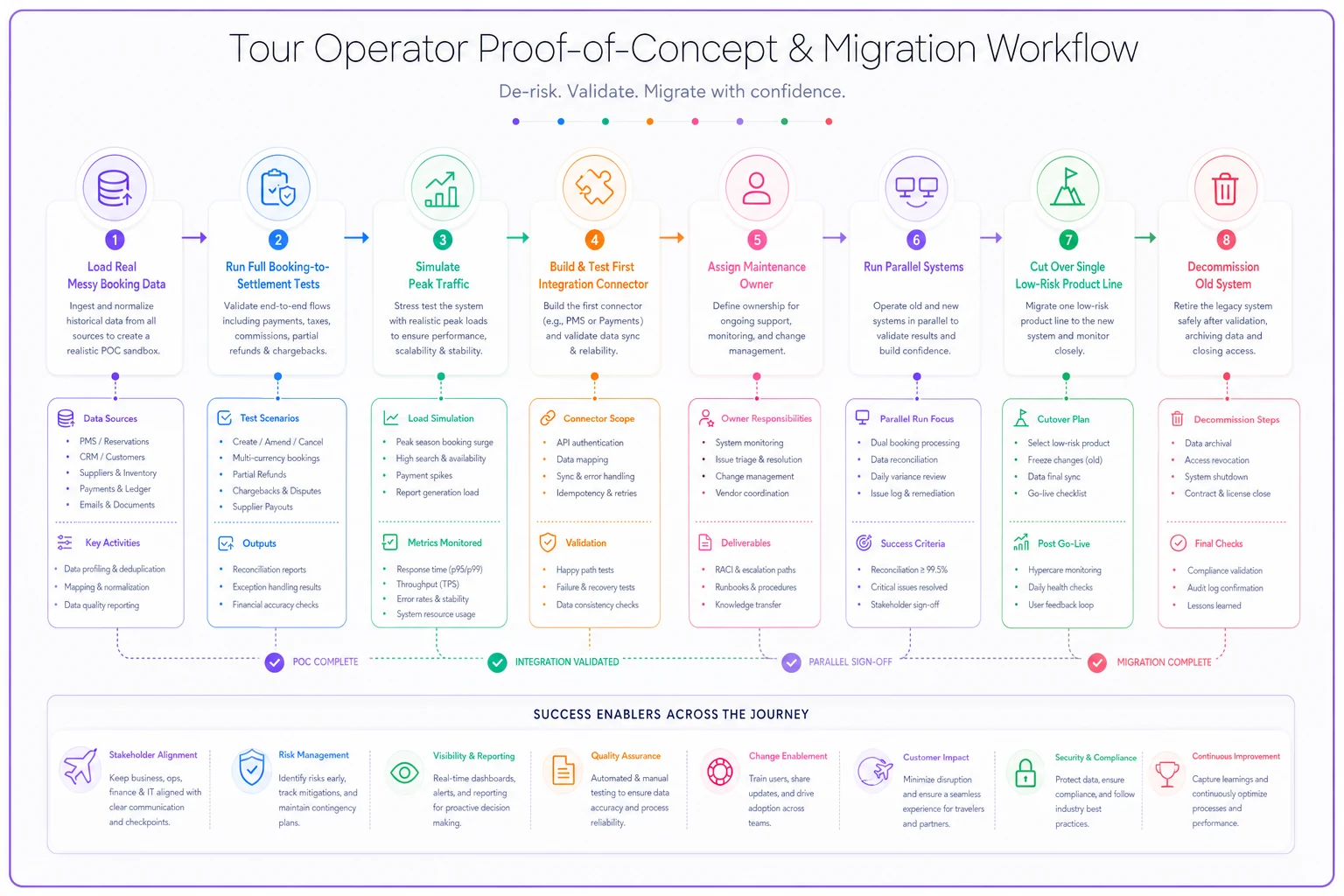
Use this flow while you run your PoC and note where manual work or edge cases appear.
Build one integration fully before committing — the first connector reveals the hidden cost of the next five.
-
[ ] Load your ugliest real data, not clean sample data. Multi‑currency bookings, partial cancellations, group deposits, voided vouchers.
-
[ ] Run a full booking→settlement cycle end to end, including a partial refund and a chargeback simulation.
-
[ ] Test the exception paths, not the happy path. Supplier substitution, split payment, waiting‑list promotion.
-
[ ] Measure month‑end reconciliation time on the PoC system against your current time.
-
[ ] Request a full data export during the PoC and inspect it. Does it include state history, audit trails, and custom fields — or just flat booking records?
-
[ ] Price the realistic scenario, not the base tier. Add the modules and API volumes you'll actually hit at 2x current scale.
-
[ ] For best‑of‑breed
build one integration fully
before committing. The first connector tells you everything about the next five. -
[ ] Assign a maintenance owner on paper before go‑live. If nobody's name is on connector health, it will rot.
-
[ ] Run the PoC through a simulated peak — 3x normal volume for a day — and watch where it strains.
A structured migration follows naturally from a good PoC. Sequence it so bookings never stop:
-
Freeze custom development on the old system.
-
Map the data model field by field, including the custom fields that quietly run your ops.
-
Run both systems in parallel for a defined window, reconciling daily.
-
Cut over a single low‑risk product line first, not the whole business.
-
Keep a documented rollback path until the new system has survived a full month‑end and a peak period.
-
Decommission the old system only after a clean reconciliation cycle on the new one.
Sequence it so bookings never stop.
Recommended next steps by where you are
Small and stable (under ~8k bookings, standard model, lean team): Pick one solid suite and resist the urge to over‑engineer. Spend your energy on operations, not architecture. Revisit the decision only when complexity — not volume — starts forcing workarounds.
Mid‑size and growing (8k–20k bookings, complexity climbing): Start watching for the ceiling signals: spreadsheet workarounds, manual reconciliation creep, workflows the suite "sort of" handles. Don't rip and replace. Consider keeping a strong core and moving the one or two functions where you most need control — usually payments and finance — to specialists. This hybrid, done deliberately, is often the smartest mid‑stage move.
Large and fragmenting (20k+ bookings, multiple markets/products): Best‑of‑breed is probably your endgame, and waiting makes lock‑in worse. Name an integration owner, run serious PoCs on the components you'll swap first, and migrate in sequence rather than in one terrifying cutover. The migration only gets more expensive the longer accumulated data sits inside a suite's black box.
The real answer to single‑vendor travel suite vs best‑of‑breed isn't picking a side — it's recognizing a sequence. Most operators who get this right don't pick one philosophy and defend it forever. They match their architecture to their actual stage, prove every change on their hardest workflows first, and treat the question as something they'll revisit at each new level of scale, rather than a bet they make once and live with.
Ready to elevate your travel business?
Join 500+ travel operators using Touryly to optimize bookings, improve client satisfaction, and grow revenue.