

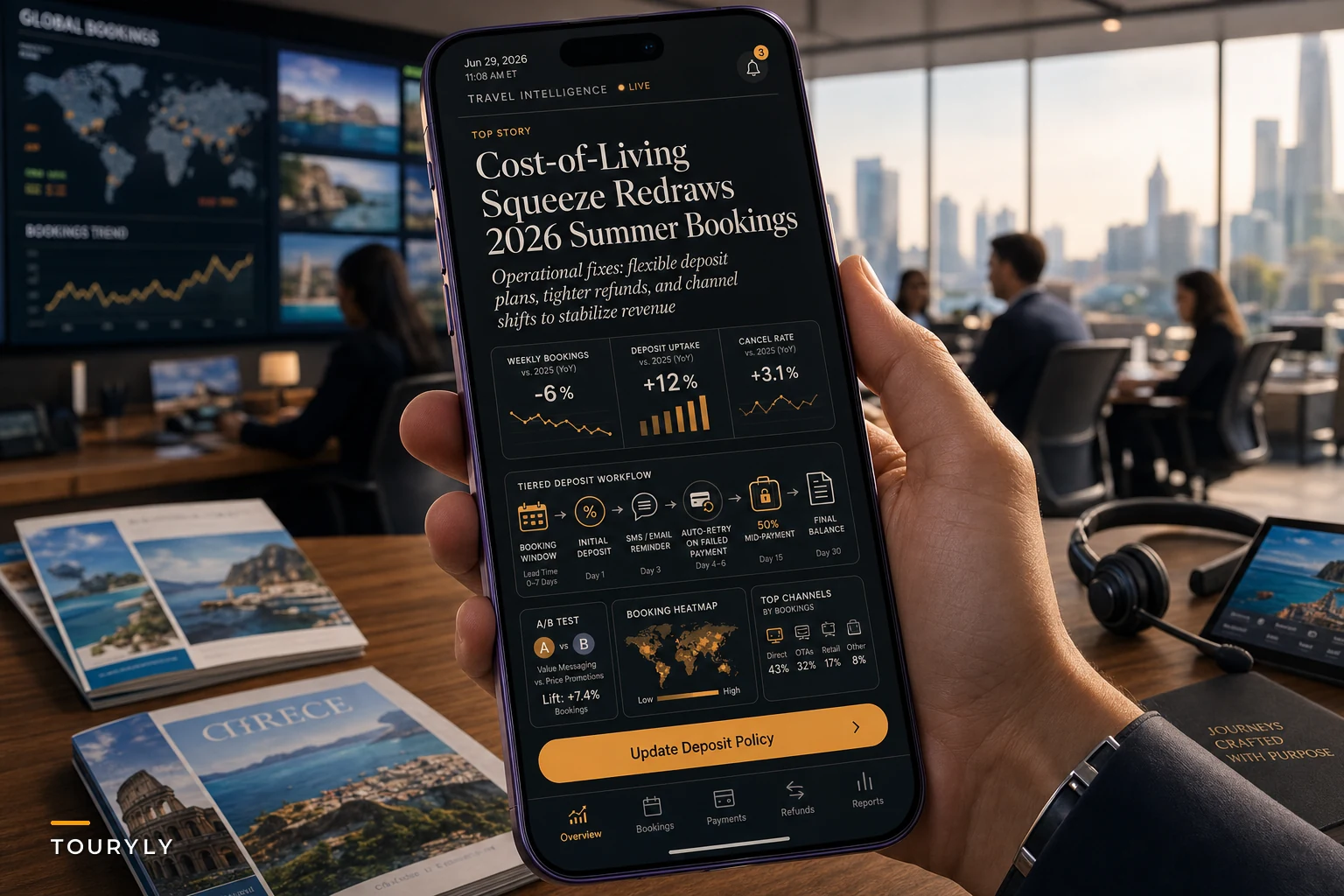

The numbers coming out of June paint a complicated picture for tour operators heading into peak season. While Reuters reported that U.S. consumer sentiment improved, the underlying worry about cost of living hasn't gone anywhere. That disconnect between improving sentiment and persistent price anxiety creates a specific operational challenge for summer bookings that most operators aren't prepared for.
Customers are still traveling, but they're behaving differently. Comparing more options, booking later, asking about payment plans they never cared about before, and canceling at rates that would've seemed wild three years ago.
The operational impact hits fast. A tour operator running day trips out of San Diego mentioned last week they're seeing booking windows compress from 21 days down to about 8. Their cancellation rate jumped from 12% to nearly 19%. Same tours, same marketing, completely different customer behavior.
This isn't just a pricing or promotions problem. The entire booking-to-fulfillment pipeline needs recalibration when customers change how they evaluate and commit to travel purchases.
Payment flexibility becomes the conversion lever nobody's talking about
Most operators still treat payment options like an afterthought. Full payment at booking, maybe a 50/50 split if you're feeling generous. That model breaks when customers have cash but won't commit it upfront.
The most effective adjustment right now: tiered deposit structures based on booking window and trip value. Not just "pay half now" but actual operational logic behind the payment schedule.
Here's what's working for a multi-day tour operator in the Southwest:
| Booking Window | Trip Value | Initial Deposit | Second Payment | Final Payment |
|---|---|---|---|---|
| 60+ days out | Under $800 | 15% | 35% at 30 days | 50% at 7 days |
| 60+ days out | Over $800 | 20% | 30% at 30 days | 50% at 14 days |
| 30-59 days | Any value | 35% | 35% at 14 days | 30% at 7 days |
| Under 30 days | Any value | 50% | 50% at 7 days | — |
The key isn't just offering splits—it's building the operational backbone to track, collect, and handle failures across multiple payment touchpoints. Every split payment roughly doubles your transaction management overhead and triples your risk of a payment failure disrupting the booking.
You need automated payment collection that handles declined cards without manual intervention, reminder sequences that don't annoy people into canceling, and clear fallback procedures for when the second payment fails three days before departure.
A simple workflow for tiered deposits and automated retries helps visualize the process.
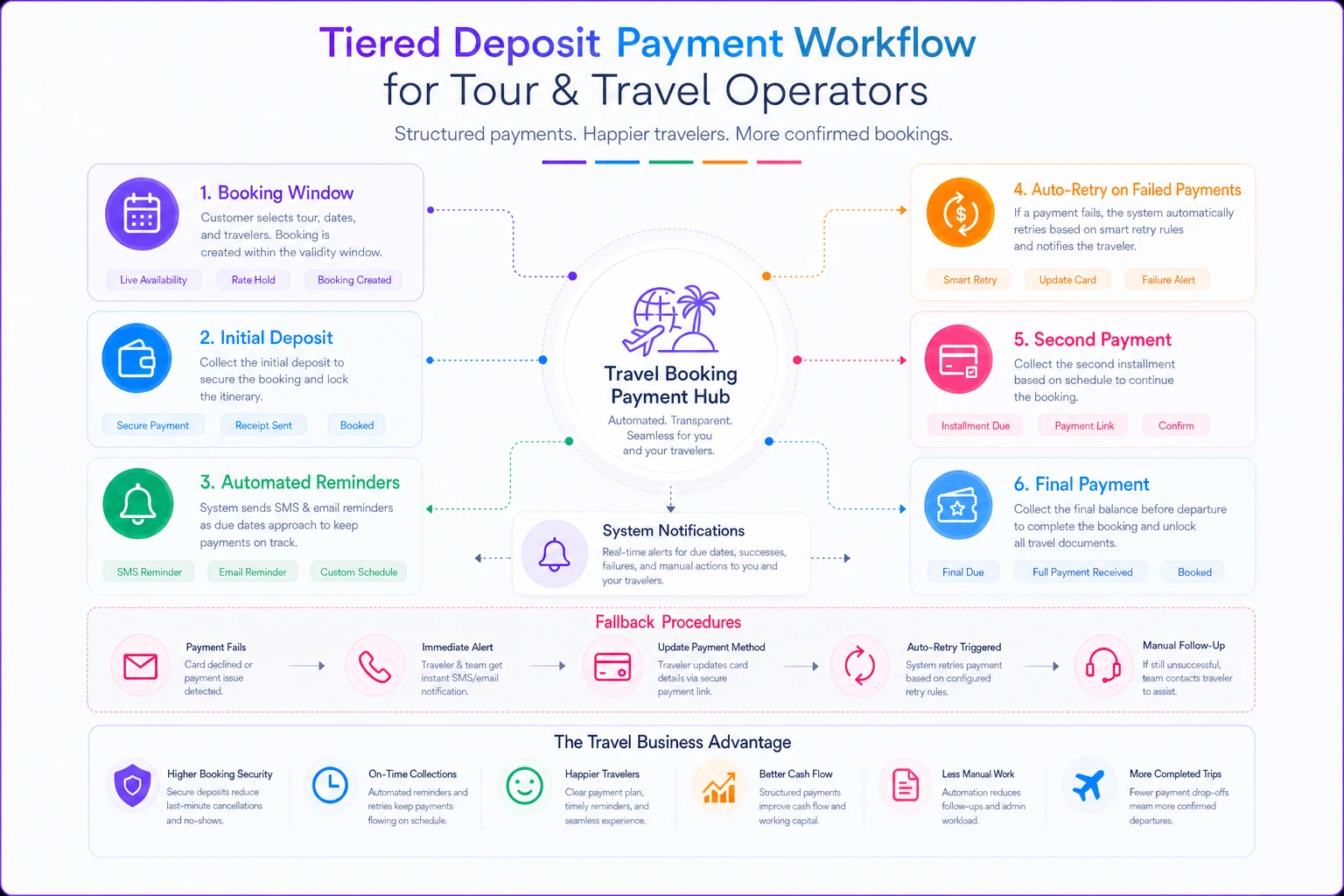
Automate SMS reminders 48 hours before each payment milestone and implement auto-retry logic to reduce payment-related cancellations.
One operator cut their payment-related cancellations by around 31% just by adding SMS reminders 48 hours before each payment milestone and running auto-retry logic on failed payments. The infrastructure matters more than the split itself.
Inventory allocation rules that assume volatility, not stability
Traditional inventory management assumes relatively predictable booking curves. Reserve 80% for direct sales, 20% for partners, adjust based on pace. That framework collapses when booking behavior turns erratic.
Never miss a booking or update.
Touryly streamlines your travel bookings, confirmations, and itinerary updates—all in one place.
- Unified booking management
- Automated customer notifications
- Itinerary & staff coordination
No credit card required
What's working instead: dynamic allocation based on real-time conversion metrics, not historical patterns. Trigger-based reallocation rules instead of fixed percentages.
A walking tour company in Boston restructured their entire allocation model around volatility indicators:
Base allocation (45 days out):
-
Direct channel
65%
-
OTA partners
25%
-
Buffer inventory
10%
Reallocation triggers:
-
If direct conversion drops below 2.8% for 3 consecutive days → shift 10% from direct to OTA
-
If cancellation rate exceeds 15% in any 7-day period → increase buffer to 15%
-
If last-minute bookings (under 48 hours) exceed 30% of total → hold additional 5% buffer
Recovery triggers:
-
If direct conversion recovers above 3.5% → reclaim 5% from OTA allocation
-
If pace exceeds forecast by 20% → release 50% of buffer inventory
Running this manually means daily spreadsheet work and someone checking numbers constantly. The automated version runs these calculations every few hours and adjusts channel availability without human input. Catching a demand shift in real-time versus discovering it in a weekly report can be thousands in lost revenue.
Messaging that acknowledges reality without sounding desperate
Marketing teams want to act like everything's normal. Operations knows it's not. That disconnect tends to produce messaging that either ignores customer concerns entirely or overcorrects into aggressive discounting. Neither works.
The middle path requires operational input in customer communication — not just what to say, but when to say it based on actual behavior patterns.
A kayak tour operator in the Pacific Northwest built their entire summer communication strategy around observed behavior shifts:
Pre-booking phase (awareness/consideration):
-
Emphasize total experience value, not just price
-
Include "flexibility guarantee" messaging prominently
-
Show payment plan options upfront, not buried in checkout
Booking phase:
-
Present flexible cancellation terms before price
-
Display "held for 24 hours" option for fence-sitters
-
Show real availability numbers to create urgency without fake scarcity
Post-booking phase:
-
Send value reinforcement emails 14 and 7 days before travel
-
Include "still excited?" check-ins with easy modification links
-
Proactively offer date changes if weather forecasts look questionable
Recovery phase (for cancellations):
-
Immediate credit offer instead of refund
-
Extended validity (12-18 months instead of 6)
-
Transfer option to friends/family
The nuance: different messages for different behavioral segments. Customers who booked 60+ days out get stability messaging. Last-minute bookers get availability and experience focus. Repeat customers get loyalty recognition that actually means something.
Building cancellation policies that protect cash flow without destroying goodwill
The old model was simple: graduated penalties based on days before departure. Cancel 30 days out, lose 25%. Cancel 7 days out, lose everything. That binary approach doesn't match how customers actually think about cancellation decisions anymore.
What's working better: risk-based cancellation structures that account for resale probability and actual operational cost.
| Cancellation Window | Standard Tours | Premium/Small Group | Private Tours |
|---|---|---|---|
| 30+ days | Full refund minus $25 processing | Full refund minus 10% | 15% penalty |
| 14-29 days | 75% refund | 60% refund | 40% refund |
| 7-13 days | 50% refund | 25% refund | No refund, 50% credit |
| Under 7 days | No refund, 25% future credit | No refund, no credit | No refund, no credit |
But the policy itself is only part of it. The operational machinery behind it matters just as much.
You need automatic refund processing that doesn't require three emails and a phone call. Clear documentation of cancellation reasons for pattern analysis. Immediate inventory recovery so cancelled spots become available for resale. Credit tracking that doesn't live in a spreadsheet someone forgets to update.
One operator found that roughly 40% of their "cancellations" were actually modification requests that got mishandled.
They built a simple decision tree: if a customer contacts about cancelling, first offer a date change, then offer credit, then process the cancellation. That sequence alone reduced actual cancellations by about 22%.
Creating surge protocols for last-minute booking spikes
When booking windows compress, last-minute availability becomes your highest-value inventory. Most operators treat day-before spots the same as month-before spots. That's leaving real money on the table.
The pattern emerging across operators: surge-style operational adjustments for the final 72 hours of availability. Not just price changes, but workflow modifications.
A food tour company in New Orleans built this escalating protocol:
72 hours before tour:
-
Release any held inventory back to all channels
-
Increase price by 15-20% on direct bookings
-
Send "final spots" alert to wait list and past customers
-
Lock modifications to prevent operational chaos
48 hours before tour:
-
Require full payment (no payment plans)
-
Add $10-15 convenience fee for processing
-
Stop accepting group bookings over 4 people
-
Send confirmation requirements to all existing bookings
24 hours before tour:
-
Direct bookings only (pull from OTAs)
-
Price increase of 30-40% from base
-
Require phone confirmation for new bookings
-
Prep backup guide in case of overflow
The operational discipline required here is real. You can't wing it when dozens of last-minute bookings are coming in. Every process needs documentation, every scenario needs a fallback path.
Monitoring metrics that actually predict problems
Everyone tracks booking volume and revenue. Almost nobody tracks the early warning signals that predict operational stress before it arrives.
Booking velocity variance: Not just total bookings, but the rate of change in booking pace. A sudden acceleration often precedes a cliff.
Payment failure rate: Tracks customer financial stress better than any survey.
Modification request ratio: High modification rates signal commitment uncertainty before cancellations show up.
Channel conversion delta: A growing gap between direct and OTA conversion points to a price sensitivity shift.
Cancellation timing distribution: Cancellations clustering around specific windows reveal what's actually triggering the decision.
An adventure tour operator in Colorado built a simple monitoring setup around these metrics. When payment failures exceeded 8% or modification requests hit 15% of bookings, they automatically triggered their volatility protocol — tighter payment terms, increased buffer inventory, adjusted cancellation fees.
Manually checking these metrics daily is manageable at 50 bookings a week. At 500 bookings it becomes untenable. The difference between catching a trend after 3 days versus 3 weeks can be genuinely brutal for cash flow, which is where AI-powered operational platforms start earning their keep — flagging anomalies automatically instead of waiting for someone to notice.
Why the old seasonal pricing rules don't work anymore
Traditional seasonal pricing assumed predictable demand curves — high season means high prices, shoulder season means discounts. When customers shop differently, those rules break down fast. We covered dynamic pricing rules in detail, but the current environment demands even more nuanced approaches.
The shift worth making: pricing based on booking behavior, not calendar dates. A tour can be in "high season" by the calendar while showing low-season booking patterns. Your pricing should reflect actual demand, not theoretical seasonality.
A whale watching operator in Maine normally raises prices 40% for July-August. This year they're seeing stronger demand for September-October as customers delay decisions. They adjusted their pricing calendar to follow booking patterns instead of traditional seasons. Revenue up roughly 18% despite softer July numbers.
Building for a different kind of peak season
Summer 2026 isn't going to look like summer 2019, and operators who pretend otherwise will have a rough time. Improved consumer sentiment sitting alongside persistent cost concerns creates a specific operational challenge — customers want to travel but need different terms to actually commit.
The operators handling this well are rebuilding around three principles:
-
Flexibility without chaos Multiple payment options, change-friendly policies, and dynamic inventory allocation — all backed by systematic processes that don't create operational meltdowns.
-
Speed with accuracy Compressed booking windows demand faster decisions and execution, but not at the expense of getting things right.
-
Monitoring that matters Real-time tracking of behavioral indicators, not just outcome metrics, with automatic triggers for operational adjustments when things shift.
The tools exist. Modern AI-assisted operational platforms can automate payment collection across multiple touchpoints, dynamically adjust inventory allocation, and surface anomalies before they become cash flow problems. The challenge isn't technology — it's accepting that customer behavior has fundamentally shifted and operations need to shift with it.
Operators still running 2019 playbooks are going to learn expensive lessons this summer. Those adapting to match actual customer behavior will capture more than their share of a challenging but still substantial market. The window to make these adjustments before peak season fully kicks in is closing fast.
Ready to elevate your travel business?
Join 500+ travel operators using Touryly to optimize bookings, improve client satisfaction, and grow revenue.