

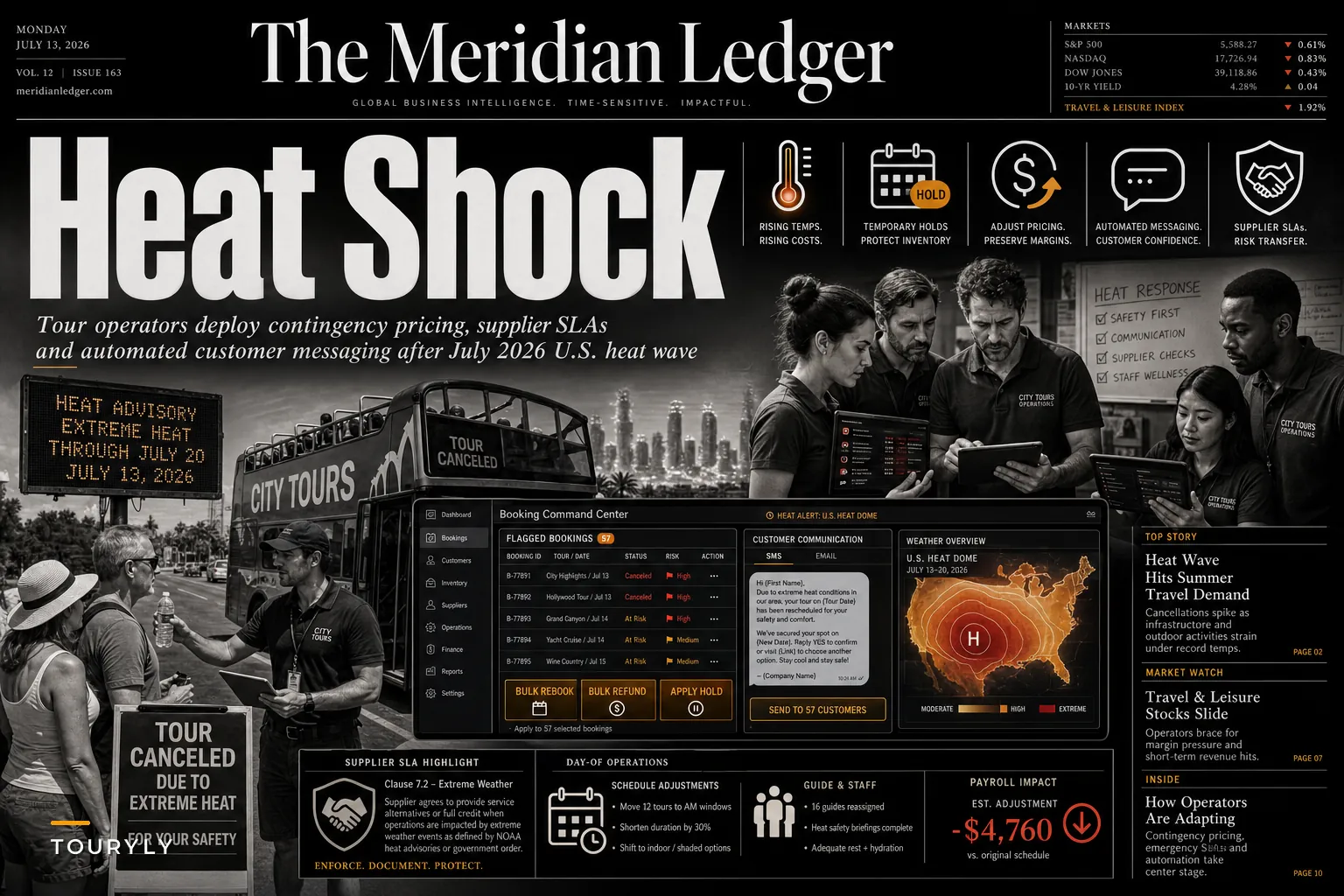

The July 4th weekend made heat wave contingency for tour operators very real, very fast. Reuters reported widespread event cancellations across the eastern U.S., power grids buckled under record demand, and transport networks started issuing delay warnings. For tour operators running at peak summer capacity, this wasn't just uncomfortable weather—it was an operational crisis hitting during the most important revenue week of the year.
What made it particularly brutal was the cascade. First, outdoor venues started canceling. Then transport providers slowed down. Power outages knocked out hotel air conditioning. Suddenly operators had thousands of customers expecting experiences that physically couldn't happen, suppliers invoking force majeure, and no clear playbook for who absorbs which costs.
The immediate refunds hurt. But the longer-term damage was worse—watching supplier relationships fall apart over contract interpretation, customer trust evaporate through fumbled communications, and realizing your standard operating procedures had nothing to say about temperature-triggered failures at this scale.
The supplier breakdown nobody plans for
Most tour operators build their supplier agreements around obvious risks—bankruptcy, natural disasters, strikes. Few think to define what happens when temperatures hit 115°F for five days straight and your outdoor walking tour supplier simply refuses to operate for safety reasons.
Here's what typically unfolds: your supplier points to their force majeure clause. You point to your SLA requiring 48-hour cancellation notice. They argue extreme heat qualifies as an "act of God." You argue the forecast gave plenty of warning. Meanwhile, customers are demanding refunds, your accounting team doesn't know how to categorize anything, and your guides are stuck at meeting points waiting for someone to make a decision.
The gap in most contracts isn't about defining force majeure—it's about establishing temperature thresholds, notice requirements, and cost-sharing formulas when heat makes operations genuinely unsafe. A venue claiming they "can't operate" at 95°F is a different conversation than documented health warnings at 110°F. Without specific temperature triggers written into agreements, you're negotiating from scratch during the crisis itself.
Building heat-specific supplier clauses that actually work
After watching operators scramble through heat-related failures, the pattern becomes obvious: generic weather clauses create more problems than they solve. You need explicit temperature provisions that address three specific scenarios.
Never miss a booking or update.
Touryly streamlines your travel bookings, confirmations, and itinerary updates—all in one place.
- Unified booking management
- Automated customer notifications
- Itinerary & staff coordination
No credit card required
-
Graduated response thresholds. Instead of a binary "operate or cancel" decision, build in modifications. At 95°F, outdoor tours shift to early morning slots. At 100°F, you switch to shortened routes with mandatory hydration breaks. At 105°F, you pivot to indoor alternatives. Only at 110°F or official heat emergency declarations do you trigger full cancellations. Each threshold needs clear financial implications—who covers overtime for schedule changes, who pays for water stations, who absorbs revenue loss from shortened experiences.
-
Notice periods tied to forecast accuracy. A seven-day forecast showing extreme heat should trigger preliminary adjustments. Three-day forecasts lock in contingency plans. Day-of surprises still happen, but they become the exception with defined penalties rather than the standard excuse.
-
Customer communication ownership. Nothing destroys relationships faster than conflicting messages from operators and suppliers. Your contract should clarify who notifies customers, what language gets used, and how refund messaging aligns. There are situations where suppliers told customers "full refunds available" while operators were offering credits—that kind of contradiction creates trust issues that linger for months.
Some operators are now adding "temperature insurance" provisions—pre-negotiated cost sharing when heat triggers affect more than 20% of scheduled operations in a week. Supplier absorbs 30% of the revenue hit, operator takes 30%, and 40% gets covered through dynamic pricing adjustments on remaining inventory.
| Party | Cost share |
|---|---|
| Supplier | absorbs 30% of the revenue hit |
| Operator | takes 30% |
| Dynamic pricing | 40% gets covered through dynamic pricing adjustments on remaining inventory |
It's not a perfect system but it gets everyone aligned before things go sideways.
Contingency pricing without destroying customer trust
When half your Saturday tours cancel due to heat, your Sunday inventory suddenly gets a lot more valuable. The question isn't whether to adjust pricing—it's how to do it without looking like you're capitalizing on a crisis.
Operators who handle this well use what I'd call capacity-based transparency. Instead of suddenly raising prices 50%, they implement pre-published heat surge pricing tiers. Customers see in advance that bookings during heat emergencies carry a 15-25% premium to cover additional operational costs—extra staff, backup venues, enhanced safety measures. Framed as covering real costs, not opportunistic gouging.
More importantly, they differentiate between existing customers needing rebooking and new customers purchasing. If someone's Wednesday tour got canceled, their rebooking into Sunday happens at original pricing. New customers booking that same slot see the surge rate. This protects your reputation with affected customers while still capturing revenue from increased demand.
The more interesting trend is "heat hedging" built into package pricing. Operators adding a 5-10% buffer into summer packages specifically to cover disruptions, marketed as "worry-free summer booking" with guaranteed alternatives or full refunds if heat prevents operation. Customers tend to prefer paying slightly more upfront over dealing with uncertainty during their vacation.
Customer messaging scripts that prevent mass panic
When temperatures trigger mass cancellations, your customer service team faces an impossible volume spike at exactly the moment they need to be most careful. The difference between a managed situation and a reputation disaster often comes down to having the right templates ready.
Start with the initial notification. Don't bury the lead. "Your Thursday tour is canceled due to extreme heat safety concerns. You have three immediate options..." beats two paragraphs explaining weather patterns. Customers in crisis mode need clarity, not context.
Build templates around decision trees. If the customer has flexibility, offer rebooking first with an incentive—10% off their next tour, a free upgrade, something tangible. If they're leaving town, offer a full refund with a clear timeline. If they're upset about disrupted plans, have a specific goodwill gesture ready—partner restaurant vouchers, priority booking for their next visit, something that costs you less than losing the customer entirely.
The element most operators miss: differentiated messaging by booking channel. Direct customers get one message. OTA bookings need different language that accounts for their refund policies. Group bookings need coordinator-focused communication. Corporate bookings might need formal documentation for internal travel policies. Same template for everyone guarantees confusion.
Operators who led with empathy and clear options saw around 70% of customers accept alternatives or future credits. Those who started with policy explanations and justifications saw closer to 85% demand immediate refunds. The framing genuinely matters.
Safety protocols that protect staff and limit liability
Guides and outdoor staff become liability exposure during extreme heat. One heat stroke incident can trigger workers' comp claims, lawsuits, and regulatory scrutiny that disrupts operations for months. Most operators still rely on "use your judgment" guidance instead of specific protocols.
The baseline starts with mandatory cancellation thresholds. When wet-bulb temperature hits 95°F, outdoor operations stop. No guide discretion, no customer pressure, no exceptions for "important groups." This protects both staff and your liability coverage.
Designate a "heat captain" before the season starts to centralize decisions and remove pressure from individual guides.
The harder operational challenge sits between 85°F and 95°F, where tours might continue with modifications. Some operators now use "heat cards"—laminated reference guides that tell guides exactly what changes at each temperature tier. At 87°F: mandatory 10-minute breaks every 30 minutes. At 90°F: routes must include indoor or shaded stops every 15 minutes. At 93°F: tours shortened by 25% with full refund offers for any dissatisfied customer.
Document everything digitally. Guides should log temperature readings at start, middle, and end of tours. Note any customer complaints. Record all safety stops and modifications. This creates the paper trail that proves you took conditions seriously if anyone later claims negligence. One operator was able to successfully defend against a heat exhaustion lawsuit largely because they had timestamped photos showing water stations and shade breaks throughout the tour.
The forward-thinking move is designating "heat captains" during summer months—specific staff who monitor conditions and have authority to modify or cancel operations. This removes the burden from individual guides who might feel pressure to continue and centralizes decision-making with someone tracking the full picture.
Building financial reserves for heat surge seasons
Every operator knows summer brings higher revenues. Far fewer properly account for the volatility that extreme heat introduces into those projections. The old model of steady June-through-August bookings gets replaced by wild swings between sellout weeks and mass cancellation events.
The math is getting rough. A single three-day heat dome can wipe out 15-20% of monthly revenue through cancellations and refunds. But indirect costs tend to hurt more: overtime for rebooking management, rush procurement for additional supplies, premium rates for backup venues, compensation for staff who showed up but couldn't work. One operator's actuals from a heat week showed direct refunds of $47,000—but total impact including indirect costs came to around $78,000.
The solution isn't just holding more cash. It's restructuring how you account for heat risk throughout pricing and operations. Start by analyzing your actual heat exposure. What percentage of your summer offerings are temperature-vulnerable? How much inventory could you realistically shift indoors or to early morning if needed? That gives you something like a heat risk score that should directly influence reserve requirements.
Then implement summer season loading—charging 8-12% more for July-August bookings, with that premium specifically allocated to a disruption reserve. Market it honestly: summer experiences cost more because they require more contingency planning and backup options. Customers understand this when you explain it upfront rather than hitting them with surge pricing during a crisis.
The smartest financial move we're seeing is operators partnering with hotels and indoor venues on contingency agreements. Pay a small monthly retainer to guarantee backup space during heat emergencies. Suddenly your outdoor food tour can pivot to an air-conditioned market hall. Your walking tour becomes a bus tour with indoor stops. The retainer seems like an unnecessary cost until you calculate it against even one week of mass refunds.
Technology infrastructure for heat event management
When extreme heat triggers operational chaos, manual systems fall apart. You can't have staff calling hundreds of customers while simultaneously rebooking tours and negotiating with suppliers. Operators who came through recent heat waves with minimal damage had one thing in common: their systems could handle rapid bulk changes without requiring someone to manage every action manually.
Automated weather monitoring tied to your booking system is the starting point. Instead of someone manually checking forecasts, your platform should automatically flag bookings when temperatures are forecast to exceed thresholds—giving you 3-5 days to begin contingency communications. Our analysis of supplier SLA failures showed that weather-triggered issues with proper monitoring had significantly better outcomes than purely reactive responses.
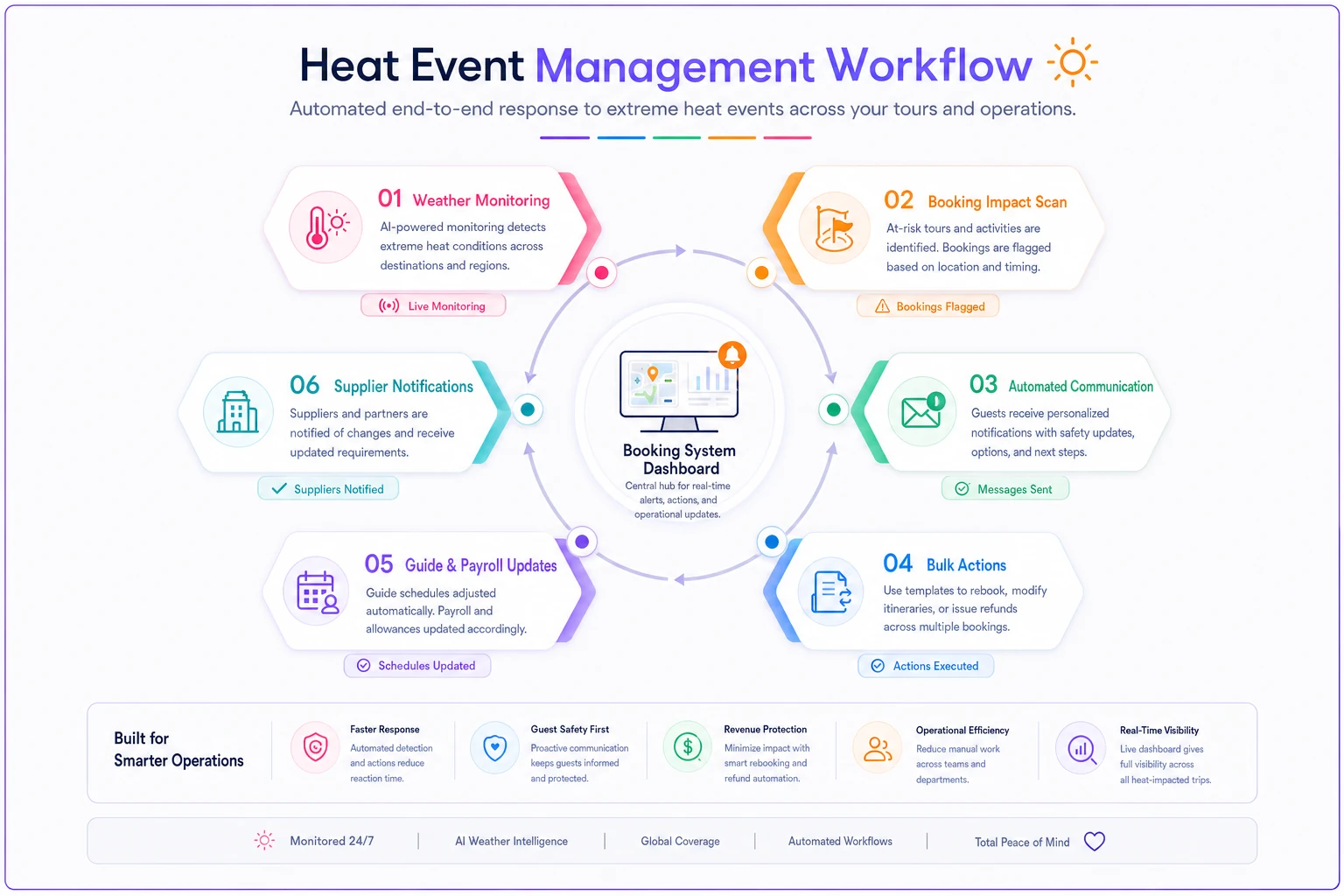
A simple workflow showing triggers, automated customer and supplier actions, and system updates.
The real efficiency comes from templatized bulk actions. When heat forces a cancellation, you need the ability to: notify all affected customers with appropriate messaging, automatically offer alternative dates based on availability, process refunds or credits based on customer preference, update guide schedules and payroll, and trigger supplier notifications with required documentation. Doing this manually for 50 bookings takes hours and introduces errors at every step. Properly configured systems handle it in minutes.
Where most operators' systems fall short is conditional logic. Not every heat cancellation is identical. A morning tour at 95°F might proceed with modifications while an afternoon tour needs full cancellation. Corporate bookings might have different refund rules than direct consumers. Your system needs to apply the right rules to the right bookings without someone manually sorting through each case.
AI-powered operational platforms can now monitor weather patterns, suggest operational adjustments, and even predict which customers are most likely to accept alternatives versus demand refunds—letting your team focus on high-value retention conversations while routine rebooking gets handled automatically.
Learning from this July's operational failures
The July 4th heat wave exposed how unprepared the tour industry still is for extreme temperature events. CNBC noted the strain on power grids and travel infrastructure during that period, and tour operators felt it directly. But it also created a natural experiment in what actually works when heat breaks your standard operations.
The operators who maintained customer trust through the crisis had three things in common. They had specific heat protocols rather than general weather policies. They communicated proactively—customers heard about potential disruptions before they became actual cancellations. And they absorbed some financial pain themselves rather than pushing all costs to either suppliers or customers.
The ones who saw relationships fall apart made one of three mistakes: they waited too long hoping conditions would improve; they hid behind force majeure clauses without showing any flexibility; or they treated all affected bookings identically when different customer situations clearly needed different responses.
Moving forward, heat wave contingency for tour operators can't stay an afterthought buried in general terms and conditions. It needs dedicated planning, specific protocols, and operational systems capable of handling the chaos that extreme heat creates.
The business case isn't subtle. Operators with comprehensive heat contingency planning retained the majority of affected customers through credits or rebooking. Those running purely reactive responses lost most of them to immediate refunds. In an industry where customer acquisition costs keep climbing, keeping an existing customer through a weather crisis is worth far more than whatever flexibility you demonstrate in that moment.
The heat events are going to keep coming. The question is whether your operation has clear contracts, tested protocols, and systems built to handle the chaos—or whether each heat wave becomes another scramble that chips away at your margins and your customer relationships. The operators holding up through these disruptions made their choice before the crisis hit.
Ready to elevate your travel business?
Join 500+ travel operators using Touryly to optimize bookings, improve client satisfaction, and grow revenue.