


The worst time to figure out who owns your merchant failover is at 2:14am when your PSP's fraud team has just frozen the account and tomorrow's departures are bouncing. By then you're not running an incident — the incident is running you.
This brief is built for operators who already know a breach is possible and want the actual artifacts on hand: the worksheets, matrices, runbooks and templates you can print, fill in, and hand to whoever is on shift. No theory. If you're looking for the legal-notification and customer-communications side specifically, that's a separate stack — this one is about keeping payments moving, preserving evidence correctly, and not making the breach worse while you contain it.
One thing worth saying upfront: most of the damage after a payments incident doesn't come from the breach itself. It comes from the panicked, uncoordinated hour after someone notices. People start deleting logs to "clean up," support keys card numbers into chat to help a stranded customer, and three different people call the PSP with three different stories. The artifacts below exist mostly to stop that.
Artifact 1: The 90‑minute data‑map worksheet
You cannot contain what you can't locate. The single biggest delay in an incident is operators spending the first day arguing about where cardholder data and PII actually live instead of locking it down. A data map built beforehand turns that argument into a 90-minute fill-in-the-blanks exercise.
Run it as a timed worksheet with two people: one who knows the booking stack, one who knows payments.
Block 1 — Inventory (first 30 minutes). List every system that touches PII or payment data. Be specific. Not "the CRM" — the CRM, its backups, the CSV export someone runs for the weekly manifest, the shared mailbox where suppliers send passport scans.
Block 2 — Classify (next 30 minutes). For each system, tag the data class. Four buckets, so people stop overthinking it:
| Data class | Examples for tour ops | Breach sensitivity |
|---|---|---|
| Full PAN / card data | MOTO bookings keyed into a terminal, stored card-on-file tokens | Critical — PCI scope |
| Identity PII | Passport numbers, DOB, visa details, dietary/medical notes | Critical — regulated |
| Contact PII | Name, email, phone, billing address | High |
| Operational | Booking refs, itinerary, supplier allocations | Medium |
Block 3 — Flow and owner (final 30 minutes). For each system: where does the data come from, where does it flow to, who owns it, and is it in PCI scope? The "flows to" column is the one everyone skips and later regrets — that's how you discover booking data also sitting in a marketing tool nobody secured.
The deliverable is a one-page table you can hand to your forensic contact and say "here's our attack surface." Operators who have this ready shave the better part of a day off containment.
Artifact 2: Supplier contact & escalation matrix
During an incident you'll need to reach your PSP, your acquirer, your booking platform vendor, and often two or three suppliers whose fulfilment depends on the data you're about to lock down. Phone-tree chaos is real. Build this as a flat table, printed, with a copy stored offline — because if the breach touches your identity provider, you may not be able to log into the tool that holds the contacts.
Never miss a booking or update.
Touryly streamlines your travel bookings, confirmations, and itinerary updates—all in one place.
- Unified booking management
- Automated customer notifications
- Itinerary & staff coordination
No credit card required
Each row needs: organisation, primary contact, after-hours number, your account/merchant ID, the escalation name one level up, and the expected response SLA. Add a "what they need from us to act" column. PSPs in particular will stall for 20 minutes verifying you're authorised — having your merchant ID and the name of the authorised signatory written down kills that delay.
A pattern worth copying: mark each supplier as payment-critical, data-critical, or both. When you're triaging who to call first, that tag tells you instantly. Your PSP is payment-critical. The vendor hosting your passport-scan mailbox is data-critical. Your core booking platform is usually both.
Build this, print it, and store an offline copy where the on-shift team can grab it in an emergency.
Artifact 3: Incident‑command role matrix
The failure mode is obvious once you've seen it: everyone's on the call, nobody's deciding. Or the opposite — one founder trying to run comms, payments, and forensics simultaneously and dropping all three.
Assign these five roles in advance. One person per role, named, with a named backup:
-
Incident Commander — makes the lockdown-vs-friction calls, owns the timeline, doesn't do hands-on work.
-
Payments Lead — owns the PSP relationship, failover, re-tokenisation.
-
Security/Forensics Lead — owns evidence preservation and technical containment.
-
Comms Lead — owns customer and supplier messaging, coordinates with legal on notification.
-
Scribe — logs every decision with a timestamp.
The Scribe matters more than people expect. When regulators or your acquirer ask "when did you detect, and what did you do," a timestamped decision log is the difference between a controlled response and a guessing game. One log, one owner, append-only.
Artifact 4: Merchant‑failover runbook
If your primary merchant account gets frozen or you route away from a compromised integration, bookings need to keep clearing without double-charging anyone.
Detection thresholds
-
Auth decline rate jumps roughly 2–3x your baseline for 15 minutes
-
PSP returns account-level error codes, not card-level declines
-
Settlement file fails to arrive within your normal window
-
Fraud-review queue spikes well beyond your normal daily volume in an hour
Below is a simple workflow to run when the detection thresholds are met.
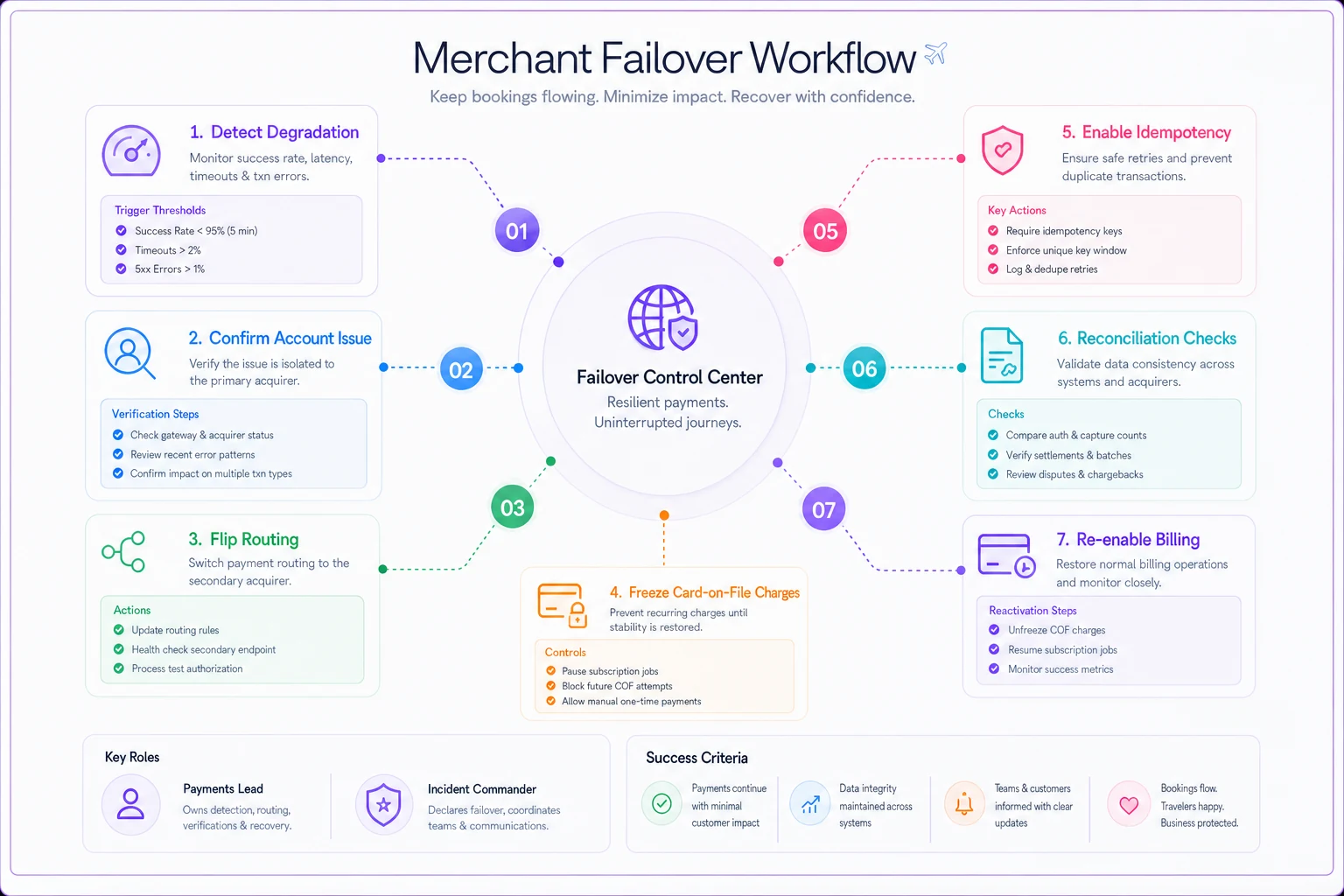
The failover process
-
Confirm it's the account, not the cards. Check whether declines are account-level or spread across many cards failing individually. Account-level means failover; scattered card declines usually don't.
-
Flip routing to the secondary acquirer. This only works if you set one up before the incident — more on that below.
-
Freeze card-on-file charges. Recurring and COF charges are where double-billing happens during failover. Pause them manually before you re-route.
-
Enable idempotency keys on every charge request. If you're not already sending them, this is where re-routing creates duplicate charges.
-
Run the reconciliation check (below) before you re-enable automated billing.
Idempotency / reconciliation checklist
-
[ ] Every charge request in the failover window carries a unique idempotency key tied to the booking ref
-
[ ] No booking ref has two successful auths across both acquirers
-
[ ] Settlement totals from primary + secondary match expected booking revenue for the window
-
[ ] Refunds issued during the window aren't re-issued on the secondary rail
-
[ ] COF charges that were paused are reconciled before re-enabling
The honest prerequisite: failover only works if the secondary rail already exists. You cannot onboard a new acquirer mid-incident — underwriting takes days. Operators who've been through this keep a dormant secondary merchant account live precisely so they can flip to it in minutes.
Keep a dormant secondary merchant account live so you can flip to it in minutes.
Operators who've been through this keep a dormant secondary merchant account live precisely so they can flip to it in minutes.
Artifact 5: Logs & forensic‑artifact preservation checklist
The mistake that turns a manageable incident into an uninsurable one: someone starts "cleaning up" the compromised system before anything is preserved. Rebuilding the server, rotating logs, deleting the suspicious export. Every one of those destroys evidence your cyber-insurer and forensic team will need — and in some cases destroys your ability to prove what was and wasn't taken, which forces you into a worst-case notification scenario.
Preserve first, remediate second
-
[ ] Snapshot affected systems before any change (full disk image where possible, not just file copies)
-
[ ] Preserve system, application, auth, and PSP/webhook logs covering at least 30 days before detection
-
[ ] Export access logs for the systems in your data map
-
[ ] Capture the state of any compromised credentials before rotating them (note them, then rotate)
-
[ ] Do not power-cycle a live-compromised host before imaging if volatile memory may matter — ask forensics first
Chain of custody
For each artifact preserved, record: what it is, when it was captured, who captured it, where it's stored, and a hash of the file. This sounds bureaucratic until your insurer asks whether the evidence could have been tampered with. A single shared spreadsheet with those five columns, append-only, owned by the Forensics Lead, is enough.
Preservation and remediation are different jobs, and preservation always goes first. The instinct to fix the hole immediately is exactly what destroys the evidence.
Artifact 6: Short‑lived token adoption and emergency re‑tokenisation playbook
If stored card-on-file tokens are in scope, you may need to invalidate and re-tokenise an entire book of recurring customers — fast, without breaking every upcoming charge.
PSP contact script (fill in the blanks)
> "This is [name], authorised contact for merchant ID [___]. We're managing a security incident and need to [invalidate stored tokens / rotate our tokenisation keys / confirm whether tokens are affected]. Can you confirm: (1) whether our stored tokens are compromised, (2) your emergency re-tokenisation process, and (3) the impact on scheduled recurring and COF charges during the rotation?"
Having this scripted stops the Payments Lead from improvising under stress and skipping the question that matters most.
TTL recommendations
-
One-off bookings
token TTL measured in minutes, not stored beyond auth
-
Card-on-file for deposits/balance
longer-lived network tokens, rotated on a schedule
-
Any token that must persist
ensure it's a network token tied to the PSP, not a raw stored reference
Recurring / COF handling during re‑tokenisation
-
Identify all bookings with a future scheduled charge against an affected token
-
Re-tokenise where the PSP supports silent re-tokenisation (network tokens often update automatically)
-
For the rest, trigger a re-auth flow — a short, plain customer message asking them to confirm their card, not a scary breach notice
-
Hold the charge, don't fail it, while tokens rotate
Short-lived tokens are far easier to rotate than long-lived stored references, which is reason enough to move toward them before an incident forces the issue.
Artifact 7: PCI‑safe MOTO workflow cheat‑sheet
MOTO bookings are where well-meaning staff create new exposure during an incident. A customer calls, stranded, can't pay online because you've locked a system down, and an agent takes the card number over the phone — and writes it on a sticky note, or types it into chat, or emails it to the ops team.
Pin this next to every phone:
-
Card numbers are never written down, typed into chat/email, or stored in the CRM notes field
-
Key card data directly into the PCI-compliant terminal or virtual terminal only
-
Don't read card numbers back aloud in a shared office
-
If a call drops mid-payment, re-key fresh — don't store the partial
-
No screen-sharing while a card is on screen
-
After the auth, confirm with the booking ref, not the card number
Good intent is exactly the problem here. Staff trying to help a stranded customer take "just this one" card the quick way. During an incident, that one card is how your containment leaks.
Artifact 8: Supplier audit checklist + sample contract clauses
A meaningful share of tour-operator breaches come through a supplier — the DMC, the activity provider, the reseller you share manifests with. After your own incident, audit who else holds your customers' data.
Audit checklist:
-
[ ] Which suppliers receive PII (names, passport data, dietary/medical notes)?
-
[ ] How do they receive it — secure portal, or email attachment?
-
[ ] Do they store it, and for how long?
-
[ ] Have they confirmed in writing they weren't the breach vector?
-
[ ] Do your contracts actually require breach notification to you?
Sample clauses worth including in every supplier contract:
> Breach notification. Supplier shall notify Operator within 24 hours of discovering any actual or suspected compromise of Operator's customer data, including the nature of the data affected and remediation steps taken.
> Data handling. Supplier shall not store full card data and shall transmit PII only via [named secure method]. Operator may audit compliance on reasonable notice.
> Deletion. Supplier shall delete Operator customer data within [X] days of trip completion unless retention is legally required.
The gap that keeps appearing: operators email passport scans to suppliers as attachments and have no clause requiring deletion. Years of passport data sitting in supplier inboxes, entirely outside your control.
Artifact 9: Customer notification timeboxes and plain‑language templates
The detailed comms stack — holding messages, confirmed-breach copy, the 0–72h timeline and RACI — is worth treating as its own dedicated pack. For the operational brief, keep three timeboxed triggers and plain-language skeletons ready:
-
Holding (within hours of confirmation) acknowledge you're investigating a security issue, tell customers what they should do right now (watch for suspicious activity), promise an update by a specific time. Don't speculate on scope.
-
Confirmed (once scope is known) state what data was affected, what wasn't, what you're doing, and what support you're offering.
-
Resolution what you fixed, what changed, how to reach you.
Plain language, no legalese, no minimising. "We've detected unauthorised access" beats "a security event may have potentially occurred." Customers forgive honesty far faster than they forgive weasel words.
For the full copy-ready treatment and regulatory timeboxes, the earlier breakdown of the immediate PII, payments and incident-response changes tour operators must make pairs directly with this brief.
Artifact 10: Lockdown vs. friction decision matrix
Not every incident justifies shutting down bookings. Over-reacting costs you a day of revenue; under-reacting spreads the breach. This matrix gives the Incident Commander a fast call.
| Situation | Lockdown (stop the flow) | Add friction (slow it) |
|---|---|---|
| Active exfiltration in progress | Yes — isolate immediately | — |
| Stored card tokens possibly exposed | Freeze COF/recurring | Re-auth customers live |
| Suspicious access, scope unknown | Lock the affected system only | Extra verification on new bookings |
| Supplier breach, your systems clean | No | Rotate shared credentials |
| Credential stuffing on customer logins | No | Force password reset + rate-limit |
The judgment call most people get wrong: locking down everything when only one system is affected. If your data map is good, you lock the compromised system and keep the rest of the business running. Blanket lockdowns are what turn a contained incident into a revenue event.
Artifact 11: Booking‑continuity voucher / export formats
If you have to take the main booking system offline, tomorrow's departures still need to run. Keep an export format defined in advance so the Ops Lead can generate a clean manifest without the live system.
Minimum fields for a continuity export: booking ref, lead passenger name, headcount, date/time, product, supplier, pickup, payment status, and any critical notes (medical/accessibility). Deliberately exclude full card data and keep PII to what the guide genuinely needs on the day.
For guests mid-funnel who can't complete payment during lockdown, a short-lived voucher — booking ref plus a validation code, redeemable when systems return — keeps the sale alive without taking card data through a compromised path.
Artifact 12: Post‑incident payments remediation workflow
Once contained, the payments cleanup begins — and this is where months of reconciliation pain hides if you skip steps.
-
Chargebacks expect a wave if cards were compromised. Pre-stage your evidence packs (booking confirmation, redemption/fulfilment proof, comms). Fraud-flagged transactions you can't defend — concede fast, don't waste the time.
-
Re-auths for every token you rotated, confirm the next scheduled charge succeeded. Build a simple exception list of failures to chase.
-
Duplicate-charge sweep cross-check the failover window again now that things are calm. Refund any genuine double-charges before the customer finds them — proactive refunds generate far fewer disputes.
-
Settlement reconciliation match primary + secondary acquirer settlements against booking revenue for the entire incident window. This is where idempotency keys earn their keep.
-
Close the loop with the Scribe's log every financial action tied back to a timestamped decision, ready for the acquirer or insurer.
Follow these in order and tie each action back to the Scribe's timestamped decisions.
A realistic scenario
A small inbound operator — roughly 600–800 bookings a month, selling multi-day trips with deposits and card-on-file balance charges — gets a call from their PSP flagging unusual activity on stored tokens. No formal plan in place.
What happened the first time: someone rebuilt the affected server to "fix it," wiping two weeks of logs. Support took three stranded customers' cards over the phone and emailed them to ops. The PSP froze the account, and because there was no secondary rail, deposit charges for the next week's departures all failed. The reconciliation afterward took the finance person close to three weeks, and a handful of customers got double-charged in the scramble.
Same operator, second time around, with the artifacts above: detection to contained-and-still-taking-bookings was under two hours. Logs preserved, failover to the dormant secondary account clean, COF charges frozen then re-tokenised silently, zero double-charges. The difference wasn't sophistication. It was having the files open on the right screens and knowing who owned each decision.
Where tooling genuinely helps — and where it doesn't
Most of what makes an incident survivable is preparation and clear ownership, not software. That said, some things are genuinely hard to do manually under pressure: generating a continuity manifest without exposing card data, sending idempotency keys on every charge, keeping an append-only decision log, and reconciling two settlement rails across an incident window.
A booking and payments platform that already enforces tokenisation, supports a secondary acquirer, and can export a clean PII-minimised manifest on demand removes a lot of the improvisation. The point isn't the tooling itself — it's that during an incident you want as few manual, error-prone steps as possible between detection and containment. If your stack forces you to hand-key card data or hand-build manifests mid-crisis, that's a gap worth closing before the next incident, not during it.
Last thing
Print these. Fill in the names, numbers and merchant IDs now, while nothing is on fire.
An incident runbook that lives in a doc nobody has opened is the same as not having one — the value is entirely in the version sitting on the shelf next to the on-shift team, already populated, ready to run the moment someone says "I think we've been breached."
Print these. Fill in the names, numbers and merchant IDs now, while nothing is on fire.
Ready to elevate your travel business?
Join 500+ travel operators using Touryly to optimize bookings, improve client satisfaction, and grow revenue.