

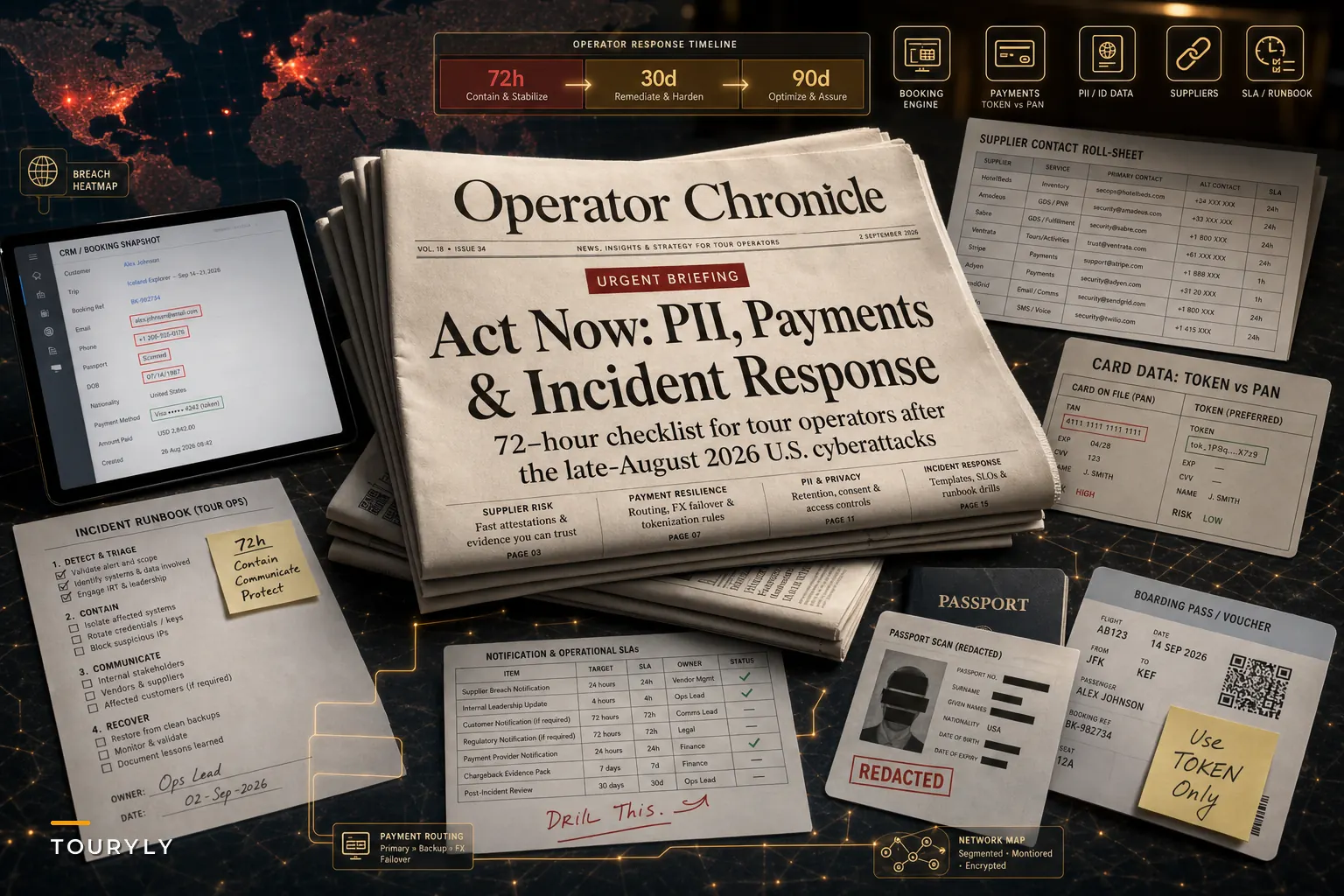

The late-August cluster of attacks got a lot of attention for good reason. Reuters reported that Boston Scientific was hit by a cyberattack that disrupted its global operations, and a day later, a U.S. federal agency confirmed a data breach tied to claims from a ransomware group. Two very different organizations, two very different threat models — and yet both ended up in the same place: systems down or records exposed, with customers and regulators waiting on answers.
For tour operators, the takeaway isn't "big companies get hacked." It's that the failure modes on display map almost perfectly onto how a mid-sized travel business actually runs. You hold passport numbers, dates of birth, emergency contacts, and card tokens. You rely on a booking engine, a payment processor, a channel manager, and a dozen supplier portals — most of which you don't operate and can't patch. If one of those goes dark during peak season, or if one leaks a passenger list, your tour operator data breach response plan is what stands between a bad week and a business-ending event.
This isn't a lecture on cybersecurity theory. It's the operational checklist I'd want a small operator working through this week, ordered roughly by how fast you should move.
Start with the assumption that a supplier will fail before you do
Most operators frame the breach question as "will we get hacked." In practice, the more likely disruption comes sideways — through a platform or supplier you integrate with. A booking engine outage, a payment gateway that goes read-only for 36 hours, a DMC whose email gets compromised and starts sending fake wire instructions. You didn't get breached, but you're absorbing the fallout.
What turns up repeatedly across these integrated setups is that operators have zero visibility into which vendor actually holds which piece of data. Ask a typical 8-person agency "where do our customers' passport scans live," and you'll get three different answers from three different people. That ambiguity is the real vulnerability. When something goes wrong, you can't notify the right people or contain anything if you don't know where the data sits in the first place.
The 90-minute data map exercise:
-
List every system that touches customer PII or payment data (booking engine, CRM, email, payment processor, channel manager, supplier portals, shared drives, spreadsheets).
-
For each, note
what fields it holds, whether card data is tokenized or raw, who at the vendor you'd call in an incident, and how fast they've committed to notifying you.
-
Flag anything storing full card numbers, unencrypted passport images, or PII sitting in plain email threads. Those are your priority fixes.
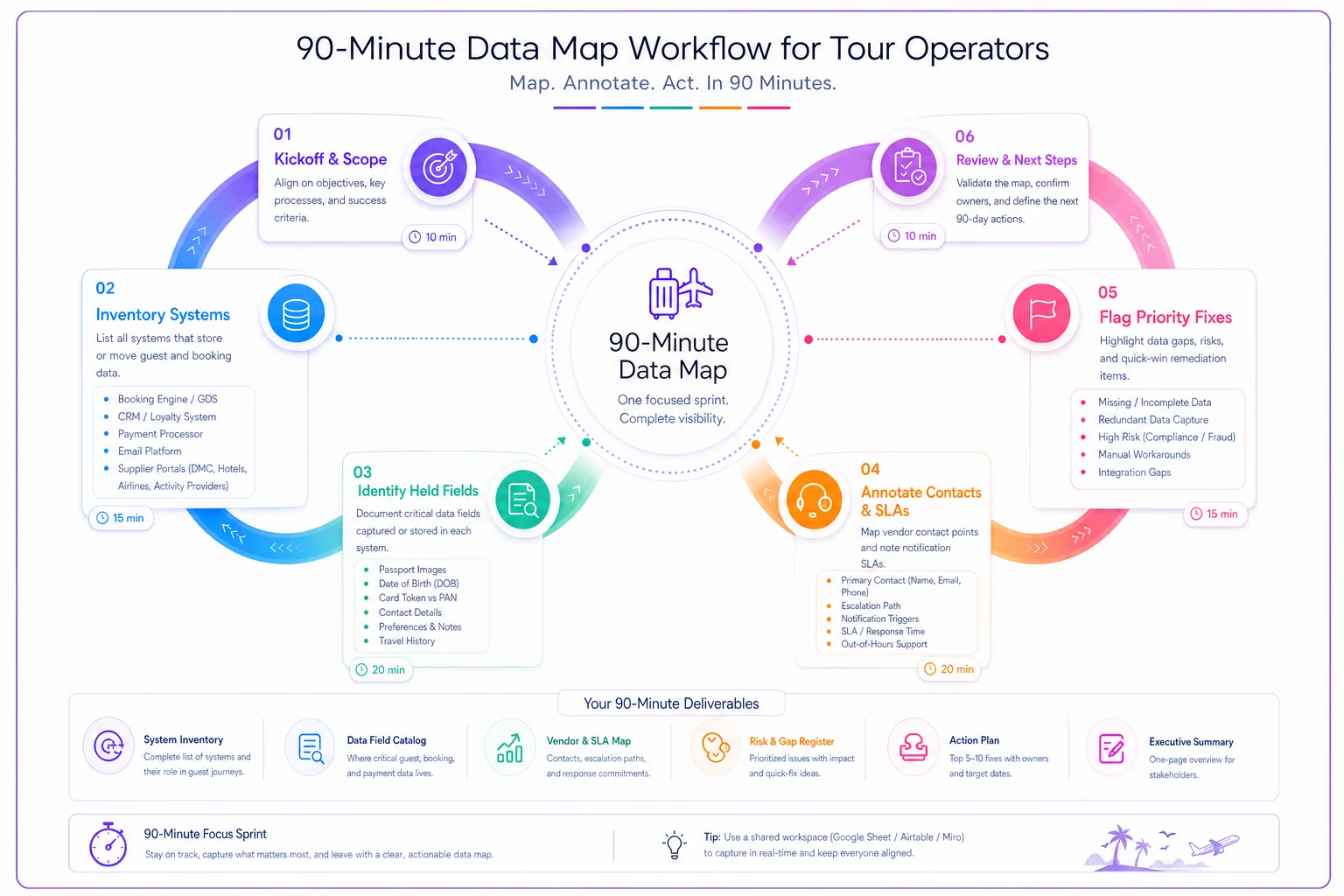
Unglamorous work, but it's the foundation everything else sits on. If you've already built a proper field-by-field PII lifecycle with consent timing and retention calendars, you're mostly done here — pull that document out and add a "who do I call" column to it.
The payment layer is where operators bleed fastest
When a payment processor or card database gets exposed somewhere upstream, two things happen to operators almost immediately: chargeback volume spikes, and fraudulent bookings tick up as stolen cards get tested against live checkouts. You don't have to be the breached party to feel it.
Never miss a booking or update.
Touryly streamlines your travel bookings, confirmations, and itinerary updates—all in one place.
- Unified booking management
- Automated customer notifications
- Itinerary & staff coordination
No credit card required
The pattern worth internalizing: attackers who grab card data don't use it at obvious luxury merchants. They test it on low-friction, instant-fulfillment purchases — which is exactly what a "book now, get voucher instantly" tour flow looks like. A small day-tours operator can go from two or three disputes a month to fifteen in a fortnight simply because a batch of stolen cards is being validated against their checkout.
Payment hardening steps to make this week:
-
Confirm you're storing tokens, not card numbers. If any part of your stack keeps raw PANs, that's a stop-everything problem.
-
Turn on 3-D Secure / step-up authentication for high-value and same-day bookings, even if it costs you a sliver of conversion. The fraud math almost always favors it during elevated-risk periods.
-
Set up a manual-review threshold — bookings above a certain value, or with mismatched billing and travel geography, pause for a human look.
-
Line up a backup payment route. If your primary gateway goes read-only, can you take payments another way without rebuilding checkout at 2am?
Line up a backup payment route before you need it; it's the one operators skip and regret.
That last point is the one operators skip and regret. Payment failover isn't just resilience against your processor being breached — it's resilience against your processor reacting to someone else's breach by tightening rules and declining your legitimate transactions.
What "notification obligations" actually mean when you're small
The part that quietly terrifies most small operators is the legal notification clock. If passenger PII is compromised — yours or a supplier's holding your customers' data — you likely have obligations to notify affected individuals and possibly regulators, often within a defined window. And "we didn't know" is not a defense that holds up well.
Many operators can't even produce a list of whose data would be affected, because bookings, PII, and payment records live in separate systems that don't reconcile cleanly. When the clock starts, you end up doing forensic archaeology instead of actually notifying anyone.
Here's a comparison of how prepared versus unprepared operators experience the same incident:
| Situation | Unprepared operator | Prepared operator |
|---|---|---|
| Discover a supplier leaked a passenger list | Days spent figuring out which bookings used that supplier | Query the booking record, export affected travelers in an hour |
| Regulator asks "who was affected and when did you know" | Reconstruct from email and memory | Pull a timestamped incident log |
| Customers start asking questions | Ad-hoc, inconsistent replies from whoever picks up the phone | Pre-written notification template, single approved message |
| Card data possibly exposed | Unsure if tokens or PANs were involved | Data map already answers this |
The difference isn't budget. It's whether the prep work happened before the incident. You cannot build a notification list in the middle of a crisis — the data has to be queryable ahead of time.
Draft the customer message before you need it
Operators dramatically underestimate how much of incident response is communication, not technology. When Boston Scientific's operations were disrupted, the operational story was outages; the reputational story was how it got communicated. Same dynamic at a smaller scale.
Write three messages now, while you're calm:
-
The "we're investigating" holding message — sent when you suspect an issue but don't have facts yet. Buys you honesty without speculation.
-
The confirmed-breach notification — what happened, what data, what you're doing, what the customer should do (freeze cards, watch statements).
-
The all-clear / resolution note — closes the loop, which most operators forget, and which quietly does a lot to rebuild trust.
Keep them plain. No legalese wall, no defensive tone. A traveler who gets a clear, human message about their exposed passport number stays a customer far more often than one who gets silence followed by a lawyer-drafted PDF three weeks later.
When aggressive lockdown is actually a bad idea
There's a temptation after a news cycle like this to overcorrect — force 3-D Secure on everything, add manual review to every booking, lock supplier integrations behind extra approval steps. For a high-volume, low-value operator running hundreds of instant bookings a week, that can do more damage than the threat you're actually guarding against.
The judgment call comes down to your real risk profile:
-
Lock down hard if you sell high-value, low-volume trips, hold sensitive PII (passports, medical or dietary info, minors' data), or take same-day instant-fulfillment bookings that fraudsters specifically target.
-
Stay lighter if you're low-value, high-volume with strong refund controls, and you can absorb occasional fraud more cheaply than the conversion you'd lose to added friction.
Who should not go all-in on lockdown: a small operator with no dedicated ops person to actually run manual reviews. Adding a review queue nobody staffs just creates a booking bottleneck that costs you real revenue while providing theater instead of actual security.
A short real scenario
A regional multi-day trekking operator — roughly 300–350 bookings a month, mostly 2-to-4-week lead times — got nervous after the August headlines and did the boring inventory work. They found two things they didn't expect: emergency-contact details and some passport images were sitting in plain email threads with a local ground handler, and their checkout allowed same-day bookings with no step-up authentication at all.
They tokenized what they could, moved passport handling into their booking system instead of email, and added 3-D Secure plus a manual-review flag for any booking made within 72 hours of departure. Over the following couple of months, chargebacks dropped from around 9–11 a month to a low single digit. The part they didn't anticipate — a supplier actually did have a security scare in that window. Because they'd already mapped which travelers used that handler, they identified the affected bookings in under an hour instead of spending days reconstructing it. No regulator notification ended up being required, but they could have produced the list in time if it had been.
The whole effort cost them a few afternoons and a slightly lower checkout conversion on same-day bookings. Cheap insurance.
The operational takeaway
The reason these incidents matter for tour operators has nothing to do with the specific companies in the headlines. It's that they expose the same three soft spots almost every small operator carries: PII scattered across systems nobody has mapped, payment flows optimized for conversion rather than resilience, and incident-response plans that exist only as vague intentions.
Fixing all three doesn't require a security team or a big budget. It requires doing the unglamorous prep — the data map, the payment failover, the pre-written messages, the notification-ready booking records — before an incident forces the issue.
The operators who handle a breach well aren't the ones with the best tools. They're the ones who did the inventory work before the crisis, not during it.
Ready to elevate your travel business?
Join 500+ travel operators using Touryly to optimize bookings, improve client satisfaction, and grow revenue.