

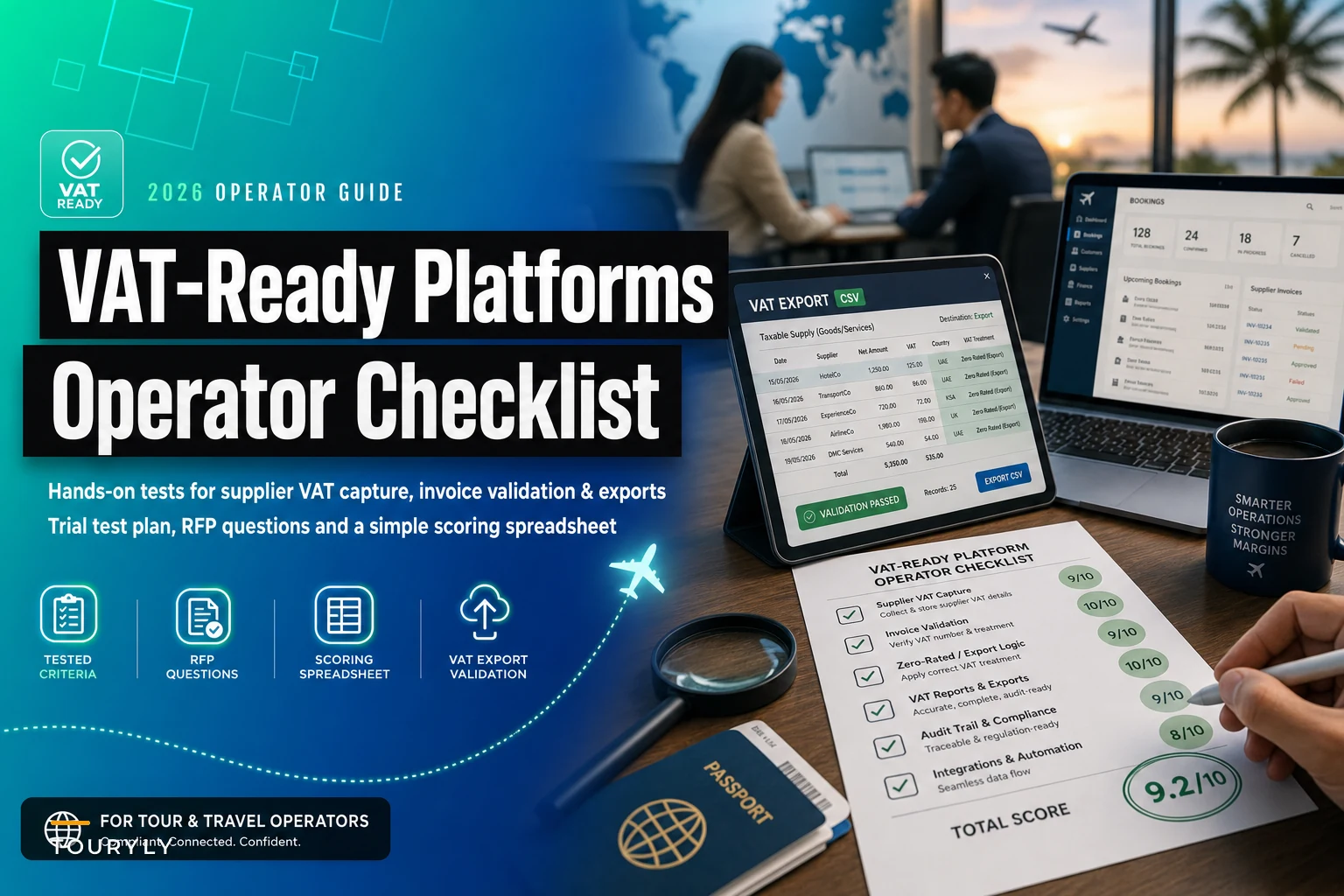

Most demos look great. The salesperson clicks through a clean booking flow, shows you a drag-and-drop itinerary, and you walk away impressed. Then three months after signing, your accountant asks why the Tour Operator Margin Scheme (TOMS) calculation doesn't match the ledger, and your ops lead is manually re-keying supplier invoices into a spreadsheet because the platform can't attach them to a booking.
That gap — between what gets demoed and what actually survives a messy real month — is what this guide exists to close. It's written specifically for small European inbound operators: the 2–15 person teams running inbound itineraries, dealing with mixed-margin bookings, supplier invoices in three currencies, and a VAT regime that punishes sloppy record-keeping. No vendor list here. Just the checklist, the trial test plan, the RFP questions, and a scoring sheet so that whatever you pick, you'll have tested it against the things that actually cost you money later.
Why most evaluations miss the two things that matter
The usual buying process goes wrong in a predictable way. Teams evaluate on features they can see in a 30-minute call — the UI, the calendar, the booking widget — and skip the parts that only show up during a full accounting cycle.
Two categories almost always get under-tested:
-
VAT and margin handling. Especially TOMS, the place of supply rules for inbound packages, and whether the platform can separate margin-scheme items from standard-rated line items on the same booking. If you're fuzzy on how your own bookings map to VAT treatment, sort that out first — the VAT decision tree and invoice mapping breakdown is a good place to get your logic straight before you judge any software against it.
-
Supplier-invoice workflow. The unglamorous reality of matching a hotel's invoice — which arrives as a PDF, two weeks late, with a different reference number than your booking — to the right trip, the right cost line, and the right VAT treatment.
The booking side of these platforms is usually solid, because that's what sells. The cost and compliance side is where corners get cut, because buyers rarely push on it during a trial. So that's exactly where you need to push.
The VAT and invoice workflow checklist
Before you score anything, walk through these. If a platform can't demonstrate most of them with your real data, it doesn't matter how clean the booking flow looks.
Never miss a booking or update.
Touryly streamlines your travel bookings, confirmations, and itinerary updates—all in one place.
- Unified booking management
- Automated customer notifications
- Itinerary & staff coordination
No credit card required
TOMS and margin handling
-
Can the platform calculate margin per package, not just per line item? (TOMS works on the margin, not the sale price.)
-
Can it handle mixed bookings where some components fall under the margin scheme and some are standard-rated — on the same invoice?
-
Does it support the annual/provisional TOMS calculation workflow, or does it assume you reconcile VAT per transaction? Many small operators do a provisional rate during the year and a true-up at year end. The software needs to not fight that.
-
Can you export a TOMS working — cost in, sale out, margin, VAT due — in a format your accountant can actually check?
Place of supply and multi-country inbound
-
For inbound packages where services are consumed in-country, can the system apply the correct VAT logic based on where the service happens, not where the customer is?
-
Does it handle B2B vs B2C distinctions on the same booking, since your treatment can differ?
Supplier invoice capture and matching
-
Can you attach a supplier invoice (PDF/image) directly to a specific booking and cost line?
-
Does it support partial invoices and multiple invoices against one booking (deposit invoice, then balance)?
-
Can it flag when a supplier invoice total doesn't match the agreed cost on the booking?
-
Can it record the supplier's VAT number, invoice date, and invoice reference as structured fields — not buried in a notes box?
Credit notes, refunds, and adjustments
-
When a supplier issues a credit note, can you link it to the original invoice and have it flow into the VAT calculation correctly?
-
Do refunds to customers adjust the margin calculation automatically, or do you have to remember to?
Audit trail and export
-
Every VAT-relevant change — a cost adjustment, a currency rate, a margin reclassification — needs a timestamp and a user. Ask to see the audit log for a single booking you edited during the trial.
-
Can you export the full VAT dataset (not just a summary report) so your accountant or auditor can rebuild the numbers independently?
Here's a simple visual of the invoice-to-booking matching and TOMS margin calculation workflow.
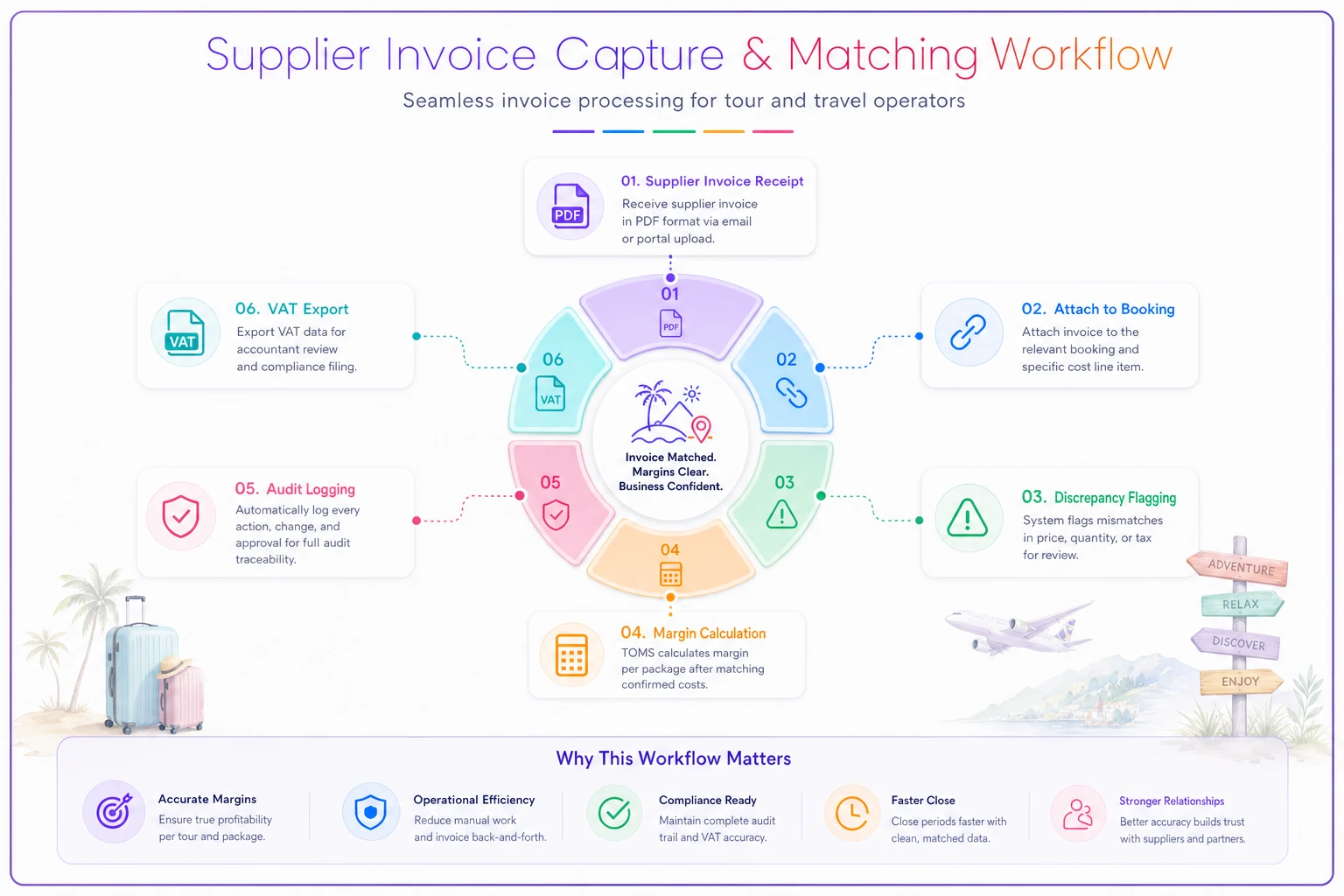
If you only test one thing properly, test the supplier-invoice-to-booking match with a real messy invoice. That's where the manual re-keying hours hide.
If you only test one thing properly, test the supplier-invoice-to-booking match with a real messy invoice. That's where the manual re-keying hours hide.
The operational features buyers actually request (and how to test them)
Beyond VAT, there's a short list of operational features small inbound operators ask for again and again. These are easy to see in a demo and hard to trust without actually testing them yourself.
| Feature | What buyers ask for | What to actually test |
|---|---|---|
| Trial period | "Can we try it?" | A real 7–14 day trial with your data loaded, not a sandbox with fake demo bookings |
| Customer notifications | "It sends confirmations and reminders" | Trigger timing, editable templates, multilingual sends, and whether a failed send is logged |
| Itinerary builder | "Drag-and-drop day planner" | Whether it handles multi-day with supplier components and feeds costs into the VAT/margin side |
| Supplier records | "We store our suppliers" | Structured VAT numbers, payment terms, per-supplier currency |
| Reporting export | "Full reporting" | Raw data export, not just dashboard PDFs |
A few notes on where each tends to fall apart:
Trial expectations. A lot of vendors offer a trial that's really a demo environment — pre-populated, locked down, no real import. That tells you nothing. Insist on loading 5–10 of your own real bookings, with real supplier invoices, during the trial. If they won't let you import real data in a 14-day window, that's a signal about how the actual onboarding will go.
Customer notifications. The common failure isn't that notifications don't send — it's that you can't see when one fails, or you can't edit the template without contacting support, or it only sends in English when half your inbound guests need something else. Test a deliberately bad email address and see if the system flags the bounce.
Lightweight itinerary builders. Small operators don't want a complex itinerary engine — they want to assemble a multi-day trip quickly and have those components carry their costs into the financial side. An itinerary builder that doesn't connect to costing is a pretty front-end that creates double entry later.
A 10-day trial test plan
Don't let the trial drift. Treat it like a structured test with a pass/fail at the end. Here's a plan that fits inside a 7–14 day window.
-
Day 1 — Import real data. Load 5–10 real bookings covering your typical mix: one simple single-service booking, one multi-day package, one mixed VAT booking, one group booking.
-
Day 2 — Supplier setup. Enter 3–4 real suppliers with VAT numbers, payment terms, and currencies. Note anything you have to shove into a free-text field because there's no proper field for it.
-
Day 3 — Attach a messy supplier invoice. Take a real PDF invoice with a mismatched reference and attach it to the right booking and cost line. Time how long it takes.
-
Day 4 — Run a TOMS/margin calculation. Produce a margin and VAT figure for one package. Hand the export to whoever does your VAT and ask: can you verify this?
-
Day 5 — Trigger notifications. Send a confirmation and a reminder. Test one failed send. Edit a template. Try a non-English version if you need it.
-
Day 6 — Build an itinerary. Assemble a 3-day package and confirm the component costs flow into the financial side rather than living in a separate silo.
-
Day 7 — Break something on purpose. Issue a partial refund and a supplier credit note. Watch whether the margin recalculates.
-
Day 8 — Pull the audit trail. Open one booking you've edited repeatedly and check whether every change is logged with user and timestamp.
-
Day 9 — Export everything. Get the raw VAT dataset out. Open it in a spreadsheet. Can you actually work with it?
-
Day 10 — Score and debrief. Fill in the scorecard below with the people who'll use it daily: ops and finance both.
Day 7 — deliberately breaking things — is the part most buyers skip. Software looks fine on the happy path. You learn the truth on the refund, the credit note, the mismatched invoice.
Sample RFP questions worth sending
Keep the RFP short and specific. Vague questions get vague answers. These are the ones that separate platforms built for European inbound operators from generic booking tools:
-
Describe exactly how your system calculates TOMS, including provisional-rate-then-true-up workflows. Can you show a sample working?
-
On a single booking containing both margin-scheme and standard-rated components, how is VAT separated and reported?
-
How does a supplier invoice get attached and matched to a booking? What happens when the invoice total differs from the agreed cost?
-
How are credit notes and refunds reflected in the VAT and margin figures?
-
What exactly is included in the trial, and can we import our own live data during it?
-
Can notification templates be edited by us, in multiple languages, without support involvement? How are failed sends surfaced?
-
What raw data can we export, in what formats, and is there an audit log at the field level?
-
When VAT rules change in a country we operate in, how and when does the platform get updated?
That last one matters more than people expect. Rates and rules shift. You want to know whether compliance updates are the vendor's job or quietly yours.
The evaluation scorecard
Score each area from 1–5, then weight it. The weighting below reflects where small inbound operators actually feel the pain — VAT and supplier invoices carry the most weight because they're the hardest to fix after you've signed.
| Category | Weight | Score (1–5) | Weighted |
|---|---|---|---|
| TOMS / margin calculation | 25% | ||
| Supplier invoice capture & matching | 20% | ||
| Credit notes / refunds / adjustments | 10% | ||
| Audit trail & raw data export | 10% | ||
| Customer notifications | 10% | ||
| Itinerary builder (and cost linkage) | 10% | ||
| Trial quality (real-data import) | 5% | ||
| Multi-currency handling | 5% | ||
| Usability for daily ops | 5% |
Multiply each score by its weight, total it, and compare across your shortlist. A platform that scores 5/5 on UI but 2/5 on TOMS and supplier invoices will land lower than it "felt" in the demo — which is exactly the correction this scorecard is meant to make.
One habit worth building: have ops and finance score separately, then compare. When they disagree sharply on a category, that's usually where the hidden problems live. Ops loves the itinerary builder; finance can't reconcile the VAT. Both are true, and the finance objection is the one that costs you.
A real scenario
A six-person inbound operator running cultural tours across two countries — roughly 300–350 bookings a year, mixed B2B and B2C — switched platforms mainly because the booking UI on their old system felt dated.
They evaluated three options on look and feel, picked the nicest one, and signed. The problem showed up at the first quarter's VAT work: the new platform couldn't separate margin-scheme items from standard-rated ones on the same booking, so their bookkeeper was exporting data and rebuilding the TOMS calculation by hand. Call it two full days every quarter, plus the risk of getting it wrong.
They'd also never tested supplier-invoice matching during the trial. In practice, invoices arrived as PDFs that nobody could attach to a booking, so costs lived in a separate spreadsheet — which meant the margin figures in the platform were never fully trustworthy.
When they re-evaluated a year later using something close to the scorecard above, the winning platform wasn't the prettiest. It was the one where a messy supplier invoice took under a minute to attach and the TOMS export reconciled without manual rework. The quarterly VAT scramble dropped from roughly two days to a couple of hours. Nothing dramatic in the demo — just the right things tested before signing instead of after.
When a lightweight platform is the right call — and when it isn't
When a simple, VAT-aware platform makes sense: small team, predictable booking types, a handful of regular suppliers, and a need to stop re-keying invoices into spreadsheets. If your complexity sits mostly in compliance and invoices rather than channel management or high volume, a focused platform that nails VAT and supplier workflow beats a feature-heavy suite you'll use 20% of.
When it's a bad idea: if you run high OTA volume, complex channel allocation, or large group operations with intricate deposit schedules, a lightweight tool will buckle. You'll outgrow it in a season, and migrating again is its own cost.
Who should not rush this: if you can't yet describe how your own bookings map to VAT treatment, don't buy anything first. Get the mapping right on paper, then evaluate software against it. A platform can only automate logic you can already articulate — if your VAT rules are fuzzy in your own head, no software will fix that, and a confident-looking automated calculation you can't verify is more dangerous than a spreadsheet you understand.
The expensive mistakes aren't in the booking flow — they're in the parts nobody tests during a demo. VAT handling and supplier-invoice workflow are quiet, unglamorous, and exactly where small inbound operators lose days of staff time and open themselves to compliance risk.
Load your real data. Attach a real messy invoice. Run a real margin calculation and hand it to the person who signs off your VAT. Break something on purpose. Then score it. Whatever platform you choose after that will have earned it against the work you actually do — not the work the demo showed you.
Ready to elevate your travel business?
Join 500+ travel operators using Touryly to optimize bookings, improve client satisfaction, and grow revenue.