

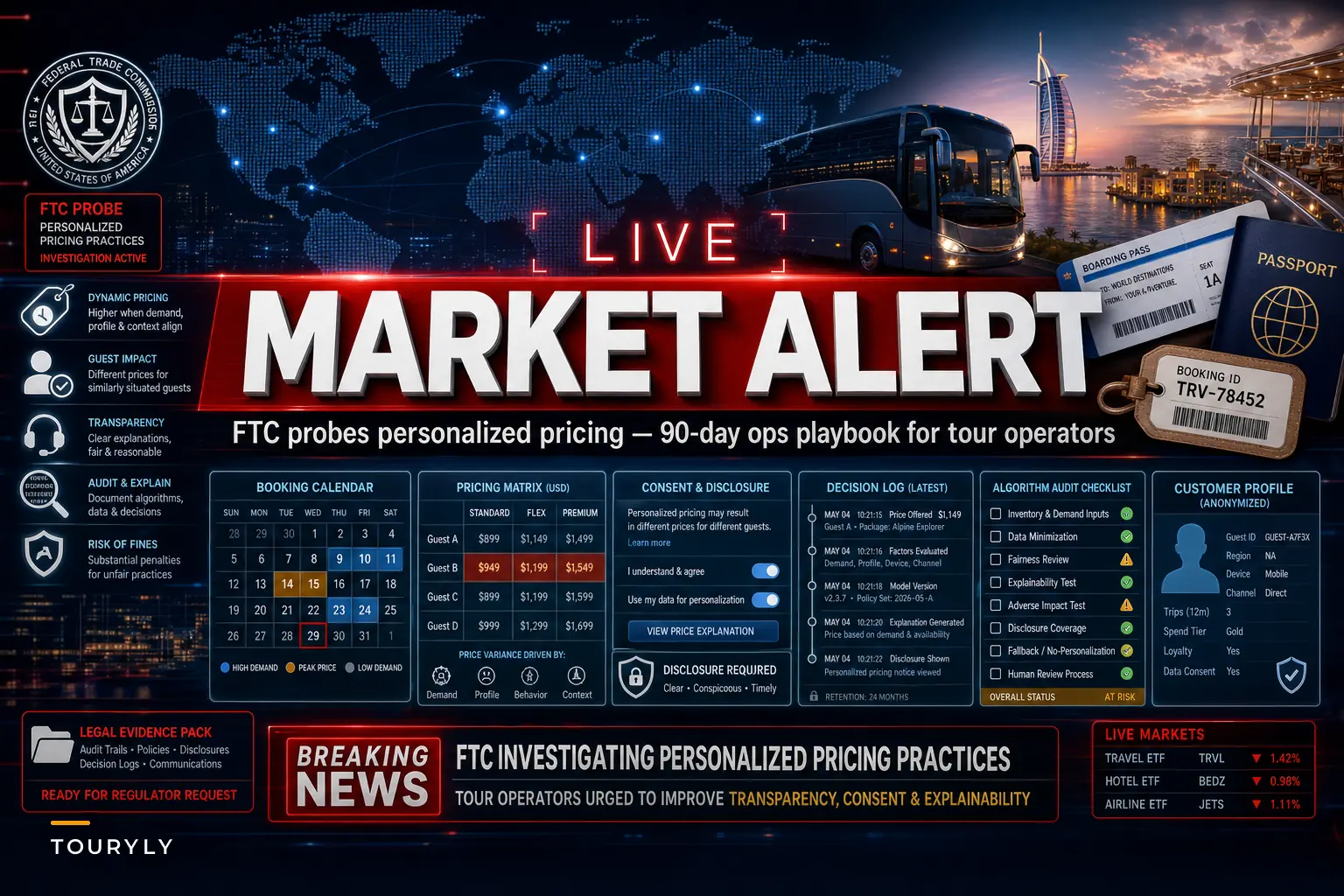

The FTC's late-October inquiry into personalized pricing wasn't aimed at tour operators. It named the big players — Walmart, Uber, Delta, a handful of delivery apps — and asked them to hand over data on how they use location, browsing history, income signals, and other personal information to set individualized prices, wages, and offers. CNBC covered the data demands in detail, and the FTC's own press release lays out the full scope.
What most small and mid-size operators miss: regulatory inquiries like this set the direction of travel for everyone, not just the companies named in the filing. The questions being asked — what data feeds your prices, can you explain a given quote, did the customer consent to the inputs — are exactly what a guest, a card network, or a consumer-protection authority in your own market could start asking you tomorrow. And if you run any kind of dynamic pricing, early-bird vs. last-minute spreads, loyalty discounts, or audience-based promo targeting, you're already doing a lighter version of what's under the microscope.
What the probe actually exposes for travel businesses
The deeper issue isn't that personalized pricing is bad. Price variation is completely normal in travel. A shoulder-season rate differs from peak. A returning guest gets a loyalty code. A corporate group gets a negotiated rate. None of that is the problem.
The problem the inquiry surfaces is unexplainable pricing built on data nobody tracked the origin of.
In real operations, this usually happens gradually. An operator plugs in a dynamic pricing rule two or three years back. Then marketing adds retargeting with discount codes tied to browsing behavior. Then someone builds an abandoned-cart flow that quietly offers 8% off to people who left at checkout. Then a partner integration starts adjusting prices by device type because "mobile converts worse." A few years later, two customers on the same tour, same date, paid different amounts — and nobody in the building can reconstruct why without a half-day investigation.
-
Regulatory
you can't produce an explainability artifact if asked.
-
Reputational
a guest posts two screenshots side by side and the story writes itself.
-
Revenue
chargebacks and "price match" demands spike when guests feel the pricing is arbitrary.
The reputational hit usually arrives before any regulator does. Someone compares notes in a Facebook group for a popular multi-day trek, and suddenly your support inbox has dozens of "why did I pay more" messages.
The quick diagnostic: are you actually exposed?
Before you touch anything, figure out where you sit. Not every operator with variable pricing has a real problem here.
Never miss a booking or update.
Touryly streamlines your travel bookings, confirmations, and itinerary updates—all in one place.
- Unified booking management
- Automated customer notifications
- Itinerary & staff coordination
No credit card required
-
Can you take any historical booking and reconstruct the exact price logic that applied that day — in under ten minutes?
-
Do you know every data input feeding your pricing? (Date, inventory, channel are fine. Inferred income, precise location, browsing history are the ones that draw scrutiny.)
-
Did customers consent to the data you use for pricing and targeting — separately from your general T&Cs?
-
Is there a published, consistent fallback price a guest would get with no personalization applied?
-
Could a non-technical staff member explain your pricing approach to an angry guest without saying "that's just what the system showed"?
Two or more "no" answers and you've got work to do. But it's bounded work, and 90 days is realistic.
Where operators usually sit
| Pricing setup | Typical exposure | First priority |
|---|---|---|
| Fixed seasonal rates + manual group quotes | Low | Document the seasonal logic; tidy group quote records |
| Dynamic pricing on date/inventory/channel only | Low–moderate | Build the pricing-decision log so you can replay quotes |
| Dynamic + loyalty/segment promos | Moderate | Audit segment definitions and consent for the data behind them |
| Dynamic + behavioral/retargeting + inferred personal data | High | Full input audit, fallback pricing, explainability artifacts |
The row that trips people up is the third one. Operators assume loyalty discounts are harmless — and they mostly are — but the segmentation data behind "customers like you" offers is often where unconsented inferred data quietly sneaks in.
The 90-day playbook
Think of this in three roughly four-week blocks. The order matters: audit before you fix, document before you redesign.
Days 0–30: find out what you're actually doing
-
Inventory every pricing input. List every variable that can move a displayed price or trigger a discount. Pull marketing into this — they almost always have promo logic ops doesn't know about.
-
Trace each input to its source and consent. For every data point: where it comes from, whether it's first-party or inferred, and whether the guest agreed to its use. Location you asked for is fine. Location you guessed from IP and used to adjust pricing is exactly what the inquiry is poking at.
-
Pull five real historical bookings and try to replay them. Pick the messiest ones — a group booking, a last-minute mobile purchase, a repeat guest with a promo code. If you can't reconstruct the price, you've found your biggest gap.
-
Separate "legitimate variation" from "personalization." Seasonal and inventory-based pricing is defensible and easy to explain. Individual-level adjustments based on who someone is — not what they're buying — are the sensitive category. Draw a clear line between them on paper.
Most operators finish this block surprised by how many promo rules were running that nobody owned. A common example: an email platform auto-applying a win-back discount that overlapped with an active dynamic surcharge, so certain guests got a confusing combination of both. Nobody set that up intentionally — it just accumulated over time.
Days 31–60: close the explainability gap
This is where you build the thing a regulator or guest would actually ask for: the ability to answer why this price, for this person, on this day.
-
Create a pricing-decision log. Every quote should record the inputs that produced it and the rules that fired, timestamped. This is the single most valuable artifact you can build. If a dispute lands six months later, you replay the quote in minutes instead of guessing.
-
Define and publish a fallback price. For every product, there should be a clean, non-personalized price a guest gets if all the clever stuff is switched off. It's your transparent default if challenged, and a sanity check when a personalization rule misbehaves.
-
Tighten data-minimization on pricing inputs. If an input isn't defensible and isn't materially helping conversion, cut it. Inferred income and precise location are usually the first casualties. You rarely lose real revenue by dropping them — they mostly add risk.
-
Write plain-language pricing explanations for support. One page per pricing type, in human words. When a guest asks why they paid more than their friend, the answer should be confident and consistent, not "the algorithm decided."
Include timestamps and rule identifiers in your pricing-decision log to make replays reliable.
This is also where a solid booking and pricing platform earns its keep. The operators who get through this fastest aren't necessarily the ones with the most sophisticated pricing — they're the ones whose systems log decisions automatically rather than requiring someone to reverse-engineer them after the fact. If your current stack can't tell you which rules fired on a given booking, that's the gap to fix. Manual reconstruction doesn't scale past a few disputes.
Days 61–90: harden consent, messaging, and the response runbook
-
Rework consent so pricing and targeting data is opted into separately. Burying it in a 4,000-word T&C won't hold up. The data used to personalize offers should have its own clear, specific opt-in.
-
Update privacy notices and marketing opt-ins to name, in plain terms, what you collect and how it affects pricing and offers.
-
Build a regulator-and-complaint response pack. A short runbook
who owns the response, where the decision logs live, how fast you can produce a replay, your standard explanation of each pricing type. You want this ready before you need it.
-
Run one tabletop exercise. Have someone play an unhappy guest with two screenshots, and another play a data request from an authority. See how long it takes your team to produce a clean, calm answer. The first run is always slower than you'd expect — that's the point.
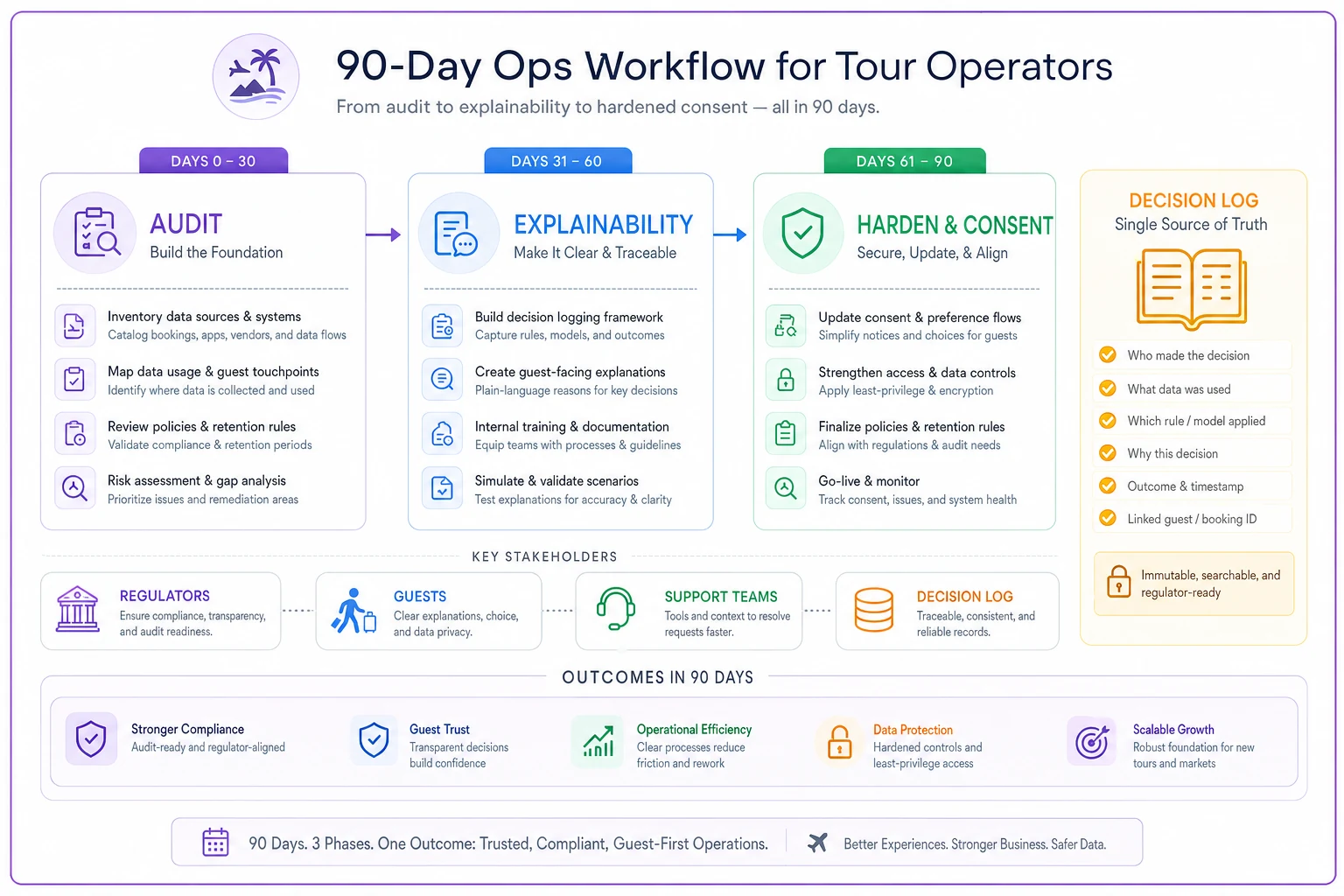
Use this as a checklist to run the audit and follow-up steps.
A realistic scenario
A mid-size inbound operator running food-and-culture day tours across three cities had layered pricing over roughly four years. Base dynamic pricing on date and remaining seats — perfectly fine. On top of that: a retargeting flow offering 10% off to cart-abandoners, a loyalty tier with hidden member rates, and a device-based adjustment someone added during a conversion push.
The trigger wasn't a regulator. It was a travel forum thread where four guests on the same Saturday tour realized they'd paid somewhere between €58 and €74 for identical seats. Support got buried, two guests filed card disputes, and the owner couldn't explain the spread without a developer digging through logs for most of a day.
They ran the 90-day process. The audit revealed the device-based adjustment was contributing almost nothing to conversion but was responsible for most of the visible price spread, so they cut it. They built decision logging into every quote, published a clean fallback price per tour, and gave support a one-pager per pricing type.
The outcome wasn't a dramatic revenue jump — pricing-transparency work rarely is. Disputes tied to pricing confusion dropped close to zero over the following quarter, support stopped burning hours on "why did I pay more" threads, and when a partner later asked how their pricing worked, they answered in an email instead of scheduling a meeting. The quieter win: they could finally see which rules actually drove margin and which just added noise.
When aggressive personalization still makes sense — and when it doesn't
Don't overcorrect into flat, boring pricing out of fear. Variation tied to genuine supply-and-demand signals is good business.
It makes sense when the inputs are things a guest would find obviously fair if explained — date, remaining availability, group size, how far in advance they book, the channel they came through. You can say it out loud without wincing.
It's a bad idea when the price moves based on who someone is rather than what they're buying — inferred wealth, device type, guessed location, anything that implies "we think you'll pay more." That's the exact category drawing regulatory attention, and it's also the category guests feel most cheated by.
Who should probably step back entirely: small operators running behavioral personalization they can't fully explain or log. The conversion lift from those tactics is usually modest, and the risk — reputational and regulatory — is badly out of proportion to the gain. Strip it back to defensible, explainable variation and you lose almost nothing real.
Tie it back to how you make money
None of this is just a compliance chore. Clean, explainable pricing is also better pricing — you can see which rules earn their keep and which just add risk and confusion. That's the same discipline behind getting your margins right across a product's full lifecycle, from launch rate to last-minute clearance, which we covered in more depth in our breakdown of revenue optimization across the product lifecycle.
The operators who come out of this probe ahead won't be the ones who ripped out all their pricing logic. They'll be the ones who can finally explain it — and who discovered, in the process, which parts were making money and which were just making noise.
Ninety days is enough. Spend the first thirty finding out what you're really doing, the next thirty making it explainable, and the last thirty making it defensible. Do that, and whatever direction the regulatory wind blows next, you're not the one scrambling.
Ready to elevate your travel business?
Join 500+ travel operators using Touryly to optimize bookings, improve client satisfaction, and grow revenue.