

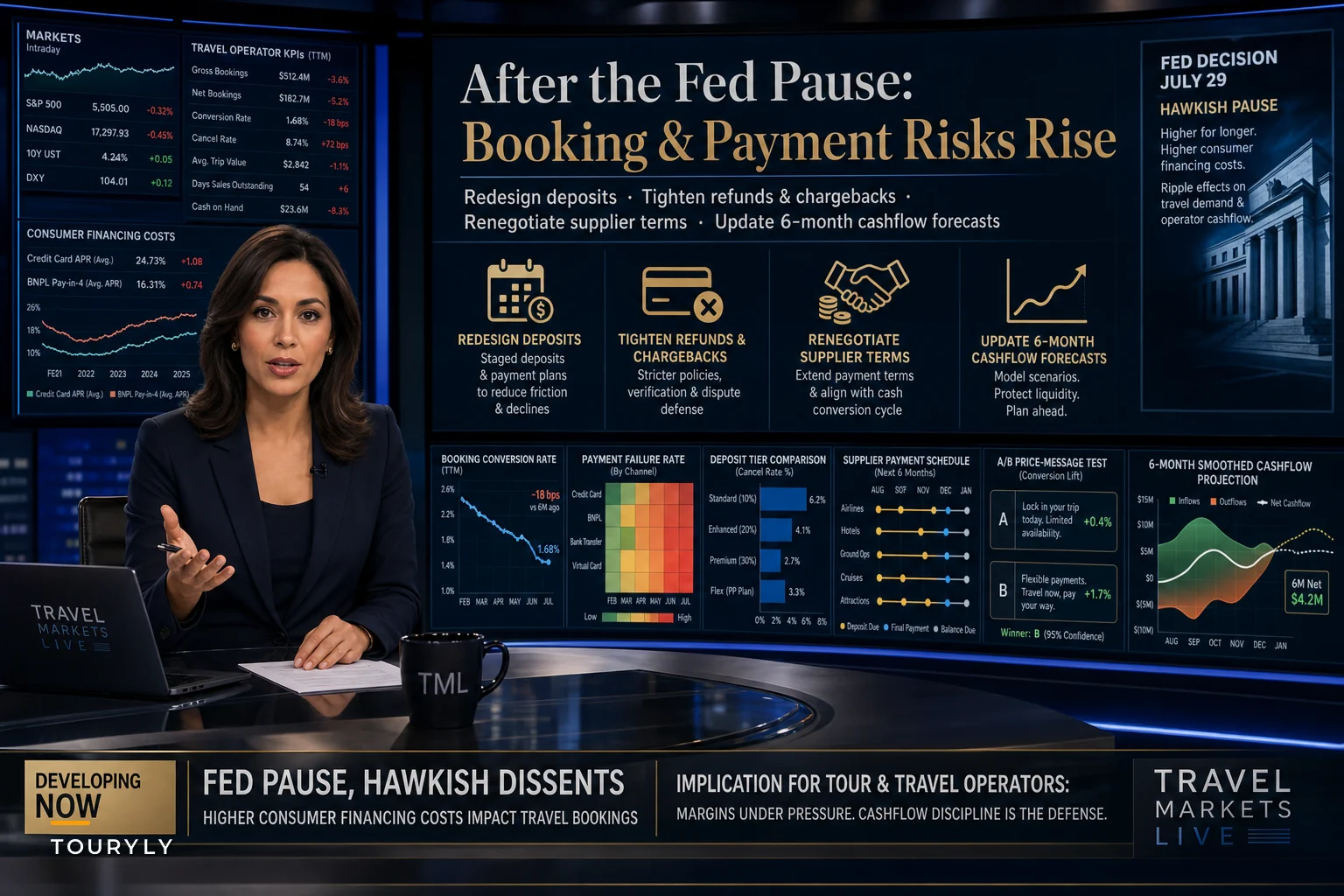

The Federal Reserve held rates at 3.50-3.75% yesterday, but what's worth paying attention to is the split vote — three regional Fed members pushed for another increase. That tells you something about where this is probably heading. Elevated borrowing costs through the rest of summer and into fall booking season looks increasingly like the base case.
For tour operators, the timing is genuinely bad. Credit card rates are sitting around 21-24% for most consumers. Personal loans are running 12-15% even for decent borrowers. And this lands right when operators need to collect final payments for August departures while simultaneously trying to secure deposits for October and November.
A customer who would've put a $4,000 Europe tour on their card six months ago is now mentally running through $80 monthly interest charges before they click anything. That same customer who used to book 90 days out is waiting until 35-40 days before departure, holding out for last-minute movement on price. Meanwhile, your suppliers still want their money 60 days in advance.
The deposit structure that worked in 2024 is now killing conversion rates
Traditional deposit models — 50% down, balance due 60 days before departure — were built on two assumptions: customers either have cash reserves or have access to affordable credit. Neither holds right now.
Operators who've moved to tiered deposit structures are holding conversion rates. Those sticking with traditional models are watching cart abandonment climb. A wine tour operator in Napa told me their booking-to-inquiry ratio dropped from around 35% to 22% before they restructured payment terms in May.
The Fed rate impact on travel bookings runs deeper than sticker shock. Customers are calculating total interest costs before they commit. A $500 deposit sitting on a credit card for four months costs them an extra $40. That psychological friction is real, even for travelers who can technically afford the trip.
Your deposit structure needs to work with that math. Lower initial commitments — 15-20% instead of 50% — combined with graduated payment milestones that line up with actual customer cash flow. Tax refunds, quarterly bonuses, monthly pay cycles — these things matter more now than they did when rates were near zero.
Why payment plans beat deposits for high-ticket tours
Asking for a $2,500 deposit on a $5,000 tour means your customer needs either liquid cash or credit they're willing to tie up for months. In this rate environment, that's a shrinking pool of people.
Never miss a booking or update.
Touryly streamlines your travel bookings, confirmations, and itinerary updates—all in one place.
- Unified booking management
- Automated customer notifications
- Itinerary & staff coordination
No credit card required
Payment plans change the framing entirely. Instead of "commit $2,500 now," it becomes "can you handle $420 a month for six months?" The total collected is exactly the same, but the decision friction drops.
A multi-day hiking tour operator I watched implement this in June had an average booking value around $3,800 per person. Old structure: $1,900 deposit, balance due 45 days out. New structure: $380 down, five monthly payments of $684. Same total, same timeline — bookings increased roughly 40% month-over-month.
Configure automated billing and dunning in your booking platform to reduce manual work and payment failures.
The tradeoff is operational complexity. You're tracking multiple payment dates per customer instead of two. But modern booking platforms handle this automatically once you configure it. Set up the payment schedule at booking, let automated billing run it. The friction moves away from the customer and into a system that can absorb it.
Repricing for margin protection without scaring customers away
Your customers aren't the only ones feeling rate pressure. Suppliers are dealing with the same working capital squeeze. Hotels want faster payment. Transport companies are shortening windows. Everyone's trying to reduce exposure in an expensive borrowing environment.
The instinct is to raise prices across the board. But blanket increases in a price-sensitive market just push bookings to competitors or delay them indefinitely. As we've covered in our look at cost-of-living pressures on travel behavior, customers have less discretionary income while facing higher costs across the board — travel pricing needs to account for that.
Surgical adjustments work better than broad ones:
Protect margins on currency-exposed bookings first. If you're paying European suppliers in euros while selling in dollars, that's where margin erosion hits hardest. Add 3-5% to international tour pricing before touching domestic offerings.
Add fees instead of raising base prices. A $75 booking fee or $50 payment plan administration fee lands differently than watching a tour jump from $2,400 to $2,475. Customers understand fees right now — they're seeing them everywhere.
Time-based pricing tiers. Lower pricing for bookings made 120+ days out (when you have supplier flexibility) and premium pricing under 45 days (when you're often paying rush rates anyway).
The refund policy adjustment nobody wants to make
Generous refund policies were a real competitive advantage when customers had credit flexibility. Now they're a cash flow problem. Someone books in March, cancels in July, and you're sending back $3,000 while trying to fill a spot with 30 days notice — in a market where most potential buyers are in wait-and-see mode.
The adjustment: shift from date-based refund calculations to percentage-of-payment-made calculations. Traditional model — cancel 60+ days out, get full refund minus a $200 fee — means a customer who paid a $2,500 deposit walks away with $2,300 back. That's rough on cash flow.
New model: refund percentage improves the more they've paid and the longer they've stayed committed. Cancel after the initial deposit? Maybe 70% back. Cancel after three monthly payments? 85%. This pushes early cancellations to happen earlier — when you actually have time to resell — and protects you from late drops.
A regional adventure tour company running $4,000-6,000 trips put this in place in May. Cancellation rates dropped slightly (from around 12% to 10%), but average cancellation timing shifted from 42 days before departure to 75 days. That extra month makes filling spots a real option instead of a scramble.
Supplier payment terms: the renegotiation most operators are missing
While you're adjusting what customers pay and when, suppliers are quietly tightening their own terms. Hotels that used to accept payment 30 days after departure now want prepayment. Ground transport windows are shrinking from 45 to 30 days.
What gets missed: suppliers are just as worried about cash flow as you are. They'd rather have reliable smaller payments than chase large invoices that might be slow or contested. That's a real opening.
Bring your top five suppliers a proposal: instead of net-30 or net-45 on large invoices, you'll pay 25% at booking confirmation, 25% at 30 days, 25% at 60 days, and the final 25% at service delivery. You're actually paying earlier on average — suppliers respond well to that — but in amounts that don't torch your working capital at once.
One operator running European cultural tours worked out this structure with three hotel partners and two transport companies. The hotels dropped rack rates 5-8% in exchange for the improved payment flow. That math worked out to roughly $200 saved per booking going straight to margin.
Building the cash flow forecast that actually works
Most tour operator cash flow forecasts fall apart because they assume linear payment collection. Customer books in January, pays deposit, pays balance in March, tour runs in April. Simple — and almost completely disconnected from how things actually go.
Real cash flow is messier. Payment failures spike when credit cards expire, which tends to cluster in January and July. Customers request date changes. Refund requests bunch around economic news cycles. Your forecast needs these patterns baked in.
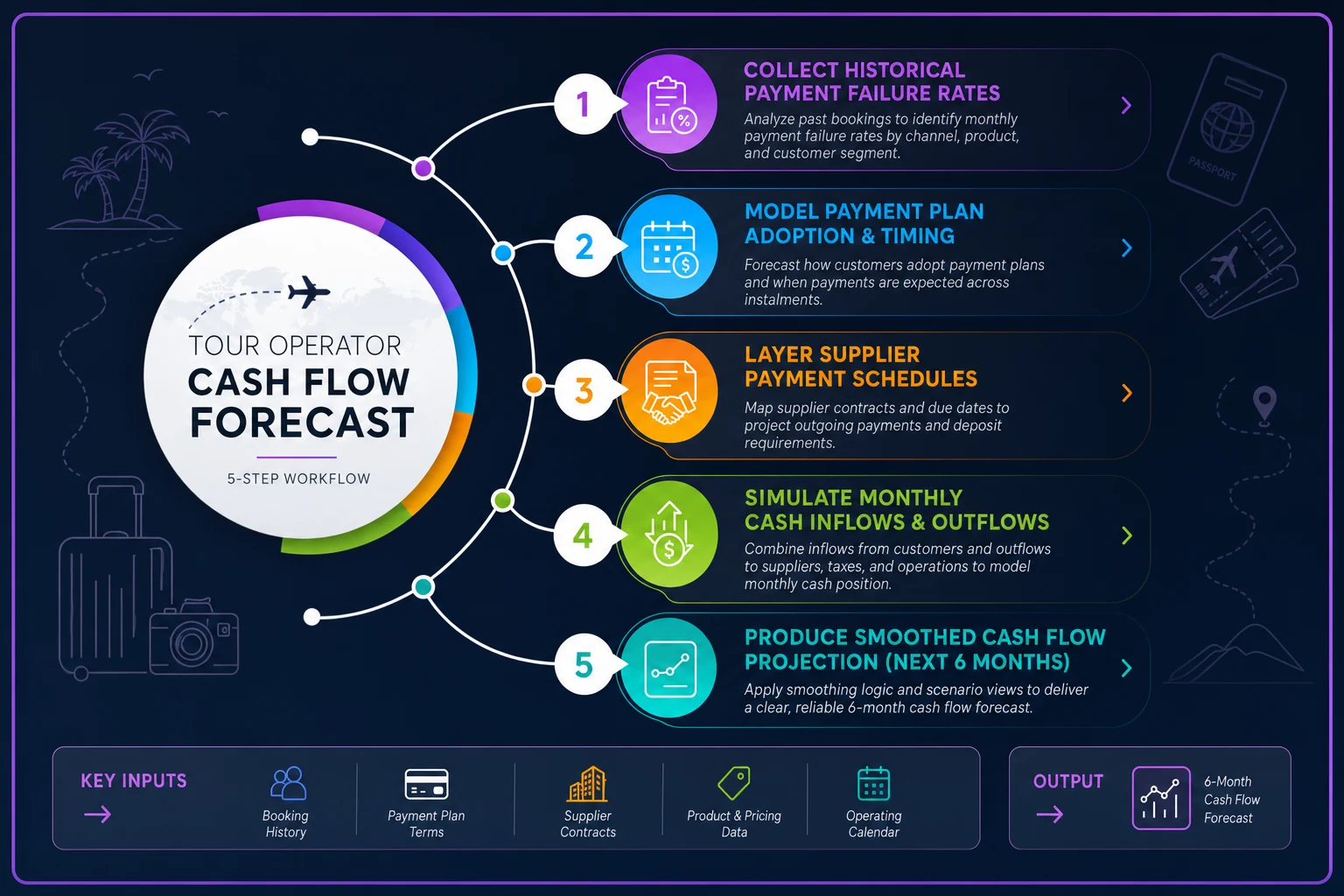
Start with historical payment failure rates by month — January bookings might have an 8% failure rate on balance collection while September sits closer to 3%. Build that in. Then layer in what payment plan adoption actually does to your timing. If 40% of bookings are now on monthly plans instead of two-payment structures, your cash flow picture shifts considerably.
| Month | Traditional Deposit Model | Payment Plan Model | Cash Flow Difference |
|---|---|---|---|
| Booking month | 50% collected | 10% collected | -40% |
| Month 2 | 0% | 18% collected | +18% |
| Month 3 | 0% | 18% collected | +18% |
| Month 4 | 50% collected | 18% collected | -32% |
| Month 5 | 0% | 18% collected | +18% |
| Month 6 | 0% | 18% collected | +18% |
Payment plans actually smooth cash flow over time, reducing the feast-or-famine cycle that creates real operational strain during slow booking periods. You need the forecast to see it clearly, though — otherwise it just looks like you're collecting less money at the start.
The workflow below summarizes the steps to build a realistic cash flow forecast for your booking mix.
Payment plans actually smooth cash flow over time, reducing the feast-or-famine cycle that creates real operational strain during slow booking periods. You need the forecast to see it clearly, though — otherwise it just looks like you're collecting less money at the start.
Quick implementation checklist
The Fed's decision yesterday wasn't a shock, but the dissenting votes matter. Rates staying elevated through peak booking season looks likely. Your response needs to be operational.
-
Audit current deposit requirements — anything above 30% initial deposit is probably too high in this environment
-
Design a monthly payment plan option — aim for payments that are 15-20% of tour price to stay under psychological barriers
-
Recalculate supplier payment timing — identify which suppliers would accept graduated payment in exchange for rate reductions
-
Update refund policies — shift from date-based to payment-percentage-based calculations
-
Add transparent fees — booking fees, payment plan fees, rush booking fees for anything under 45 days
-
Rebuild cash flow forecast — incorporate payment plan timing and realistic failure rates by month
Customers haven't stopped wanting to travel. They've stopped being able to commit large sums upfront. That's the actual problem, and it's solvable — but only if your operational model adjusts to meet their financial reality rather than assume it away.
Start with payment plans. They're the fastest change to implement and the one with the most immediate impact on conversion. Once that's running, work through supplier renegotiations and refund policy updates. The full overhaul might take six to eight weeks, but you'll likely see booking movement within days of launching the payment plan option.
This isn't a temporary blip to wait out. The Fed's holding pattern points to at least two more quarters of this, probably more. The operators who come out ahead won't be the ones who held on and hoped things normalized — they'll be the ones who restructured while others hesitated.
This isn't a temporary blip to wait out. The Fed's holding pattern points to at least two more quarters of this, probably more. The operators who come out ahead won't be the ones who held on and hoped things normalized — they'll be the ones who restructured while others hesitated.
Ready to elevate your travel business?
Join 500+ travel operators using Touryly to optimize bookings, improve client satisfaction, and grow revenue.