



Most tour operators don't fail because they can't sell. They fail because the machine that turns a sale into a delivered trip was never built for volume. At 100 bookings a month, one coordinator holding everything in her head is a feature. At 1,000, that same person is a single point of failure who takes the whole operation down when she's sick during peak week.
The jump from 100 to 1,000 bookings isn't linear. Costs, headcount, and complexity don't grow ten times — they grow in ugly, uneven steps, and the steps that break first are almost always the handoffs. Sales hands to ops. Ops hands to suppliers. Suppliers hand back confirmations. Finance reconciles it all after the fact. Every one of those handoffs is a place where something can sit unattended for three days and nobody notices until a guest is standing at a locked gate.
This is a systems piece, not a tips list. The goal is to show you how the whole pipeline holds together — and where the seams tear — so you can build a tour operations playbook that scales without hiring a new coordinator for every additional hundred trips.
The scaling problem nobody names: throughput vs. coordination
There's a real difference between doing more work and coordinating more work, and operators consistently confuse the two.
Doing more work is easy to plan for. You need more guides, more vehicle capacity, more supplier inventory. That's throughput, and you can forecast it with a spreadsheet. Coordination is the invisible tax. It's the confirmation that has to be chased, the supplier who replies "maybe," the customer who changes a pickup address two days out, the finance question that stalls a refund.
What you see across operators making this jump: throughput scales roughly with headcount, but coordination overhead scales with the number of connections between people and systems. Add one more sales channel and you haven't added 10% more work — you've added a new set of handoffs that touch ops, suppliers, and finance simultaneously.
A typical example: an operator at 120 monthly bookings runs three OTAs, two direct channels, and a WhatsApp group with guides. That's manageable. At 700 bookings they've added two more OTAs, a reseller network, and a corporate travel account. Now a single itinerary change can trigger notifications that need to reach five different parties, and there's no defined order for who acknowledges what. Confirmations start getting missed not because anyone is lazy, but because nobody owns the specific handoff.
The uncomfortable insight: you don't scale by working harder at the handoffs. You scale by making the handoffs boring, predictable, and time-bound. That's what SLAs do.
Why SLAs are the backbone, not the paperwork
Most operators think of SLAs as something you sign with a supplier and file away. Internally, they treat "who does what by when" as tribal knowledge. That's the exact gap that breaks at volume.
Never miss a booking or update.
Touryly streamlines your travel bookings, confirmations, and itinerary updates—all in one place.
- Unified booking management
- Automated customer notifications
- Itinerary & staff coordination
No credit card required
An SLA-driven handoff is simple: every transition in the pipeline has an owner, a maximum response time, and a defined escalation if that time is missed. Not a suggestion — a clock.
The difference in practice: without an internal SLA, a supplier confirmation request goes out and sits. Someone follows up "when they get a chance." At 100 bookings, they get a chance. At 1,000, the follow-up queue is 40 items deep and the oldest ones rot. With an SLA, that confirmation request has a 4-hour acknowledgment window and a 24-hour hard confirm deadline. Miss the acknowledgment, it escalates to a named backup. Miss the confirm, it triggers an alternate-supplier workflow before the guest ever knows there was a problem.
The pattern that separates operators who scale cleanly from those who firefight constantly: the clean ones measure handoff time, not just outcomes. They know their average confirmation turnaround is, say, 9 hours in shoulder season and 26 hours in peak, and they staff and set deadlines accordingly. The firefighters only find out a handoff was slow when a trip falls apart.
A workable internal SLA map for a growing operation looks like this:
| Handoff | Owner | Acknowledge within | Complete within | Escalation trigger |
|---|---|---|---|---|
| Sale → ops intake | Sales rep | 1 hour | 4 hours | Ops lead notified |
| Ops → supplier confirm | Ops coordinator | 4 hours | 24 hours | Alternate supplier workflow |
| Supplier → confirm back | Supplier | — | 24–48 hours | Penalty clause + backup sourcing |
| Ops → guide assignment | Ops lead | 12 hours | 72 hours before trip | Roster manager paged |
| Trip complete → finance | Guide/ops | Same day | 48 hours | Reconciliation flag |
The numbers aren't universal — yours will differ by trip type and season. The point is that every row has an owner and a clock. That's the skeleton everything else hangs on.
RACI: the fix for "I thought you had it"
The most common operational failure at scale isn't a missing skill. It's ambiguity about ownership. Two people both think the other is handling the supplier follow-up, so nobody does. Or three people pile onto the same task and duplicate the work while something else goes untouched.
A RACI matrix — Responsible, Accountable, Consulted, Informed — sounds like corporate overhead until you've watched a trip fall apart because "everyone assumed." The discipline it forces is that for every meaningful task, exactly one person is Accountable. Not two. One. That's the rule that actually matters; everything else is just detail.
In real operations, this usually breaks down in the gray zones between departments. Who owns a same-day supplier substitution — ops or the guide on the ground? Who's accountable for a refund decision when finance, ops, and customer service all touch it? Without a RACI, those decisions get made by whoever happens to be looking at the screen, inconsistently, and the guest experience swings wildly depending on the day.
A trimmed RACI for a core booking-to-delivery flow:
-
Booking intake accuracy — Responsible
sales rep. Accountable: sales lead. Consulted: ops. Informed: finance.
-
Supplier confirmation — Responsible
ops coordinator. Accountable: ops lead. Consulted: procurement. Informed: sales.
-
Guide assignment & briefing — Responsible
roster manager. Accountable: ops lead. Consulted: guide. Informed: sales.
-
Day-of incident response — Responsible
guide. Accountable: ops lead on call. Consulted: supplier. Informed: customer service.
-
Refund/adjustment — Responsible
customer service. Accountable: finance lead. Consulted: ops. Informed: sales rep.
Notice the ops lead is Accountable for a lot. That's normal at mid-scale, and it's also a warning sign: when one role is Accountable for six things, that role is your next bottleneck. Scaling cleanly often means splitting that accountability before the person burns out, not after.
Day-one templates: the difference between onboarding and improvising
Operators who scale badly treat every new booking as a fresh problem. Operators who scale well have templates that turn 80% of bookings into a fill-in-the-blanks exercise, so human attention goes only to the 20% that's genuinely unusual.
Day-one templates are the standardized starting points for each trip type — the itinerary skeleton, the supplier dependency list, required documents, the messaging sequence, hold windows. When a booking comes in for a product you run regularly, nobody rebuilds the workflow. They pull the template and adjust.
Operators who resist templates usually say their trips are "too custom." Almost always, they're less custom than they think. A five-day multi-region tour has maybe four or five real decision points; everything else repeats. The custom feeling comes from the fact that nobody wrote the repeatable part down, so it feels like fresh work every time.
A practical day-one template set covers:
-
The itinerary structure with fixed and variable slots clearly marked
-
Supplier dependencies and the order they must be confirmed in
-
Standard hold windows per supplier and what happens when a hold expires
-
Required guest documents and the deadline for each
-
The default customer message sequence from booking to day-of
-
Finance touchpoints — deposit schedule, balance due, payout timing
Keep template field names consistent across products so automation and new hires find the same data in the same place.
When these exist, a new ops hire is productive in days, not months, because the system carries the knowledge instead of a veteran's memory. That's the real test of whether you can scale: can someone competent but new run a standard trip without asking three questions per booking?
The cutover: how to change your operations without breaking the trips already in flight
This is the part operators dread and usually botch. You've decided to move from the chaotic-but-familiar way to an SLA-driven system. The problem is you can't stop selling while you rebuild. You've got 300 trips already booked and in various stages of confirmation. Flip a switch and you'll lose track of half of them.
A cutover is a staged migration, not a launch date. The mistake is treating it like turning on a new tool — one Monday, everyone starts fresh. In reality, live trips were set up under the old rules and can't be forced into a new system mid-flight.
A cutover timeline that actually survives contact with a running operation:
-
Weeks 1–2
Map and freeze.
Document the current handoffs as they really happen, not as you wish they did. Freeze the SLA definitions and RACI so you're building against a fixed target. -
Weeks 3–4
Parallel run on new bookings only.
Every new booking goes through the new system. Everything already in flight stays on the old process until delivered. Yes, you run two systems briefly. That's the cost of not breaking live trips. -
Weeks 5–6
Migrate near-term trips.
Trips more than three weeks out get moved into the new templates and SLA clocks. Anything closer than that finishes on the old rails. -
Weeks 7–8
Full cutover and old-system sunset.
By now the old-process trips have mostly been delivered. Migrate the stragglers manually, one by one, with a checklist so none fall through. -
Week 9+
Monitor handoff times.
Watch actual acknowledgment and completion times against your SLA targets. The first month always reveals a deadline you set unrealistically. Adjust it.
The single most important cutover rule: never migrate a trip inside its final delivery window. The risk-to-reward is terrible. Let it finish on the old system and clean up after.
A real scenario: 140 to 900 bookings without adding a coordinator per hundred
Consider a regional adventure operator running around 140 monthly bookings across three channels, coordinated mostly by two people and a shared spreadsheet. Demand was pushing them toward 900+ in high season, but every time volume climbed, missed supplier confirmations climbed with it. In one peak month they had roughly a dozen near-misses where a guest was confirmed but a supplier slot wasn't — caught only because a guide double-checked the morning of.
The fix wasn't more people first. It was defining the handoffs. They mapped every transition, assigned single accountability per task, set acknowledgment and confirm windows, and built day-one templates for their eight most common products. Confirmation follow-ups moved from "when someone remembers" to a 4-hour acknowledgment clock with automatic escalation.
Over the next couple of seasons, they scaled past 800 monthly bookings having added two ops staff instead of the six or seven the old model would have demanded. Near-miss confirmations dropped to a handful across the whole peak period, not per month. The coordinators stopped being the bottleneck because the system, not their memory, held the state of every trip. Nobody would call it flawless — peak weeks still get hectic — but the failure mode changed from "trips silently break" to "system flags the risk early."
Where the software layer earns its place
You can run SLA-driven handoffs, RACI ownership, and day-one templates on spreadsheets and calendar reminders — at low volume. The reason that stops working isn't that the logic is wrong. It's that manually tracking dozens of clocks across hundreds of live trips is exactly the kind of work humans are bad at, especially under pressure.
Here's a simple visual of how a platform enforces handoff clocks and routes escalations.
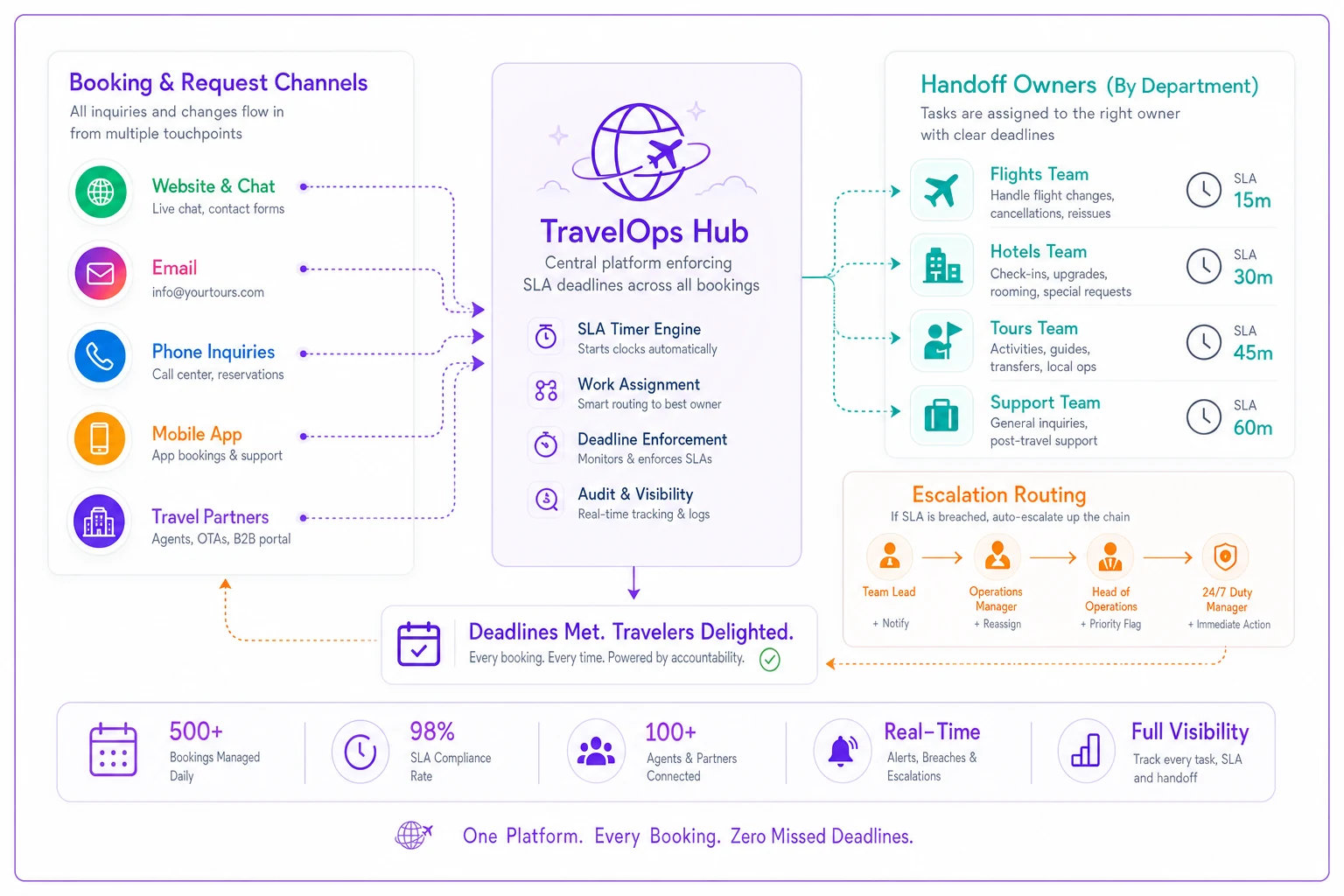
This is where an AI-assisted operational platform quietly does the heavy lifting: watching every handoff clock, flagging the confirmation that's about to breach its window, routing the escalation to the right owner without someone remembering to check, and pulling the correct day-one template the moment a booking lands. The point isn't automation for its own sake — it's that coordination overhead, the thing that grows fastest and breaks first, is precisely the part that shouldn't depend on someone remembering to look. Let the platform hold the state and enforce the clocks, and your team's attention goes to the genuinely unusual trips that need real judgment.
The mistake is buying the tool before defining the system. Software that enforces handoffs you haven't designed just gives you faster chaos. Get the SLAs and ownership right first, then let the platform enforce them at a scale no spreadsheet survives.
When this playbook makes sense — and when it doesn't
When it makes sense: You're consistently above 200–300 monthly bookings, or growing toward it fast, and coordination — not selling — is already becoming the constraint. If missed confirmations, duplicated work, or "I thought you had it" moments are showing up in peak season, you've outgrown tribal knowledge.
When it's overkill: If you're running 40 trips a month with one well-organized coordinator and near-zero confirmation misses, building a full SLA-and-RACI apparatus is premature. You'll spend weeks documenting a system to solve a problem you don't have yet. Keep it light and revisit when volume or channel complexity climbs.
Who should not rush this: Operators mid-peak-season. Do not run a cutover during your busiest eight weeks. Map now, build in the shoulder, migrate before the next surge. Trying to re-engineer your handoffs while running peak volume is how you cause the exact failures you're trying to prevent.
The real lesson
Scaling bookings isn't a sales problem past a certain point — it's a coordination-design problem. The operators who make the 100-to-1,000 jump without operational breakdowns aren't smarter or better staffed. They've moved the knowledge out of people's heads and into a system of defined handoffs, single-owner accountability, repeatable templates, and clocks that don't rely on anyone remembering to check.
Start with your handoffs. Map them honestly, give each one an owner and a deadline, and watch where the clocks breach. That's your bottleneck, and it's almost never where you assumed it was.
Ready to elevate your travel business?
Join 500+ travel operators using Touryly to optimize bookings, improve client satisfaction, and grow revenue.