

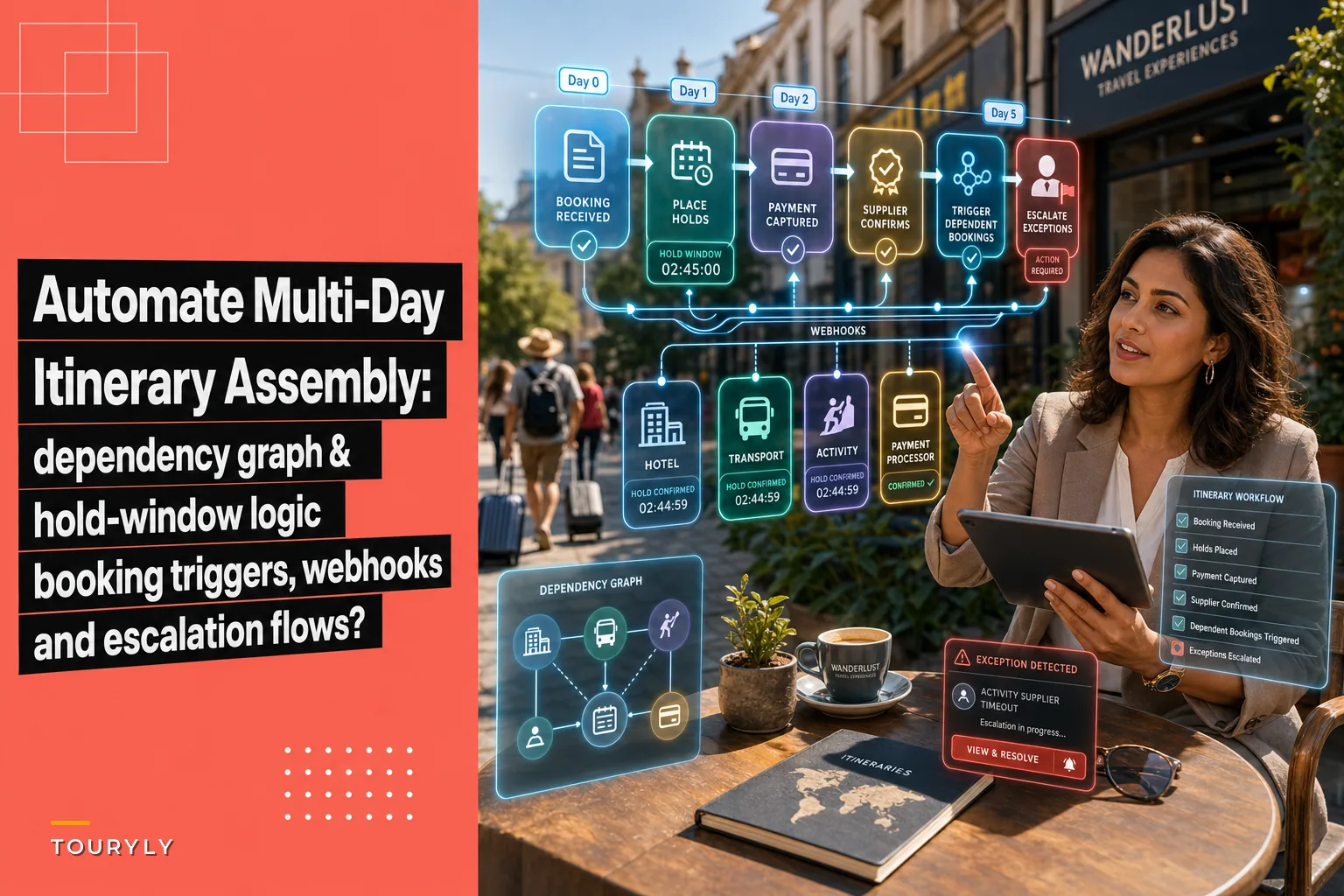

Tour operators managing multi-day packages deal with a specific kind of operational mess that doesn't get talked about enough. Hotels need 72-hour confirmation, activities require 48-hour advance booking, transportation has its own cancellation windows, restaurants release tables if you don't confirm within 24 hours. Every supplier runs on their own timeline with their own rules, creating a dependency web that falls apart the moment one piece shifts.
The real problem isn't just coordinating these moving parts. It's that traditional booking systems treat each component as an isolated transaction. Your operations team ends up juggling spreadsheets, calendar reminders, and supplier portals, trying to keep track of which bookings depend on others and when each confirmation window closes.
What happens in practice? A 7-day Portugal wine tour gets partially confirmed because your team booked the Douro Valley vineyard before securing the Porto hotel, only to find the hotel fully booked—triggering a cascade of rebookings. Or worse, you hold expensive supplier inventory too long without customer commitment, eating into margins through forfeited deposits.
Why multi-day itinerary automation breaks down at the dependency level
Most tour operators build itineraries linearly—accommodation first, then transport, then activities. But actual multi-day tours function more like a dependency graph where some bookings need to happen in parallel, others in sequence, and some only after specific conditions are met.
Take a typical 5-day adventure package in Costa Rica. The zip-lining company requires confirmation 48 hours before the activity date, but they also need pickup location details—which means the hotel must be confirmed first. Meanwhile, the hotel wants assurance the group is actually coming, so they need flight confirmations. The domestic transfer company bridges these bookings but operates on a 24-hour confirmation window.
Standard reservation systems can't model these relationships. They process bookings individually without understanding that confirming component A affects whether B, C, and D are even viable. Teams compensate with elaborate manual workarounds—color-coded spreadsheets, booking sequence checklists, calendar blocks for follow-ups.
It gets worse when you factor in hold windows. Suppliers offer different reservation hold periods—some give you 7 days to confirm, others just 48 hours. These windows rarely line up with customer decision timelines or payment schedules. You either lose held inventory because customers need more time, or you confirm bookings before receiving deposits and take on real financial risk.
Mapping the real supplier dependency chain
Understanding dependencies starts with mapping how suppliers actually interact within multi-day packages. Not a pretty flowchart—a working document that identifies which bookings genuinely depend on others versus which can proceed independently.
Never miss a booking or update.
Touryly streamlines your travel bookings, confirmations, and itinerary updates—all in one place.
- Unified booking management
- Automated customer notifications
- Itinerary & staff coordination
No credit card required
Primary dependencies form the backbone of the itinerary. A Nile cruise cabin has to be secured before booking the embarkation transfer from Cairo, because transfer timing depends on the cruise's actual departure schedule, which changes by vessel and season. These are hard dependencies where booking order matters absolutely.
Secondary dependencies are softer constraints. A morning cooking class in Marrakech doesn't technically require a specific riad, but practically you want them close to each other. These create preferred sequences rather than mandatory ones, and your system needs to distinguish between the two.
Timing dependencies add another layer. Some bookings need to happen simultaneously—like securing outbound and return charter flights for island packages. Others need staggered timing—confirming the glacier tour 72 hours out but the helicopter transfer just 24 hours before, even though they're part of the same day.
Then there are conditional dependencies. If the primary wine estate in Bordeaux isn't available, the backup requires different transportation arrangements. Or weather-dependent activities that trigger alternative bookings if conditions don't meet thresholds 48 hours out.
Financial dependencies often get overlooked but they drive real decisions. That luxury safari lodge might have incredible rates, but they want full prepayment 60 days out. Now you have a dependency on early customer payment confirmation before you can lock in what might be the centerpiece of the whole package.
Building conflict resolution into your booking sequence
Conflicts happen when dependency rules clash with business realities. A customer wants to book a Tuscany tour starting in 3 days. The villa requires 5-day advance booking. The cooking class needs 48-hour notice. The vintage car rental demands 72-hour confirmation. Traditional handling means either turning down the booking or scrambling to make expensive last-minute arrangements.
Good conflict resolution starts with clear priority rules. Which bookings absolutely cannot be compromised? For a Northern Lights package, the aurora viewing excursion is non-negotiable—accommodation can flex if needed. For a culinary tour, the Michelin-starred restaurant reservations come before specific hotel properties.
| Resolution Matrix Item | Details |
|---|---|
| Supplier flexibility scoring | Track which partners accept last-minute bookings, which handle modifications easily, and which strictly enforce their policies. That boutique hotel might have rigid cancellation terms but will always accommodate date changes. The adventure activity company has loose booking windows but zero flexibility once confirmed. |
| Alternative pathway mapping | For each primary booking, identify two backup options with different dependency requirements. If the preferred desert camp is full, the alternative might not need the special 4x4 transfer, which opens up more transportation options. |
| Cost impact thresholds | Set clear limits on when to accept higher-cost alternatives versus when to decline or restructure the package. Taking a 15% margin hit to secure alternative accommodation might make sense on an $8,000 booking but not a $2,000 one. |
| Customer preference weights | Some travelers prioritize specific experiences over everything else. Track these preferences to guide conflict resolution. The couple celebrating their anniversary cares more about the sunset dinner cruise than the specific hotel. The adventure group values the mountain trek over luxury accommodation. |
Your resolution matrix should cover:
These components help you decide which bookings to prioritize, when to accept higher costs, and how to present trade-offs to customers in a way that aligns with their preferences.
Reservation hold windows that actually match customer behavior
Standard hold periods assume uniform customer decision-making, but purchasing patterns vary a lot by package type, price point, and season. Your hold strategy needs to reflect actual behavior while managing supplier constraints.
High-value multi-day packages typically see decision windows of 5–7 days. Customers are comparing operators, talking it over with travel companions, arranging time off work. But many suppliers offer just 24–48 hour holds, which forces premature confirmations or lost inventory.
The fix isn't demanding longer holds from suppliers—most won't move on this. Instead, use staged holding strategies. Secure critical, limited-availability components with shorter holds while maintaining longer holds on flexible inventory. That exclusive ryokan in Kyoto gets confirmed quickly; the Tokyo hotel can wait since you have three comparable backup properties.
-
Adventure tours
3–4 day average decision time
-
Luxury packages
6–8 days with multiple touchpoints
-
Family trips
5–7 days with weekend discussion patterns
-
Corporate groups
2–3 days with defined approval processes
Use staged hold releases—confirm scarce, high-impact inventory first and keep flexible options on longer holds to reduce cancellations and unnecessary prepayments.
Adjust hold strategies accordingly. Adventure tour customers usually know what they want—they just need to check calendars and sort logistics. Offer shorter, more focused hold periods. Luxury travelers comparison shop extensively, so build buffer time into your hold windows even if it means risking some supplier inventory.
Consider graduated hold releases. Instead of all-or-nothing confirmations, release bookings in stages. Confirm accommodation and core experiences first, leaving optional activities and transfers for later once customer commitment solidifies.
Automation triggers that prevent cascade failures
Manual itinerary management means someone has to remember every dependency, every confirmation deadline, every follow-up. This breaks down fast at scale, especially during peak booking periods when your team is managing dozens of multi-day packages simultaneously.
Smart automation starts with triggered workflows, not complex systems. When a hotel confirmation comes through, automatically trigger the activity booking sequence for location-dependent experiences. When a customer payment processes, initiate supplier confirmation workflows based on your dependency map.
A practical webhook sequence for a 6-day Japan tour:
Day 0 (booking received): Trigger hotel availability checks across all nights. Place 48-hour holds where available. Set calendar reminders for hold expirations.
Day 1: If primary hotels are confirmed, trigger transportation bookings. If not, activate alternative hotel search with adjusted location parameters.
Day 2: Customer deposit received triggers: confirm hotels, initiate activity reservations, send supplier notifications, update inventory systems.
Day 5: Pre-departure trigger: verify all confirmations, flag pending items, send final supplier notifications, generate vouchers.
These aren't complex automations—they're simple if-then rules that eliminate manual checking. The key is building them around your actual operational patterns, not theoretical workflows.
Here's a concise visual to show the triggered workflow and how webhooks connect bookings, payments, and supplier confirmations.
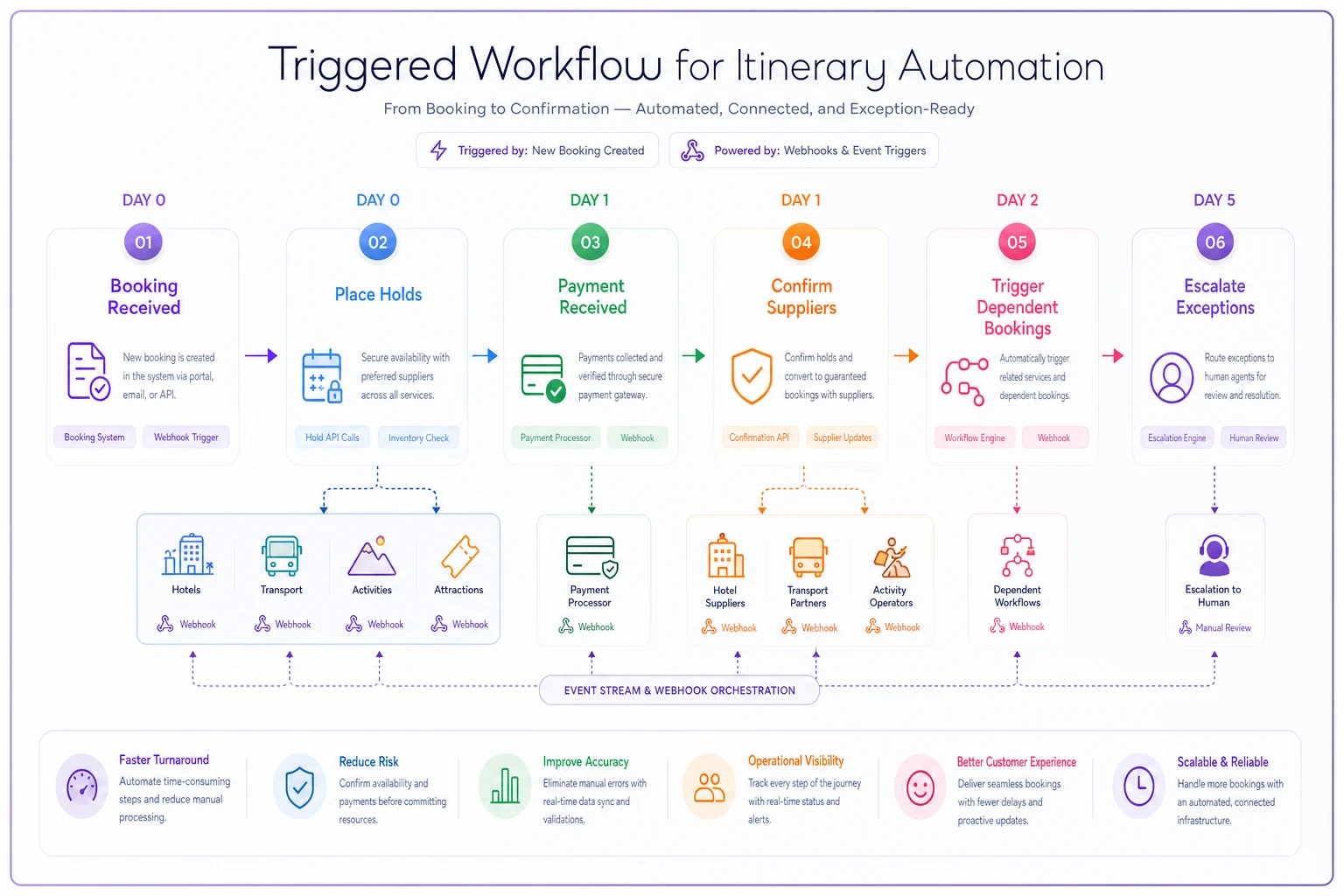
Webhook integrations with supplier systems cut out double-entry and timing errors. When your channel manager updates availability, it triggers hold releases. When payment processors confirm transactions, booking confirmations fire automatically. When suppliers send confirmation emails, your system parses them and updates booking statuses.
That said, automation shouldn't eliminate human judgment. Flag exceptions for manual review—bookings outside normal parameters, unusual supplier responses, or dependency conflicts the system can't resolve. The goal is handling routine sequences automatically while escalating edge cases to your team.
A working example: 8-day Morocco desert tour
An 8-day Morocco tour combining Marrakech, Atlas Mountains, and Sahara Desert components is a good illustration of classic dependency challenges—and one that comes up constantly with operators running North Africa itineraries.
The desert camp only confirms bookings 5 days in advance due to weather uncertainties. But the 4x4 transfer from Ouarzazate needs 7-day advance booking during peak season. The camel trek runs on 48-hour confirmation. The Marrakech cooking class requires 72-hour notice and also needs dietary restrictions confirmed before then. The riad has a 24-hour free cancellation policy.
Traditional approach: your team tracks each deadline separately, probably misses the 4x4 booking window while waiting for desert camp confirmation, then scrambles for alternative transport at higher cost. It's a familiar situation—and an expensive one.
With dependency mapping: the system understands that desert camp availability is the critical bottleneck. It places a provisional hold on two 4x4 operators with different confirmation deadlines. When the desert camp confirms at day 5, it automatically locks in the best-available transfer option. The camel trek booking triggers only after camp confirmation. The cooking class gets booked early with a note that dietary requirements will be confirmed later.
The automation handles routine sequencing. A webhook from the desert camp's booking system confirms availability, which triggers the 4x4 confirmation, which sends pickup details back to the camp. Calendar integration schedules the camel trek. An email parser catches the cooking class confirmation and updates the master itinerary.
When something breaks—say the primary 4x4 operator is suddenly full—the system escalates to your team with context already loaded: "Primary transfer unavailable, alternative costs $40 more per person, customer has premium package, recommend automatic approval." One click to approve rather than reconstructing the entire situation from scratch.
What previously required a dozen or more manual touchpoints across 8 days now needs maybe 2–3 human decisions. Confirmation rates improve, processing time drops, and your team isn't spending their day chasing supplier emails.
Moving from spreadsheet chaos to systematic itinerary assembly
The shift from manual to systematic itinerary automation doesn't require blowing up your existing processes. Start by documenting your current dependency patterns. Which bookings consistently cause problems? Where do confirmation windows create bottlenecks? What conflicts keep surfacing?
Build your dependency graph incrementally. Pick your most popular multi-day package. Map every supplier relationship, timing requirement, and confirmation dependency. Test automated sequences on that one package type before expanding to others.
The practical impact compounds quickly. Operators running 15–20 multi-day bookings per week often report a significant drop in confirmation errors after implementing even basic dependency automation—not because of anything sophisticated, just simple rules that prevent human oversight errors. Teams stop missing hold windows, stop double-booking limited inventory, stop confirming activities before accommodation is secured.
More importantly, automation gives teams time to actually handle exceptions and customer communication rather than grinding through routine confirmations. When a supplier changes availability unexpectedly, there's bandwidth to find creative alternatives. When a customer has special requests, someone can actually evaluate options instead of being buried in follow-up emails.
AI-powered operational software plays a useful role here. Platforms built around workflow automation can model dependency chains, trigger confirmation sequences, parse supplier communications, and surface exceptions for human review. That's not magic—it's systematizing operational knowledge that already exists in your team's heads and putting it somewhere consistent and scalable.
The real value isn't the technology. It's that you're codifying what your team already knows about dependencies, timing, and conflict resolution into repeatable systems. Every multi-day tour you've successfully assembled taught you something. Automation applies those lessons consistently, at scale, without relying on someone remembering every detail on a busy Tuesday.
Multi-day itinerary automation isn't about replacing human expertise with software. It's about building systems that handle predictable sequencing automatically while escalating real decisions to your team. The dependency graph approach means understanding how your supplier ecosystem actually connects, then creating simple rules that respect those relationships.
The alternative—manually tracking every confirmation window, dependency, and conflict—becomes impossible as you scale. Not because your team isn't capable, but because human attention is finite and complex interconnected sequences don't forgive missed details. Start with one package type. Map its dependencies. Build simple automation rules. Test and refine. Then expand. The operational improvements compound while implementation risk stays low.
Ready to elevate your travel business?
Join 500+ travel operators using Touryly to optimize bookings, improve client satisfaction, and grow revenue.